How AI Chatbots and Voice Bots Are Redefining SaaS Client Onboarding and Support

Table of Contents
- Introduction: The Modern SaaS Paradox
- The Problem: Great Products, Broken Experiences
- The Vision: Meet Your AI Onboarding & Support Assistant
- How It Works: AI Support Workflow in Action
- Why Every SaaS Platform Needs an AI Support Assistant/a>
- Behind the Scenes: The Technology That Powers It
- Real-World Use Cases
- How This Differs from a Regular Support Chatbot
- Integrating It into Your SaaS Platform
- Why Voice Interaction Matters
- The ROI of AI Onboarding and Support Automation
- Conclusion
Introduction: The Modern SaaS Paradox
Building a great SaaS product is one thing. Helping customers use it efficiently — that’s the real challenge.
Every SaaS founder knows the pain: your platform is feature-rich, your UI is polished, but new users still feel lost.
Support tickets pile up. The onboarding team gets overloaded. And your best engineers spend hours answering repetitive “how do I…” questions.
This is where AI steps in.
Imagine if every new customer had a personal onboarding assistant — one that could guide them step by step, troubleshoot issues, and even connect them to your support team automatically.
That’s the power of an AI chatbot or voice bot built for SaaS client onboarding and support.
The Problem: Great Products, Broken Experiences
Let’s be honest — SaaS onboarding often breaks where it matters most: at the beginning.
Here’s what typically happens:
- A new customer signs up but doesn’t complete the setup.
- They open multiple help tabs or chat windows looking for tutorials.
- When stuck, they wait hours for human support.
- Frustration sets in — and churn follows soon after.
In an age where time is everything, customers expect instant guidance. That’s why AI-driven self-service has become the new gold standard for SaaS platforms.
The Vision: Meet Your AI Onboarding & Support Assistant
Think of this AI bot as the first-line customer success engineer — always available, always patient, and always knowledgeable.
Whether it’s text-based (chatbot) or voice-enabled (voice bot), it acts as your customer’s personal guide inside the platform.
Here’s what it can do:
1. Smart Onboarding Walkthroughs
When a new user logs in, the bot greets them and guides them through account setup, product configuration, or integration steps — interactively.
2. Contextual Troubleshooting
If a user encounters an issue (say, an API key error or billing glitch), the bot can analyze the context, suggest solutions, and even walk the user through fixes.
3. 24/7 AI Support
No waiting for office hours — the bot handles most common support queries automatically, reducing ticket volume by up to 60%.
4. Escalation & Ticket Creation
If the issue requires human assistance, the bot seamlessly hands off to a support engineer or creates a detailed support ticket with all the necessary context.
It’s not just automation — it’s intelligent assistance that blends empathy with efficiency.
How It Works: AI Support Workflow in Action
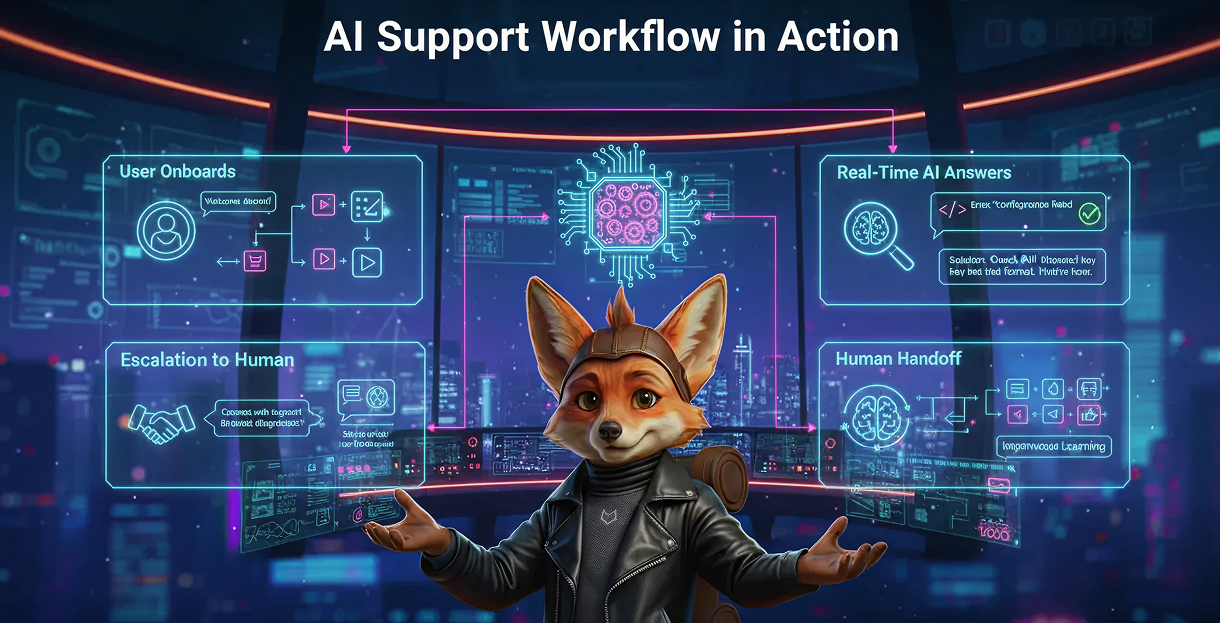
Let’s imagine how this would play out inside a real SaaS product:
Step 1: User Onboards
A new client signs up for your SaaS platform.
The bot greets them with:
“Welcome aboard! Would you like me to walk you through the setup, or jump right into your dashboard?”
Based on the response, it triggers a guided onboarding flow — explaining each section interactively.
Step 2: AI Answers in Real Time
The user asks,
“I’m getting a ‘configuration failed’ message during integration.”
Instead of waiting for an agent, the bot analyzes logs or help articles in the background and replies:
“It looks like your API key format might be missing a prefix. Try replacing it with your team-specific key. Here’s how.”
That’s real-time troubleshooting powered by AI knowledge retrieval and workflow logic.
Step 3: Escalation When Needed
If the user still can’t resolve it, the bot follows up with empathy:
“No worries — I can connect you with one of our support engineers. Would you like to open a ticket or schedule a quick call?”
With a single tap, a support ticket is auto-generated, complete with diagnostic data, user history, and logs — saving the engineer hours of context gathering.
Step 4: Continuous Learning
Every interaction helps the bot get smarter.
It learns which issues occur frequently, which fixes work best, and which articles users actually read.
Over time, it evolves into a self-improving support system, continuously reducing manual intervention.
Why Every SaaS Platform Needs an AI Support Assistant
Let’s face it: scaling human support isn’t sustainable.
When your user base grows from 100 to 10,000, your support team can’t grow proportionally — but your bot can.
Here’s what you gain:
1. Faster Onboarding
Guide new users through setup instantly. No need for webinars or 50-page PDFs.
2. 24/7 Availability
Your AI support never sleeps, ensuring global customers always get help in their time zone.
3. Reduced Ticket Volume
Automated troubleshooting solves most repetitive issues before they reach human agents.
4. Smarter Escalations
When human help is needed, tickets come pre-filled with problem details — saving engineers up to 80% of diagnostic time.
5. Better Customer Retention
A guided, frustration-free experience keeps users engaged longer — lowering churn and boosting NPS.

Behind the Scenes: The Technology That Powers It
A powerful AI onboarding and support bot uses a blend of technologies:
- Natural Language Processing (NLP) – Understands user queries in plain language.
- Conversational AI (LLM-based) – Generates contextual, human-like responses.
- Knowledge Retrieval (RAG) – Fetches answers from help docs, FAQs, or database entries.
- Workflow Automation Engine – Executes tasks like ticket creation or data lookup.
- Voice-to-Text / Speech Recognition – Powers natural voice conversations.
- API Integrations – Connects with CRM, support ticketing, or internal systems.
This architecture allows the bot to not just talk but act — bridging chat support and actual problem resolution.
Real-World Use Cases
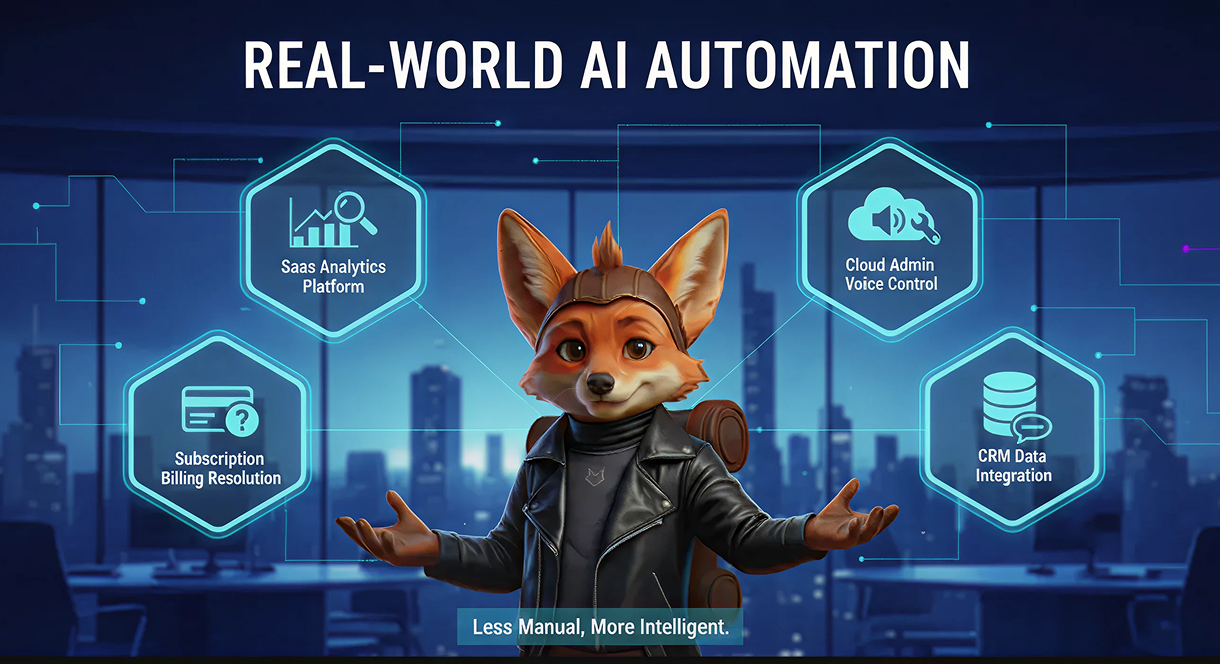
1. SaaS Analytics Platform:
The AI bot helps new customers set up their dashboards, connect data sources, and troubleshoot integration errors — cutting onboarding time by 70%.
2. Cloud Software Provider:
Voice bot assists users in navigating admin controls and can even restart instances or check service status via voice commands.
3. Subscription Billing App:
When users encounter payment failures, the chatbot diagnoses the cause, suggests fixes, and raises billing support tickets if needed.
4. CRM SaaS:
During onboarding, the AI agent auto-imports data, syncs email integrations, and answers “how-to” questions instantly — replacing manual setup calls.
How This Differs from a Regular Support Chatbot
Regular support chatbots are reactive — they wait for users to ask questions.
MIA’s AI-driven model is proactive and intelligent.
It doesn’t just reply — it:
- Guides users through workflows.
- Detects issues before they’re reported.
- Automates backend actions (reset password, restart API, regenerate token).
- Escalates intelligently when human expertise is needed.
That’s the difference between a static chatbot and an AI-powered onboarding and troubleshooting assistant.
Integrating It into Your SaaS Platform
Deploying such a system doesn’t need to be complex.
With SuperMIA’s AI Agent Framework, developers can integrate this bot in a few steps:
- Connect Knowledge Base: Sync FAQs, documentation, and API reference material.
- Configure Voice or Chat Mode: Choose whether you want a chatbot, voice assistant, or both.
- Define Triggers: Map workflows (e.g., “if error 503 → offer troubleshooting script”).
- Integrate with CRM or Ticket System: Connect with tools like Zendesk, Freshdesk, or HubSpot for ticketing and escalation.
- Train and Deploy: Let the bot learn from interactions and improve continuously.
Within days, your SaaS platform will have a built-in AI support assistant — saving costs and delighting customers.
Why Voice Interaction Matters
Voice assistants bring a new level of accessibility to SaaS.
For complex platforms, voice commands can simplify tasks dramatically:
- Check my API usage for the last 24 hours.
- Show me my active integrations.
- Generate a new access key.
Voice reduces friction for users who prefer hands-free interactions — making onboarding feel conversational, not technical.
The ROI of AI Onboarding and Support Automation
AI bots are not just a support upgrade — they’re a business efficiency engine.
Based on case studies across SaaS ecosystems:
- Companies see 40–60% reduction in first-response times.
- Average ticket volume drops by 30–50%.
- Onboarding completion rates rise by 25–40%.
- Customer satisfaction (CSAT) improves by up to 20 points.
Conclusion
The future of SaaS isn’t just about features — it’s about frictionless user experiences.
And nothing delivers that faster than a conversational AI agent that guides, supports, and resolves in real time.
Whether it’s client onboarding, troubleshooting, or 24/7 customer service, your AI chatbot or voice bot becomes the face of your product — always available, always helpful.
With SuperMIA’s AI Agent Framework, you can launch such a bot in weeks — tailored to your platform, brand voice, and customer workflow.
Call to Action:
Ready to redefine customer experience for your SaaS platform?
Build your AI Support & Onboarding Bot with SuperMIA — and let your users get the help they need, the moment they need it.
FAQs
AI onboarding bots guide new users through setup, explain features, and handle FAQs in real time — improving adoption and retention.
Chatbots interact via text, while voice bots use speech recognition and voice responses to deliver hands-free support experiences.
Yes. Advanced AI agents can analyze error patterns, retrieve solutions, and even execute small fixes like API key resets or integration checks.
When an issue requires expert help, the AI bot auto-generates a ticket with detailed logs and connects users to the right engineer.
Faster onboarding, fewer support tickets, higher customer satisfaction, and round-the-clock availability — all while reducing operational costs.

Harikrishna Patel is the founder of MIA – My Intelligent Assistant, the AI automation platform built under Botfinity Inc. in Dallas, Texas. With 15+ years in software engineering, AI/ML, and enterprise solution design, he focuses on creating practical, scalable AI tools that help businesses automate support, workflows, and operations through voice and chat. Hari blends strong technical depth with product strategy to make AI accessible and usable for real-world business needs.
Recent Blogs
-
AI Agent 14 Jan, 2026
Tailored AI Solutions with AgenticAI: Why Customization Is the Real Competitive Advantage
-
AI Automation 12 Jan, 2026
Benefits of AI Workflow Automation: Why It’s Becoming a Boardroom Priority
-
AI Agent 09 Jan, 2026
How to Create Marketing Campaigns Easily with MIA
-
AI Agent 07 Jan, 2026
How MIA’s AI Simplifies Your Hiring and Saves Hours of HR Work
-
AI Agent 05 Jan, 2026
AI Is No Longer an Experiment – It’s Enterprise Infrastructure