Top AI Workflow Automation Tools
Table of Contents
Top AI Workflow Automation Tools: Intelligent Automation Software & Strategies
Introduction
AI is not only revolutionizing daily tasks but also how companies evaluate data. This is where AI workflow automation tools come in. But there are so many options, from low-code apps to enterprise-scale solutions; picking the best tool can be difficult.
In this blog we will be covering the definition of AI workflow automation, its significance, and how to choose the best tool for your business. Additionally, we will highlight the best platforms, compare various kinds of automation software, and exchange best practices for AI workflow automation software.
What is AI Workflow Automation?
AI workflow automation is basically a type of software that uses intelligence to take care of company tasks on its own; no manual labor is required. It’s designed to handle the grunt work, help make decisions based on data, and bring together different applications into a single cohesive process. This way everything runs smoothly and efficiently.
In simple terms, AI workflow automation software replaces manual steps with intelligent, rule-based processes. So, for instance, rather than having some individual on your staff update a customer list once a new person fills out a form, the system can pull their info, verify it’s accurate, distribute it to the correct individual, and send them a personalized email, all without any human intervention.
This technology is not simple routine automation since it employs the use of machine learning. It learns, makes an educated guess about what will occur next, and improves with time, hence increasing your workflows’ speed and intelligence.
Why Are AI Workflow Automation Tools Important?
The way teams work and what they can accomplish can be significantly altered by these tools. Businesses can explore full possibilities and get more out of their employees by automating tasks and simplifying processes.
Here are some reasons they matter:
1. Efficiency at Scale
Doing things by hand gets slow as a company gets bigger. AI automation solutions make sure things like approvals, entering data, and making reports happen in the background, so your team can think about the bigger picture.
2. Error Reduction
When we repeat the same activities repeatedly, such as transferring data or ensuring you’re complying with rules, these can pull money out of your pocket. Intelligent automation software reduces errors by doing it the same every time.
3. Smarter Decisions
With machine learning, AI workflow integration helps companies do more than just automate. Your workflows can suggest what to do next, decide where to use resources, or put tasks in order based on what the data shows.
4. Integration Across Platforms
Today’s businesses use tons of different apps. An AI workflow automation platform links these tools together, so you have one smooth process instead of a bunch of separate systems.
5. Easy to Change
Whether you’re growing, dealing with new rules, or switching to remote work, AI workflow automation strategies let you make changes fast without having to start from scratch.
Types of AI Automation Tools
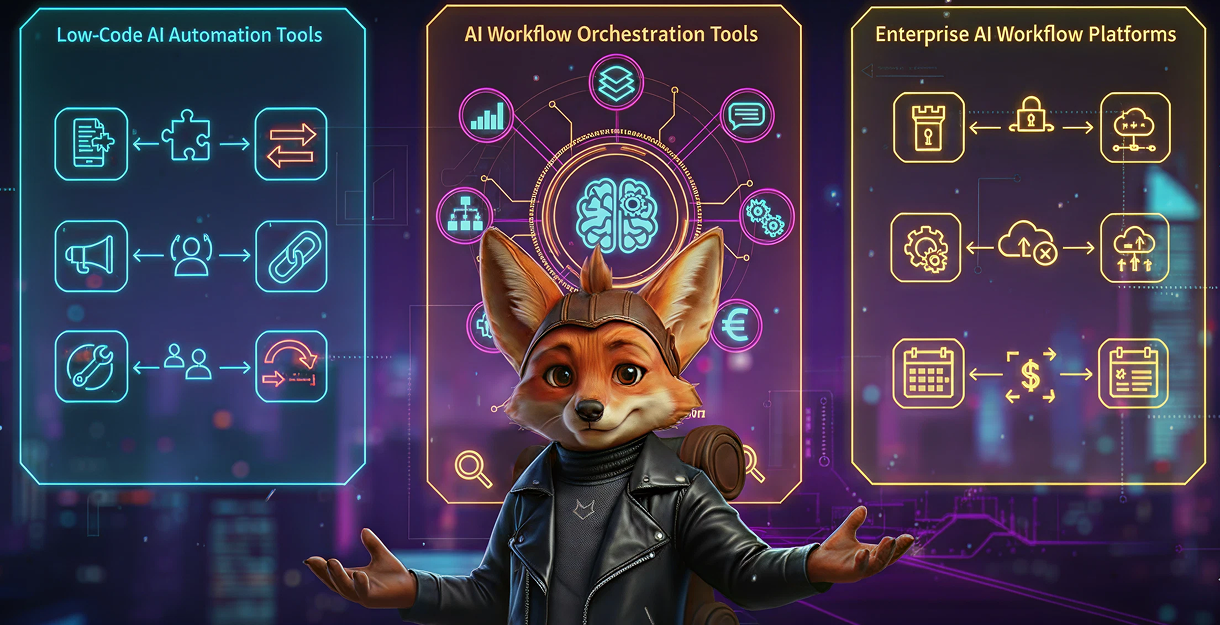
All workflow automation tools are not the same. One should pick an AI Automation Tool according to what your business needs, how complex your workflows are, and how much technical knowledge you have. Automation tools are divided into three categories:
1. Low-Code AI Automation Tools
Low-code AI automation tools are for teams that need automation but don’t know how to code. They have simple interfaces where you can drag and drop things, ready-made integrations, and quick setup.
- Use case: Marketing automation, onboarding new employees, and IT support requests
- Strengths: Simple to begin using, rapid results, does not require a great deal of assistance from developers
- Limitations: Not customizable enough for really complicated workflows
2. AI Workflow Orchestration Tools
Orchestration platforms handle complex workflows that involve many steps across different systems. They ensure data moves securely and work gets completed with minimal human intervention.
- Use case: Financial operations, ensuring you’re obeying the law, and supply chain management
- Strengths: Can handle complicated workflows, links many systems together, can grow with you
- Limitations: Need significant technical expertise to set up and understand
3. Enterprise AI Workflow Platforms
Enterprise AI Workflow platforms handle all sorts of AI workflow automation for large companies. They have advanced features for managing who can access what, security, compliance, and detailed data analysis.
- Use case: Big companies managing important processes in finance, IT, and operations.
- Strengths: Can handle a lot, secure, and helps with following rules; works with big systems.
- Limitations: More expensive and time-consuming to install
AI Automation Tools Comparison
| Tool Type | Best For | Strengths | Limitations |
|---|---|---|---|
| Low-code AI Automation Tools | Non-technical teams, SMBs | Easy setup, fast deployment | Limited customization |
| AI Workflow Orchestration Tools | Mid to large-sized enterprises, IT-driven teams | Complex process handling, integrations | Technical expertise required |
| Enterprise AI Workflow Platforms | Large organizations, regulated industries | Scalability, security, compliance | Costly, longer setup time |
Top AI Workflow Automation Tools
With many AI workflow automation tools on the market, it can be hard to find the ones that provide real value. Here are five standout options, starting with SuperMIA and followed by four other widely used platforms.
1. SuperMIA
SuperMIA isn’t just another AI workflow automation tool. It’s made to fit the needs of big companies while still being easy to use. It combines basic functions with complex tools, making it suitable both for medium-sized companies and huge companies.
- Best for: Businesses expanding automation in numerous departments
- Key features: Simple to build, advanced AI workflow integration, management tools
- Why it stands out: Combines flexibility and performance for big companies without being too hard to learn.
2. UiPath
UiPath is a top player in robotic process automation (RPA) and now includes AI. It is a great choice for companies that want to automate repetitive office tasks on a large scale.
- Best for: companies looking to streamline their resources and IT operations
- Key features: AI-powered RPA, management tools, data analysis
- Limitations: Small teams may find it challenging to deploy
3. Zapier AI
Zapier is now a major tool used by marketing teams and businesses. One reason for its popularity is its ease of use and low setup requirements for connecting multiple apps. It is a lightweight automation solution for everyday tasks.
- Best for: Non-technical users and small enterprises
- Key features: AI-enhanced app integrations and drag-and-drop workflows.
- Limitations: Not ideal for intricate business processes
4. Microsoft Power Automate
Being a product of Microsoft, products such as Office 365 Dynamics and Azure are compatible with Power Automate.
- Best for: Businesses that are already a part of the Microsoft network
- Key features: Process Automation, AI Builder, and safe enterprise tool integration
- Limitations: More difficult to learn if you’re not already familiar with Microsoft products
5. IBM Watson Orchestrate
Smart, safe procedures for large settings are the main focus of IBM’s technology.
- Best for: Certain fields, like finance, healthcare, and government, are heavily. Have a lot of rules to follow, making them a good fit
- Key features: Include in-depth data analysis, compliance, and AI management
- Limitations: costs more and takes a little longer to get everything operational
Why This Matters
Comparing AI workflow automation platforms shows that the best tool depends on your team size, tech skills, and compliance needs. SuperMIA stands out by combining easy-to-use automation with features for big companies, balancing ease and performance.
How Do We Select the Best AI Workflow Automation Tools?

Picking the right tools means finding a platform that fits well with your business’s tech and business needs. When it comes to deciding how to move, the people in charge of IT and automation should take a step back. Think about what this thing is actually capable of and how it’s going to affect everything.
Key Criteria for Selection
- Integration Capabilities
Look for AI workflow automation software that works with other systems. Strong integration guarantees seamless adoption across cloud, HR, CRM, and ERP environments. - Scalability and Orchestration
AI workflow orchestration tools can smoothly handle hundreds of concurrent processes and should be supported by enterprise AI workflow platforms. For big businesses, scalability is crucial. - Low-Code Flexibility
Development cycles are shortened by low-code AI automation tools, which enable IT teams and business users to jointly create workflows. For businesses looking for agility without a lot of coding dependencies, this is essential. - Governance and Security
Intelligent automation software must have audit trails, role-based access, and compliance monitoring. This protects personal data while adhering to industry standards. - Total Cost of Ownership (TCO)
In addition to licensing, consider the expenses of infrastructure, integration, training, and maintenance. At first glance, some AI automation solutions might appear reasonably priced, but they need a lot of customization. - Vendor Ecosystem and Support
Evaluate the vendor’s ecosystem, partnerships, and support services to ensure long-term reliability and faster issue resolution.
Examine the provider’s technical support, developer community, and update transparency. The success of implementation can be significantly impacted by quality support.

Conclusion
The rise of AI workflow automation tools is about more than just doing things faster. It is about making operations smarter. From simple tools that speed up development to enterprise platforms that manage systems, the right choice depends on how well the tool fits with your business goals.
The takeaway? Give integration, scalability, and governance top priority for sustained success. A structured evaluation process, along with a pilot rollout, helps identify the best solution for your enterprise.
Ready to see how AI workflow automation tools can enhance your processes?
Request a demo for an AI workflow automation platform designed to streamline integration, boost efficiency, and support scalable operations.
FAQs

Harikrishna Patel is the founder of MIA – My Intelligent Assistant, the AI automation platform built under Botfinity Inc. in Dallas, Texas. With 15+ years in software engineering, AI/ML, and enterprise solution design, he focuses on creating practical, scalable AI tools that help businesses automate support, workflows, and operations through voice and chat. Hari blends strong technical depth with product strategy to make AI accessible and usable for real-world business needs.
Recent Blogs
-
AI Agent 14 Jan, 2026
Tailored AI Solutions with AgenticAI: Why Customization Is the Real Competitive Advantage
-
AI Automation 12 Jan, 2026
Benefits of AI Workflow Automation: Why It’s Becoming a Boardroom Priority
-
AI Agent 09 Jan, 2026
How to Create Marketing Campaigns Easily with MIA
-
AI Agent 07 Jan, 2026
How MIA’s AI Simplifies Your Hiring and Saves Hours of HR Work
-
AI Agent 05 Jan, 2026
AI Is No Longer an Experiment – It’s Enterprise Infrastructure