AI Receptionist for Healthcare Appointment Scheduling & Patient Inquiries
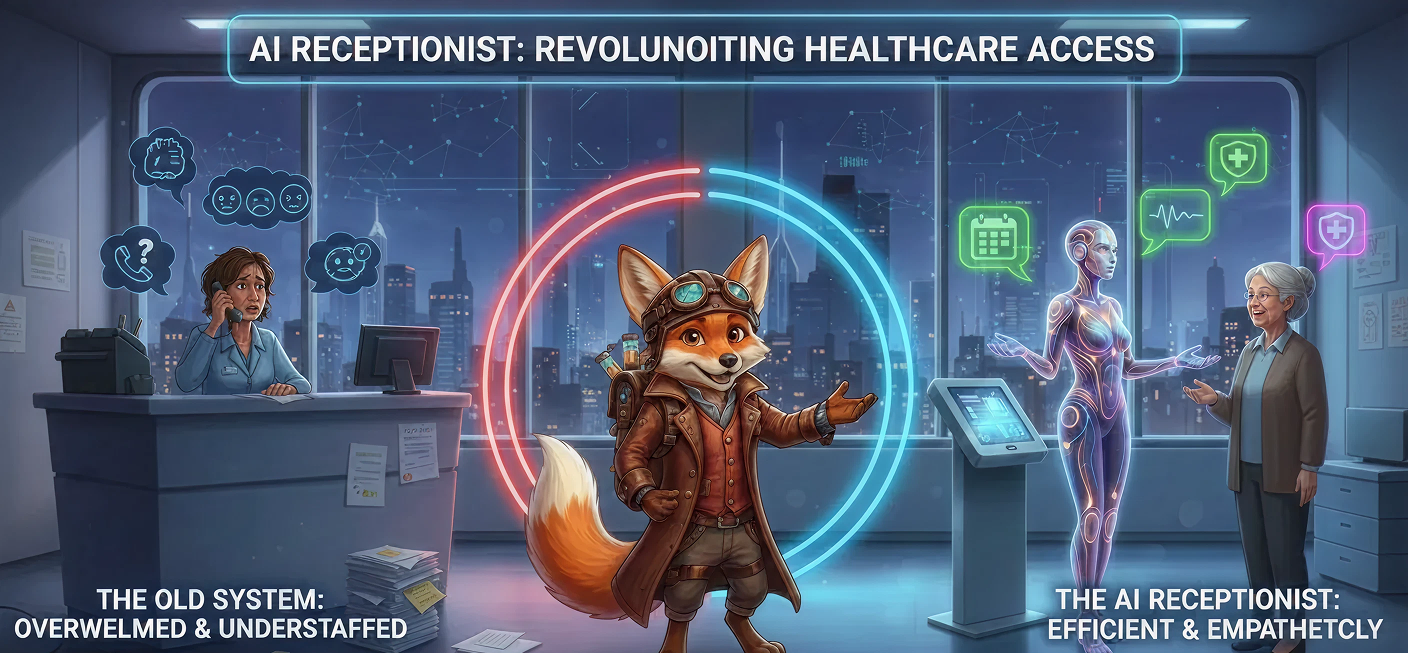
Table of Contents
- The Growing Strain on Healthcare Front Desks
- Why Appointment Scheduling Has Become a Bottleneck
- Handling Patient Inquiries Without Overloading Staff
- Always-On Access in a 24/7 World
- Cost Efficiency Without Compromising Care
- Use Cases Across Healthcare Settings
- Supporting Staff, Not Replacing Them
- Security, Privacy, and Compliance
- The Bigger Shift in Healthcare Operations
- Final Thought
10 Healthcare has always been about people. But access to healthcare has increasingly become about systems. And today, many of those systems are under strain.
Across clinics, hospitals, dental practices, and specialty care centers, the front desk has become a pressure point. Phones ring constantly. Appointment requests arrive from multiple channels. Patients ask the same questions again and again. Staff try to keep up, but staffing shortages and rising patient expectations make it harder every year.
This is not a temporary phase. It’s a structural shift in healthcare operations. And it’s why AI Receptionists are rapidly becoming part of the modern healthcare infrastructure.
The Growing Strain on Healthcare Front Desks
Healthcare staffing shortages are now a global concern. According to the World Health Organization, the global healthcare workforce shortage is projected to reach 10 million workers by 2030, with administrative and support roles among the hardest hit. In the United States alone, the American Hospital Association reports that over 80% of hospitals face persistent staffing challenges, particularly in patient-facing administrative functions.
Yet patient demand continues to rise. Aging populations, increased chronic care needs, and post-pandemic care backlogs have dramatically increased appointment volumes. At the same time, patient behavior has changed. People expect healthcare access to feel more like modern services responsive, immediate, and frictionless.
The traditional front desk model, built around fixed hours and manual coordination, simply cannot scale to meet this demand.
Why Appointment Scheduling Has Become a Bottleneck
Appointment scheduling is deceptively complex. It’s not just about finding an open slot. It involves provider availability, appointment types, insurance rules, follow-ups, rescheduling, cancellations, and reminders. Every call takes time. Every mistake creates downstream issues.
Studies show that up to 30% of healthcare appointment slots go unused due to no-shows and scheduling inefficiencies. Meanwhile, research published in the Journal of Medical Practice Management indicates that front-desk staff spend nearly 40% of their time on scheduling-related tasks.
This isn’t just inefficient. It directly impacts patient access and clinic revenue.
An AI Receptionist removes this bottleneck by automating scheduling end to end. Patients can book, reschedule, or cancel appointments instantly through voice or chat without waiting for a human agent. The system checks availability in real time, applies rules correctly, and confirms appointments immediately.
The result is faster bookings, fewer no-shows, and a smoother experience for both patients and staff.
Handling Patient Inquiries Without Overloading Staff
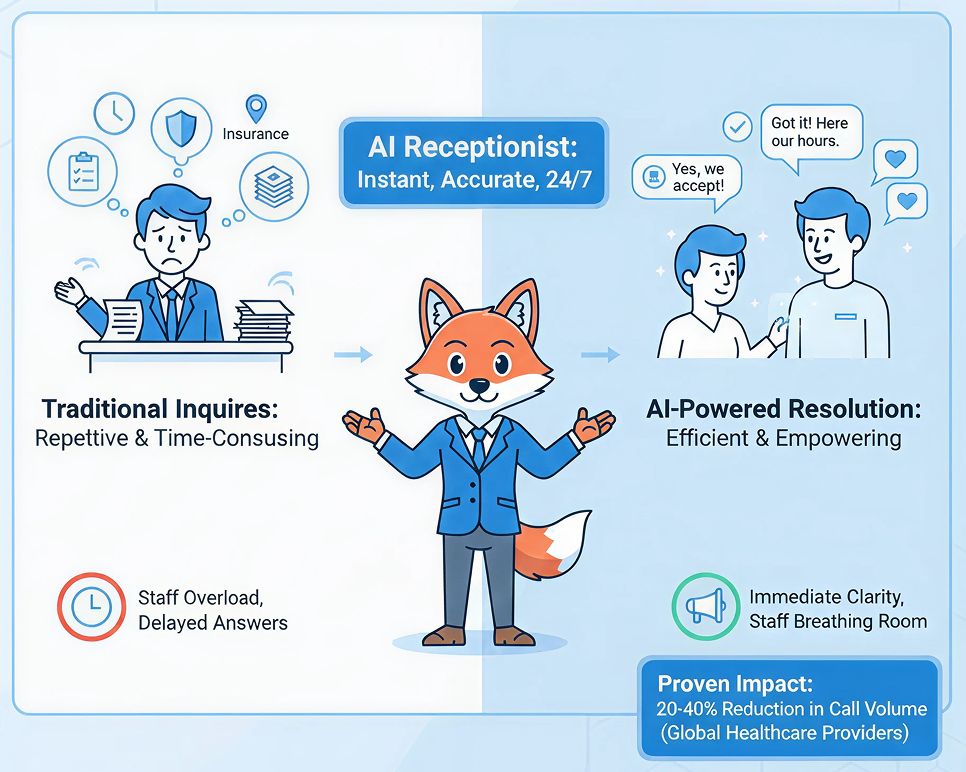
Beyond scheduling, patient inquiries are another major source of operational load. Clinics receive thousands of repetitive questions every month:
- What are your hours?
- Do you accept my insurance?
- How do I prepare for my appointment?
- What documents do I need?
- Where is the clinic located?
These are important questions, but answering them repeatedly consumes time that staff could spend on higher-value patient interactions.
An AI Receptionist handles these inquiries instantly and consistently. Because it is trained on clinic-specific information, it delivers accurate responses 24/7. Patients get clarity immediately. Staff get breathing room.
Global healthcare providers adopting AI-driven virtual assistants have reported 20 – 40% reductions in call volume within the first few months of deployment, according to case studies from healthcare systems in the US, UK, and Australia.
Always-On Access in a 24/7 World
Healthcare does not stop at 5 p.m. Patient needs don’t align with office hours. Yet many clinics still rely on voicemail after hours, creating frustration and delays.
An AI Receptionist changes that dynamic by providing continuous availability. Whether a patient calls at night, early morning, or on weekends, they receive immediate assistance. Appointments can be scheduled anytime. Questions are answered instantly. Urgent cases can be routed appropriately.
This always-on access is particularly valuable in urgent care, specialty clinics, and multi-location healthcare networks where call volume spikes unpredictably.
In the UK’s National Health Service, pilot programs using AI-powered virtual reception systems showed significant improvements in patient satisfaction scores, especially related to access and response time.

Cost Efficiency Without Compromising Care
Hiring additional administrative staff is expensive and increasingly difficult. Beyond salaries, there are costs related to recruitment, training, benefits, turnover, and management. And even then, coverage remains limited to shifts.
An AI Receptionist operates at a fraction of that cost and scales effortlessly. It doesn’t replace human staff, it absorbs the repetitive workload that causes burnout and inefficiency.
Healthcare organizations using AI reception systems have reported administrative cost reductions of 25 – 35%, while simultaneously improving patient experience. This creates a rare outcome in healthcare operations: better service at lower cost.
Use Cases Across Healthcare Settings
In primary care clinics, AI Receptionists manage high appointment volumes, handle routine inquiries, and reduce phone congestion during peak hours.
In dental practices, they automate bookings, confirmations, and reminders – significantly lowering no-show rates.
In specialty clinics, such as cardiology or orthopedics, AI assistants ensure patients receive accurate pre-visit instructions and timely follow-ups.
In hospitals and healthcare networks, AI Receptionists act as the first point of contact, routing patients correctly and reducing unnecessary call transfers.
Across these use cases, the impact is consistent: faster access, better communication, and less operational strain.
Supporting Staff, Not Replacing Them
One of the biggest misconceptions about AI in healthcare is that it replaces people. In reality, it reshapes roles.
By automating scheduling and inquiries, staff are freed to focus on tasks that require human judgment – complex patient needs, coordination of care, and emotional support. Burnout decreases. Job satisfaction improves.
The AI Receptionist becomes a support layer, not a substitute.
Security, Privacy, and Compliance
Healthcare AI systems must meet strict standards. Modern AI Receptionists are designed with HIPAA, GDPR, and other regulatory frameworks in mind. Conversations are encrypted. Access controls are enforced. Patient data is handled securely.
This ensures that efficiency gains never come at the expense of trust or compliance.
The Bigger Shift in Healthcare Operations
The adoption of AI Receptionists reflects a broader transformation. Healthcare is moving away from manual, people-dependent systems toward intelligent, resilient infrastructure.
Just as electronic health records became standard, AI-driven front desks are quickly becoming the new normal. Not because they are trendy – but because they solve real problems at scale.
Healthcare leaders are no longer asking if AI should be used. They’re asking where it creates the most immediate impact. The front desk is one of the clearest answers.
Final Thought
Healthcare access should never depend on how busy the front desk is. Patients deserve clarity, speed, and responsiveness. Staff deserve systems that support them, not overwhelm them.
An AI Receptionist does not change the heart of healthcare.
It strengthens the system around it.
And in a world where access matters as much as care, that difference is profound.
FAQs
An AI Receptionist is a virtual assistant that autonomously handles appointment scheduling, patient inquiries, and front-desk communication through voice and chat.
No. It complements staff by handling repetitive tasks, allowing humans to focus on complex and patient-centric responsibilities.
Yes. Healthcare AI systems are designed to comply with HIPAA, GDPR, and other healthcare data protection standards.
Most AI Receptionists integrate with popular EHR and scheduling platforms to ensure real-time availability and accurate bookings.
Deployment is typically fast - often within days - without major infrastructure changes.

Harikrishna Patel is the founder of MIA – My Intelligent Assistant, the AI automation platform built under Botfinity Inc. in Dallas, Texas. With 15+ years in software engineering, AI/ML, and enterprise solution design, he focuses on creating practical, scalable AI tools that help businesses automate support, workflows, and operations through voice and chat. Hari blends strong technical depth with product strategy to make AI accessible and usable for real-world business needs.
Recent Blogs
-
AI Agent 14 Jan, 2026
Tailored AI Solutions with AgenticAI: Why Customization Is the Real Competitive Advantage
-
AI Automation 12 Jan, 2026
Benefits of AI Workflow Automation: Why It’s Becoming a Boardroom Priority
-
AI Agent 09 Jan, 2026
How to Create Marketing Campaigns Easily with MIA
-
AI Agent 07 Jan, 2026
How MIA’s AI Simplifies Your Hiring and Saves Hours of HR Work
-
AI Agent 05 Jan, 2026
AI Is No Longer an Experiment – It’s Enterprise Infrastructure