AI Workflow Automation

Table of Contents
- Introduction
- What is AI Workflow Automation?
- Why Do Enterprises Need AI Workflow Automation Now?
- Technologies used in AI Workflow Automation
- Key Benefits of AI Workflow Automation
- Real-World Enterprise Examples
- How GenAI-enabled AI Workflow works
- Top Builder for AI Workflow Automation Strategy
- Conclusion
Why SuperMIA AI Workflow Automation is the Future of Enterprise Operations
Introduction
Enterprises today don’t just want automation, they need it to keep up with the speed and complexity of modern business operations. AI Workflow Automation enters the picture. While most ordinary automation software cannot change course, learn, or make decisions, AI-based workflows can adapt, learn, and decide. This eliminates repetitive work and enhances general output.
The real shift is coming from agentic AI to workflow automation. Instead of following rigid rules in agentic AI systems, one can analyze data, adjust to changing inputs, and coordinate across multiple business processes with little to no human intervention. For large enterprises, this isn’t just a technological upgrade; it’s a competitive necessity.
A solid AI workflow automation solution does more than run tasks. It touches all aspects of the business and assists in decision-making, reduces delays, and makes essential operations flexible. Whether it’s employing AI for workflow automation in businesses and eliminating inefficiencies or employing AI for businesses and enabling them to grow at a faster rate, the potential is massive.
This blog breaks down what an AI workflow automation strategy really means, why it matters right now, and how companies can design strategies that drive measurable results. We will also look at real-world enterprise examples, the benefits of automating business workflows with AI, and how solutions are setting their benchmark for next-generation workflow automation.
What is AI Workflow Automation?
AI Workflow Automation involves employing artificial intelligence in developing, governing, and optimizing business processes. It achieves this through automation of routine tasks, enabling flexible decision-making, and getting everything working more smoothly.
Unlike traditional automation, agentic ai for workflow automation doesn’t just follow preset rules. To keep quality in check, you need clear performance metrics, solid test datasets, and a process where people step in whenever the system isn’t confident.
This aids companies in shifting from doing rule based tasks to AI-driven process automation for enterprises. AI can learn from data, predict results, and take actions before issues arise.
This means that:
- Administrative duties like document processing, approvals, and customer support requests are performed by robots.
- Improving productivity with AI workflow automation by cutting down human mistakes and making operations faster.
- Applying AI automation for enhanced decision-making through real-time data that provides informed decisions.
When there is a solid AI workflow automation strategy, companies can save money, increase flexibility, and enable new ideas.
Why Do Enterprises Need AI Workflow Automation Now?
Businesses aren’t just out to be more efficient; they also need to be flexible. That’s where AI-based workflow automation enters the picture.
1. The Need of Business Enterprises
- Enterprise AI automation of workflows enables large businesses to automate thousands of workflows across departments from finance to HR to supply chain.
- Enterprises can’t waste time on slow processes. Automated business workflows with AI guarantee approvals, onboarding, and reporting instantly without waiting for manual inputs.
- Customers demand quicker resolution. In AI workflow automation in business operations, service requests can be routed, processed, and resolved in real time.
2. The Enterprise Shift
- AI-powered process automation is already being used by progressive companies as part of their digital transformation.
- Rather than putting together manual systems, they are implementing AI workflow automation solutions that grow with the business and adjust to changing needs.
Technologies Used In AI Workflow Automation
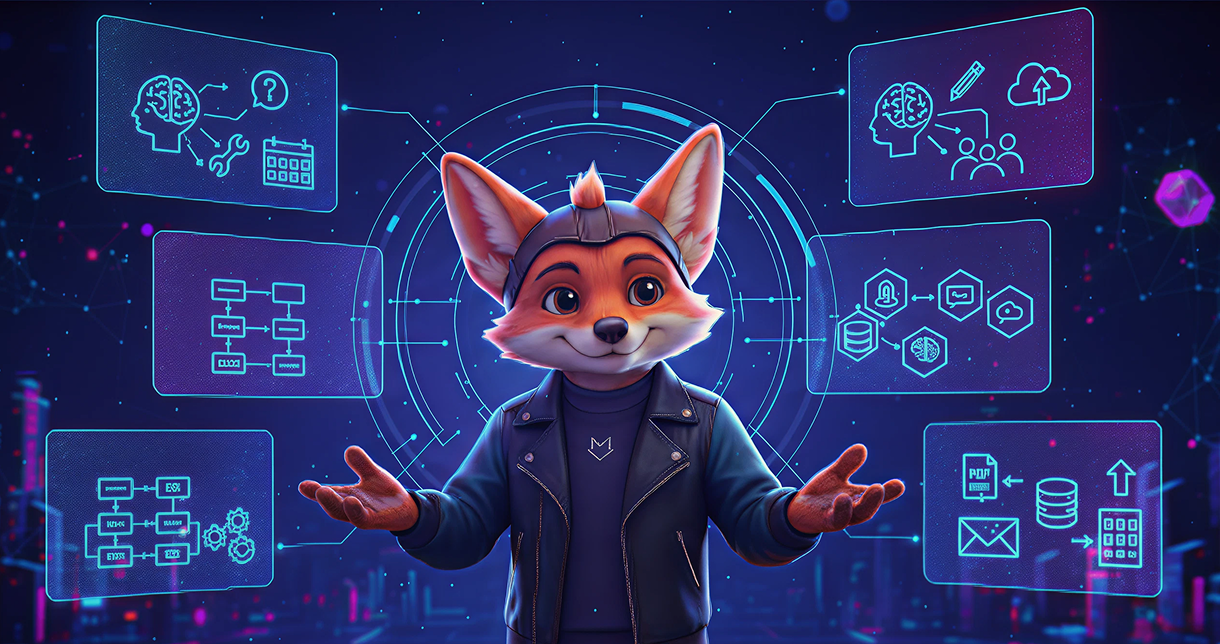
AI Workflow Automation sits on a stack of tools that let agents understand language, read documents, call systems, and learn from outcomes.
How to pick them for your AI workflow automation strategy:
1. Generative AI
Generative models create content and summaries that move work forward. They create knowledge briefs, gather meeting minutes, draft emails, and make recommendations for next actions. They serve as the intermediary between humans and systems in AI workflow automation in business operations, converting requests in plain language into organized actions.
Look for: Red-team tests to cut incorrect outputs, safety checks, and adjustable prompts. Combine with source checks and verification before doing anything outside.
2. Large Language Models (LLMs)
LLMs power understanding, tool use, and reasoning. They extract intent, map it to a workflow, and call the right tools through structured outputs. In agentic ai for workflow automation, LLMs select actions, plan multi-step tasks, and hand results to downstream systems.
Look for: function calling, reliable JSON output, latency under target SLAs, cost controls, privacy options, and fine-tuning or adapters for domain terms.
3. No-code AI platforms
No-code platforms allow teams to create flows without extensive scripting. Drag-and-drop steps, reusable templates, and role-based access simplify scaling AI workflow automation solutions to departments.
They are useful in change management, human-in-the-loop approvals, and rapid pilots.
4. APIs and connectors
CRMs, ERPs, data warehouses, email, chat, and payment gateways are all connected to agents via APIs. Good connectors provide predictable and safe automation of business processes with AI.
5. Intelligent Document Processing (IDP)
IDP converts dirty documents into structured data. It unites OCR, classification, entity extraction, and validation to process forms, invoices, KYC documents, claims, and contracts.
How it fits: IDP provides clean fields to downstream flows so that agents are able to approve, escalate, or post entries to core systems.
How these pieces work together
- An employee submits a PDF invoice. OCR extracts text. IDP can scan and sort files, pull out details such as vendor names, dates, and amounts, and even give you a confidence score on how accurate that extraction is.
- An LLM verifies fields, queries the vendor record through APIs, and checks budget status.
- Generative AI drafts a message for approval. A no-code AI platform routes it to the manager and logs the action.
- The agent posts the approved entry to the ERP and closes the ticket. The system learns from corrections to improve the next run.
Selection Checklist For Enterprises
- Quality checks: should include clear metrics, test data, and human review for uncertain cases.
- Scalability: Horizontal scaling for peak loads and cost controls by workflow.
- Fit to strategy: align each tool with your AI workflow automation strategy so pilots grow into standard operating procedures.
Used well, these technologies deliver practical AI workflow automation that scales across teams and regions, supports compliance, and improves time to value. They also set the base for agentic ai for workflow automation that plans work, executes steps, and learns from outcomes.
Key Benefits Of AI Workflow Automation
Enterprises adopting AI workflow automation aren’t just cutting costs; they’re starting a new level of speed, accuracy, and decision-making. Here are the most impactful benefits:
1. Efficiency at Scale
Enterprise AI workflow automation reduces repetitive, manual tasks across departments. From approvals to reporting, processes run faster with fewer errors.
2. Improved Decision-Making
By improving productivity with AI workflow automation, leaders have real-time knowledge rather than relying on outdated knowledge. This helps in taking faster and more confident decisions in competitive markets.
3. Cost Reduction
By automating business workflows with AI, companies lower overhead from manual processes and reduce risks of compliance errors.
4. Greater Agility
Enterprises using AI-driven process automation that can adapt workflow quickly to respond to customer needs or market changes.
5. Smarter Business Operations
Using AI to automate workflows in business operations helps create smooth links between systems, departments, and customer interactions.
6. Scalable Solutions
Modern AI workflow automation solutions grow with the business from pilot programs to enterprise-wide deployments.
Real-World Enterprise Example of AI Workflow Automation
Theory is one thing, but nothing lands better than seeing AI workflow automation in action inside a large organization. Let’s break down a real-world scenario where multiple technologies we just discussed come together to solve a problem at scale.
The Challenge
A global insurance provider was drowning in manual claims processing. Thousands of claims arrived daily via email, fax, and online forms. The team had to:
- Open and scan documents.
- Extract customer details and policy numbers.
- Verify coverage against internal systems.
- Flag potential fraud.
- Route valid claims for approval and payment
Customer irritation was caused by delay, and workers became less enthusiastic as repetitive work grew.
The AI Workflow Automation Approach
The insurer rolled out an AI-driven process automation strategy in three layers:
- Document Intake & Understanding
- OCR converted scanned forms into text.
- Intelligent Document Processing (IDP) identified the claim type, extracted fields like policy ID, and checked confidence levels.
- Validation & Decisioning with LLMs
- A Large Language Model cross-checked extracted details with the policy database via APIs.
- Suspicious claims were flagged for fraud detection models.
- Clean claims were automatically enriched with missing metadata before moving forward.
- Communication & Routing
- Generative AI drafted acknowledgement emails to customers.
- A no-code AI platform routed low-risk claims directly to payment processing while escalating high-risk cases to human reviewers.
Why This Matters for Enterprises
This demonstrates that AI workflow automation solutions aim to improve customer experience, reduce risk, and equip teams to perform judgment-based tasks in addition to saving money. Scaling automation was made possible without compromising control by combining OCR, IDP, LLMs, Generative AI, APIs, and no-code orchestration.
For financial, healthcare, retail, and logistics companies, the plan is all the same: find bottlenecks, add the appropriate AI tools on top, and leave people in the loop where accuracy matters.
How GenAI-Enabled AI Workflow Functions
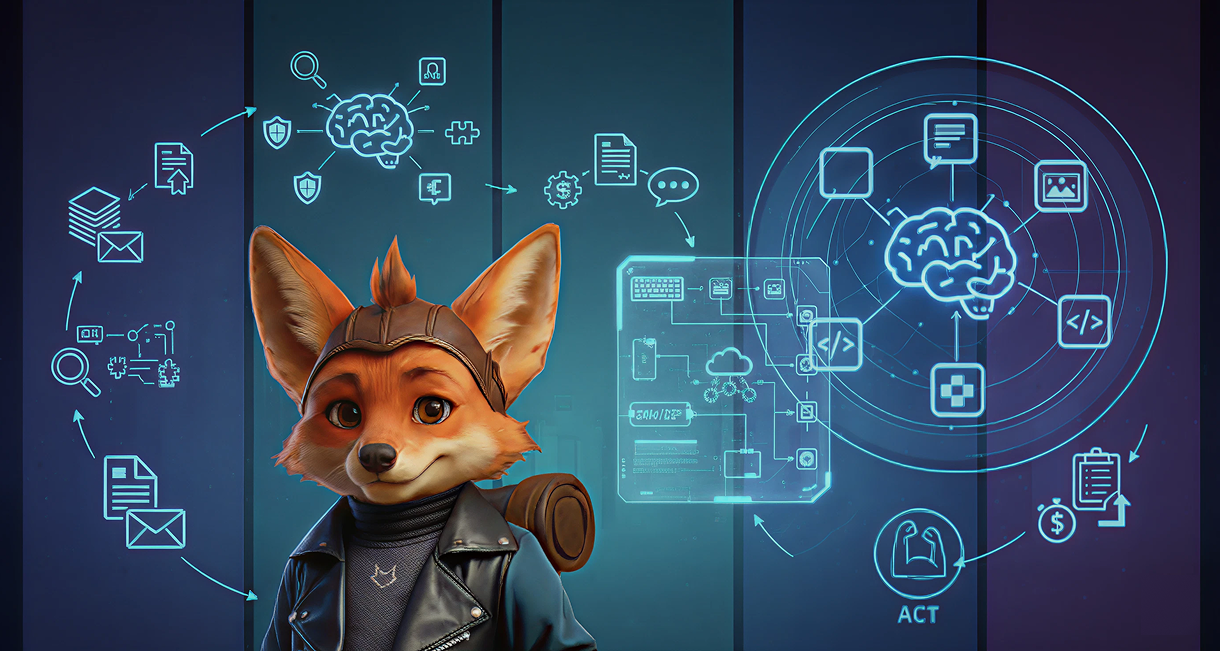
In essence, GenAI-powered workflow automation synergizes the forecasting ability of Large Language Models (LLMs) with automation platforms’ efficiency to manage end-to-end enterprise workflows. In contrast to rigid rule-based traditional automation, Generative AI introduces flexibility, context sensitivity, and decision-making into workflows.
This is how it usually goes:
1. Data Ingestion and Understanding
The process begins by collecting structured and unstructured data from invoices, customer tickets, PDFs, emails, or API feeds.
- OCR and IDP handle scanned documents.
- LLMs interpret text, extract key details, and normalize formats.
This step replaces hours of manual sorting and entry.
2. Contextual Analysis with LLMs
LLMs analyze the data, recognize intent, and impose enterprise-specific rules.
- For instance, in insurance, an LLM can identify whether a claim is for property damage, medical expenses, or fraud threats.
- In banking, it can scan applicant profiles and risk scores.
Unlike static scripts, LLMs adapt to nuanced inputs.
3. Generative AI for Task Execution
At this stage, generative AI shifts automation from simply reacting to actually taking the lead.
- Writing responses (emails, reports, summaries).
- Generating custom workflows when new scenarios arise.
- Developing human-like instructions for employees and customers.
For example, rather than sending a template loan rejection email, GenAI writes a customized explanation according to regulatory rules.
4. No-Code Workflow Orchestration & APIs
Automation platforms tie everything together:
- No-code AI platforms let business teams design or tweak workflows.
- LLMs and GenAI outputs are connected to CRMs, ERPs, or ticketing systems via APIs.
- When circumstances change, agentic AI dynamically reroutes tasks (for example, a shipment delay causes suppliers to be reallocated).
5. Human-in-the-Loop Supervision
Checkpoints for human oversight are a feature of GenAI processes for industries that are extremely sensitive to compliance.
- Employees validate high-stakes outputs (financial advice, medical approvals).
- AI is trained with feedback, getting more accurate with time.
6. Continuous Optimization
GenAI-enabled workflows are not static.
- Machine learning models refine predictions.
- Generative AI adapts communication styles and responses.
- Enterprises track KPIs like cycle time, cost savings, and error reduction.
Top Builder for AI Workflow Automation Strategy
When organizations venture out to automate workflows with AI, the issue isn’t so much choosing tools, it’s figuring out how to marry the appropriate technology to business requirements, compliance rules, and scalability.
That’s where solutions like SuperMIA stand out.
What Makes SuperMIA Different
SuperMIA takes a GenAI-first approach to workflow automation. It offers an orchestration layer where enterprise data, APIs, and LLMs collaborate seamlessly rather than putting together separate tools.
They:
- Context-aware processes: workflows change dynamically in response to natural language input, not rigid rules.
- Scalable architecture: built to support high-volume, multi-department enterprise processes.
Why Enterprises Make the Choice
The actual value of SuperMIA is not in the technology itself; it is in the strategic methodology toward automation. Rather than creating siloed bots, enterprises can design smart workflows that learn from fresh data and shifting business priorities. This eliminates repetitive tasks, speeds up decision cycles, and preserves compliance.

Why AI Workflow Automation is the Next Enterprise Standard
AI workflow automation is no longer a test. It is becoming the operating system of today’s businesses, enabling teams to replace fragmented procedures with intelligent, scalable workflows. The effects are evident in customer-facing operations and heavily documented industries: faster decision-making, lower costs, and better results for both customers and employees.
What this actually implies is that the companies that implement GenAI-facilitated automation today will be the pacesetters for efficiency and innovation tomorrow. Those who wait risk being saddled with antiquated systems while others grow faster, adjust faster, and provide more value with fewer resources.
If your business is ready to break free from tedious tasks and separate automation software, now is the time. Creating an AI workflow automation strategy begins with finding the right processes, the right tech stack, and the right partners.
Request A Demo and see how automation can drive growth, compliance, and efficiency across your business.
FAQs

Harikrishna Patel is the founder of MIA – My Intelligent Assistant, the AI automation platform built under Botfinity Inc. in Dallas, Texas. With 15+ years in software engineering, AI/ML, and enterprise solution design, he focuses on creating practical, scalable AI tools that help businesses automate support, workflows, and operations through voice and chat. Hari blends strong technical depth with product strategy to make AI accessible and usable for real-world business needs.
Recent Blogs
-
AI Agent 14 Jan, 2026
Tailored AI Solutions with AgenticAI: Why Customization Is the Real Competitive Advantage
-
AI Automation 12 Jan, 2026
Benefits of AI Workflow Automation: Why It’s Becoming a Boardroom Priority
-
AI Agent 09 Jan, 2026
How to Create Marketing Campaigns Easily with MIA
-
AI Agent 07 Jan, 2026
How MIA’s AI Simplifies Your Hiring and Saves Hours of HR Work
-
AI Agent 05 Jan, 2026
AI Is No Longer an Experiment – It’s Enterprise Infrastructure