Exploring Open Source Tools for SuperMIA AI Workflow Automation

Table of Contents
- What is AI Workflow Automation?
- Why Open Source Matters in AI Workflow Automation
- The Core of SuperMIA: Open Source Meets Intelligence
- Top Open Source Tools Powering AI Workflow Automation
- Building AI Workflow Automation Strategies
- Why SuperMIA Is Leading the Way
- The Future: Autonomous AI Workflow Automation
- Conclusion
As enterprises shift toward intelligent automation, the demand for AI workflow automation solutions is skyrocketing. Gone are the days when AI was confined to isolated experiments in data science labs. Today, AI-driven workflows power customer interactions, data pipelines, decision-making systems, and even software delivery processes.
But as these workflows become more complex—spanning multiple tools, APIs, and models—tech leads and developers face a challenge: How do you orchestrate everything seamlessly?
That’s where open source AI workflow automation tools come in. Platforms like SuperMIA are redefining automation by enabling businesses to design, deploy, and monitor AI-driven workflows without vendor lock-in, offering full control, flexibility, and transparency.
What is AI Workflow Automation?
AI workflow automation is the process of integrating artificial intelligence into repetitive business or technical workflows—automating decision-making, data movement, and task execution with minimal human intervention.
Imagine this simple scenario:
A customer query arrives → AI model classifies intent → relevant department is notified → CRM is updated → personalized response is sent.
All of that can be done without a single human click. That’s the promise of AI workflow automation platforms—bringing intelligence to every operational layer.
For developers, this means building modular, reusable workflows that link models, APIs, and databases to create scalable AI ecosystems.

Why Open Source Matters in AI Workflow Automation
When it comes to automation, open-source technologies have become the backbone of innovation. Here’s why:
- Transparency: Developers can inspect and modify code to ensure security and compliance.
- Customizability: Unlike proprietary platforms, open-source frameworks allow deep customization for unique business needs.
- Community & Collaboration: Global developer communities contribute plugins, connectors, and improvements, making these tools evolve faster.
- Interoperability: Open-source solutions integrate easily with APIs, cloud systems, and third-party AI services.
For modern AI systems like SuperMIA, open-source integration forms the foundation for rapid prototyping and deployment—accelerating innovation without compromising on flexibility.
The Core of SuperMIA: Open Source Meets Intelligence
SuperMIA, an AI workflow automation platform by Botfinity, is built around the principle that AI orchestration should be modular, intelligent, and open.
It integrates the power of open source workflow automation software to connect large language models (LLMs), APIs, and custom machine learning pipelines—turning static AI capabilities into dynamic, agent-driven operations.
SuperMIA’s architecture is inspired by leading frameworks in the open-source ecosystem, ensuring that developers can leverage existing components, build their own, and maintain ownership of their data and logic.
Top Open Source Tools Powering AI Workflow Automation
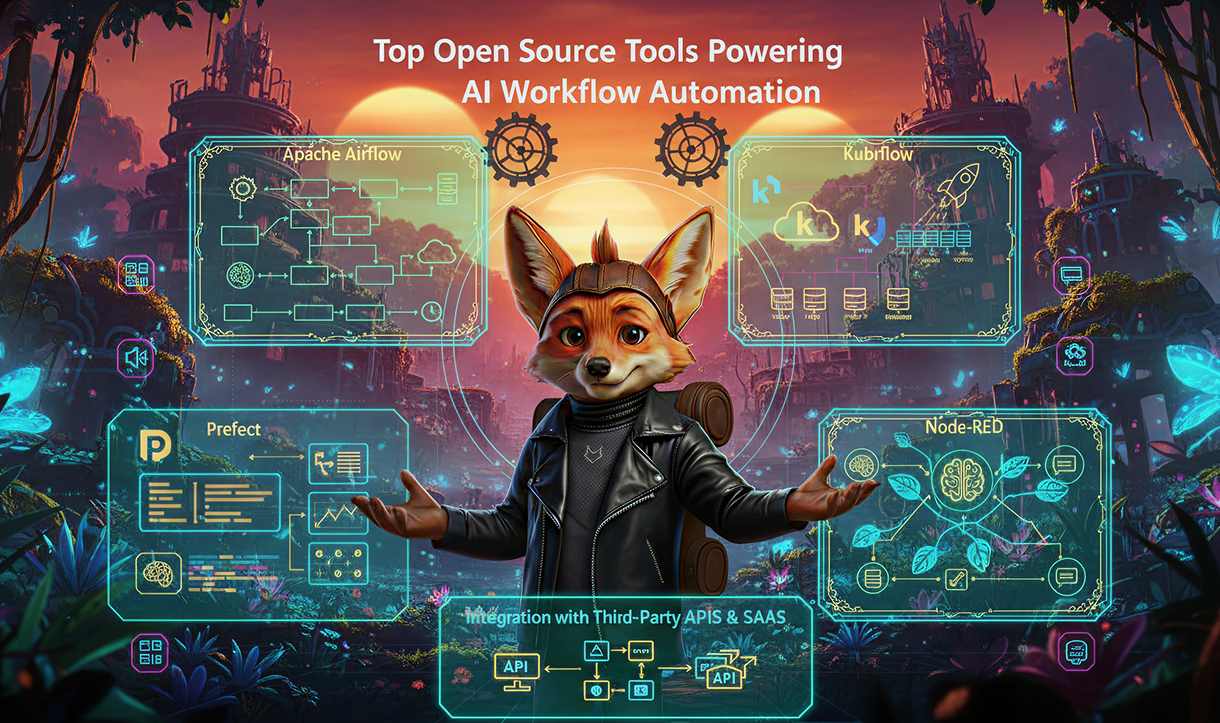
Let’s explore some of the best open source AI workflow automation
frameworks that influence or integrate with platforms like SuperMIA:
1. Apache Airflow
– The Orchestrator’s Standard
Originally developed by Airbnb, Apache Airflow is the backbone of many enterprise data and AI workflows.
- Best For: Complex data pipelines, ML model training, ETL tasks.
- Strength: DAG-based orchestration (Directed Acyclic Graphs) helps developers visualize and control dependencies.
- Use Case: Integrating AI data preprocessing with model training and monitoring.
2. KubeFlow
– ML Workflows for Kubernetes
If your organization is already Kubernetes-heavy, Kubeflow is the ideal choice.
- Best For: Running machine learning workloads at scale on Kubernetes clusters.
- Strength: Native integration with cloud infrastructures (GCP, AWS, Azure).
- Use Case: Automating end-to-end ML pipelines—from data ingestion to model serving.
3. Prefect
– The Next-Gen Dataflow Framework
- Best For: Developers who prefer Python-native workflow control.
- Strength: Declarative syntax, real-time monitoring, hybrid execution (local + cloud).
- Use Case: Combining AI model predictions with operational data automation.
4. Node-RED
– Visual Flow for IoT and APIs
Originally developed by IBM, Node-RED provides a low-code, visual interface for connecting devices, APIs, and AI models.
- Best For: Rapid prototyping and integration-heavy projects.
- Strength: Visual UI with drag-and-drop logic nodes.
- Use Case: Automating AI chatbot workflows or IoT-driven event triggers.
5. LangChain + Flowise
– For LLM Workflow Automation
In the Generative AI era, LangChain and Flowise have become essential.
- Best For: Developers working with GPT-based or custom language models.
- Strength: Modular prompt management, vector databases, and contextual memory.
- Use Case: Building conversational AI agents and intelligent workflow bots inside SuperMIA.
6. Temporal.io
– Durable, Fault-Tolerant Workflow Engine
Used by Uber and Stripe, Temporal provides robust workflow orchestration with built-in retries and state management.
- Best For: Mission-critical automation requiring fault tolerance.
- Strength: Code-as-workflow concept supports multiple languages (Go, Java, Python).
- Use Case: Ensuring reliability in AI-driven financial or logistics automation.
Building AI Workflow Automation Strategies
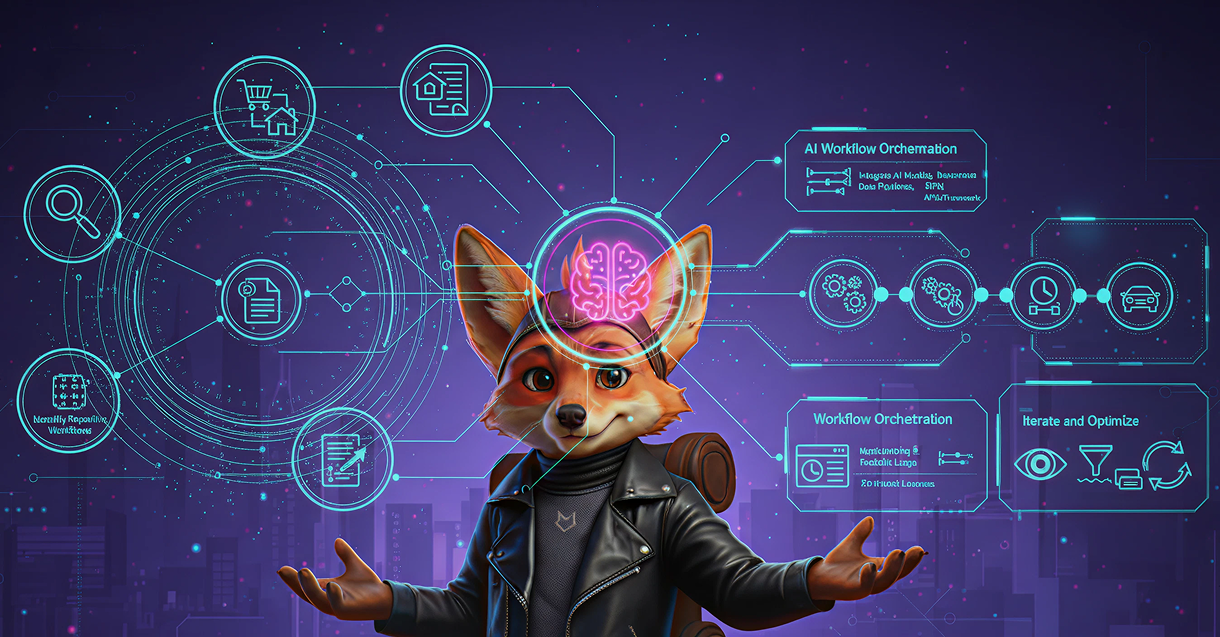
Choosing the right tool is only half the battle. Implementing an effective AI workflow automation strategy requires clarity, planning, and iteration.
Here’s a blueprint for tech leads and developers to get started:
Step 1: Identify Repetitive or Rule-Based Workflows
Start with predictable, high-volume tasks—like data labeling, report generation, or ticket classification.
Step 2: Integrate AI Models with Data Pipelines
Use APIs or frameworks (e.g., LangChain, Hugging Face) to connect AI models directly into your workflow automation engine.
Step 3: Implement Workflow Orchestration
Adopt a tool like Airflow or Prefect to control the sequence, dependencies, and triggers for each step in your workflow.
Step 4: Add Monitoring & Feedback Loops
AI models evolve over time. Establish real-time monitoring to track performance, accuracy, and drift.
Step 5: Iterate and Optimize
The key to sustainable AI workflow automation platforms like SuperMIA is continuous improvement—automating feedback loops and refining model behavior with new data.
Why SuperMIA Is Leading the Way
SuperMIA takes the best of these open-source innovations and packages them into a no-code + pro-code hybrid environment—perfect for both non-technical users and experienced developers.
Plug-and-Play AI Workflows
Drag-and-drop interface to design intelligent workflows connecting LLMs, APIs, and databases.
API-Centric Flexibility
Supports REST, GraphQL, and WebSocket integrations for third-party services.
Developer-First Architecture
Extend functionality using open-source SDKs and custom nodes.
Cloud & On-Premise Options
Deploy securely on private servers or in the cloud—complete data ownership guaranteed.
With SuperMIA, AI workflow automation becomes accessible, scalable, and completely customizable—allowing teams to innovate without rebuilding the wheel.
The Future: Autonomous AI Workflow Automation
The next evolution of open-source automation is autonomous orchestration, where AI agents manage workflows end-to-end without explicit instructions.
Imagine agents in SuperMIA that:
- Detects data anomalies and triggers model retraining.
- Dynamically scale compute resources.
- Update workflows autonomously as APIs or business rules evolve.
This convergence of Agentic AI and open source automation frameworks will redefine enterprise productivity, giving businesses self-healing, self-optimizing operational intelligence.
Conclusion
AI workflow automation isn’t just a buzzword—it’s the foundation for next-generation digital operations. With the rise of open source AI workflow automation tools, developers now have the power to design intelligent systems that adapt, scale, and evolve with minimal friction.
By integrating the best of open-source innovation, SuperMIA stands out as a flexible, future-ready AI workflow automation platform—bridging the gap between low-code simplicity and developer-level control.
As the ecosystem matures, organizations that embrace these frameworks early will unlock a competitive advantage—where AI doesn’t just assist, it orchestrates.
FAQs

Harikrishna Patel is the founder of MIA – My Intelligent Assistant, the AI automation platform built under Botfinity Inc. in Dallas, Texas. With 15+ years in software engineering, AI/ML, and enterprise solution design, he focuses on creating practical, scalable AI tools that help businesses automate support, workflows, and operations through voice and chat. Hari blends strong technical depth with product strategy to make AI accessible and usable for real-world business needs.
Recent Blogs
-
AI Agent 14 Jan, 2026
Tailored AI Solutions with AgenticAI: Why Customization Is the Real Competitive Advantage
-
AI Automation 12 Jan, 2026
Benefits of AI Workflow Automation: Why It’s Becoming a Boardroom Priority
-
AI Agent 09 Jan, 2026
How to Create Marketing Campaigns Easily with MIA
-
AI Agent 07 Jan, 2026
How MIA’s AI Simplifies Your Hiring and Saves Hours of HR Work
-
AI Agent 05 Jan, 2026
AI Is No Longer an Experiment – It’s Enterprise Infrastructure