Why Voice is the Future of Enterprise Automation
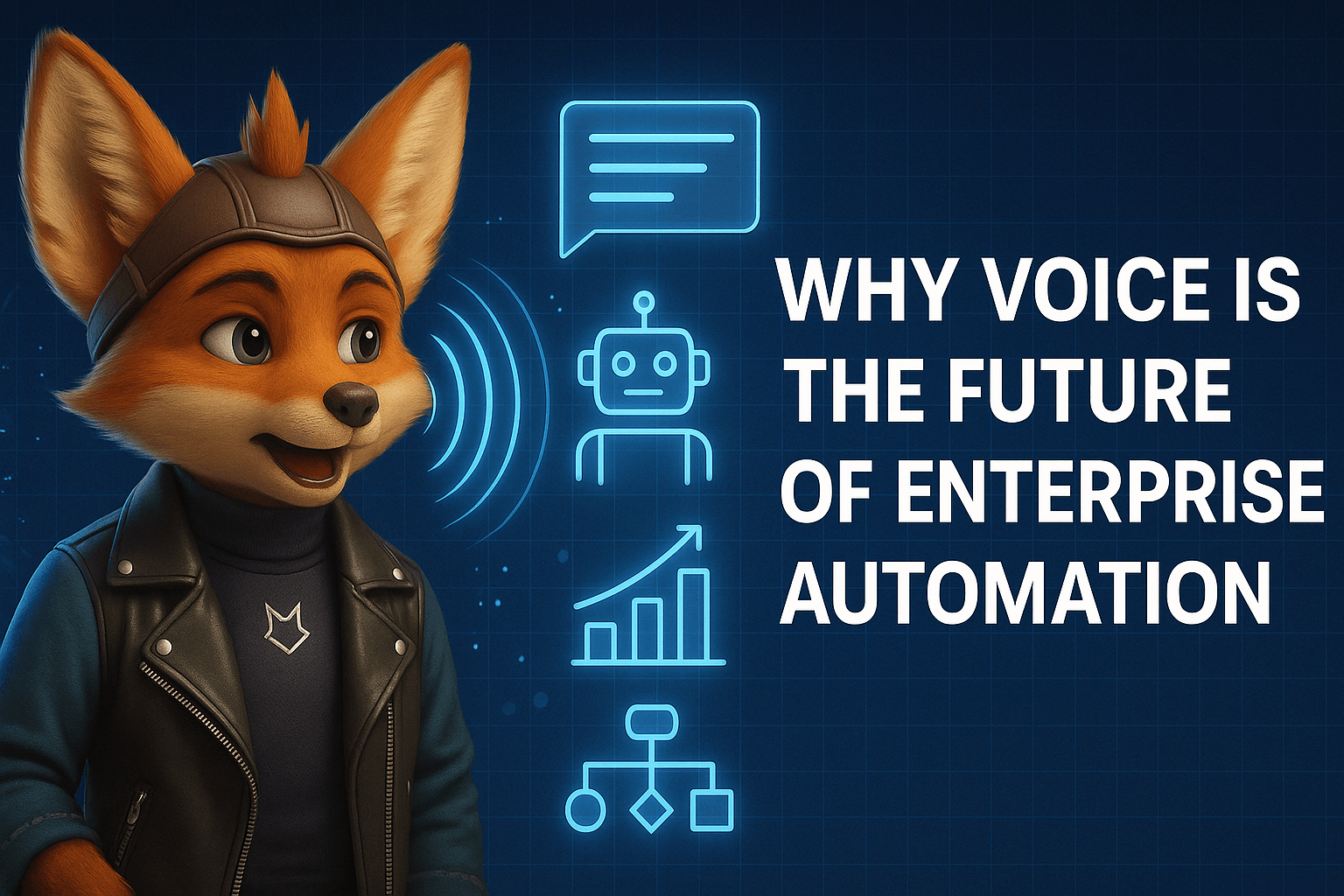
Table of Contents
- Voice Is Natural; That’s Why It’s Powerful
- Global Momentum: The Rise of Voice Interfaces in Business
- Voice + AI = True Automation
- Voice in the Enterprise: Use Cases Across Departments
- Security, Compliance & Multilingual Edge
- How MIA Is Leading This Voice Revolution
- What’s Next? Voice as the Default Interface
- Ready to Start with Voice AI?
In a world increasingly driven by speed, simplicity, and on-demand experiences, voice is emerging as the most natural interface for technology. Once seen as a convenience, voice-based interactions are now positioned to become a core pillar of enterprise automation. From AI-powered support desks to sales outreach, onboarding flows, and workflow orchestration, voice AI is being integrated across digital ecosystems and fast becoming the preferred mode of interaction.
With advancements in speech recognition, large language models, and multimodal AI, voice is no longer just a command layer, and it’s becoming a decision-making interface. This blog explores how voice is redefining enterprise automation, what global trends support this shift, and how forward-thinking businesses can leverage it for competitive advantage.
Voice Is Natural; That’s Why It’s Powerful
Humans are inherently voice-first beings. It’s how we communicate emotion, urgency, intent, and nuance far beyond what buttons or typed text can convey. Unlike form-based interfaces or rigid automation flows, voice enables real-time, freeform interactions that feel personal and frictionless.
This is why voice is quickly gaining traction across enterprise functions:
- Faster interactions compared to typing
- Hands-free, multitask-friendly workflows
- Lower training requirements for end users
- More inclusive across languages and literacy levels
As enterprise processes get more complex, voice reduces user fatigue by simplifying input. The rise of voice-enabled AI agents is turning this potential into business-ready productivity.
Global Momentum: The Rise of Voice Interfaces in Business
The global voice assistant market is expected to exceed $30 billion by 2026, with enterprise adoption being one of the primary drivers (Statista, 2023). In customer service alone, Gartner predicts that by 2025, 70% of customer interactions will involve emerging technologies like voice AI, up from 15% in 2018.
Countries like the U.S., India, Brazil, and the UAE are seeing exponential growth in voice tech adoption across industries. In multilingual markets, voice offers a critical advantage, allowing enterprises to serve regional audiences without forcing them to adapt to English or typing-heavy systems.
This is particularly evident in industries like:
- Telecommunications (automated call handling)
- Healthcare (AI-assisted appointment scheduling)
- Hospitality (voice concierge services)
- Banking (voice-based KYC or balance checks)
- Logistics (driver task management via voice bot)
The message is clear: voice is no longer a nice-to-have; it’s becoming an enterprise standard.
Voice + AI = True Automation
The real revolution comes when voice interfaces are paired with Generative AI. This enables systems to not only comprehend speech but also react intelligently, decide, initiate actions, and gain knowledge over time.
This shift enables enterprises to:
- Replace static IVRs with dynamic voice agents
- Automate form-filling through verbal Q&A
- Summarize calls in real-time with auto-notes
- Initiate CRM updates, ticket creation, or emails via voice
- Deliver hyper-personalized customer experiences
For example, a support agent can say:
“Create a follow-up ticket for John about the refund issue, and email him the return policy.”
And the AI system, powered by a voice interface and backend agent — executes the entire workflow automatically.
This is not just automation. It’s Agentic AI over voice, the future of productivity.
Voice in the Enterprise: Use Cases Across Departments
Voice AI is no longer confined to smart speakers or IVRs. It’s entering core enterprise functions:
- Sales: Outbound voice agents qualifying leads and scheduling appointments
- HR: Voice bots answering policy questions or capturing leave requests
- IT Helpdesk: AI agents handling Tier 1 queries hands-free
- Operations: Warehouse or logistics staff interacting with dashboards using voice
- Finance: Voice-based report retrieval or KPI insights on demand
These use cases reduce load, improve efficiency, and allow human teams to focus on higher-value tasks, all while improving accessibility across non-digital-native roles.
Security, Compliance & Multilingual Edge
Modern voice AI systems come equipped with enterprise-grade security, including encryption, role-based access, and audit trails. Speech models now support intent tracking, sentiment detection, and speaker verification, allowing companies to build trust without compromising data safety.
In markets like India or LATAM, voice-first experiences in local languages are proven to drive 3x higher engagement compared to text. Enterprises using voice automation in regional languages are seeing significant uplift in adoption, especially in B2C and rural outreach scenarios.
How MIA Is Leading This Voice Revolution
Our MIA Platform is built to help enterprises tap into the full power of voice-first AI automation. Whether you’re in telecom, healthcare, retail, or government. MIA offers plug-and-play voice agents that:
- Automate conversations across voice, WhatsApp, chat, and email
- Understand natural speech in 10+ Indian languages
- Integrate with CRMs, ERPs, and CPaaS platforms
- Enable businesses to deploy without writing a single line of code
We recently launched the Voice-to-Template GenAI Agent, enabling users to create CPaaS messaging templates simply by speaking — now live on the MIA Marketplace.

What’s Next? Voice as the Default Interface
In the next 2–3 years, we’ll see a shift where voice becomes the default interface for enterprise tools — just as touch became the standard for mobile. Meetings, dashboards, internal apps, and even analytics will be voice-controlled. And with GenAI agents behind the scenes, users will expect voice interfaces that are not only reactive, but also proactive.
Whether you’re a business leader, a CIO, or a digital transformation consultant, the question is no longer “Should we explore voice?” but rather, “Where can we apply it first?”
Ready to Start with Voice AI?
Start your voice automation journey with intelligent, multilingual agents from the MIA Marketplace. From CPaaS integration to workflow bots, we help you build voice-first experiences that scale.
Need a Custom Voice Agent? Talk to Our Team
FAQs

Harikrishna Patel is the founder of MIA – My Intelligent Assistant, the AI automation platform built under Botfinity Inc. in Dallas, Texas. With 15+ years in software engineering, AI/ML, and enterprise solution design, he focuses on creating practical, scalable AI tools that help businesses automate support, workflows, and operations through voice and chat. Hari blends strong technical depth with product strategy to make AI accessible and usable for real-world business needs.
Recent Blogs
-
AI Agent 14 Jan, 2026
Tailored AI Solutions with AgenticAI: Why Customization Is the Real Competitive Advantage
-
AI Automation 12 Jan, 2026
Benefits of AI Workflow Automation: Why It’s Becoming a Boardroom Priority
-
AI Agent 09 Jan, 2026
How to Create Marketing Campaigns Easily with MIA
-
AI Agent 07 Jan, 2026
How MIA’s AI Simplifies Your Hiring and Saves Hours of HR Work
-
AI Agent 05 Jan, 2026
AI Is No Longer an Experiment – It’s Enterprise Infrastructure