AI Is No Longer an Experiment – It’s Enterprise Infrastructure
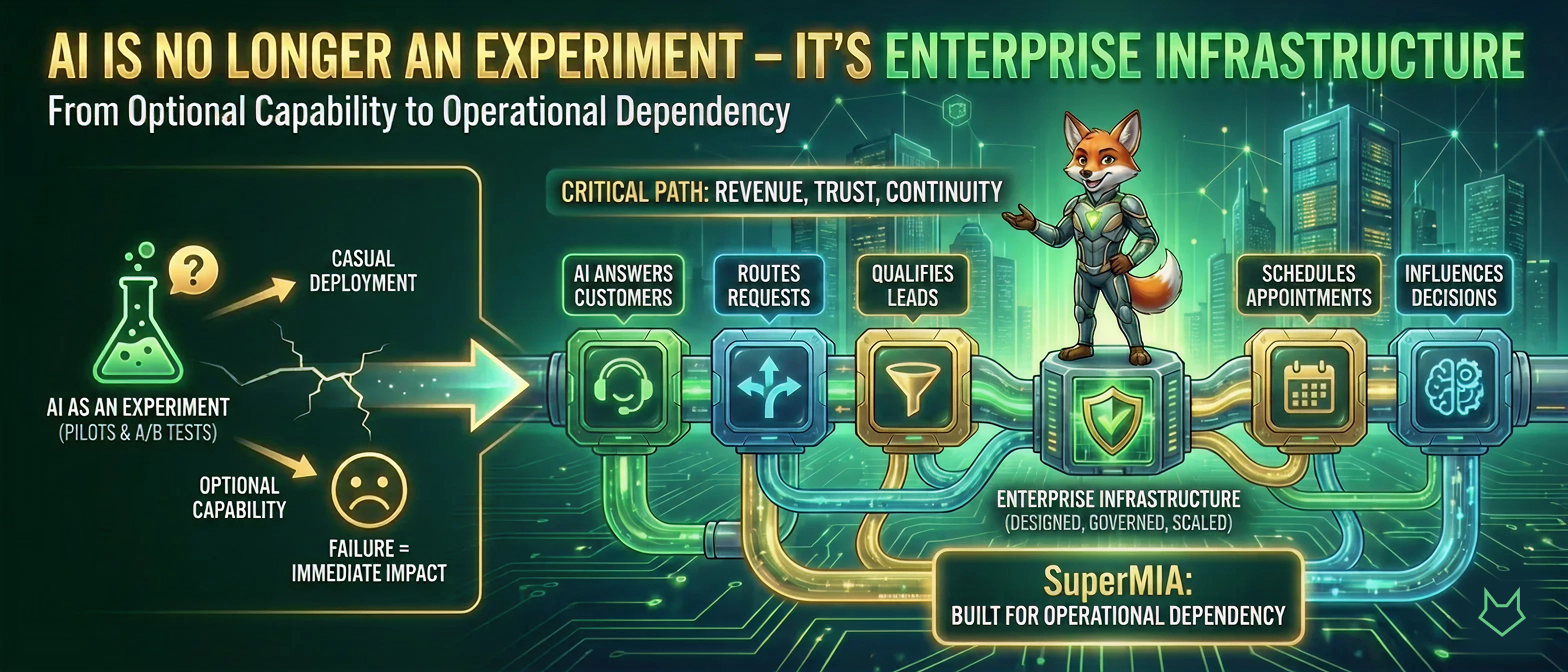
Table of Contents
Introduction
Enterprises don’t experiment with infrastructure.
- They don’t “pilot” their identity systems.
- They don’t A/B test their payment rails.
- They don’t casually deploy systems that customers rely on every day.
And yet, many organizations still treat AI that way.
In reality, AI already sits in the critical path of revenue, customer trust, and operational continuity. It answers customers. It routes requests. It qualifies leads. It schedules appointments. It influences decisions.
When that AI fails, customers feel it immediately.
This is the shift leaders must recognize: AI is no longer an optional capability. It is an operational dependency, and dependencies must be designed, governed, and scaled as infrastructure.
SuperMIA was built with this exact premise in mind.
The Problem: AI Failures Are Becoming Business Failures
The biggest AI risk facing enterprises today is not model accuracy.
It’s availability, consistency, and control.
Across industries, organizations are embedding AI into frontline operations without treating it as mission-critical. The result is fragile systems that break silently and recover slowly.
Common enterprise failure points include:
- Missed or dropped customer interactions when AI systems stall
- Inconsistent responses across channels creating trust erosion
- Lack of 24/7 coverage during peak or off-hours
- No clear audit trail for AI-driven decisions
- Operational teams unaware of failures until customers complain
The Solution: Conversational AI Designed as Infrastructure – Built on SuperMIA
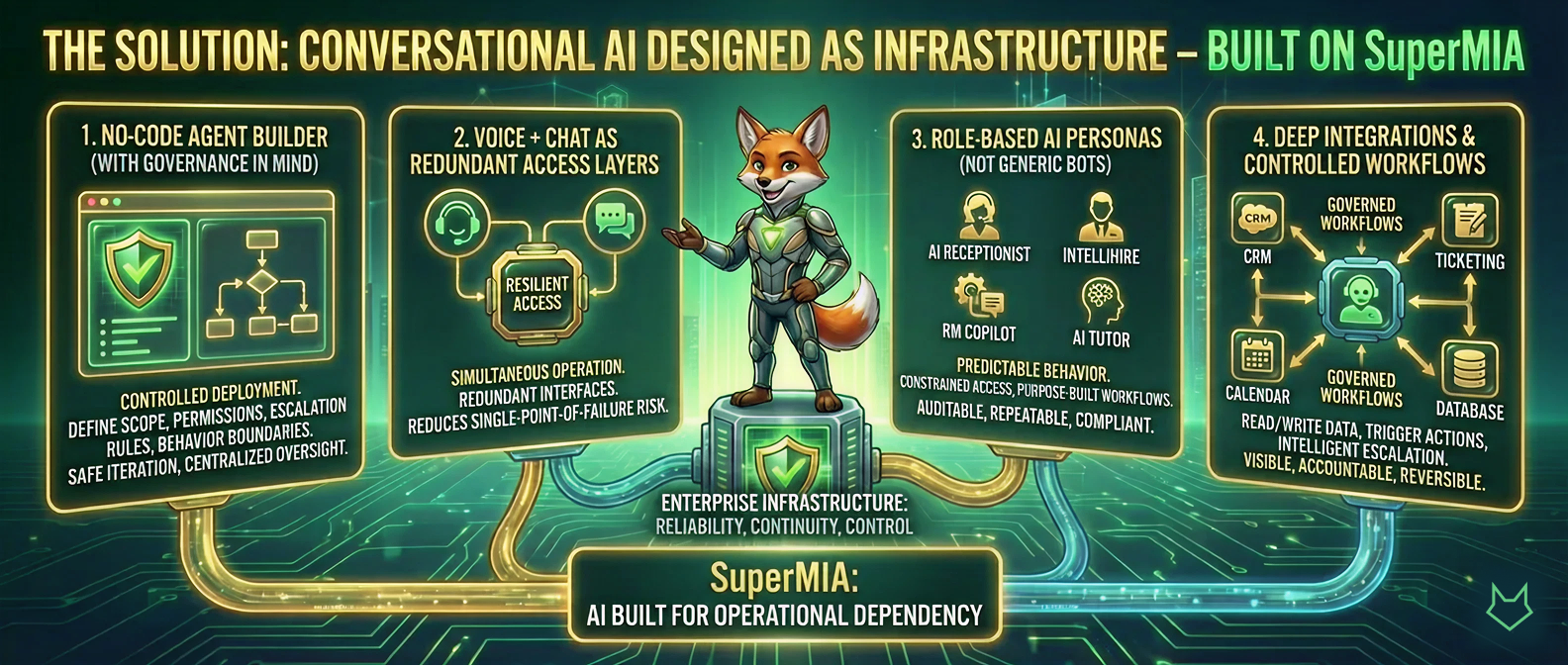
SuperMIA approaches AI from an infrastructure-first perspective. Every component is designed around reliability, continuity, and enterprise control.
1. No-Code Agent Builder (With Governance in Mind)
SuperMIA’s no-code builder is not about speed alone – it’s about controlled deployment.
Enterprises can define agent scope, permissions, escalation rules, and behavior boundaries without engineering intervention. This allows business teams to iterate safely while maintaining centralized oversight.
AI changes no longer require risky deployments or shadow IT.
2. Voice + Chat as Redundant Access Layers
Infrastructure must be resilient across interfaces.
SuperMIA agents operate across voice and chat channels simultaneously, ensuring customer access does not depend on a single interaction mode. If one channel is overloaded, others remain operational.
This redundancy reduces single-point-of-failure risk in customer engagement.
3. Role-Based AI Personas (Not Generic Bots)
Generic AI creates unpredictable outcomes.
SuperMIA deploys role-specific AI personas designed around clearly defined responsibilities such as AI Receptionist, IntelliHire, RM Copilot, or AI Tutor. Each persona has constrained access, purpose-built workflows, and predictable behavior.
This makes AI interactions auditable, repeatable, and compliant with enterprise expectations.
4. Deep Integrations & Controlled Workflows
SuperMIA agents integrate directly with CRMs, ticketing systems, calendars, databases, and APIs, but always through governed workflows.
Agents can read and write data, trigger actions, and escalate intelligently, while maintaining logs and traceability. This ensures AI actions remain visible, accountable, and reversible when required.
Real-Life Use Case
A multi-location service organization embedded AI into its appointment and inquiry handling but relied on fragmented tools with limited monitoring.
During peak demand, response delays went unnoticed for hours, resulting in missed revenue and customer dissatisfaction.
After consolidating conversational AI Platform onto SuperMIA, the organization gained centralized visibility into AI activity, uptime, and performance. Agents handled inquiries reliably across channels, with automatic escalation when thresholds were exceeded.
Why SuperMIA Is Different
SuperMIA is designed for enterprises that think in terms of risk, resilience, and scale.
- Voice + Chat built as core layers
- No-code customization with centralized control
- 50+ role-based AI personas
- Tool libraries for CRM, calendars, payments, workflows
- API, webhook, and database connectors with governance
- Logs, insights, and operational visibility
- SuperMIA doesn’t just enable AI adoption.
- It reduces AI-related operational risk.

Getting Started Is Easy
Treating AI as infrastructure doesn’t require a long transformation program.
With SuperMIA:
Sign up → Select a role-based persona → Train with enterprise data → Deploy across channels → Monitor logs and performance.
Enterprises move from fragmented AI usage to controlled deployment quickly and safely.
Email hello@supermia.ai
FAQs
Yes. SuperMIA is designed with scalability, observability, and governance in mind.
Yes. AI actions are logged, traceable, and configurable within defined access controls.
Through built-in integrations, APIs, and webhooks with controlled workflows.

Harikrishna Patel is the founder of MIA – My Intelligent Assistant, the AI automation platform built under Botfinity Inc. in Dallas, Texas. With 15+ years in software engineering, AI/ML, and enterprise solution design, he focuses on creating practical, scalable AI tools that help businesses automate support, workflows, and operations through voice and chat. Hari blends strong technical depth with product strategy to make AI accessible and usable for real-world business needs.
Recent Blogs
-
AI Agent 14 Jan, 2026
Tailored AI Solutions with AgenticAI: Why Customization Is the Real Competitive Advantage
-
AI Automation 12 Jan, 2026
Benefits of AI Workflow Automation: Why It’s Becoming a Boardroom Priority
-
AI Agent 09 Jan, 2026
How to Create Marketing Campaigns Easily with MIA
-
AI Agent 07 Jan, 2026
How MIA’s AI Simplifies Your Hiring and Saves Hours of HR Work
-
AI Agent 05 Jan, 2026
AI Is No Longer an Experiment – It’s Enterprise Infrastructure