Benefits of AI Workflow Automation: Why It’s Becoming a Boardroom Priority
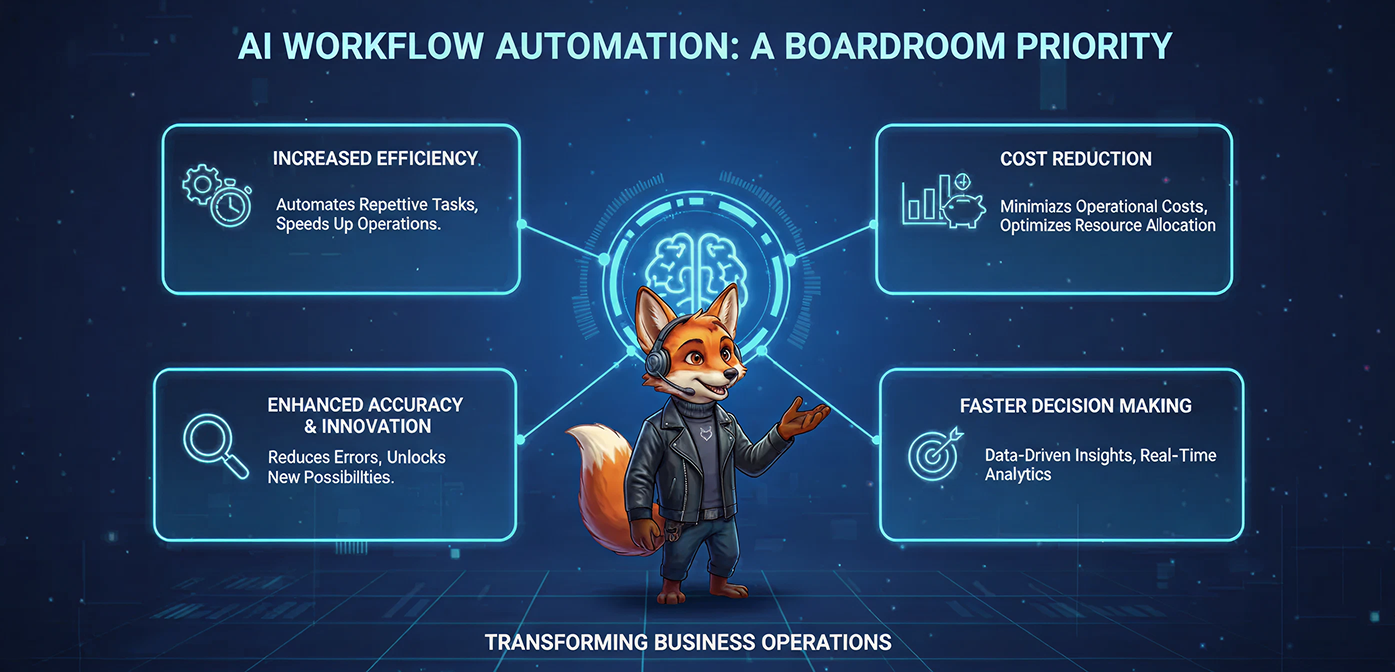
Table of Contents
Introduction
For years, automation was viewed as an operational improvement, something teams used to reduce manual work and improve efficiency at the margins. That perception has changed.
Today, AI-powered workflow automation is no longer an IT initiative or a productivity experiment. It is becoming a strategic lever for how modern organizations operate, scale, and compete.
CXOs are facing a new reality. Businesses must move faster, operate leaner, and respond in real time – while managing growing complexity across teams, systems, and markets. Traditional workflows, even when digitized, are no longer sufficient.
AI workflow automation introduces a fundamental shift: workflows that don’t just follow rules, but adapt, learn, and act intelligently.
This is why AI-powered automation is increasingly discussed not in operations meetings,but in boardrooms.
The Problem: Traditional Workflows Can’t Keep Up
Most organizations already have workflows. The problem is that they are rigid, fragmented, and heavily dependent on human intervention.
- Manual handoffs between teams
- Static rules that don’t adapt to changing conditions
- Disconnected systems that require reconciliation
- Human judgment for repetitive decisions
As scale increases, these workflows become bottlenecks. Decisions slow down. Errors increase. Teams compensate by adding people instead of improving systems.
For leadership, this creates a familiar tension: growth without proportional efficiency.
AI-powered workflow automation addresses this imbalance by redesigning how work flows through the organization, not just speeding up individual steps.
What Makes AI Workflow Automation Different
Traditional automation executes predefined instructions. AI workflow automation goes further by introducing intelligence into the process itself.
AI-powered workflows can:
- Interpret unstructured data
- Make contextual decisions
- Route work dynamically
- Learn from outcomes over time
This transforms workflows from static pipelines into adaptive systems.
For CXOs, this distinction matters. The value of AI automation is not just cost reduction, it’s organizational agility.
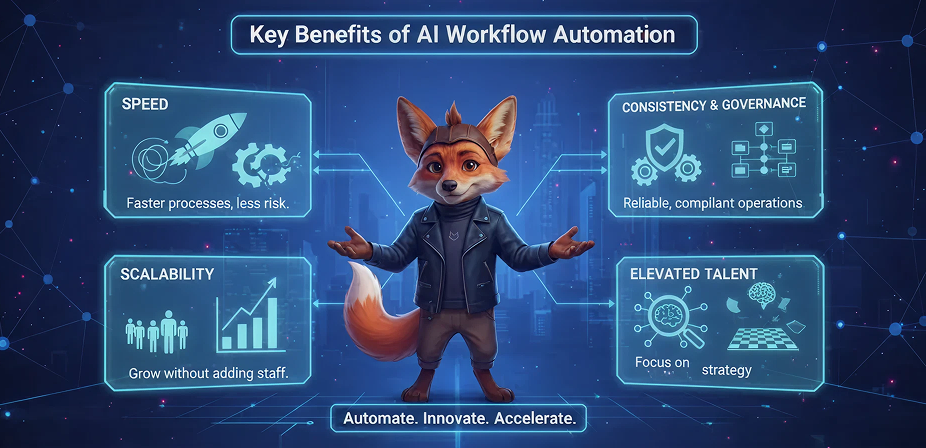
Key Benefits of AI Workflow Automation
1. Operational Speed Without Operational Chaos
AI-driven workflows reduce dependency on manual intervention, allowing processes to move faster without increasing risk. Tasks that once required approvals, reviews, or coordination across teams can now be executed automatically with built-in logic and safeguards.
Speed improves not because people work harder, but because systems work smarter.
2. Scalability Without Headcount Growth
One of the most immediate benefits leaders notice is scale.
AI workflow automation allows organizations to handle increased volume customers, transactions, data, requests without linearly increasing staff. This is particularly critical in environments where talent is scarce or expensive.
Growth becomes sustainable rather than burdensome.
3. Consistency and Governance at Scale
Human-led workflows vary. AI-driven workflows don’t.
By embedding policies, compliance rules, and decision logic directly into automated workflows, organizations achieve consistency across teams and regions. This reduces risk while improving auditability and control.
For regulated industries, this is not just a benefit, it’s a requirement.
4. Better Use of Human Talent
AI workflow automation doesn’t eliminate human involvement. It elevates it.
By removing repetitive, low-value tasks, teams can focus on strategic thinking, relationship-building, and complex problem-solving. This improves employee satisfaction while increasing organizational effectiveness.
From a leadership perspective, this is about talent optimization, not workforce reduction.
5. Improved Decision-Making Through Intelligence
AI-powered workflows continuously generate data. Over time, this creates insight into process performance, bottlenecks, and outcomes.
Instead of relying on periodic reports, leaders gain near-real-time visibility into how work flows through the organization and where it can be improved.
Decisions become data-informed rather than assumption-driven.
AI Workflow Automation Across the Enterprise
While the benefits are universal, the impact varies by function.
In customer experience, AI workflows handle inquiries, route issues, and resolve common requests autonomously improving response times and satisfaction.
In HR, AI automates hiring, onboarding, and internal requests reducing cycle times and administrative burden.
In finance, workflows manage approvals, reconciliations, and compliance checks improving accuracy and control.
In operations, AI-driven workflows adapt to demand fluctuations, supply chain signals, and service requirements in real time.
For CXOs, the takeaway is clear: AI workflow automation is not a departmental tool. It is an enterprise capability.
Why AI Workflow Automation Is a Strategic Investment
Technology investments are often evaluated on short-term ROI. AI workflow automation requires a broader lens.
Its true value lies in:
- Faster organizational response to change
- Reduced dependency on manual coordination
- Improved resilience under pressure
- Stronger alignment between strategy and execution
Organizations that adopt AI-powered workflows early build operational muscle that compounds over time. Those that delay risk being constrained by processes that no longer match their ambition.
Getting Started Without Disruption

One of the biggest misconceptions is that AI workflow automation requires a complete overhaul.
In reality, the most successful organizations start small. They identify high-friction workflows, automate them incrementally, and expand once value is proven.
Modern platforms like SuperMIA make this approach practical by enabling no-code configuration, modular workflows, and AI agents that integrate with existing systems.
This lowers risk while accelerating value realization.
AI workflow automation is no longer about efficiency alone. It’s about how organizations operate in a world that demands speed, scale, and intelligence.
For CXOs and decision-makers, the question is no longer if AI-powered workflows will be adopted but who will benefit first.
Email hello@supermia.ai
FAQs
No. While enterprises benefit significantly, startups and mid-sized organizations often see faster impact due to leaner structures.
No. It reduces repetitive work and allows teams to focus on higher-value responsibilities.
Many organizations see measurable improvements within weeks when starting with high-impact workflows.
Yes. AI workflow automation adds intelligence, adaptability, and learning beyond rule-based automation.

Harikrishna Patel is the founder of MIA – My Intelligent Assistant, the AI automation platform built under Botfinity Inc. in Dallas, Texas. With 15+ years in software engineering, AI/ML, and enterprise solution design, he focuses on creating practical, scalable AI tools that help businesses automate support, workflows, and operations through voice and chat. Hari blends strong technical depth with product strategy to make AI accessible and usable for real-world business needs.
Recent Blogs
-
AI Agent 14 Jan, 2026
Tailored AI Solutions with AgenticAI: Why Customization Is the Real Competitive Advantage
-
AI Automation 12 Jan, 2026
Benefits of AI Workflow Automation: Why It’s Becoming a Boardroom Priority
-
AI Agent 09 Jan, 2026
How to Create Marketing Campaigns Easily with MIA
-
AI Agent 07 Jan, 2026
How MIA’s AI Simplifies Your Hiring and Saves Hours of HR Work
-
AI Agent 05 Jan, 2026
AI Is No Longer an Experiment – It’s Enterprise Infrastructure