
Table of Contents
- Why Healthcare Practices Are Losing Patients Before They Even Walk In
- What an AI Chatbot Actually Does in a Healthcare Setting
- The HIPAA Question: What "Compliant" Actually Means
- Real Results: What the Data Shows
- How to Evaluate an AI Chatbot for Healthcare
- Who Should NOT Deploy a Healthcare AI Chatbot (Yet)
- Common Questions Healthcare Teams Ask
- What to Do Next
A 3-dentist practice in Texas was losing 18 to 22 bookable appointments every week.
Not because patients did not want to come. Because nobody picked up the phone.
Their front desk answered 52% of calls on the first ring. The rest went to voicemail. After hours? Zero coverage. That meant roughly $5,600 in missed booking revenue every single week from a practice with only 900 active patients.
They deployed an AI chatbot and voice bot on a Monday. By Friday, their first-ring answer rate was 100%. Their weekly revenue jumped from $24,800 to $38,976.
That is a 57% increase. In one week.
This is not a hypothetical. It is documented in the Brite Smile Dental case study, and the pattern repeats across healthcare organizations that replace manual front-desk workflows with AI.
This guide breaks down exactly how AI chatbots work in healthcare, what compliance requirements matter, which use cases drive the most ROI, and how to evaluate whether one is right for your practice.
Why Healthcare Practices Are Losing Patients Before They Even Walk In
The problem is not clinical. It is operational.
The American Hospital Association reports that over 80% of hospitals face persistent staffing challenges. The WHO projects a 10 million healthcare worker shortage by 2030. But the bottleneck most practices feel first is not in the exam room, it is at the front desk.
Here is what the data shows:
- Front-desk staff spend nearly 40% of their shift on scheduling-related tasks: confirming, rescheduling, handling cancellations.
- Up to 30% of appointment slots go unused due to no-shows and scheduling inefficiencies.
- The average patient waits 11+ minutes for a response when they call a healthcare practice during business hours.
- After-hours call handling at most practices: 0%. Every evening and weekend call is a lost opportunity.
These are not clinical problems. They are communication problems. And they compound: a missed call becomes a missed appointment, which becomes a patient who books elsewhere.
The question healthcare operators are actually searching for is not "what is an AI chatbot." It is: how do I stop losing patients to my own phone system?
What an AI Chatbot Actually Does in a Healthcare Setting
Forget the generic chatbot image. In healthcare, AI chatbots handle real operational workflows across multiple channels.
Channel Coverage: Not Just Your Website
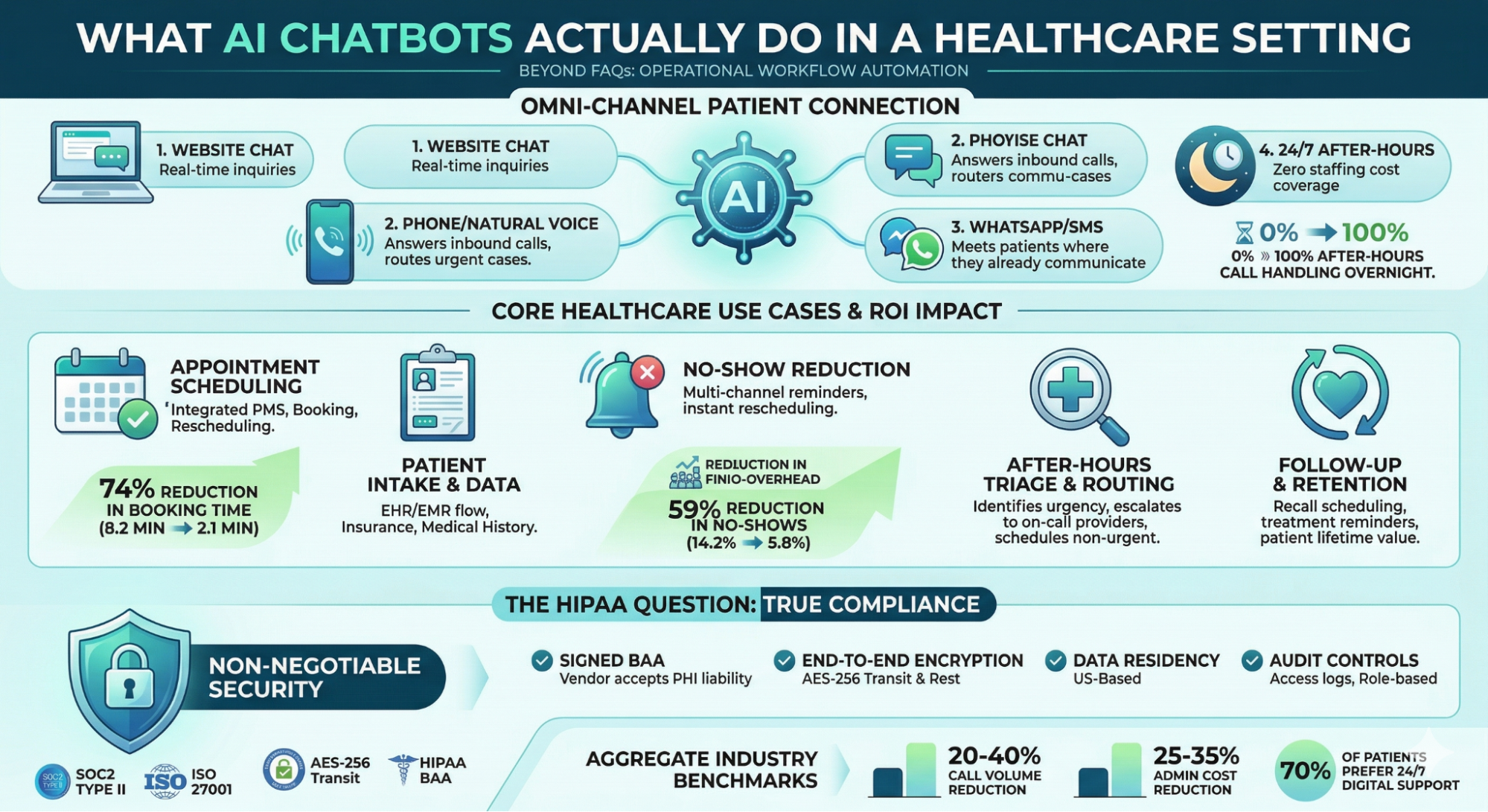
A healthcare AI chatbot worth evaluating works across:
- Website chat: handles patient inquiries in real time.
- Phone/voice: answers inbound calls, routes urgent cases, books appointments via natural conversation.
- WhatsApp/SMS: meets patients where they already communicate.
- After-hours: 24/7 coverage with zero staffing cost.
The Brite Smile practice went from 0% after-hours call handling to 100% overnight. They captured roughly 14 additional bookings per week just from calls that previously went to voicemail.
Core Use Cases That Drive ROI
Based on real deployment data from healthcare practices:
1. Appointment Scheduling and Management
The single highest-ROI use case. AI handles booking, rescheduling, cancellations, and reminders integrated directly with your practice management system (PMS). Learn more about AI receptionist healthcare appointment scheduling.
At Brite Smile, booking completion time dropped from 8.2 minutes to 2.1 minutes, a 74% reduction.
2. Patient Intake and Data Collection
AI captures patient profiles, insurance information, medical history, and preferences before the visit. No clipboard. No redundant forms. Data flows directly into systems like Open Dental, DrChrono, or your existing EHR/EMR.
NeoSmile Dental reduced administrative overhead by 50% primarily through automated intake.
3. No-Show Reduction
Automated reminders via SMS, WhatsApp, and voice calls with the ability to reschedule on the spot if a patient cannot make it. Brite Smile cut their no-show rate from 14.2% to 5.8%, a 59% reduction.
4. After-Hours Triage and Routing
Patients with urgent concerns do not wait until morning. AI identifies urgency level, provides appropriate guidance, and escalates to on-call providers when necessary.
5. Follow-Up and Patient Retention
Post-appointment follow-ups, treatment reminders, recall scheduling for hygiene visits or annual checkups. This is where long-term patient lifetime value compounds through better patient engagement.
The HIPAA Question: What "Compliant" Actually Means
This is the first question every healthcare decision-maker asks and the most commonly misrepresented claim in the market.
What HIPAA Compliance Requires from a Chatbot
A chatbot handling Protected Health Information (PHI) must meet these non-negotiable requirements:
| Requirement | What It Means | Why It Matters |
|---|---|---|
| Business Associate Agreement (BAA) | The vendor signs a legal contract accepting liability for PHI protection | Without a BAA, you are liable for any data breach through the chatbot |
| End-to-End Encryption | All data in transit and at rest is encrypted (AES-256 minimum) | PHI intercepted during transmission is a violation |
| Access Controls | Role-based access, audit logs, automatic session timeouts | Every access to PHI must be tracked and auditable |
| Data Residency | PHI stored in US-based, HIPAA-compliant infrastructure | Offshore data storage creates jurisdictional compliance risk |
| Breach Notification | Vendor must notify you within 60 days of a discovered breach | Required by the HITECH Act |
Red Flags When Evaluating Vendors
- "HIPAA-ready" vs "HIPAA-compliant". If they will not sign a BAA, walk away.
- No SOC2 audit. SOC2 Type II proves controls are tested over time.
- Generic chatbot with a healthcare template. HIPAA compliance is an architectural requirement.
- No mention of data residency. If they cannot tell you where PHI is stored, they have not thought about it.
What a Compliant Stack Looks Like
- HIPAA compliance with signed BAA
- SOC2 Type II certification
- PCI DSS (if handling payments)
- ISO 27001 information security
- GDPR compliance (if serving international patients)
Real Results: What the Data Shows
Theory is cheap. Here is what is actually measured.
Brite Smile Dental - Full Metrics Breakdown
Practice profile: 3 dentists, 2 hygienists, around 900 active patients, 65 to 80 daily inbound calls.
| Metric | Before AI | After AI | Change |
|---|---|---|---|
| Weekly revenue | $24,800 | $38,976 | +57% |
| First-ring answer rate | 52% | 100% | +48 pts |
| No-show rate | 14.2% | 5.8% | -59% |
| Schedule occupancy (Mon-Fri) | 71% | 94% | +23 pts |
| Patient response time | 11.4 min | 6.5 min | -43% |
| Booking completion time | 8.2 min | 2.1 min | -74% |
| After-hours bookings/week | 0 | ~14 | New revenue |
| Staff hours freed/week (per FTE) | - | ~12 hrs | Redeployed to care |
| Patient NPS | 61 | 78 | +17 pts |
Implementation time: 48 hours. The full Brite Smile Dental case study includes complete operational details.
Industry Benchmarks (Aggregated)
- 20-40% reduction in call volume within months of deployment.
- 25-35% administrative cost reduction while improving patient experience.
- 70% of patients prefer 24/7 digital support for non-emergency queries (Healthcare IT News).
How to Evaluate an AI Chatbot for Healthcare
Must-Have Criteria
- Multi-Channel (Chat + Voice + Messaging): A website-only chatbot misses most patient communication.
- HIPAA Compliance with Signed BAA: Non-negotiable.
- PMS/EHR Integration: Must read and write to your practice management stack.
- No-Code Configuration: Office managers should update flows without developers.
- Escalation Logic: Urgent cases must route immediately to the right human.
Nice-to-Have Criteria
- Multilingual support for diverse patient populations.
- Sentiment analysis to flag negative interactions.
- Analytics dashboard for booking and no-show trends.
- Outbound capabilities for reminders and recall campaigns.
Who Should NOT Deploy a Healthcare AI Chatbot (Yet)
Being direct: AI chatbots are not right for every practice.
Skip it if:
- You have fewer than 20 inbound patient calls per day.
- Your PMS does not support API integrations.
- You do not have a process owner to tune responses in weeks 1-4.
Move fast if:
- You are missing more than 10 calls per day.
- Your no-show rate exceeds 10%.
- You have zero after-hours coverage.
- Front-desk staff are burned out and turning over.
- You are a multi-location practice with inconsistent patient experience across sites.
Common Questions Healthcare Teams Ask
What to Do Next
- Calculate your current leakage: missed calls, no-show rate, after-hours coverage gap.
- Check PMS compatibility and integration readiness.
- Run a real pilot with your actual call flows and appointment logic.
Start a free trial of SuperMIA
Healthcare practices deploy AI chatbots because the economics are clear: missed calls and no-shows are expensive, and modern conversational AI closes that gap quickly.
SuperMIA is a HIPAA-compliant, SOC2 Type II certified conversational AI platform used by healthcare practices across the US. Read the full Brite Smile Dental case study to see complete before-and-after data.

Harikrishna Patel
Harikrishna Patel is the founder of MIA - My Intelligent Assistant, the AI automation platform built under Botfinity Inc. in Dallas, Texas. With 15+ years in software engineering, AI/ML, and enterprise solution design, he focuses on creating practical, scalable AI tools that help businesses automate support, workflows, and operations through voice and chat.