
Table of Contents
- Why This Comparison Matters for Dental Practice Owners
- What Is a Dental Virtual Receptionist?
- The True Cost of a Human Front Desk Receptionist
- The True Cost of a Dental Virtual Receptionist (AI)
- Side-by-Side Cost and Capability Comparison
- ROI Breakdown: Where AI Pays for Itself
- Real-World Results: Media Brite Smile Dental
- When a Human Front Desk Still Makes Sense
- The Optimal Model: AI and Human Working Together
- How SuperMIA's AI Dental Receptionist Works
- Free Tool: Dental Practice ROI Calculator
- Frequently Asked Questions
- Conclusion
Your front desk receptionist goes to lunch. Three calls come in. One is a new patient with a toothache, one wants to reschedule tomorrow's cleaning, and one is checking if you accept their insurance. All three go to voicemail.
By the time someone calls back, the new patient may already have booked with another practice.
This is not rare. It happens during lunch breaks, after hours, and on high-volume days when the phone never slows down. That is why the most important question for dental owners is not whether AI is trendy. It is whether your current phone coverage is quietly leaking revenue.
This guide breaks down the real numbers: annual staffing cost, cost per call, after-hours revenue impact, and practical ROI.
Calculate Your Practice's ROI — Free Spreadsheet →
Why This Comparison Matters for Dental Practice Owners
This is a revenue decision, not just a staffing decision.
The average new dental patient can generate around $1,000 to $1,500 in first-year production. Miss only five patient calls per week and the annual opportunity cost becomes significant:
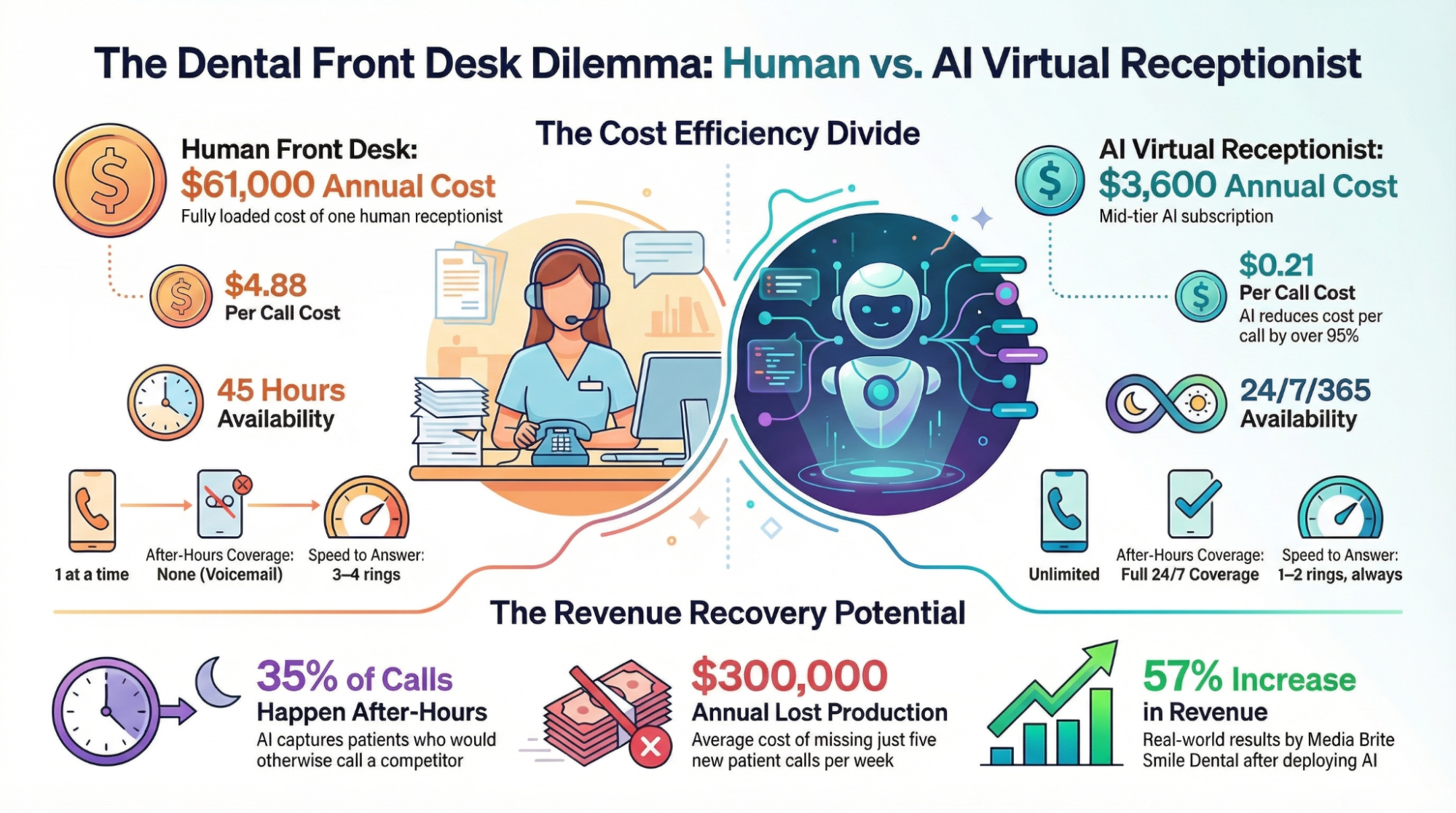
5 missed calls x 50 weeks x $1,200 average first-year value = $300,000 potential annual production at risk.
Modern AI dental receptionist systems can answer calls, route intent, book appointments, and send reminders without increasing front desk workload. But you still need to compare options with real math.
What Is a Dental Virtual Receptionist?
A dental virtual receptionist is a system that handles front-desk phone tasks like call answering, scheduling, rescheduling, reminders, and urgent call routing.
AI-Powered vs Human Virtual Receptionists
AI-powered virtual receptionists use conversational AI and speech recognition to handle calls in real time, integrate with PMS tools like Dentrix and Open Dental, and provide 24/7 coverage.
Human virtual receptionists are remote staff who follow scripts and take calls on your behalf. They can add warmth, but availability and simultaneous handling are limited by staffing capacity.
This article focuses on the real decision most owners face: AI phone coverage vs in-house human-only coverage.
The True Cost of a Human Front Desk Receptionist
Most practices know salary. Fewer calculate fully loaded cost.
Salary, Benefits, and Hidden Costs
According to average dental receptionist salary data, base pay alone ranges from $39,000 to $47,000 — but that is only part of the real cost.
| Cost Category | Annual Cost |
|---|---|
| Base salary | $39,000 to $47,000 |
| Employer payroll taxes (FICA) | $2,980 to $3,600 |
| Health insurance (employer portion) | $6,000 to $8,500 |
| Paid time off | $1,500 to $1,800 |
| Training and onboarding | $1,500 to $3,000 |
| Turnover cost (amortized) | $2,000 to $4,000 |
| Workers' comp and unemployment | $500 to $1,200 |
| Fully loaded total | $53,480 to $69,100 |
A practical midpoint is about $61,000 per year, roughly $5,080 per month, for business-hours coverage only.
Cost Per Call Calculation
| Metric | Value |
|---|---|
| Calls per day | 50 |
| Working days per year | 250 |
| Total annual calls | 12,500 |
| Fully loaded annual cost | $61,000 |
| Cost per call | $4.88 |
If 25% of calls are missed, effective cost per answered call rises to around $6.50.
The True Cost of a Dental Virtual Receptionist (AI)
Monthly Subscription Costs
| Tier | Monthly Cost | Annual Cost | Best For |
|---|---|---|---|
| Entry-level | $99 to $199 | $1,188 to $2,388 | Solo or low-volume practices |
| Mid-tier (incl. SuperMIA) | $250 to $500 | $3,000 to $6,000 | 1 to 3 location practices |
| Enterprise/DSO | $500 to $1,500 per location | $6,000 to $18,000 | Multi-location groups |
Cost Per Call Calculation
| Metric | Value |
|---|---|
| Monthly cost | $299 |
| Annual cost | $3,588 |
| Total annual calls handled | 15,000 to 20,000 |
| Cost per call | $0.18 to $0.24 |
That is typically a 95% to 97% lower cost per call compared with human-only coverage.
Side-by-Side Cost & Capability Comparison
| Factor | Human Front Desk | AI Virtual Receptionist |
|---|---|---|
| Annual cost | $53,000 to $69,000 | $2,400 to $6,000 |
| Cost per call | $4.88 to $6.50 | $0.18 to $0.24 |
| Availability | Business hours | 24/7/365 |
| Simultaneous calls | One at a time | Multiple at once |
| After-hours coverage | Voicemail | Always on |
| Appointment booking | Manual PMS entry | Direct PMS integration |
| Insurance verification | Manual workflow | Automated where integrated |
| Language coverage | Usually 1 to 2 | 40+ with detection |
| In-person patient greeting | Yes | No |
| Complex/emotional calls | Strong | Escalates to staff |
| Deployment timeline | Hiring/training cycle | 24 to 48 hours |
Calculate Your Practice's ROI — Free Spreadsheet
ROI Breakdown: Where AI Pays for Itself
Cost savings matter, but recovered revenue is where the largest gains usually come from.
After-Hours Call Capture
Up to 35% of dental calls can happen outside standard hours. Without coverage, those calls often disappear into voicemail.
Even conservative assumptions can produce meaningful annual upside from better call capture and faster booking follow-through.
Reduced No-Shows
Automated reminders by call, text, and email reduce no-shows and keep appointment slots filled. Practices commonly report improved attendance after automation goes live.
Speed to Answer
Speed has direct revenue impact. Practices that answer quickly convert more inquiries into booked appointments.
Real-World Results — Media Brite Smile Dental Case Study
Media Brite Smile Dental implemented SuperMIA to support patient calls, appointment workflows, and follow-ups. Reported outcomes include:
| Metric | Result |
|---|---|
| Patient response time | 43% faster |
| Revenue growth | 57% increase |
| Weekday slot fill rate | 94% |
| No-show reduction | From 14.2% to 5.8% |
See the full results in the full Media Brite Smile Dental case study.
Explore how SuperMIA's AI dental receptionist supports these workflows in real practice operations.
See How MIA Works — Book a Demo
When a Human Front Desk Still Makes Sense
AI does not replace everything. Human front desk staff remain essential for:
- In-person check-in, copays, and patient reassurance
- Complex insurance and authorization conversations
- Sensitive or emotionally charged patient interactions
- Real-time in-office coordination between staff and providers
The Optimal Model — AI + Human Working Together
The strongest model for many practices is hybrid.
AI handles first-ring phone coverage, routine scheduling, and reminders. Humans focus on in-person experience and cases that need judgment or empathy.
| Component | Annual Cost |
|---|---|
| AI receptionist (mid-tier) | $3,600 |
| 1 human receptionist | $61,000 |
| Total | $64,600 |
| Coverage | 24/7 phone plus full in-person care |
How SuperMIA's AI Dental Receptionist Works
- Answers every call, 24/7, including after-hours and lunch gaps
- Books and updates appointments directly in Dentrix, Open Dental, and Eaglesoft
- Sends confirmations and reminders to reduce no-shows
- Runs follow-up and recall workflows for reactivation
- Supports HIPAA-compliant AI for healthcare workflows with enterprise security controls
- Deploys quickly for most practices
Need multi-channel support too? See how our AI voice bot extends the same automation across inbound and outbound calling workflows.
Explore the product page: SuperMIA's AI dental receptionist.
Need a live walkthrough? Book a free demo.
Free Tool: Dental Practice ROI Calculator
Use our calculator to estimate your own numbers:
- Current human cost per call
- Estimated AI cost per call
- Revenue currently lost to missed calls
- After-hours recovery opportunity
- Projected ROI across different plan tiers
Calculate Your Practice's ROI — Free Spreadsheet
FAQs
Conclusion
Ready to stop losing patients? Book a free demo →
The numbers are straightforward: human-only coverage is costly and limited to office hours, while AI coverage is lower-cost and always on.
The highest-performing model is usually hybrid: AI for first-line phone operations, humans for in-person service and complex calls.
If missed calls are costing your practice patients and revenue, now is the right time to evaluate your coverage model with real data.

Harikrishna Patel
Harikrishna Patel is the founder of MIA – My Intelligent Assistant, the AI automation platform built under Botfinity Inc. in Dallas, Texas. With 15+ years in software engineering, AI/ML, and enterprise solution design, he focuses on creating practical, scalable AI tools that help businesses automate support, workflows, and operations through voice and chat.