
Table of Contents
- The Evolution of Customer Interaction Technology
- What Defines a Traditional Bot
- What Makes a Voice Agent Fundamentally Different
- Why Voice Matters in Customer Experience
- Bots vs. Voice Agents in Real-World Use Cases
- Scalability Without Experience Degradation
- Cost Efficiency Beyond Headcount Reduction
- Security, Compliance, and Trust
- The Strategic Shift in Customer Experience
- Conclusion
The Evolution of Customer Interaction Technology
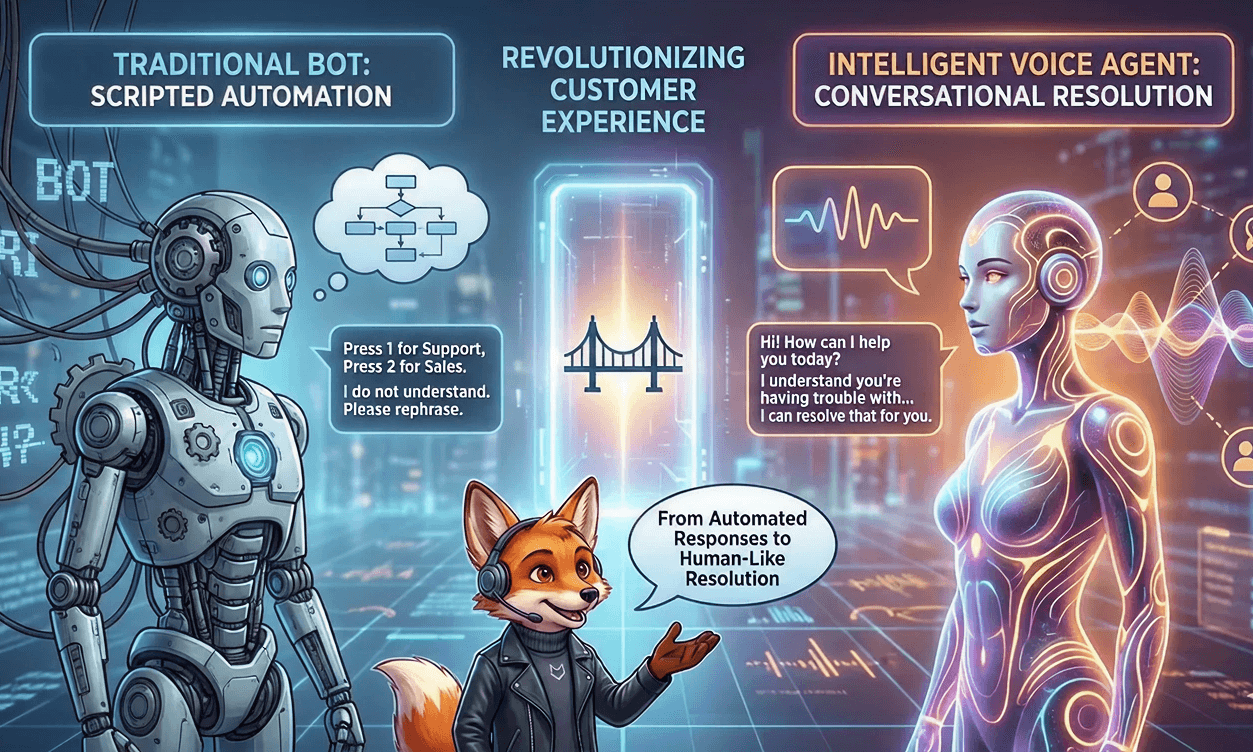
Traditional bots emerged as rule-based systems designed to handle repetitive queries. They followed predefined flows, relied heavily on keywords, and worked best when customer questions matched expected patterns. In controlled scenarios, bots reduced workload and improved response times. However, real customers don’t follow scripts. As digital channels expanded, businesses layered more bots across websites, apps, and call centers. Instead of simplifying experiences, this often fragmented them. Customers bounced between chatbots, IVRs, and human agents, repeating the same information at every step. According to global CX research, over 60% of customers report frustration with automated support systems, citing poor understanding and lack of resolution as the main issues. This dissatisfaction isn’t caused by automation itself, but by its limitations. That’s where voice agents enter the picture.What Defines a Traditional Bot
Bots are primarily interaction-driven. Their purpose is to respond to inputs, guide users through predefined options, or redirect them to other channels. Most bots excel at answering FAQs, collecting basic information, or deflecting low-complexity queries. But bots struggle when conversations become unpredictable. They lose context. They fail to interpret intent accurately. They require constant updates as workflows evolve. And when something falls outside their script, the experience quickly degrades. In practice, bots often act as gatekeepers rather than problem solvers.What Makes a Voice Agent Fundamentally Different
Voice agents represent a shift from scripted automation to intent-driven intelligence. Instead of reacting to keywords, voice agents understand natural language, context, and purpose. They are designed not just to converse, but to act. A voice agent can listen to a customer describe an issue in their own words, determine what needs to be done, access relevant systems, execute the task, and confirm completion-all within a single interaction. This is a fundamental change. Voice agents don’t just guide customers. They complete workflows. They schedule appointments, resolve account issues, update records, route calls intelligently, and escalate only when human intervention adds value. Because voice is the most natural form of human communication, these interactions feel intuitive rather than transactional.Why Voice Matters in Customer Experience
Voice changes how customers behave. When people speak, they provide more context, express urgency more clearly, and explain issues more naturally than when typing or selecting menu options. This gives voice agents richer input to work with, improving accuracy and resolution rates. Industry data supports this shift. Organizations adopting voice-based AI report:- Higher task completion rates compared to chatbots
- Shorter average handling times
- Improved first-contact resolution
- Higher customer satisfaction scores
Bots vs. Voice Agents in Real-World Use Cases
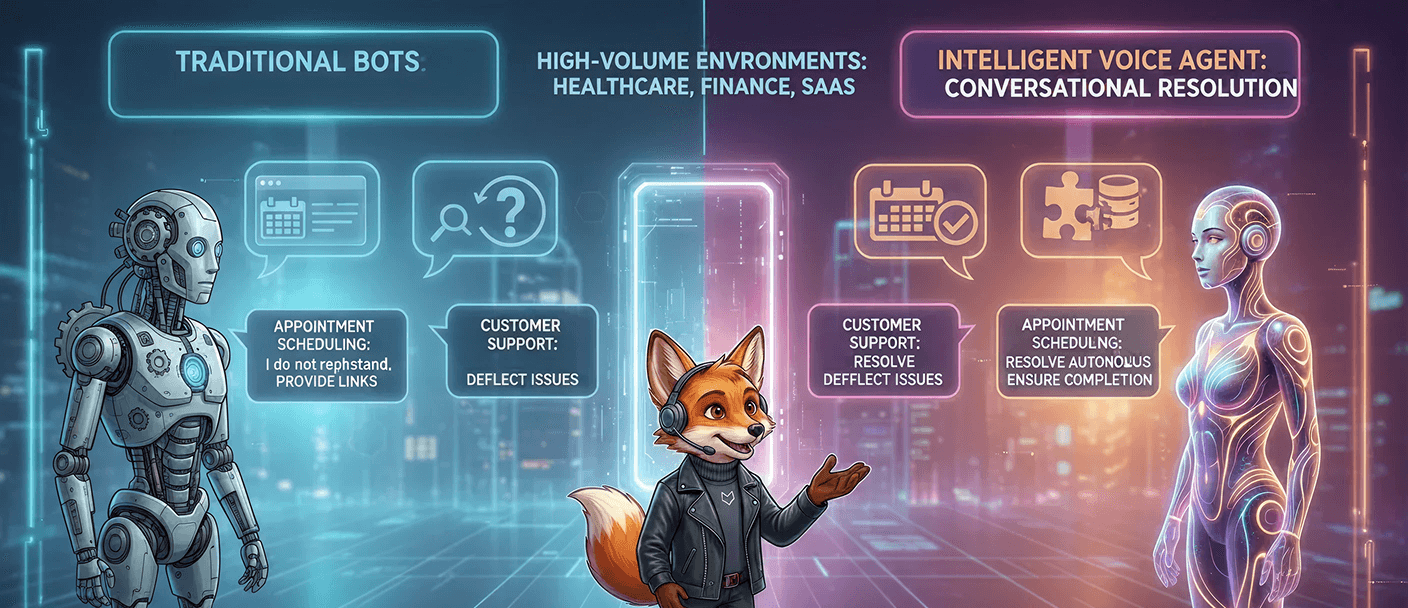
In appointment scheduling scenarios, bots often provide links or instructions, leaving customers to complete the process themselves. Voice agents handle scheduling end-to-end by checking availability, confirming details, and updating calendars in real time.
In customer support, bots typically deflect issues by offering help articles or routing to agents. Voice agents diagnose problems, retrieve account information, and resolve common issues autonomously.
In onboarding flows, bots explain steps. Voice agents guide users through those steps and ensure completion.
This distinction becomes especially important in high-volume environments such as healthcare, hospitality, financial services, and SaaS-where speed, accuracy, and continuity directly impact revenue and trust.
Scalability Without Experience Degradation
One of the biggest limitations of traditional bots is scalability. As businesses grow, bot flows become more complex, harder to maintain, and less reliable. Every exception requires manual redesign. Voice agents scale differently. Because they are intent-driven, they handle variation naturally. As volumes increase, performance remains stable without exponential maintenance effort. This makes voice agents particularly valuable for organizations experiencing growth, seasonal spikes, or unpredictable demand.Cost Efficiency Beyond Headcount Reduction
While automation is often justified on cost savings alone, the real value of voice agents lies in operational resilience. They reduce dependency on staffing availability, eliminate bottlenecks during peak hours, and ensure consistent service quality. Businesses using voice agents report reduced support costs, but more importantly, they see improvements in conversion, retention, and lifetime value-outcomes that traditional bots rarely influence directly.Security, Compliance, and Trust
Modern voice agents are designed with enterprise-grade security and compliance in mind. They operate within strict data governance frameworks, supporting regulations such as GDPR, HIPAA, and SOC standards where applicable. This ensures that automation enhances customer experience without compromising privacy or trust.The Strategic Shift in Customer Experience
The rise of voice agents reflects a broader transformation in how businesses think about CX. The goal is no longer to reduce interactions. It’s to resolve them efficiently and intelligently. Bots were a stepping stone. Voice agents are the next evolution. Forward-looking organizations are already restructuring their CX strategies around intelligent agents that act as the first line of engagement, not a fallback.
Conclusion
The future of customer experience is not about choosing between humans and machines. It’s about designing systems where intelligence removes friction and supports meaningful interaction. Bots helped businesses automate responses. Voice agents help businesses automate outcomes. That difference is reshaping how customers engage, how teams operate, and how companies scale. And as expectations continue to rise, the organizations that adopt voice agents today will define the customer experience standards of tomorrow.
Harikrishna Patel
Harikrishna Patel is the founder of MIA – My Intelligent Assistant, the AI automation platform built under Botfinity Inc. in Dallas, Texas. With 15+ years in software engineering, AI/ML, and enterprise solution design, he focuses on creating practical, scalable AI tools that help businesses automate support, workflows, and operations through voice and chat.