
Table of Contents
- The $260K Problem Hiding in Your Scheduling System
- What Is AI Appointment Scheduling in Healthcare?
- Why Clinics Are Losing Patients to Broken Scheduling
- What Smart Clinics Look for in an AI Scheduling Platform
- AI Scheduling Platforms Compared
- Real Results: How One Clinic Cut No-Shows by 59%
- Implementation Timeline: What Week 1-4 Looks Like
- HIPAA Compliance Checklist for AI Scheduling
- AI Scheduling vs Traditional Answering Services
- How to Calculate Your Clinic's Scheduling ROI
- How SuperMIA Powers AI Scheduling for Healthcare
- Frequently Asked Questions
- Your Schedule Is Your Revenue - Stop Leaving Slots Empty
Quick Answer
AI appointment scheduling in healthcare lets patients book, reschedule, and cancel 24/7 via voice, chat, and SMS. It reduces missed calls, automates reminders, and backfills cancellations so clinics cut no-shows and recover revenue without adding front-desk headcount.
The $260K Problem Hiding in Your Scheduling System
It is 2:15 PM on a Tuesday. Your front desk receptionist is handling insurance, check-ins are stacking up, and the phone keeps ringing. Three of those calls are new patients. Two book with another clinic because nobody answered in time.
This is not a bad day. It is a normal day for many practices.
Research repeatedly shows the first responder wins more bookings. In healthcare, that creates a direct revenue equation: each empty slot is lost income, and every missed call compounds that loss.
At $200 per empty slot, 5 missed slots per day over 260 working days equals $260,000 in annual revenue leakage.
Industry reports estimate missed appointments cost the US healthcare system billions each year, and no-show rates can sit between 5% and 30% depending on specialty and workflow maturity.
This is exactly where healthcare AI solutions change outcomes: immediate responses, always-on scheduling, and consistent follow-up without burnout.
What Is AI Appointment Scheduling in Healthcare?
AI appointment scheduling for healthcare is the use of conversational AI to automate patient booking, rescheduling, cancellation, reminders, and waitlist recovery across voice, chat, and SMS channels, integrated directly with EHR/PMS systems.
AI appointment scheduling for healthcare uses conversational AI to automate booking, rescheduling, cancellations, reminders, and waitlist backfill through channels patients already use: phone, SMS, and web chat.
It integrates with systems like Epic, Cerner, athenahealth, Dentrix, and Open Dental to read real-time availability, place appointments correctly, and reduce manual scheduling errors.
As a conversational AI platform, it understands natural language, so patients can ask for a next-week appointment or request a specialist in plain language.
In short, AI scheduling does not only book visits. It runs the scheduling lifecycle from first contact to reminder to fill-rate recovery.
For the broader view of how AI chatbots transform healthcare operations beyond scheduling - including intake, triage, follow-up, and patient retention - see AI chatbot for healthcare.
Why Clinics Are Losing Patients to Broken Scheduling
Missed Calls = Lost Patients
Long hold times and missed calls still drive avoidable patient loss. When clinics fail to answer quickly, the patient often books with whoever responds first.
That behavior mirrors broader speed-to-lead research from Harvard Business Review: rapid response wins conversions.
No-Shows Cost More Than You Think
No-show rates in outpatient environments can range from 5% to 30%, and can be higher in some specialties according to published clinical literature.
Each no-show is not just lost revenue. It creates downstream disruption: idle providers, delayed care, and reactive overbooking that increases stress on staff and patients.
Front Desk Burnout - The Crisis Nobody Talks About
Front-desk teams handle calls, scheduling, check-ins, insurance friction, and complaint routing simultaneously. Manual reminder workflows and repeated outbound callbacks increase fatigue and turnover risk.
The Overbooking Trap
Overbooking is often used to offset no-shows, but it introduces clinical delays when attendance spikes and both booked patients arrive. AI helps practices prevent no-shows upstream instead of compensating downstream.
What Smart Clinics Look for in an AI Scheduling Platform
Not all AI chatbots for healthcare are equal. The platform must combine compliance, automation depth, and workflow fit.
24/7 Availability (Voice, Chat, SMS)
Patients call outside business hours. If your intake flow only works 9-5, you lose high-intent demand.
The MIA Voice Agent answers every scheduling call instantly - including evenings, weekends, and holidays - so no high-intent patient call goes to voicemail.
EHR/PMS Integration
Native or API-based integration with Epic, Cerner, athenahealth, Dentrix, Open Dental, and related systems is essential for real-time slot accuracy.
HIPAA Compliance with Signed BAA
Any system handling scheduling data tied to patients should provide encryption, auditability, and a signed BAA. If a vendor avoids a BAA, that is a red flag.
Automated Reminders and Waitlist Backfill
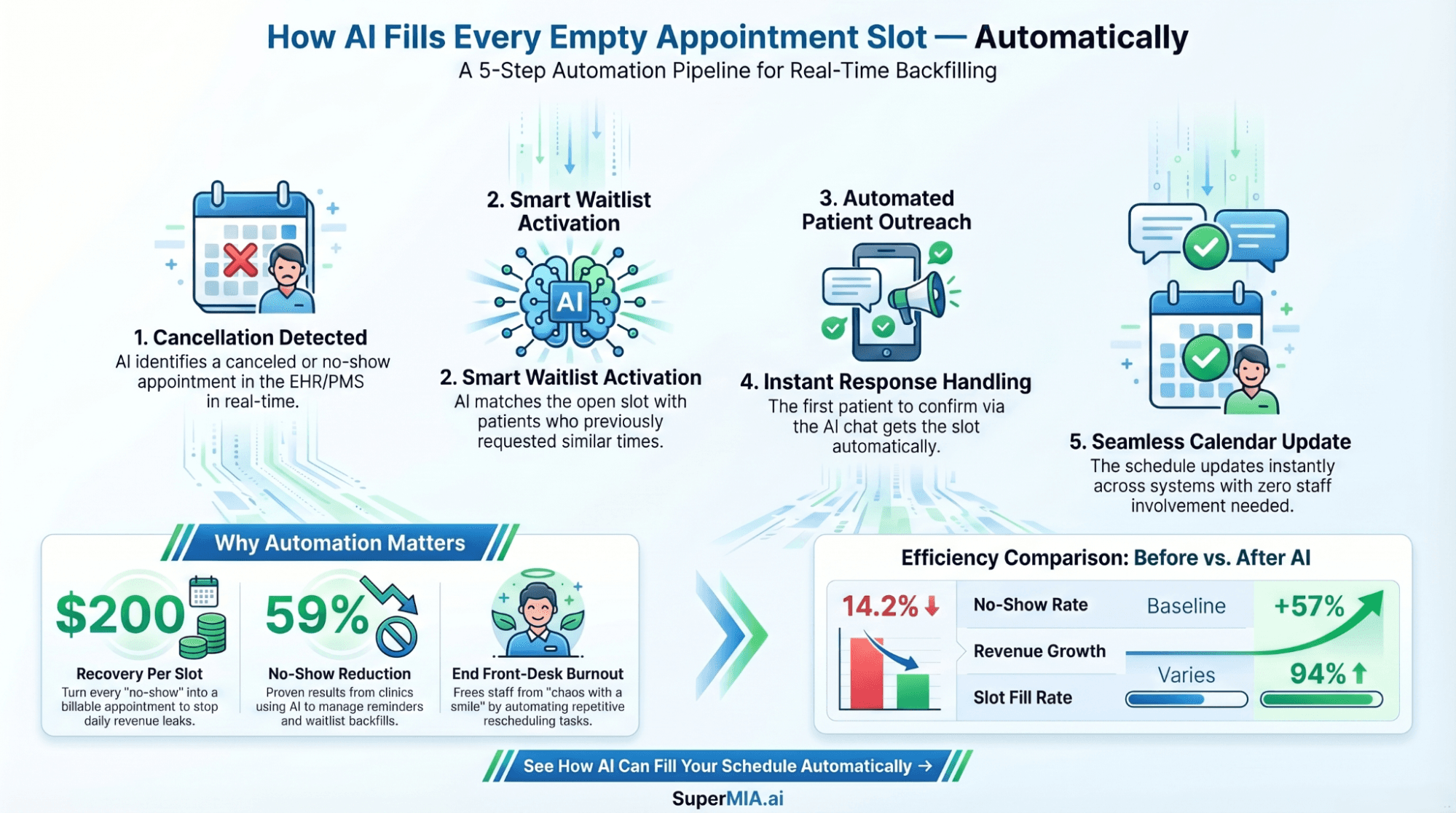
Automated reminders across SMS, email, and voice at staged intervals reduce no-shows. Waitlist backfill recovers canceled slots in near real time.
No-Show Prediction and Prevention
Predictive risk signals help clinics intervene earlier and prioritize outreach where it is most likely to prevent missed visits.
And yes, AI chatbot pricing matters - but low monthly cost without scheduling depth usually costs more in lost revenue.
AI Scheduling Platforms Compared
| Platform | 24/7 Scheduling | HIPAA | EHR Integration | Reported No-Show Impact | Pricing |
|---|---|---|---|---|---|
| SuperMIA | Voice + Chat + SMS | Yes (BAA + encryption) | Epic, Cerner, Dentrix, Open Dental | 59% reduction (verified) | Custom - demo |
| Luma Health | Chat + SMS | Yes | Epic, Cerner, athenahealth | ~30% (claimed) | Quote-based |
| Hyro | Voice + Chat | Yes | Epic | No public data | Quote-based |
| Zocdoc | Web booking | Partial | Limited | No public data | Per-booking |
| Phreesia | Check-in + intake | Yes | Multiple EHRs | No public data | Quote-based |
Real Results: How One Clinic Cut No-Shows by 59%
Media Brite Smile Dental in Philadelphia tested multiple platforms and then deployed SuperMIA scheduling workflows across voice and automation touchpoints.
| Metric | Before SuperMIA | After SuperMIA |
|---|---|---|
| No-show rate | 14.2% | 5.8% |
| Revenue growth | - | +57% |
| Weekday slot fill rate | - | 94% |
| Platforms tested | 12 platforms, 1,500+ calls | SuperMIA selected |
Before SuperMIA, Media Brite Smile Dental in Philadelphia had tested 12 different platforms across 1,500 patient calls. The core problem was consistent: systems either took messages without booking, or booked appointments without sending reliable reminders, or handled chat but not phone calls. The front desk was still the bottleneck because no single platform covered the full scheduling lifecycle.
After deploying SuperMIA, the workflow changed immediately. Every inbound call - including after-hours and weekends - was answered by AI, which collected insurance details, matched the patient to the right provider, and booked directly into the practice management system. Confirmation texts went out within 30 seconds. Reminder sequences triggered at 72 hours, 24 hours, and 2 hours before each appointment, with a one-tap reschedule link in every message.
For the complete AI phone answering workflow - how the system handles inbound calls, qualifies patients, and books appointments in 30 seconds - see AI receptionist for healthcare practices.
The front desk team's reaction: relief. Instead of spending the first 90 minutes of each morning returning voicemails and calling no-shows, they focused on patients in the waiting room. The result was not just lower no-shows - it was a fundamentally different workday for the staff.
Implementation Timeline: What Week 1-4 Looks Like
Most clinic owners assume deploying AI scheduling takes months of integration work and staff retraining. In practice, modern platforms go live in under 30 days. Here is what a typical rollout looks like for a small to mid-size practice.
Week 1: Discovery and Configuration
The vendor reviews your current call volume, scheduling rules, provider availability patterns, and EHR system. If you use Epic, Cerner, athenahealth, Dentrix, or Open Dental, the integration path is typically pre-built. Custom scheduling logic - like specific appointment types, durations per provider, and insurance pre-checks - gets configured during this phase.
Week 2: Script Development and Testing
AI call scripts and chat flows are built around your practice's real workflows. This includes how new patients are greeted, what qualifying questions are asked (insurance, reason for visit, provider preference), how emergencies are routed, and what confirmation messages patients receive. Internal testing happens with your front desk team calling the AI as if they were patients.
Week 3: Soft Launch
AI handles after-hours and overflow calls first while your front desk continues to manage peak-hour volume. This gives the system real patient interactions to refine against while keeping your existing workflow intact. Most issues surface and get resolved in this phase - things like pronunciation of provider names, handling of edge-case appointment types, and insurance-specific routing.
Week 4: Full Deployment
AI takes all inbound scheduling calls, with your front desk team focusing on in-office patients, insurance follow-ups, and complex cases the AI escalates. Automated reminders and waitlist backfill activate. Your team reviews the AI dashboard daily for the first two weeks, then weekly once patterns stabilize.
HIPAA Compliance Checklist for AI Scheduling
Any AI system handling appointment data tied to patients is processing ePHI. Before signing with a vendor, verify these five items - they are non-negotiable for healthcare scheduling tools.
- Signed BAA: The vendor must provide a signed Business Associate Agreement before any patient data flows through their system. No BAA means the vendor cannot legally process PHI for your practice.
- Encryption: AES-256 at rest and TLS 1.2 or higher in transit. Ask for documentation, not just a checkbox on a marketing page.
- Audit Logging: The system must capture who accessed what patient data, when, and from where. This is mandatory for breach investigations and compliance audits.
- HIPAA-Eligible Hosting: Verify the actual cloud infrastructure configuration, not just the cloud vendor name. Running on AWS does not automatically make a product HIPAA compliant - the configuration and access controls matter.
- SOC 2 Type II: Ask for the actual audit report, not a website badge. SOC 2 Type II means the vendor's controls have been independently tested over time, not just documented once.
For a deeper walkthrough on evaluating AI vendors for HIPAA compliance, see our full HIPAA-compliant AI chatbot checklist.
AI Scheduling vs Traditional Answering Services
Many clinics currently pay $500 to $2,000 per month for after-hours answering services. The problem: answering services take messages. They do not book appointments. Your staff still has to call every patient back the next morning, which means delayed bookings, phone tag, and lost patients who found another provider overnight.
| Factor | Traditional Answering Service | AI Scheduling |
|---|---|---|
| What happens on the call | Takes a message | Books the appointment in real time |
| Patient callback required | Yes - next business day | No - booking is complete on first contact |
| EHR integration | None | Real-time sync with Epic, Dentrix, etc. |
| Reminders sent | No | Automated SMS + email + voice |
| Waitlist backfill | No | Automatic when cancellations occur |
| Monthly cost | $500-$2,000 | $200-$600 |
| Availability | After-hours only (usually) | 24/7/365 |
The math is clear: AI scheduling costs less, does more, and eliminates the callback delay that loses patients between the first call and the actual booking.
How to Calculate Your Clinic's Scheduling ROI
You do not need a spreadsheet model to understand whether AI scheduling pays for itself. Here is the calculation in four steps.
Step 1: Count your average daily missed or unfilled appointment slots. For most small practices, this is 3 to 7 per day.
Step 2: Multiply by your average revenue per visit. Primary care averages $150 to $250. Dental averages $200 to $350. Dermatology and specialty can exceed $300.
Step 3: Multiply by 260 working days per year. Example: 5 missed slots x $200 x 260 = $260,000 in annual revenue leakage.
Step 4: Compare against the AI platform cost. At $400 per month ($4,800 per year), even a 10% reduction in missed slots recovers $26,000 - a 5.4x return on investment.
Most practices using AI scheduling see 30 to 59% reductions in no-shows within the first 90 days, which translates to $78,000 to $153,000 in recovered annual revenue against a $4,800 platform cost.
How SuperMIA Powers AI Scheduling for Healthcare
SuperMIA combines healthcare AI solutions with automation logic designed for appointment operations.
- Answers every inbound call 24/7, including evenings and weekends. When a patient calls at 9 PM on a Saturday, AI picks up within two rings, greets them by practice name, and starts the booking flow immediately. No voicemail. No hold music. No "call us back Monday."
- Books, reschedules, and cancels in connected systems
- Sends staged reminders over SMS, email, and voice at optimized intervals: 72 hours before for schedule awareness, 24 hours before for confirmation, and 2 hours before as a final check. Each message includes a one-tap reschedule link so patients who cannot make it free the slot instead of ghosting it.
- Backfills canceled slots from waitlist queues automatically. When a patient cancels or reschedules, the system immediately offers the open slot to the next patient on the waitlist via SMS. If the first patient declines, it moves to the second, then the third - all within minutes, not hours.
- Flags high no-show risk appointments for proactive follow-up
- Supports HIPAA-ready controls with encryption and auditability
For full-funnel deployment, teams pair voice intake with AI appointment scheduling automation for ongoing patient communications.
Frequently Asked Questions
Your Schedule Is Your Revenue - Stop Leaving Slots Empty
Every empty appointment slot is lost revenue. Every unanswered call is a patient who may never come back.
AI scheduling gives clinics a practical path to reduce no-shows, improve patient access, and protect staff capacity without expanding headcount.
Practices that fill more slots in 2026 will not necessarily have bigger teams. They will have better systems.
Sources: MGMA, PubMed Central, Harvard Business Review, McKinsey, Epic.

Harikrishna Patel
Harikrishna Patel is the founder of MIA – My Intelligent Assistant, the AI automation platform built under Botfinity Inc. in Dallas, Texas. With 15+ years in software engineering, AI/ML, and enterprise solution design, he focuses on creating practical, scalable AI tools that help businesses automate support, workflows, and operations through voice and chat.