
What Is a HIPAA Compliant Chatbot?
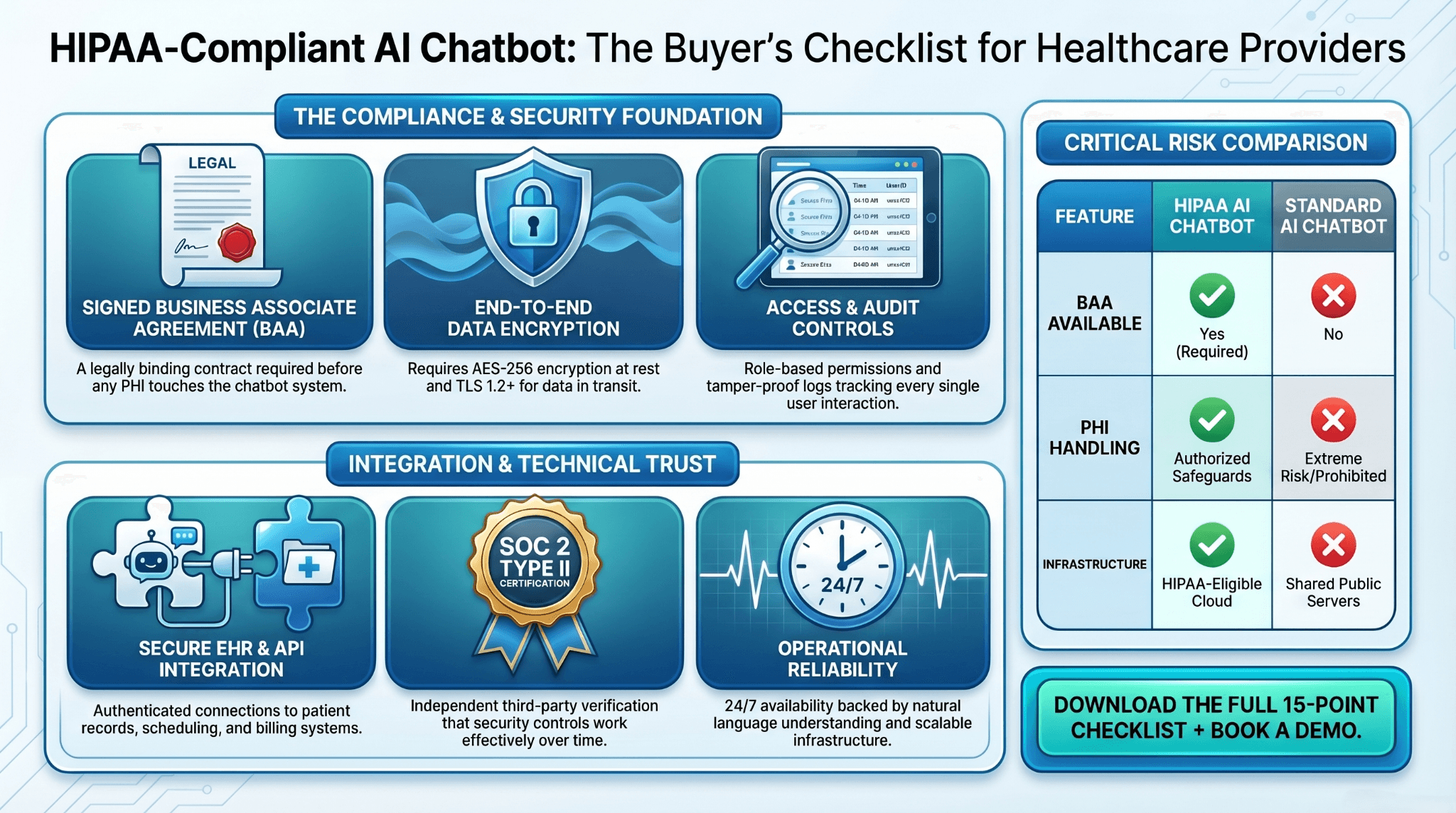
A HIPAA compliant chatbot is a conversational AI system (chat, voice, or SMS) built to handle protected health information (PHI) under the HIPAA Security Rule. It requires a signed BAA, encryption in transit and at rest, role-based access controls, audit logging, HIPAA-eligible hosting, and documented PHI handling.
A standard AI chat agent is not HIPAA compliant by default. If a tool creates, receives, stores, or transmits PHI, it must be built for compliance from day one.
Before choosing one, verify these 15 requirements ↓
A common scenario: a care coordinator at a mid-sized clinic downloads a free AI transcription tool to help manage patient calls. She does not ask IT. She does not check for a BAA. She uses it for three months before anyone notices.
By the time the compliance team finds out, patient information has been stored on a third-party cloud server with no HIPAA protections. No encryption. No access controls. No audit trail.
This is exactly why every healthcare team needs a clear evaluation framework before deploying conversational AI. If you are exploring HIPAA-compliant AI for healthcare, start with this checklist.
Why Healthcare Providers Need HIPAA Compliant AI Chatbots
Healthcare organizations are balancing rising patient expectations, staffing pressure, and response-time demands. AI chatbots can support:
- 24/7 scheduling and appointment management, including AI appointment scheduling for healthcare
- AI phone reception and patient intake - see AI receptionist for healthcare practices
- Pre-visit intake and triage
- Post-visit follow-ups and reminders
- Insurance and billing inquiry handling
- High-volume FAQ responses without call overload
Each of these workflows can involve PHI. That makes compliance non-negotiable, whether you deploy web chat or a healthcare AI voice agent.
The 15-Point HIPAA Chatbot Compliance Checklist
Use these 15 requirements to vet any chat, voice, or SMS vendor. Each one explains what to look for, the question to put to the vendor, and the red flag that should end the conversation.
1. Signed Business Associate Agreement (BAA)
A Business Associate Agreement is the contract HIPAA requires whenever a vendor creates, receives, stores, or transmits PHI on behalf of a covered entity. It spells out how the vendor may use the data, the safeguards it must apply, and its duty to report breaches. Sharing PHI with a vendor that has not signed one is itself a HIPAA violation by your organization.
Ask the vendor: "Can you send me your standard BAA before we start a pilot?"
Red flag: The vendor says a BAA "isn't necessary," or offers one only on request after purchase.
2. Encryption in Transit and at Rest
Every message, transcript, recording, and backup that contains PHI should be encrypted: TLS 1.2 or higher in transit and AES-256 at rest are the industry baseline. Encryption also matters after an incident. Under HHS breach guidance, properly encrypted data is treated as "secured" PHI, which can take a lost device or leaked backup out of breach-notification territory.
Ask the vendor: "Which data stores hold our PHI, and how is each one encrypted, including backups and call recordings?"
Red flag: Encryption covers the database but not logs, exports, recordings, or backups.
3. PHI Handling Transparency
You need to know exactly where PHI goes after a patient types or says it: which systems store it, which subprocessors see it, and how long each keeps it. A written data-flow diagram is the only reliable way to confirm that nothing leaves the protected environment. Feature demos do not show you this.
Ask the vendor: "Can you share a data-flow diagram showing every system and subprocessor that touches PHI?"
Red flag: The vendor cannot name its subprocessors, or treats the question as confidential.
4. Role-Based Access Controls
The HIPAA minimum-necessary standard means staff should see only the PHI their role requires. A front-desk user who books appointments does not need full conversation transcripts, and an agency marketer should never see patient data at all. The platform should let you define roles and restrict access by location, team, and data type.
Ask the vendor: "Can we create custom roles and limit transcript access by location or department?"
Red flag: One shared admin login, or an all-or-nothing permission model.
5. Audit Logging
The Security Rule requires audit controls that record activity in systems containing ePHI. For a chatbot, that means logging who viewed or exported which conversation, when, and from where. Logs should be tamper-resistant and retained long enough to support an investigation.
Ask the vendor: "Can we export access logs for a specific patient conversation, and how long do you retain them?"
Red flag: Logs cover system errors only, not user access to PHI.
6. HIPAA-Eligible Cloud Hosting
Major cloud providers sign BAAs, but only for their HIPAA-eligible services, and only when those services are configured correctly. A "hosted on AWS" or "hosted on Azure" logo tells you nothing about which services the vendor uses or how they are set up.
Ask the vendor: "Which cloud services store or process our PHI, and are they all covered by your cloud provider's BAA?"
Red flag: The vendor points to the cloud provider's compliance page instead of its own configuration.
7. Authentication Controls
Stolen credentials are one of the most common ways attackers reach health data. Admin and staff accounts should require multi-factor authentication, and larger organizations should be able to enforce single sign-on (SSO) so access is revoked the moment someone leaves.
Ask the vendor: "Can we enforce MFA for every user and connect our identity provider through SSO or SAML?"
Red flag: MFA is optional, or only available on a higher plan than the one you are buying.
8. API and Integration Security
A chatbot that books appointments or looks up balances connects to your EHR, practice-management, billing, or CRM systems. Each connection is a path to PHI. Integrations should use scoped credentials, encrypted connections, and the least access needed to do the job.
Ask the vendor: "What access does your integration request in our EHR, and can we restrict it to scheduling data only?"
Red flag: The integration needs full read/write access to the whole patient record.
9. Data Retention and Disposal
PHI should not live in a chatbot platform forever. You should be able to set retention windows for transcripts and recordings that match your own policies and applicable state rules, and the vendor should securely delete data when those windows expire or the contract ends.
Ask the vendor: "Can we set our own retention period, and how do you certify deletion when we leave?"
Red flag: Data is kept indefinitely by default, or deletion is "on request" with no confirmation.
10. Breach Notification Procedures
Under the HIPAA Breach Notification Rule, a business associate must notify you of a breach without unreasonable delay and no later than 60 days after discovery, so that you can meet your own obligations to patients and HHS. Many BAAs set a much shorter window. Know what the vendor has committed to before you need it.
Ask the vendor: "How quickly will you notify us of a suspected incident, and what will that notice include?"
Red flag: The BAA uses only the 60-day statutory maximum, with no commitment to notify sooner.
11. Employee Training and Acceptable Use
The biggest AI risk in many practices is staff pasting patient details into consumer tools. HIPAA requires security awareness training for your workforce, and your acceptable-use policy should name which AI tools are approved for PHI. A good vendor supports this with admin guidance and training material.
Ask the vendor: "What training and onboarding do you provide for staff who will use the platform with patient data?"
Red flag: The vendor has no view on staff use of consumer AI tools alongside its product.
12. De-identification Capabilities
Reporting, analytics, and model tuning rarely need identifiable data. HIPAA recognizes two de-identification methods: Safe Harbor, which removes 18 specified identifiers, and Expert Determination. The platform should be able to strip identifiers before data leaves the protected environment.
Ask the vendor: "Is conversation data used for analytics or model improvement, and if so, how is it de-identified first?"
Red flag: The vendor uses customer conversations to improve its product and cannot explain how PHI is removed.
13. Consent and Communication Preferences
HIPAA does not require patient consent for routine treatment and scheduling communication, but some uses do need authorization, and patients can ask to be contacted in specific ways. Automated calls and texts also fall under the TCPA, a separate law with its own consent rules. The platform should record each patient's preferences and consent so every outreach can be traced back to them.
Ask the vendor: "How do you record opt-outs and communication preferences, and do they apply across chat, voice, and SMS?"
Red flag: Opt-outs in one channel are not honored in the others.
14. Independent Security Audit
An independent security audit (SOC 2 Type II, ISO 27001 or HITRUST) is an outside auditor's assessment of a vendor's security controls. None of these is a HIPAA certification, but a current audit report is the strongest routine evidence that the controls a vendor describes are real. Check which systems and services the report covers.
Ask the vendor: "Which independent security audits have you completed, and can we see the report under NDA?"
Red flag: A compliance logo with no report behind it, or only a self-attestation.
15. Incident Response Plan
HIPAA requires documented procedures for responding to security incidents. Before go-live, you should know how the vendor detects, contains, and recovers from an incident, who contacts whom, and how the plan has been tested.
Ask the vendor: "When did you last test your incident response plan, and what did you change as a result?"
Red flag: The plan exists only as a policy document that has never been exercised.
Get the 15-point checklist as a PDF
All 15 requirements with pass/fail criteria, the vendor questions, and the red flags to watch for. Print it and take it into your next vendor call.
HIPAA Compliance for AI Voice Agents and SMS
Most HIPAA chatbot guides stop at web chat. Patients also call and text, and an AI voice agent or SMS assistant handles PHI just as a chat widget does. These channels add a few rules of their own:
- Call recordings and transcripts are PHI. When a recorded or transcribed call includes identifiable health information, the recording and the transcript are PHI and need the same encryption, access controls, retention limits, and BAA coverage as chat logs. That includes the speech-to-text service that produces the transcript.
- Verify the caller before disclosing PHI. The Privacy Rule requires you to verify the identity of anyone requesting PHI if you do not already know them. A voice agent should confirm identifiers such as date of birth before it discusses appointments, results, or balances.
- Voicemail follows the minimum-necessary principle. Leaving a reminder on voicemail is permitted, but the message should contain only what is needed, such as your practice name and a callback number, not diagnoses or test details.
- Unencrypted texts need an informed patient. Appointment reminders are a permitted communication. HHS guidance lets providers send PHI unencrypted when the patient asks for it after a brief warning about the risk, and most compliance teams apply the same rule to text messages. Warn patients, record their preference, and keep clinical details out of texts.
- Automated calls and texts also need TCPA consent. The TCPA is a separate law from HIPAA. The FCC exempts certain healthcare messages, such as appointment reminders sent to the number the patient gave you, from prior consent only when strict conditions are met: free to the patient, no marketing or billing content, no more than one message a day and three a week, texts of 160 characters or less, and an easy opt-out in every message.
5 AI-Specific Risks Most HIPAA Checklists Miss
Two concerns come up again and again when healthcare teams evaluate AI. One is shadow AI: staff using consumer tools because approved ones are slow or hard to access. The other is vendors who are confident in demos but vague about BAAs, data flow, and incident response. The five risks below are where those concerns turn into real exposure, and standard HIPAA checklists rarely cover them.
1. Caller and Patient Identity Verification
Before a chatbot or voice agent shares anything about an appointment, a bill or a test result, it has to confirm who it's talking to. A "HIPAA compliant" label means nothing if the bot skips this step. In one widely shared r/healthIT thread, a user described a healthcare group's new chatbot, marketed as HIPAA compliant, handing out personal information without verifying identity.
How SuperMIA handles it: SuperMIA's chat and voice agents check that the user is authenticated before sharing any patient-specific information. Until that check passes, the agent sticks to general information such as hours, services and how to book.
Ask the vendor: "What exactly does your bot check before it discloses PHI, and what happens when that check fails?"
2. The BAA Chain Behind the Chatbot
A chatbot vendor rarely runs everything itself. Behind it sit an AI model provider, a cloud host and, for voice and SMS, a telephony provider. Every company in that chain that touches PHI must be covered by a BAA.
How SuperMIA handles it: SuperMIA runs its AI on OpenAI models through Microsoft Azure OpenAI Service, which is covered by Microsoft's HIPAA Business Associate Agreement. SuperMIA signs a BAA with each healthcare customer, and patient data is never used to train AI models.
Ask the vendor: "Which AI model and hosting providers touch our data, is each covered by a BAA, and will you confirm in writing that our patient data is never used for training?"
3. PHI in Prompts and the Minimum-Necessary Rule
Large language models only see what you send them, and it is tempting to send everything. The minimum-necessary standard applies to AI too: an agent booking a cleaning does not need the patient's full history in its prompt. Retrieval should pull only the fields a task needs. Remember that prompt logs and AI monitoring tools that store prompts become PHI stores of their own.
4. Handoff to a Human and Emergency Escalation
An AI agent must know when to stop. Symptoms such as chest pain, stroke signs, or statements about self-harm should trigger an immediate emergency message and escalation, never an attempt to book an appointment. Routine handoffs should pass the conversation context to a staff member so the patient does not have to repeat PHI, and every handoff should be logged.
5. Tracking Pixels in Chat Widgets
In December 2022, updated in March 2024, HHS's Office for Civil Rights warned that tracking technologies such as the Meta Pixel or Google Analytics can disclose PHI to third parties that have no BAA. In June 2024, a federal court in Texas (American Hospital Association v. Becerra) vacated part of that guidance: the part covering visits to public, unauthenticated web pages. The rest still stands, and a chat widget where patients type symptoms, appointment details or insurance information is a different situation from a simple page view. Before launch, check which third-party scripts load on every page that hosts your chatbot, and make sure none of them can read chat content without a BAA.
Which AI Chatbots Will Sign a BAA? (2026)
Whether a vendor will sign a BAA is the fastest way to rule a tool in or out. Here is where the most common options stand:
| Category | BAA Available? |
|---|---|
| ChatGPT Free / Plus / Business | No |
| OpenAI API / ChatGPT Enterprise and Edu | Yes. API on request; Enterprise and Edu for sales-managed accounts. Some API features, such as live web search, are excluded (OpenAI) |
| Claude API / Claude Enterprise | Yes. First-party API and Enterprise plans with HIPAA enabled; some features, such as beta features, are excluded (Anthropic) |
| Gemini in Google Workspace | Yes, on eligible paid Workspace editions with a signed BAA. The consumer Gemini app is not covered (Google) |
| Generic website chat widgets | Most do not |
| Healthcare platforms (SuperMIA, etc.) | Yes (SuperMIA: Enterprise plan) |
Last verified: September 30, 2026. BAA coverage often excludes specific features, so confirm against each vendor's current documentation before you share PHI.
HIPAA Compliant AI Chatbot vs Standard Chatbot vs Live Chat
| Feature | HIPAA AI Chatbot | Standard AI Chatbot | Live Chat |
|---|---|---|---|
| Encryption | AES-256 + TLS 1.2+ | TLS only (sometimes) | Varies |
| BAA available | Yes - required | No | Rarely |
| PHI handling | Yes - with safeguards | No - violates HIPAA | Not designed for PHI |
| Audit logging | Comprehensive | Basic or none | Basic logs |
| Access controls | RBAC + MFA | Single admin | Basic roles |
| Independent security audit | Ask for the report | Rarely | Some enterprise |
| Compliance risk | Low when configured | Extreme | High unless customized |
| Typical range (monthly) | $200-$600/mo+ | $0-$50/mo | $50-$200/mo |
Price rows are typical ranges, not quotes. Actual pricing depends on volume, channels, and whether the plan includes a BAA.
How Much Does a HIPAA Compliant Chatbot Cost?
Pricing depends on the channels you need (chat, voice, SMS), your conversation or call volume, the integrations you require (EHR, practice management, billing), and implementation support. The typical range above is a starting point, not a quote.
The number that matters most is the price of the plan that includes the BAA. Many vendors advertise a low entry price but sign a BAA only on higher or enterprise tiers. Compare the plan that includes the BAA, not the entry price. Without it, you cannot use the tool with patient data at all.
At SuperMIA, HIPAA compliance and a signed BAA are available on the Enterprise plan. Compare SuperMIA plans and pricing.
Which Controls Matter Most for Your Organization?
All 15 requirements apply to everyone, but where you should push hardest depends on who you are:
| Buyer Type | Key Controls to Prioritize |
|---|---|
| Solo or dental practice | BAA, encryption, audit log, patient ID verification |
| Multi-location group | + RBAC, centralized admin, location-level access |
| Health system or payer | + SSO/SAML, EHR integration, data residency |
| Digital health startup | + API security, model-layer BAA chain, independent security audit |
How SuperMIA Helps Healthcare Organizations Stay Compliant
HIPAA compliance and a signed BAA are available on the Enterprise plan. SuperMIA's healthcare AI solutions are built with compliance controls as a foundation:
- Signed BAA for healthcare customers (Enterprise plan)
- AI runs on Microsoft Azure OpenAI Service, covered under Microsoft's HIPAA BAA
- Patient data never used to train AI models
- 256-bit encryption
- Authentication required before any patient-specific information is shared
The MIA Chat Agent and voice agent for healthcare are built around the controls in this checklist, configured for clinical, admin, and patient-facing workflows.
Media Brite Smile Dental deployed the SuperMIA AI dental assistant in under 48 hours. It cut no-shows from 14.2% to 5.8%, reduced patient response time by 43%, and grew revenue 57% without hiring staff. Read the full case study.
Request a BAA / Talk to Our Healthcare Team
Frequently Asked Questions
Conclusion
AI chatbots in healthcare are accelerating. The teams that implement responsibly will outperform those that adopt without safeguards.
The checklist above helps you evaluate vendors with clarity: verify controls, validate claims, and avoid shortcuts with patient data.
For a broader implementation playbook, read AI chatbot for healthcare and compare your current setup against compliance-ready workflows.
Sources
- HHS: The HIPAA Security Rule
- 45 CFR Part 164: Security and Privacy (eCFR)
- HHS: Business Associate Contracts, sample provisions
- HHS: Breach Notification Rule
- 45 CFR 160.404: Civil money penalty amounts (eCFR)
- HHS: Annual Civil Monetary Penalties Inflation Adjustment, 91 FR 3665 (January 2026)
- HHS OCR: Use of Online Tracking Technologies by HIPAA Covered Entities and Business Associates (updated March 2024)
- HHS OCR: Resolution Agreements and Civil Money Penalties
- HHS FAQ: Right to receive PHI by unencrypted email
- 47 CFR 64.1200: TCPA delivery restrictions (eCFR)

Harikrishna Patel
Harikrishna Patel is the founder of MIA – My Intelligent Assistant, the AI automation platform built under Botfinity Inc. in Dallas, Texas. With 15+ years in software engineering, AI/ML, and enterprise solution design, he focuses on creating practical, scalable AI tools that help businesses automate support, workflows, and operations through voice and chat.