
Table of Contents
- Every vendor says their product is the answer
- The three technologies, defined
- Head-to-head comparison - 13 dimensions
- When each one actually wins
- Case study: Regional healthcare network
- ROI Math - 3 Scenarios
- Common objections - honest answers
- How SuperMIA fits across all three
- Frequently asked questions
- The bottom line
Quick Answer
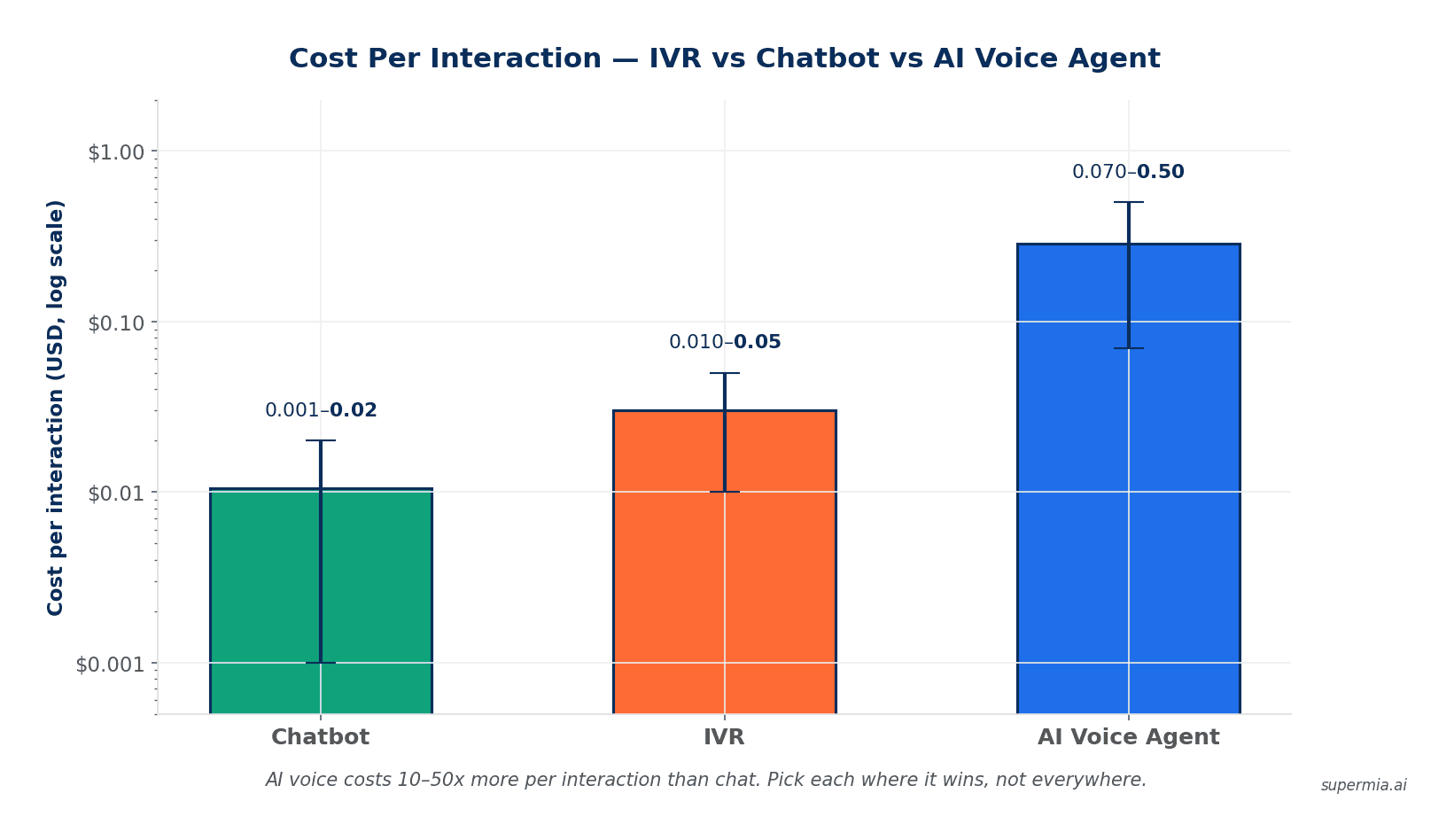
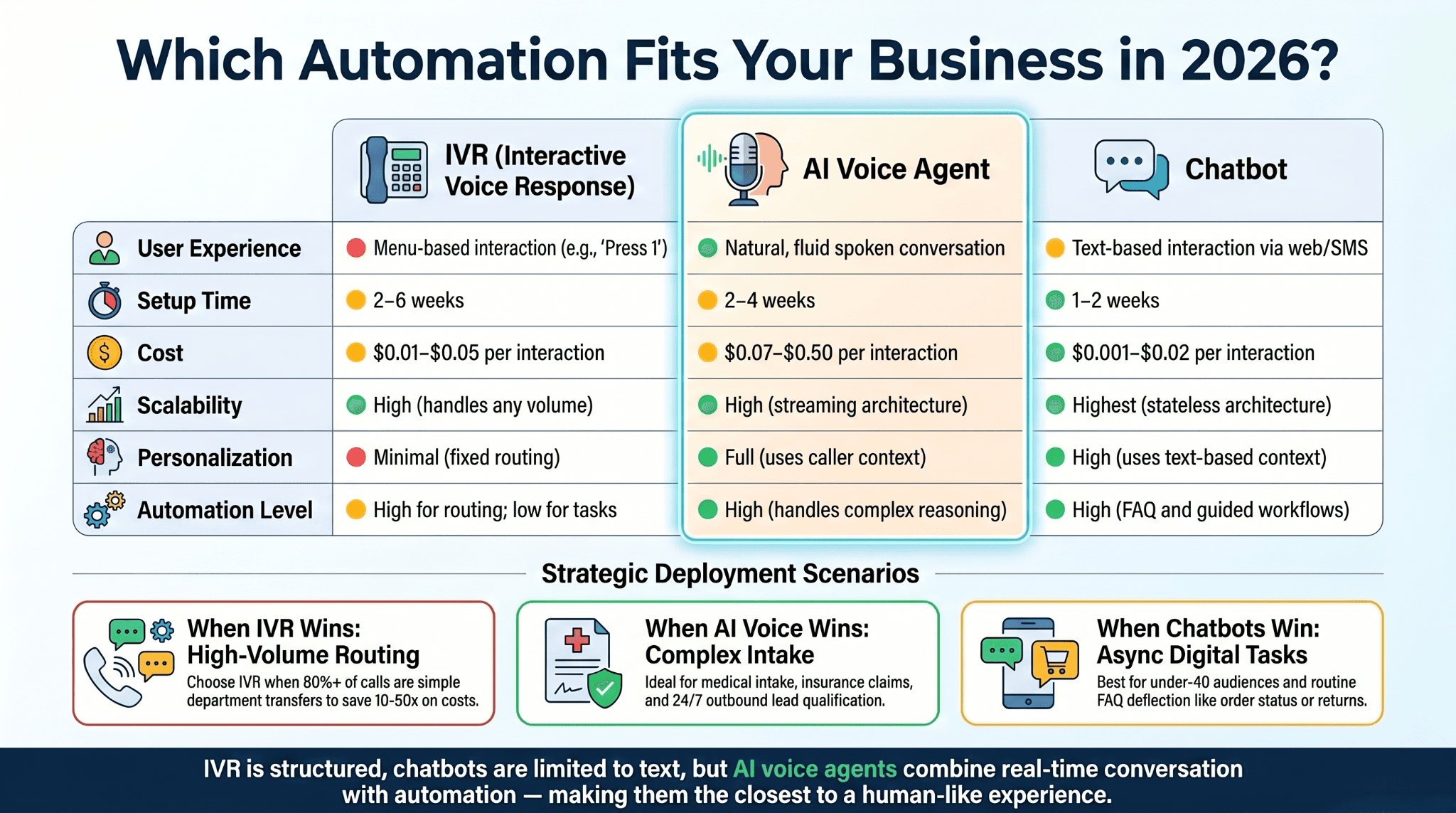
All three technologies have legitimate use cases in 2026. IVR wins for predictable routing at high volume ($0.01–0.05/interaction). AI voice agents win for complex conversations, outbound, and 24/7 coverage ($0.07–0.50). Chatbots win for async, text-native audiences ($0.001–0.02). Most successful contact centers run a hybrid of all three. The question isn't 'which one' - it's 'which mix.'
Key Stats
- IVR wins when routing is predictable, volume is high, and your use case doesn't require natural conversation. ROI in 3–6 months.
- AI voice agents win when conversations are complex, outbound calls matter, or 24/7 availability is required. ROI in 6–12 months.
- Chatbots win when your audience is under 40, tasks are async-friendly, or the interaction needs a written record. ROI in 3–9 months.
- Cost per interaction varies widely: IVR $0.01–0.05, chatbot $0.001–0.02, AI voice agent $0.07–0.50.
- Most successful contact centers run all three. The question isn't 'which one' - it's 'which mix.'
Every vendor in this space tells you their product is the answer. Most of the time, they're wrong about yours.
The honest truth about AI voice agent vs IVR vs chatbot is that all three have legitimate use cases in 2026. An AI voice agent isn't automatically better than an IVR. A chatbot isn't automatically worse than a voice agent. And IVR - the technology everyone loves to mock - still wins in specific scenarios where predictability beats flexibility.
"We almost spent $380K on AI voice for our call routing. Our director of CX asked one question: 'what percentage of our calls go beyond picking a department?' 78% don't. We kept our IVR for routing and used the AI voice budget on a chatbot instead. CSAT went up. Cost went down."
The Three Technologies, Defined
IVR (Interactive Voice Response)
IVR is a phone-based system that routes callers using pre-recorded menus and keypad or basic voice input. 'Press 1 for billing, 2 for support.' It's been the contact center workhorse since the 1990s. In 2026, it still handles the majority of enterprise call routing worldwide.
AI Voice Agent
An AI voice agent is a conversational system powered by large language models that handles voice interactions in natural language. Unlike IVR, there's no menu tree. The caller says what they need. The agent understands, asks follow-up questions, performs tasks, and escalates when necessary.
For a full breakdown of the leading AI voice agent platforms, latency benchmarks, and pricing models, see our complete guide to AI voice agents in 2026.
Chatbot
A chatbot handles text-based conversations on websites, apps, or messaging platforms. Modern chatbots use the same LLM backbone as voice agents but interact through typed messages. They excel at async interactions, FAQ handling, and guided workflows.
Key Takeaways
- ✓ IVR is still the right answer when call volume is predictable and the routing tree is stable.
- ✓ AI voice agents replace IVR when callers complain about menu fatigue or calls need unstructured handling.
- ✓ Chatbots beat voice on cost per interaction by 10–50x - when your use case is actually text-appropriate.
- ✓ The cost math changes at scale. Under 10K interactions/mo: native bundles win. Above 100K: specialist platforms.
- ✓ Most contact centers end up hybrid: IVR for routing, AI voice for complex, chatbot for async digital.
Head-to-Head Comparison - 13 Dimensions
| Dimension | IVR | AI Voice Agent | Chatbot |
|---|---|---|---|
| Interaction mode | Keypad / basic voice | Natural spoken conversation | Text (web/app/SMS) |
| Natural language? | No - rigid menus | Yes - full conversational | Yes - text-based NLU |
| Setup time | 2–6 weeks | 2–4 weeks | 1–2 weeks |
| Cost per interaction | $0.01–0.05 | $0.07–0.50 | $0.001–0.02 |
| Scalability | High (any volume) | High (streaming arch) | Highest (stateless) |
| Integration depth | Basic call routing | Deep CRM/API/tools | Deep (web/app stack) |
| Personalization | Minimal | Full (caller context) | High (text context) |
| Error handling | Transfer to human | Self-recover + escalate | Rephrase + escalate |
| Analytics | Call routing stats | Full conversation intel | Conversation logs + NPS |
| Compliance fit | Mature (HIPAA, PCI) | Mature (HIPAA, SOC2, PCI) | Mature (text is simpler) |
| Best audience | Predictable routing | Complex calls, 24/7, outbound | Async, FAQs, e-commerce |
| Primary weakness | Menu fatigue (~63% frustrated) | Higher cost per minute | Limited for urgent |
| ROI timeline | 3–6 months | 6–12 months | 3–9 months |
When Each One Actually Wins
When IVR Wins
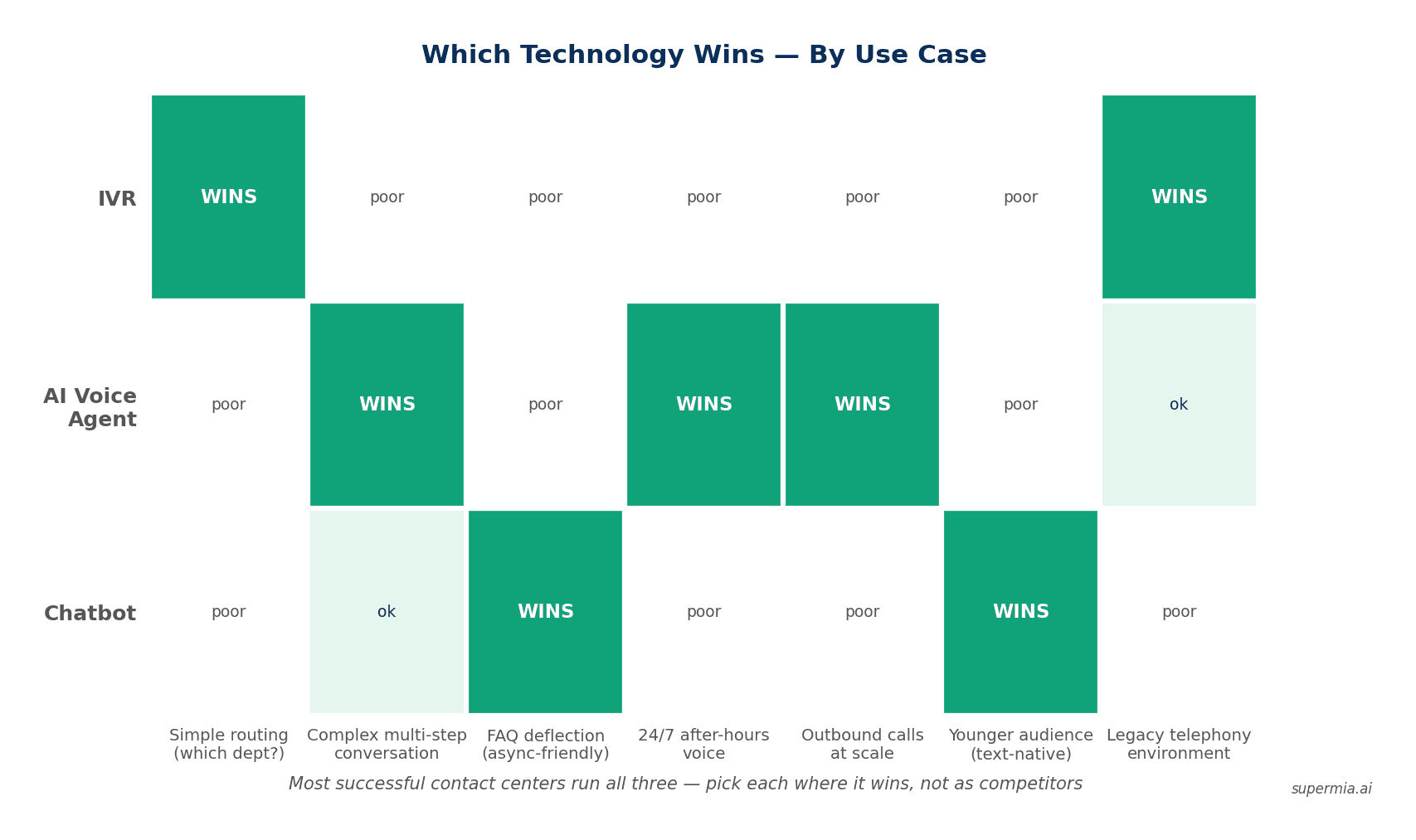
- Pure routing use cases - 'press 1 for sales, 2 for support, 3 for billing.' Adding AI here burns money.
- Cost-sensitive high-volume deployments - >5M min/mo and 80% simple routing: IVR's $0.01–0.05/interaction crushes AI voice.
- Legacy telephony - if your core is on-prem Avaya Aura or Genesys Engage, IVR fits the existing architecture.
When AI Voice Agent Wins
- Complex conversations - medical intake, insurance claims, loan qualification, motivated seller discovery.
- Outbound calling at scale - appointment reminders, payment reconciliation, lead qualification.
- After-hours and peak overflow - when agent staffing can't flex to call volume. See SuperMIA's AI voice agent capabilities.
When Chatbot Wins
- Async interactions - customers don't want to be on a call; they want to message and return.
- High-frequency FAQ deflection - store hours, order status, returns, password resets.
- Younger audiences - Millennial/Gen Z customers prefer text for routine support. Explore SuperMIA's AI chatbot.
Case Study: Regional Healthcare Network Gets Hybrid Right
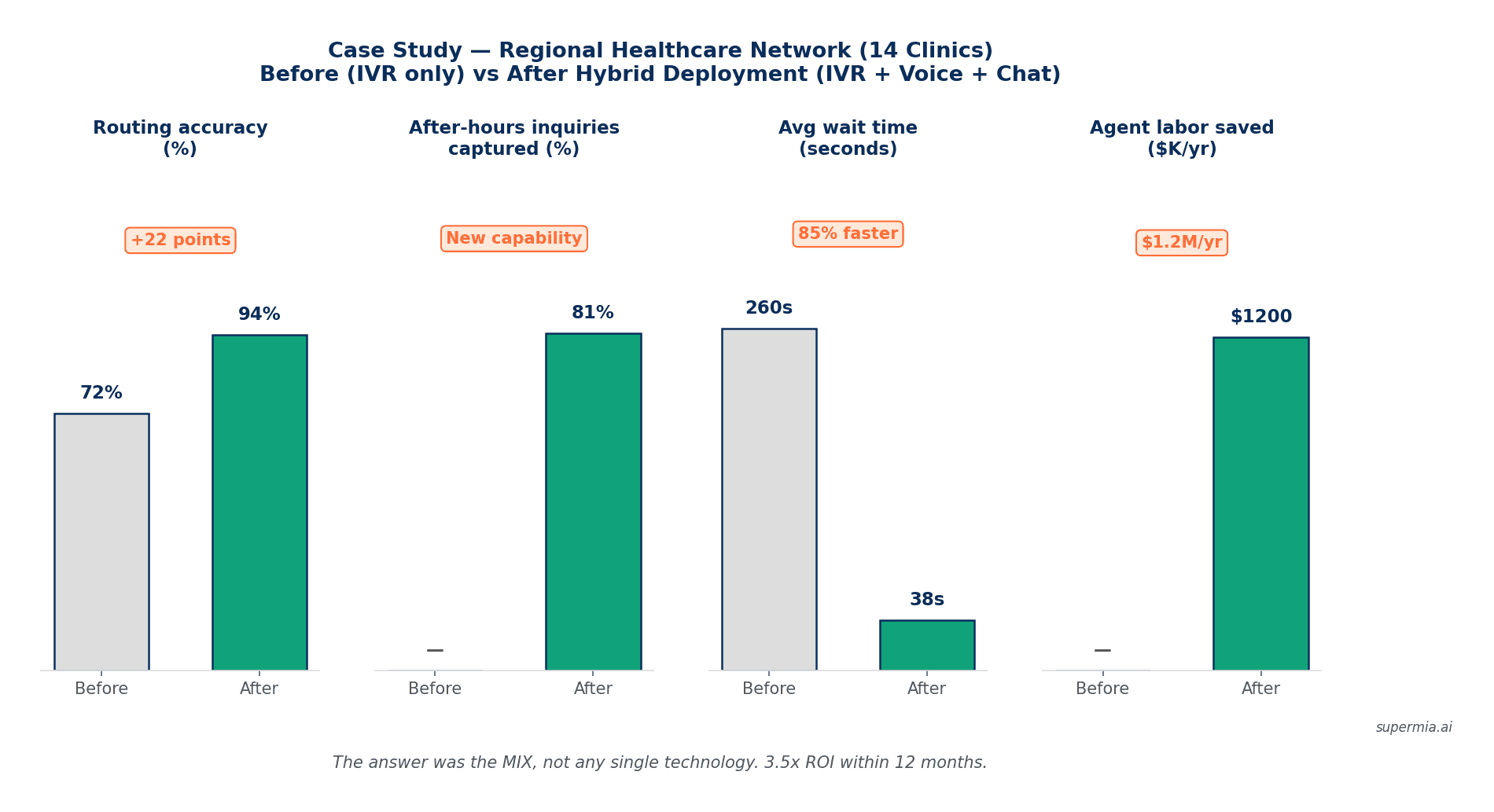
A 14-clinic regional healthcare network in Texas ran a 6-month analysis before committing to a single technology. They ended up deploying all three. Before and after:
| Metric | Before (IVR only) | After (hybrid IVR + AI voice + chatbot) | Change |
|---|---|---|---|
| Patient call routing accuracy | 72% | 94% | +22 points |
| Post-hours inquiries captured | 0% | 81% | +81 points |
| Average wait time (inbound) | 4 min 20 sec | 38 seconds | 85% faster |
| Appointment scheduling (after-hours) | Not possible | 67% automated end-to-end | New capability |
| Annual tech spend (3 channels) | Baseline | +$340K/yr | Justified by capacity |
| Agent labor saved | - | $1.2M/yr (14 FTE equivalents) | 3.5x ROI |
Their IVR still handles first-layer routing - 'clinic location, appointment, billing, other.' AI voice agent takes the appointment calls end-to-end. Chatbot handles the website: appointment requests, prescription refill status, insurance questions. The mix was the answer, not any single technology. Learn more about SuperMIA's healthcare deployments.
ROI Math - 3 Scenarios
Per-interaction cost is only part of the picture. Setup, integration, and ongoing maintenance matter just as much. Realistic cost picture for a 500,000-interaction/month contact center across three deployment scales (see McKinsey's contact-center automation research for industry benchmarks):
Scenario A - SMB (50K interactions/mo)
- IVR-only: $3,200/mo ($38K/yr) - routing-focused
- AI voice agent-only: $18,500/mo ($222K/yr) - premium capability
- Hybrid (IVR + chatbot): $4,400/mo ($53K/yr) - best cost/CX balance
- Winner: Hybrid IVR + chatbot. 5x cheaper than AI voice, still handles modern expectations.
Scenario B - Mid-Market (500K interactions/mo)
- IVR-only: $15K/mo ($180K/yr) - limited by voice-only
- AI voice agent-only: $145K/mo ($1.74M/yr) - capability without cost discipline
- Full hybrid (IVR + AI voice + chatbot): $68K/mo ($816K/yr) - routes each channel optimally
- Winner: Full hybrid. 53% cheaper than AI-only, better outcomes than IVR-only.
Scenario C - Enterprise (5M interactions/mo)
- IVR-only: $125K/mo ($1.5M/yr) - ceiling on capability
- AI voice agent-only: $1.4M/mo ($16.8M/yr) - enormous cost, diminishing returns
- Full hybrid: $620K/mo ($7.44M/yr) - modern capability + cost discipline
- Winner: Hybrid. 56% cheaper than AI-only, 18% YoY improvement in NPS vs IVR-only baseline.
Common Objections - Honest Answers
"Why not just replace IVR with AI voice across the board?"
Because you'd pay 10–50x more per interaction for calls that don't need natural language. If 78% of your calls are simple routing, adding AI to them is economic insanity. Keep IVR for the predictable majority. Use AI voice only where conversational capability earns the premium.
"Won't managing three technologies be operationally painful?"
It can be, if you pick three unrelated vendors. It isn't, if you pick a platform that supports all three on one backbone. The trick is unified context - when a chatbot conversation escalates to voice, or an AI voice call hands off to a human via IVR queue, context has to travel. CRM integration is the glue.
"Aren't chatbots just dumbed-down voice AI at this point?"
They share the LLM backbone, yes. But the user experience, engineering patterns, and failure modes are completely different. Voice needs sub-800ms latency and has no 'scrollback.' Chat tolerates multi-second delays and users can re-read context. These are different products - don't conflate them just because the underlying model is similar.
"Our call volume is too low to justify AI voice - should we skip it?"
Maybe. Under 10K voice interactions/month, UCaaS-native bundled AI is usually cheaper than a specialist AI voice platform. The specialist wins at scale or when capability matters more than cost. Run the math on your specific volume before committing.
How SuperMIA Fits Across All Three
SuperMIA is a conversational AI platform built on the SuperMIA platform that covers voice and chat on a single backbone. A hybrid deployment might look like:
- SuperMIA voice agent handles inbound calls after your existing IVR routes them - no rip-and-replace
- SuperMIA chatbot runs on your website and in-app, sharing intent and customer context with the voice agent
- Outbound voice campaigns run through the same platform for reminders, reactivation, lead qualification
See SuperMIA pricing tiers to find the plan that matches your volume. For the deeper comparison across 12 AI voice agent platforms, see our 2026 AI Voice Agent Platform Guide.
Frequently Asked Questions
The Bottom Line
The honest answer to 'AI voice agent vs IVR vs chatbot' is: it depends on your specific use case, your audience, and your cost structure. Don't let any vendor tell you otherwise. IVR isn't dead. Chatbots aren't toys. AI voice agents aren't always the answer. Each technology has legitimate scenarios where it wins, and the smartest contact centers run hybrid architectures that use all three.
See SuperMIA across voice and chat on a single platform.
Book a 15-minute demo and we'll show you which use cases actually need voice AI - and which don't.
Book a 15-minute demo →
Harikrishna Patel
Harikrishna Patel is the founder of MIA – My Intelligent Assistant, the AI automation platform built under Botfinity Inc. in Dallas, Texas. With 15+ years in software engineering, AI/ML, and enterprise solution design, he focuses on creating practical, scalable AI tools that help businesses automate support, workflows, and operations through voice and chat.