
Table of Contents
Table of Contents
- Your phone system isn't the problem
- What does 'UCaaS + AI Voice Agent' actually mean?
- The three integration patterns
- Case Study: Mid-Market BPO layers AI on existing Genesys Cloud
- UCaaS Integration Matrix - Vendor Comparison
- ROI Math - 3 Integration Scenarios
- Common objections - honest answers
- How SuperMIA integrates with any UCaaS
- Frequently asked questions
- The bottom line
Quick Answer
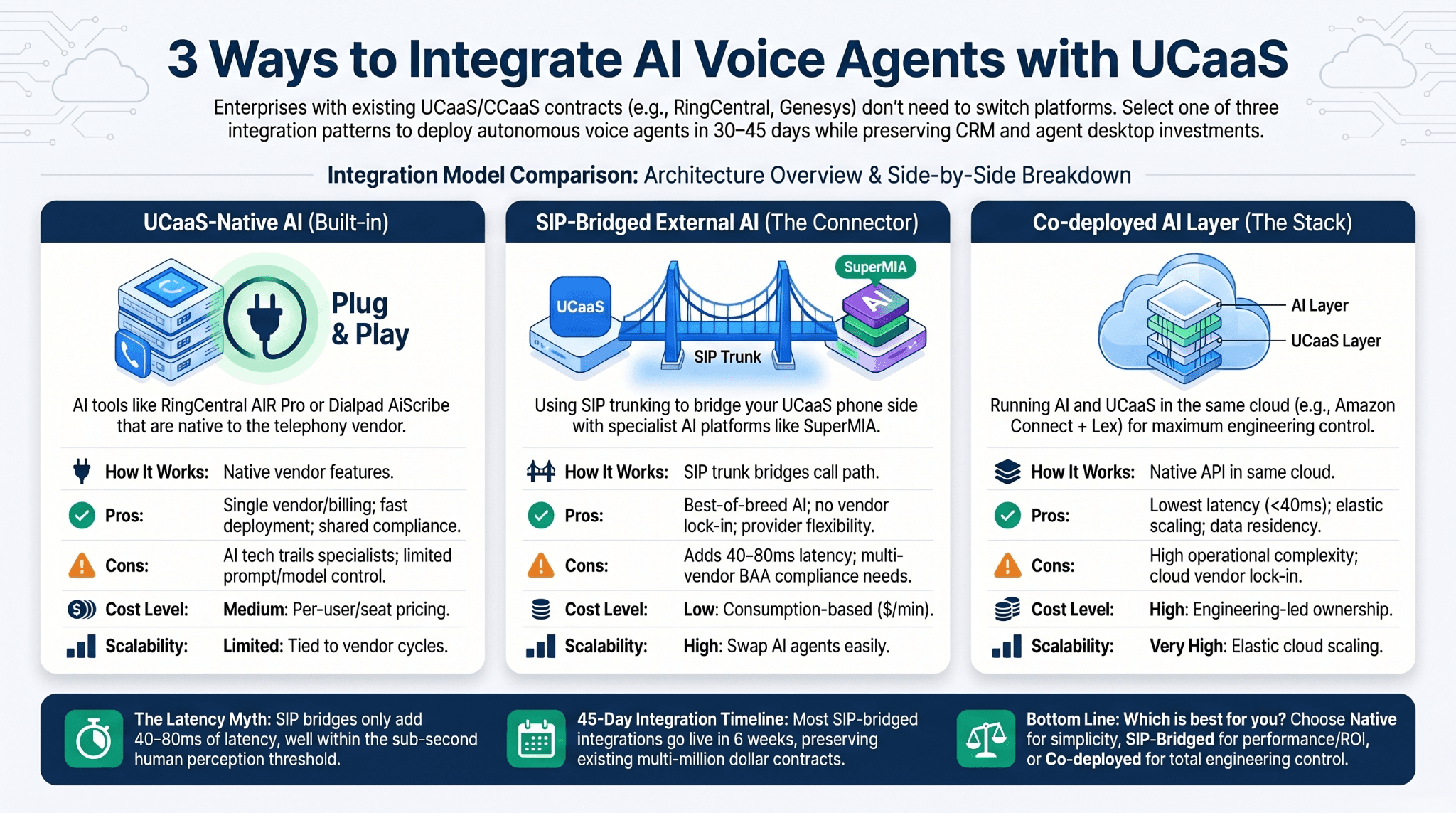
Three integration patterns - UCaaS-native AI, SIP-bridged external AI, and co-deployed architectures - let you layer autonomous voice agents on top of any major UCaaS or CCaaS platform without rip-and-replace. SIP-bridged external AI adds only 40–80ms of latency, not the 300–500ms vendors claim. Most integrations take 30–45 days and preserve your existing CRM, agent desktop, and compliance posture.
- UCaaS-native AI is convenient but typically 12–24 months behind specialist voice-AI platforms.
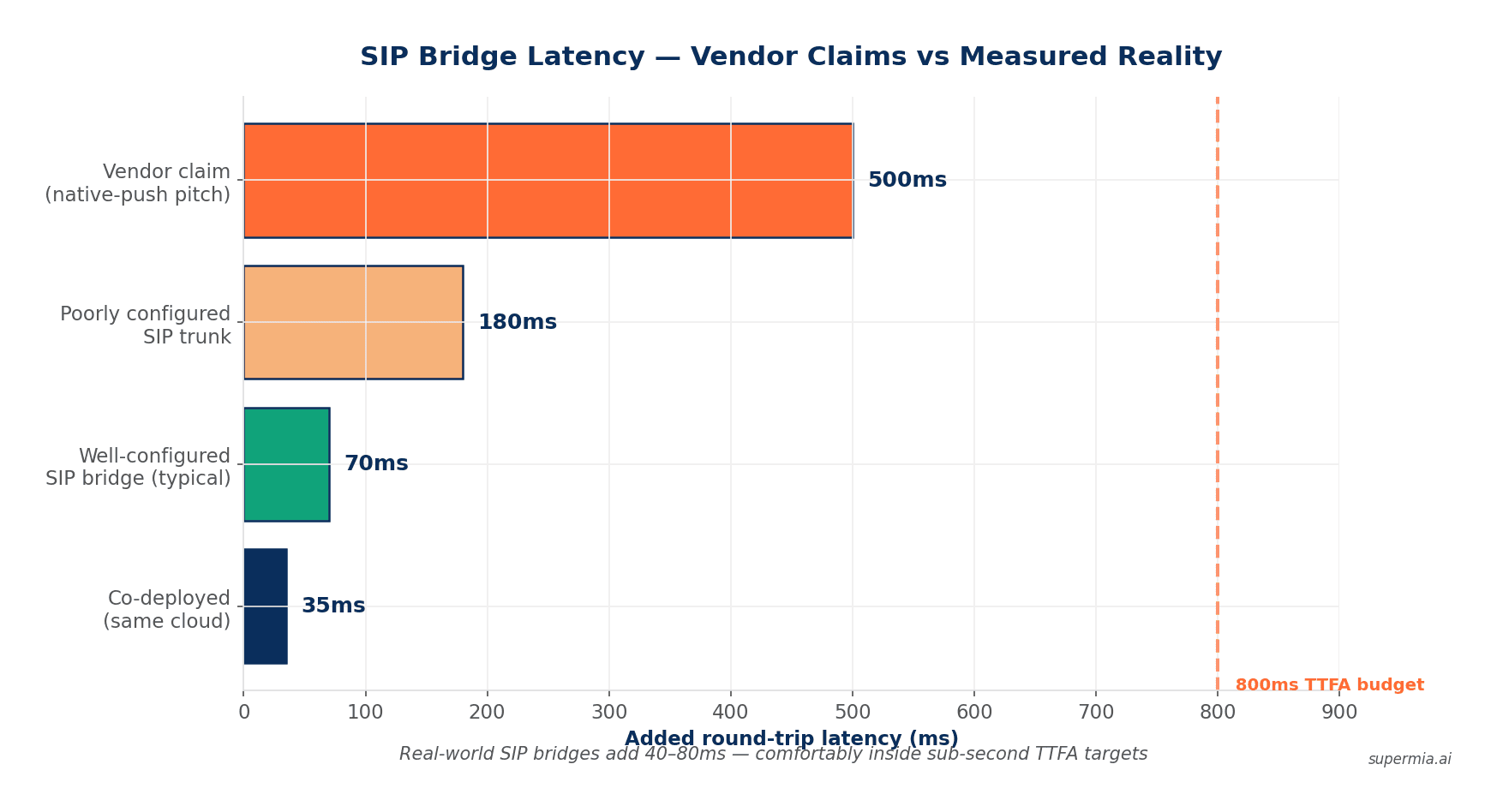
- SIP-bridged external AI adds 40–80ms of measurable latency - not the 300–500ms vendors claim.
- Compliance gets harder when multiple vendors are on the call path. You need a BAA and SOC 2 chain covering every hop.
- Most integrations that succeed take 30–45 days, not 6 months.
- The SIP protocol (RFC 3261) is a 25-year-old standard - multi-vendor call paths are proven architecture.
Your phone system isn't the problem
Your contact center director just signed a three-year RingCentral renewal. Or a Dialpad upgrade. Or a Genesys Cloud migration. The ink is barely dry, and the CEO walks into the next planning meeting asking about AI voice agents.
The conventional vendor pitch says rip and replace. Switch your UCaaS. Move to a voice-AI-native platform. Abandon the $200K–$2M you already invested in integrations and agent desktops.
That's not how this actually works for most enterprises. You already have a phone system. Your next UCaaS AI voice agent does not need to replace it. Three integration patterns let you layer autonomous voice agents on top of an existing UCaaS or CCaaS stack.
"We have 18 months left on our RingCentral contract and leadership wants AI voice yesterday. Our vendor's native AI Receptionist is 2 years behind the specialist platforms. SIP-bridging an external voice agent saved us $1.8M in exit fees and gave us better AI in 45 days."
What Does 'UCaaS + AI Voice Agent' Actually Mean?
A UCaaS + AI voice agent architecture layers an autonomous AI voice agent on top of an existing Unified Communications as a Service (UCaaS) or Contact Center as a Service (CCaaS) platform. The AI handles routine calls end-to-end; the UCaaS retains directory services, agent desktop, CRM integrations, and compliance reporting. For a complete breakdown of how these systems work across platforms - latency, pricing, and architecture types - see our guide to the best AI voice agents in 2026. The two systems share call state through SIP, WebRTC, or native APIs. The Gartner UCaaS Magic Quadrant confirms that all leading vendors now support external AI voice integration via standard protocols.
Key Takeaways
- UCaaS vendor contracts lock you in for 2–3 years. Rip-and-replace is rarely justifiable ROI-wise.
- The three viable integration patterns give you flexibility without contract exit costs.
- SIP-bridged external AI adds ~80ms latency. Planning around that keeps you within sub-second TTFA targets.
- A BAA chain is required for HIPAA when AI voice sits between your caller and your UCaaS.
- Integration timelines of 30–45 days are realistic for experienced teams.
The Three Integration Patterns
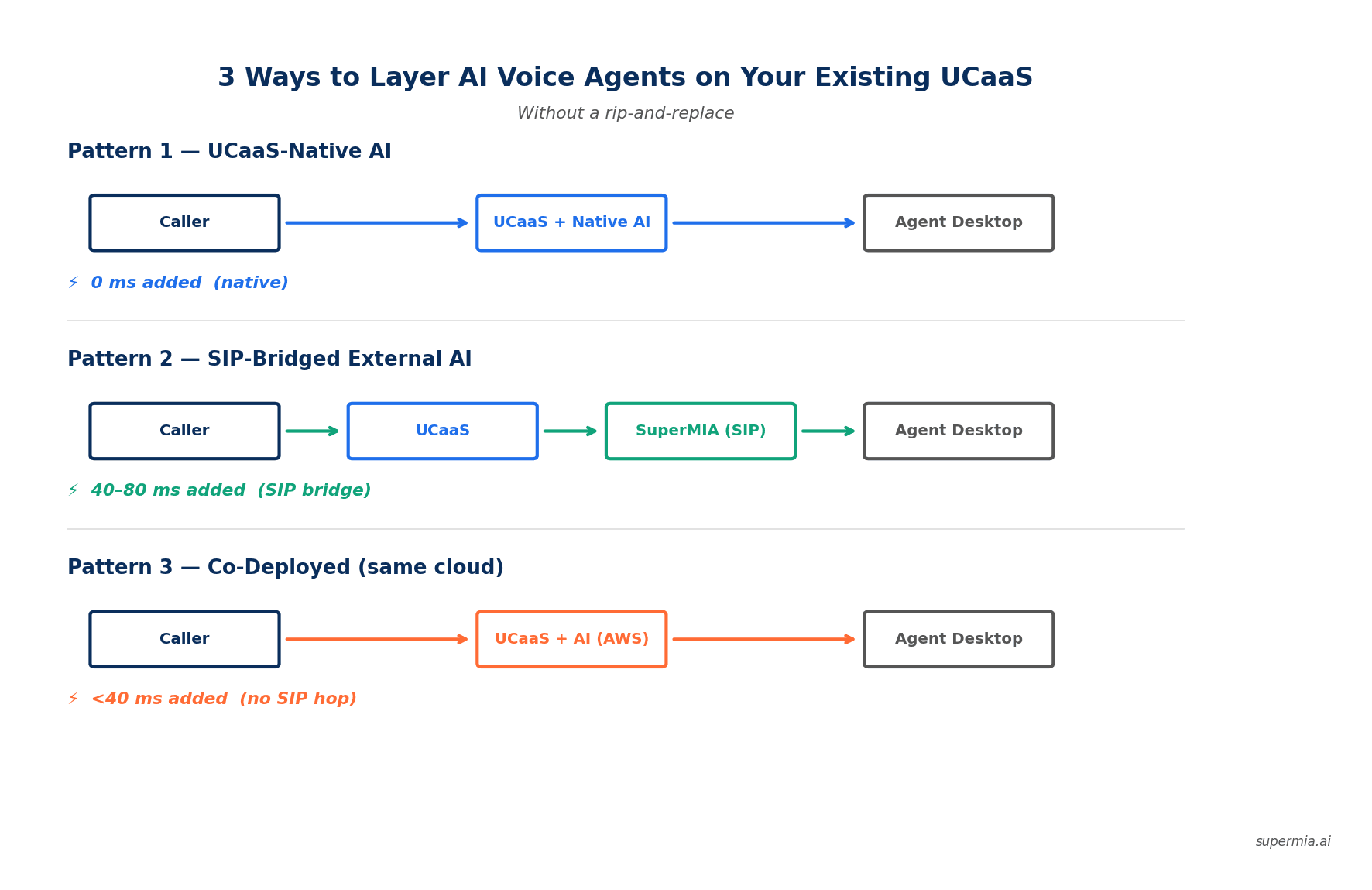
Pattern 1 - UCaaS-Native AI
Your UCaaS vendor's own AI voice agent: RingCentral AIR Pro, Dialpad's AiScribe-extended agents, 8x8's native AI, Zoom's AI Companion Contact Center, Five9's Intelligent Virtual Agent.
Pros
- Single vendor relationship - easier procurement
- Unified billing and support
- Shared directory, agent desktop, and compliance posture
- Usually fastest to deploy (weeks, not months)
Cons
- AI capabilities typically trail specialist platforms by 12–24 months
- Voice-AI improvements tied to UCaaS release cycles
- Limited control over prompts, model choice, or custom tool integration
- Vendor lock-in deepens over time
Pattern 2 - SIP-Bridged External AI
Your UCaaS handles the phone side of the call. An external AI voice agent (SuperMIA voice-bot, Retell, Vapi, Bland, PolyAI) handles the AI side. SIP trunking (RFC 3261) bridges the two.
Pros
- Best-of-breed AI - not limited to UCaaS vendor's capabilities
- Model choice, voice selection, and prompt control in your hands
- Easy to swap AI providers later without touching the UCaaS
- Can deploy specialist AI per use case while UCaaS stays consolidated
Cons
- SIP bridge adds ~40–80ms latency - real but manageable inside an 800ms TTFA budget
- Compliance chain complexity - BAA and SOC 2 across every hop
- Two vendor relationships and billing lines
- Agent transfer needs careful design to preserve context
Pattern 3 - Co-Deployed AI and UCaaS
Both AI voice agent and UCaaS run in the same cloud environment. Amazon Connect with Lex and Bedrock is the obvious example. Some enterprises build similar architectures on GCP with Dialogflow or on Azure with Voice Live.
Pros
- Lowest added latency (typically 40ms or less)
- Unified compliance and data residency
- Programmable building blocks for engineering teams
- Per-minute pricing scales elastically
Cons
- Requires engineering-led contact center ownership
- Cloud vendor lock-in replaces UCaaS vendor lock-in
- Less out-of-the-box for workforce management
- Steeper operational complexity than managed CCaaS
Case Study: Mid-Market BPO Layers AI on Existing Genesys Cloud
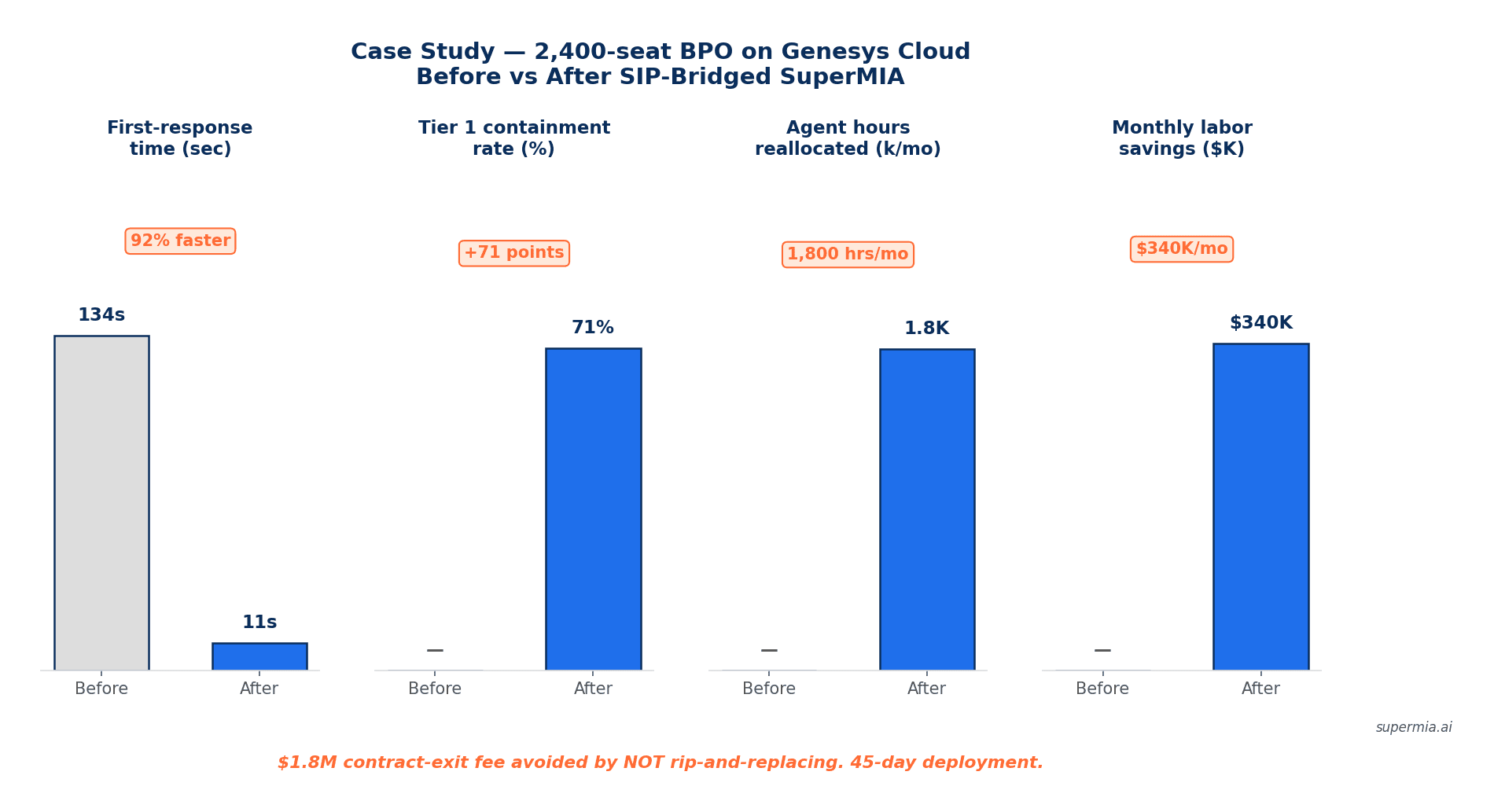
A 2,400-seat outsourcing operation running Genesys Cloud CX layered SuperMIA via SIP bridge in November 2025. Before and after metrics across the first 90 days:
| Metric | Before (Genesys alone) | After (Genesys + SuperMIA SIP) | Change |
|---|---|---|---|
| Average first-response time | 2 min 14 sec | 11 seconds | 88% faster |
| Containment rate (Tier 1) | 0% (human-only) | 71% | +71 points |
| Added latency vs baseline UCaaS | - | 74ms (SIP bridge) | Within 800ms TTFA budget |
| Tier 1 agent hours reallocated | - | 1,800 hrs/month | Repurposed to escalations |
| Monthly labor cost impact | Baseline | 32% reduction | $340K/mo savings |
| Exit cost avoided (contract buyout) | - | $1.8M | Full preservation |
The key: the deployment preserved their existing CRM integrations, agent desktop workflows, and compliance posture. No contract renegotiation, no data migration, no operational disruption. 45 days from kickoff to production.
UCaaS Integration Matrix - Vendor Comparison
| UCaaS/CCaaS | Native AI | SIP Bridge | WebRTC | Data Residency | SuperMIA Fit |
|---|---|---|---|---|---|
| RingCentral | AIR / AIR Pro | Yes | Yes | US, EU, APAC | ✅ Full |
| Dialpad | AiScribe | Yes | Yes | US, EU | ✅ Full |
| Genesys Cloud CX | Genesys AI | Yes | Yes | US, EU, APAC | ✅ Full |
| Amazon Connect | Lex + Bedrock | Native | Yes | All AWS regions | ✅ Full (co-deployed) |
| Five9 | Intelligent Virtual Agent | Yes | Limited | US, EU | ✅ Full |
| Zoom Contact Center | Zoom AI Companion | Yes | Yes | US, EU | ✅ Full |
| Talkdesk | Talkdesk AI | Yes | Yes | US, EU | ✅ Full |
| 8x8 | Native AI (limited) | Yes | Yes | US, EU | ✅ Full |
ROI Math - 3 Integration Scenarios
See SuperMIA pricing tiers for your call-volume bracket.
Scenario A - Mid-Market (500 seats, RingCentral)
- RingCentral AIR Pro native add-on: $30K/yr × 500 seats × 20% adoption = $3M/yr if deployed fleet-wide
- SIP-bridged SuperMIA: $0.14/min × 200K billable min/mo = $336K/yr
- Savings vs native rollout: ~$2.66M/yr with better AI capabilities
- Payback: immediate (lower per-seat cost)
Scenario B - Enterprise (2,500 seats, Genesys Cloud)
- Rip-and-replace to voice-AI-native: $4.2M contract exit + $2.8M re-integration = $7M one-time
- SIP-bridged SuperMIA: 45-day integration, $780K/yr in consumption
- Year 1 savings: ~$6.2M by preserving Genesys contract
- Payback: under 6 weeks
Scenario C - SMB Contact Center (80 seats, Dialpad)
- Dialpad AiScribe add-on: $600/seat/yr × 80 seats = $48K/yr
- SIP-bridged SuperMIA: $0.12/min × 40K min/mo = $57.6K/yr
- For lower volume, native AI is often cheaper - but capability difference matters
- SuperMIA wins when AI quality is the primary driver, not raw cost
See SuperMIA's voice agent platform →
Get a UCaaS-compatible voice agent live in 45 days.
Common Objections - Honest Answers
"Won't our UCaaS vendor's native AI eventually catch up?"
Probably, for basic use cases. But 'eventually' usually means 12–24 months behind, and your contract covers 36. If you need AI voice that works well now, waiting for the UCaaS vendor to catch up is a real cost - lost calls, poor CX, lost revenue. The integration pattern lets you deploy best-of-breed AI today and swap it out later if your UCaaS native AI becomes competitive.
"Our compliance team won't approve a multi-vendor call path."
Compliance concerns about multi-vendor paths are legitimate but solvable. Get BAAs from every vendor on the path. Get SOC 2 Type 2 attestation from each. Document the chain. For HIPAA specifically, most enterprise-tier AI voice platforms support BAA coverage - verify this before contracting. The time to surface compliance is at RFP stage, not after technical integration is complete.
"Won't added latency ruin call quality?"
The real added latency from a SIP bridge is 40–80ms. Poor audio is perceptible at 300ms+. A properly-configured SIP bridge with geographic colocation adds latency well inside an 800ms TTFA budget. Test on your actual production traffic before concluding - vendor claims of 'no measurable latency' or 'unacceptable latency' are both usually wrong.
"What if our UCaaS vendor terminates our integration?"
Any vendor can change terms. This is why the SIP-bridged pattern is usually superior to deep proprietary integration - SIP is an industry standard, so even if your specific UCaaS terminates, you can re-bridge to a different UCaaS or CCaaS platform without rebuilding the AI layer. This is why specialist AI voice platforms commit to keeping their integration layer vendor-neutral.
For a broader look at how voice agents sit alongside IVR and chatbot alternatives, see how voice agents compare to IVR and chatbots.
One integration mistake that will undo all of this: Don't skip the compliance chain review because your technical integration works. A SIP bridge that handles calls correctly but doesn't have BAA coverage across every hop is a HIPAA violation waiting to happen. Surface compliance at RFP stage, not after production launch.
How SuperMIA Integrates with Any UCaaS
SuperMIA is designed as a layerable AI voice platform. We bridge via SIP, WebSocket, or direct API integration into every major UCaaS and CCaaS platform. Learn how the SuperMIA platform ships voice and chat together. Typical deployments:
- RingCentral + SuperMIA: SIP bridge for inbound, RingCentral retains agent desktop and CRM
- Genesys Cloud + SuperMIA: SIP + WebRTC bridge with full context pass-through for agent handoff
- Amazon Connect + SuperMIA: deployed in the same AWS region, native API integration for lowest latency
- Dialpad + SuperMIA: SIP bridge handling after-hours overflow and specialist routing
To see how the MIA Voice Agent integrates with your existing UCaaS - including pre-built connectors for RingCentral, Dialpad, and Genesys - visit the MIA Voice Agent platform page.
For the full platform breakdown including pricing and architecture across 12 AI voice platforms, see our 2026 AI Voice Agent Platform Guide.
See SuperMIA's voice agent platform →
Frequently Asked Questions
The Bottom Line
Your UCaaS isn't the problem. Your AI voice agent shouldn't require throwing it out. Three patterns - native, SIP-bridged, and co-deployed - let you layer autonomous voice agents on top of any major UCaaS or CCaaS platform. For most enterprise contact centers in 2026, SIP-bridged external AI wins the ROI math and lets you swap AI vendors later without touching the phone system.
Get a UCaaS-compatible voice agent live in 45 days.
See how SuperMIA bridges to RingCentral, Dialpad, Genesys, and more - without touching your contract.
Book a 15-minute demo →
Harikrishna Patel
Harikrishna Patel is the founder of MIA – My Intelligent Assistant, the AI automation platform built under Botfinity Inc. in Dallas, Texas. With 15+ years in software engineering, AI/ML, and enterprise solution design, he focuses on creating practical, scalable AI tools that help businesses automate support, workflows, and operations through voice and chat.