
Table of Contents
Table of Contents
- The Black-Hole Problem Your Careers Page Has
- What Is an AI Recruiting Chatbot?
- The 5-Minute Flow, Step by Step
- How an AI Recruiting Chatbot Actually Works
- Why Form-Based Applications Leak 60% of Your Candidates
- Where AI Recruiting Chatbots Actually Earn Their Keep
- AI Recruiting Chatbot Options Compared
- The 24/7 Advantage Your ATS Does Not Show You
- Case Study: Softqube + SuperMIA IntelliHire
- The Objections Candidates (and Compliance) Will Raise
- How SuperMIA IntelliHire Handles the 5-Minute Flow
- Frequently Asked Questions
- Stop Losing Candidates Between Apply and Interview
Quick Answer
An AI recruiting chatbot compresses the highest-leak stage of hiring - from apply to first recruiter touch - into a 5-minute conversation: greet, parse resume, conversational screening, and live calendar booking. Teams using this model report 90%+ completion rates versus low-single-digit completion on long forms, especially outside business hours.
The Black-Hole Problem Your Careers Page Has
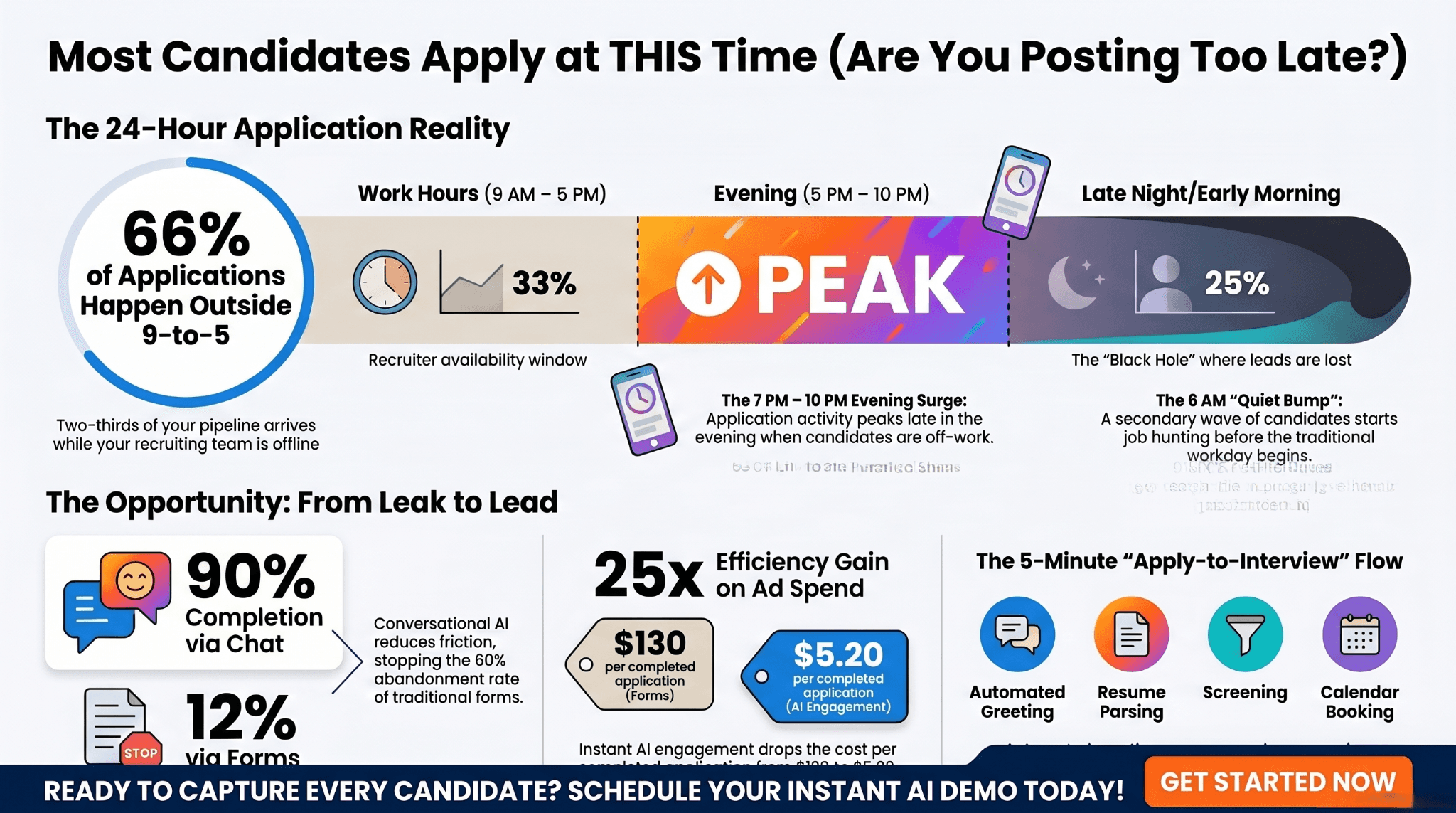
A candidate taps apply at 8:42 PM. Your recruiting team is offline. They have three other tabs open. Whoever responds first wins - not whoever has the best JD.
This is where most hiring funnels break. Application volume is not the issue. Silence is. The top leak is the gap between candidate intent and recruiter response time.
"The first 200 applications were a total black hole... it felt like I was shouting into a void."
An AI recruiting chatbot closes that void with a two-way conversation that qualifies, answers, and schedules in one flow.
Key Stats
- 60% of candidates abandon applications midway when flow friction is high.
- Chatbot-guided applications can push completion to 90%+ for high-volume roles.
- The winning flow is simple: greet, parse, screen, schedule, handoff.
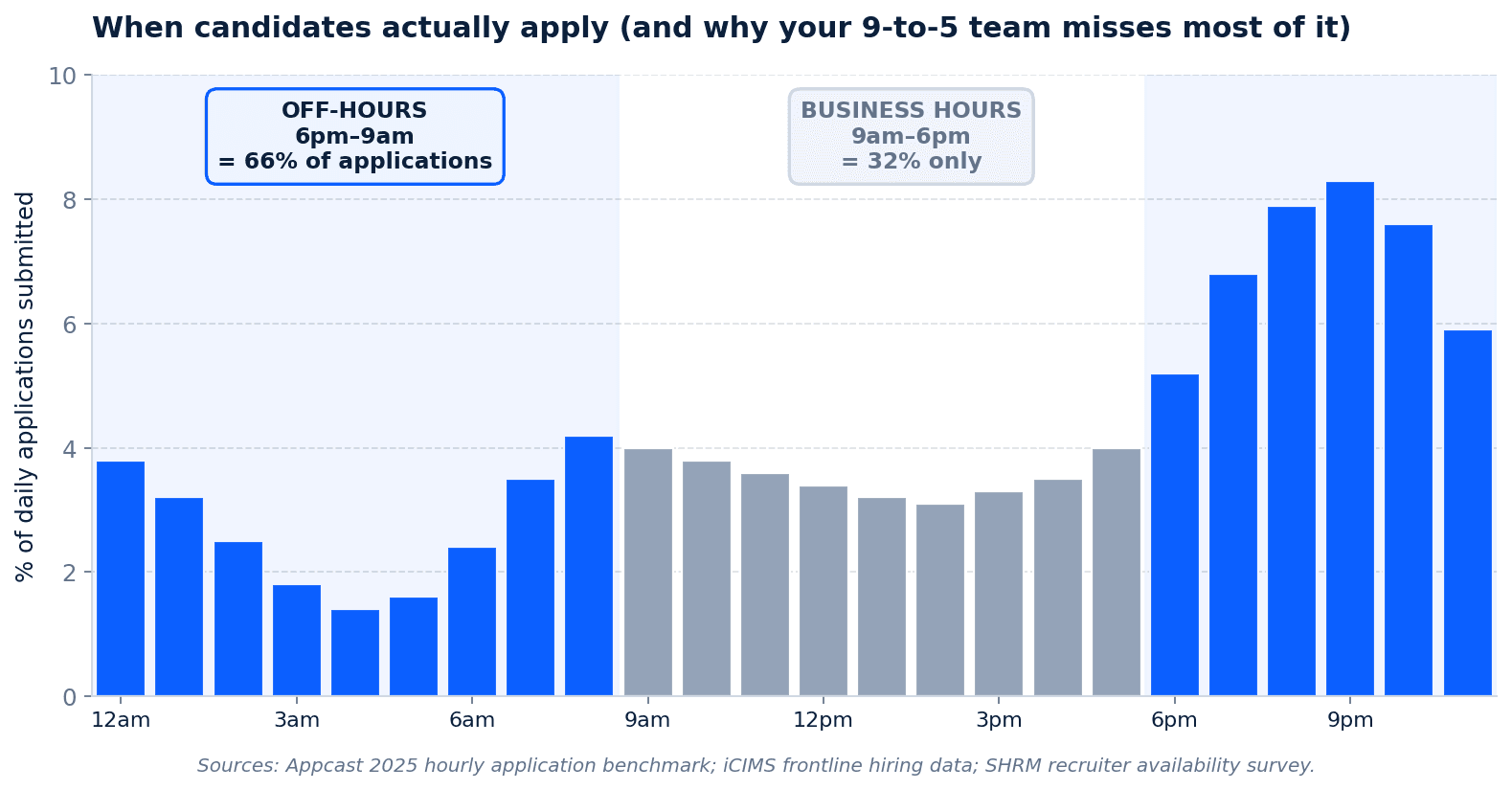
- Most applications arrive outside business hours, where chatbots capture demand your team misses.
- Keep humans in the loop for nuanced roles and final hiring decisions.
Automate First-Round Interviews → Book a SuperMIA IntelliHire Demo
What Is an AI Recruiting Chatbot?
An AI recruiting chatbot is conversational hiring software that talks with candidates through web chat, SMS, or WhatsApp, screens them against role criteria, and books qualified candidates directly into interview slots. It replaces form friction and email ping-pong with one guided flow.
The MIA Chat Agent handles this conversational layer - engaging candidates across web chat, WhatsApp, and SMS before handing off to IntelliHire for AI-led structured interviews.
Key Takeaways
- The core problem is not sourcing; it is drop-off between apply and interview.
- Conversation-first flows outperform long forms on mobile completion.
- 24/7 responsiveness is a structural advantage for capture and conversion.
- Best practice is hybrid: chatbot for first minutes, recruiter for final judgment.
- No escalation path means poor candidate experience; human handoff must be explicit.
The 5-Minute Flow, Step by Step
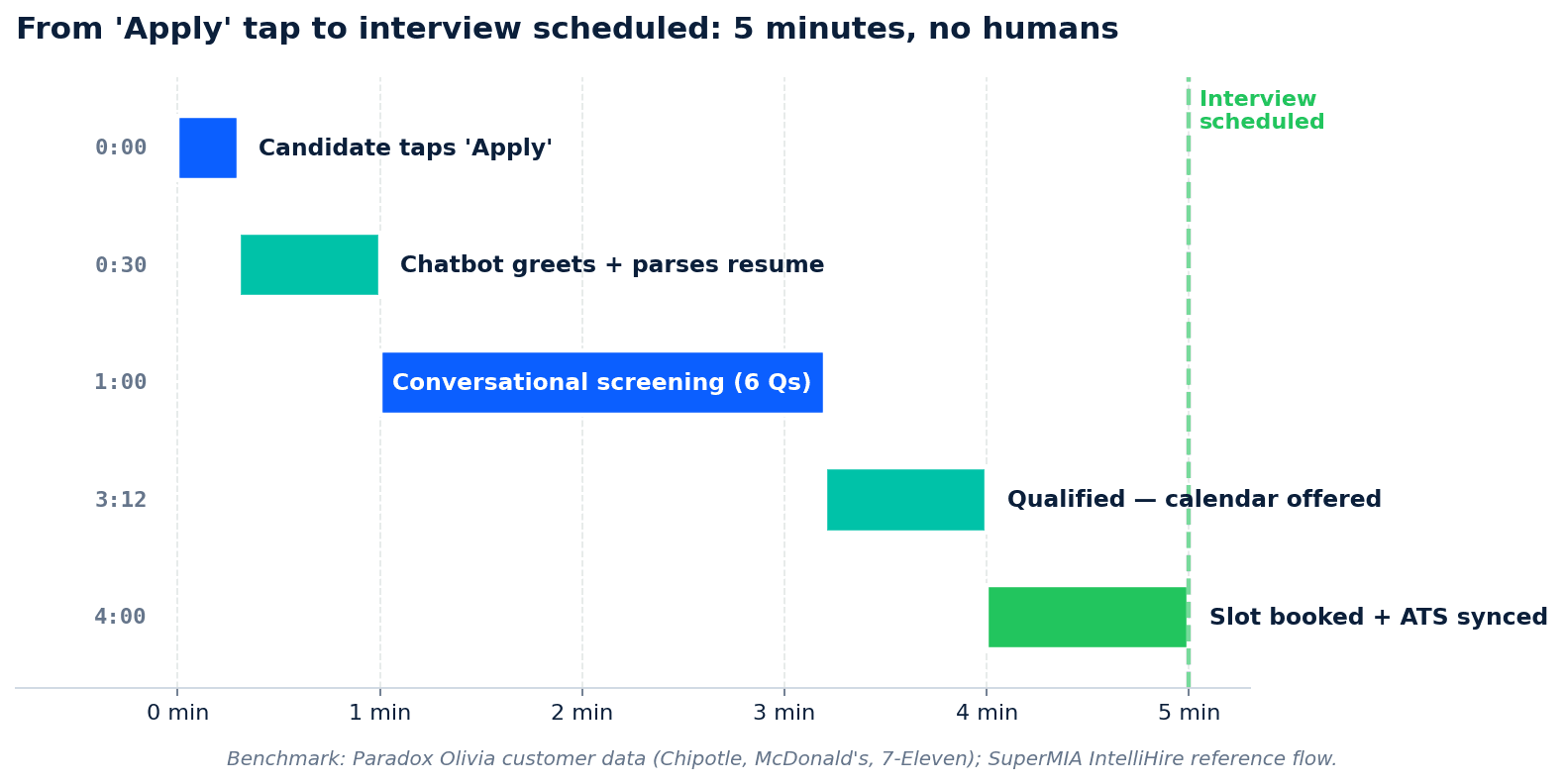
The 5-minute benchmark is practical when process handoffs are eliminated. Candidates upload one resume, answer short conversational qualifiers, and choose an interview slot immediately.
How an AI Recruiting Chatbot Actually Works
Under the hood, the best systems do not act like a simple FAQ bot. They orchestrate four separate layers: intent detection, candidate data extraction, business-rule evaluation, and downstream system writes. That is why weak chat widgets fail while well-implemented recruiting agents actually compress the apply-to-interview gap.
-
1. Greet and Parse
The chatbot starts instantly, identifies role context, and parses resume/profile inputs into structured fields. In practice this means NLU intent detection identifies whether the candidate wants to apply, ask a question, or reschedule; entity extraction captures location, shift preference, certifications, years of experience, and work authorization; then the system maps those into an ATS-friendly payload.
A typical payload schema includes candidate name, email, phone, target role, source, work status, availability window, screening answers, and resume URL. Instead of a recruiter manually copying answers from chat to the ATS, the chatbot writes a clean JSON object directly into Greenhouse, Lever, BambooHR, or a webhook endpoint your ATS can ingest.
-
2. Screen Conversationally
It runs 4 to 8 qualifying questions with branching logic and clear knockout rules. The key is that the logic is narrow and explicit. License required? Ask it. Weekend availability required? Ask it. Willing to work on-site? Ask it. The system should never improvise hidden hiring criteria. It should route candidates based on role-specific requirements your team has already agreed on.
Good implementations also store the reason path for every answer. If a candidate is disqualified, the recruiter can see exactly which knockout fired, which is essential for candidate review, auditability, and later bias analysis.
-
3. Schedule Instantly
Qualified candidates receive live slots tied to hiring-manager availability in their own timezone. This is not just a calendar embed. The agent checks panel rules, interview duration, recruiter assignment, timezone normalization, and hold windows before offering a slot. On hourly hiring teams, that speed is the difference between a candidate speaking with you tomorrow and disappearing into a competitor's flow tonight.
-
4. Hand Off Clean
Recruiters receive transcript, fit summary, and candidate context in ATS for informed interviews. The handoff should include the structured screen outcome, knockout status, notes on candidate constraints, and the full transcript so the recruiter enters the call with context instead of starting cold.
→ Book a 15-Minute SuperMIA IntelliHire Walkthrough
Why Form-Based Applications Leak 60% of Your Candidates
Long, form-heavy applications leak intent at scale. Every extra field increases abandonment and pushes high-intent candidates to faster funnels.
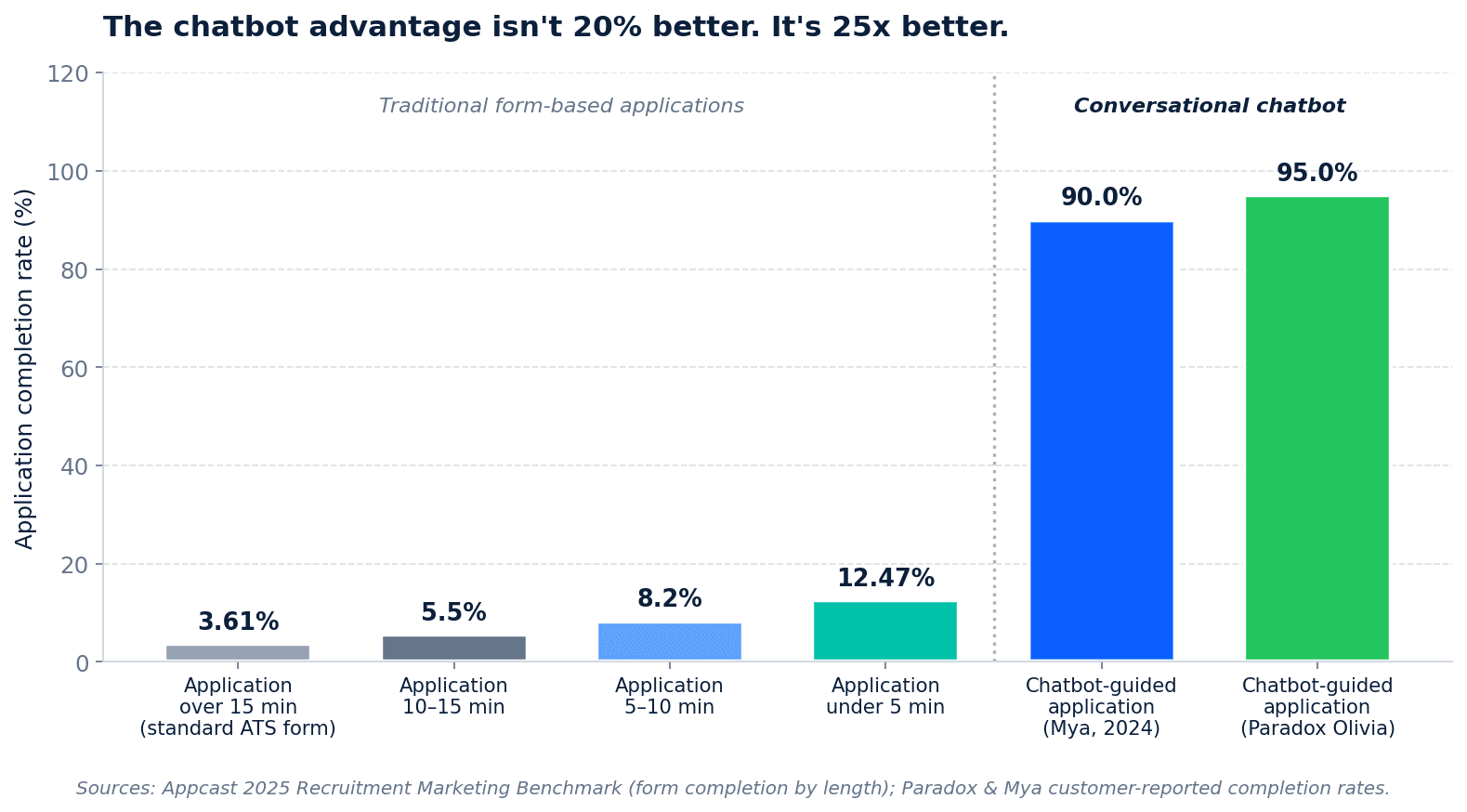
For hiring teams, this changes unit economics: improving completion rates can reduce cost per completed application without increasing media spend.
Where AI Recruiting Chatbots Actually Earn Their Keep
High-Volume Hourly Hiring
Retail, hospitality, field service, and contact-center teams use chatbot-first workflows to sustain response speed and interview throughput. These are environments where speed beats polish. If 300 people apply for 40 openings in a weekend, the winning team is the one that turns intent into scheduled interviews before Monday afternoon.
For the full AI screening workflow - how AI scores resumes, ranks candidates, and cuts time-to-hire 80% - see AI candidate screening.
After-Hours Career Site Capture
Most candidates do not apply in recruiter office hours. Chatbots effectively operate the second shift your team does not staff. That matters most when candidate demand peaks in evenings and on mobile devices, where long forms perform worst.
Dental, Healthcare, and Clinic Front Desk Roles
SMS-first reminder and rescheduling flows reduce no-shows and stabilize interview attendance. Clinic groups hiring front-desk coordinators, assistants, and dental reception staff often care less about resume polish and more about schedule fit, location, patient-facing availability, and certification status. A chatbot can collect those details in minutes, then keep interview attendance high with reminder and reschedule logic. For deeper vertical context, see our healthcare hiring playbook and dental front-desk hiring guide.
Mini-case: A multi-location clinic network hiring front-desk coordinators can use the bot to ask only four decisive questions: which location the candidate can reach, whether they have prior scheduling or insurance-verification experience, whether they can work opening or closing shifts, and when they can interview. That removes two rounds of back-and-forth before a recruiter even touches the application.
Campus and Early-Career Programs
Chat channels help triage large applicant pools while preserving response quality and candidate experience.
Retail Floor and Store Ops Hiring
Retail teams benefit when a chatbot can ask about weekend availability, store radius, shift flexibility, and start date before routing candidates. That is especially useful for seasonal spikes, store openings, and replacement hiring where managers cannot sit in an ATS all day.
Mini-case: A regional retail brand hiring 60 associates across 12 stores can let the chatbot route candidates by preferred store, available shift block, and earliest start date. Instead of one recruiter manually triaging hundreds of applications, each store manager receives only candidates who actually fit the roster and can interview this week.
AI Recruiting Chatbot Options Compared
For the broader evaluation framework on choosing any AI chatbot for your business - covering integration, scalability, and cost - see our guide to picking an AI chatbot for your business.
| Factor | Enterprise Chatbot | Mid-Market Chatbot | ATS-Bundled Bot | SuperMIA IntelliHire |
|---|---|---|---|---|
| Best fit | Very high-volume enterprise | Growth-stage teams | SMB workflow add-on | Mid-market to enterprise |
| Application completion | 90-95% | 80-90% | 60-70% | 90-95% |
| Live calendar booking | Yes | Yes | Partial | Yes, two-way sync |
| Escalation to human | Built-in | Built-in | Ticket-style | Live handoff |
The 24/7 Advantage Your ATS Does Not Show You
Recruiters run business hours. Candidates do not. A 24/7 chatbot captures and converts demand spikes in evening windows that static forms underperform.
Case Study: Softqube + SuperMIA IntelliHire (the Scheduling Piece)
Softqube's hiring bottleneck was not sourcing. It was handoffs between resume review, screening, and calendar coordination.
What the Chatbot Specifically Unlocked
- Resume + screen + schedule in one flow: from 2-3 days to under 4 hours.
- Interview throughput moved from roughly 25 per week to 40+.
- Auto-screened share grew to 80%, reserving human time for edge cases.
- Shortlist consistency improved with structured screening criteria.
Full case study: supermia.ai/use-cases/softqube-intellihire-ai-interview-agent-case-study/
The Objections Candidates (and Compliance) Will Raise
"Won't candidates feel like they are talking to a robot?"
They will if handoff paths are hidden. Make human escalation obvious in every step.
"What if the chatbot rejects a strong candidate?"
Use narrow knockouts, monitor false negatives weekly, and retune early.
"How do we stay compliant with NYC LL 144 and EU AI Act?"
Bias audits, disclosure, per-candidate reasoning logs, and human oversight are non-negotiable. Start with the source rules themselves: NYC LL 144 sets disclosure and audit expectations for automated employment decision tools, while the EU AI Act places hiring AI in a high-risk category with strict oversight obligations. The safe operating model is straightforward: the chatbot assists with first-touch screening and scheduling, and a human remains accountable for hiring decisions.
How SuperMIA IntelliHire Handles the 5-Minute Flow
IntelliHire runs inside SuperMIA's enterprise agentic AI platform and connects hiring conversations to real operational systems.
- Conversational apply flow with resume parsing and multilingual support
- Two-way sync with Google, Outlook, and iCal calendars
- Voice and chat variants of the same screening logic
- ATS integrations with Workable, Greenhouse, Lever, BambooHR, and API connectors
- Bias-audit-ready logs with SOC 2 Type II, GDPR, and HIPAA-aligned controls
Explore IntelliHire and the SuperMIA platform.
Build Your 5-Minute Hiring Flow - Book a Demo →
Frequently Asked Questions
Stop Losing Candidates Between Apply and Interview
Every hiring funnel has one choke point: the delay between candidate intent and first response. The longer the silence, the higher the loss.
A recruiting chatbot closes that gap by converting intent in real time and handing recruiters qualified, scheduled candidates instead of unread applications.
The tooling is ready. The workflow is proven. What remains is execution.

Harikrishna Patel
Harikrishna Patel is the founder of MIA – My Intelligent Assistant, the AI automation platform built under Botfinity Inc. in Dallas, Texas. With 15+ years in software engineering, AI/ML, and enterprise solution design, he focuses on creating practical, scalable AI tools that help businesses automate support, workflows, and operations through voice and chat.