
Table of Contents
- Your store ops are a slow leak. AI is the patch.
- What is AI retail operational excellence?
- Where the $18.4B in retail AI spend is going
- The 10 AI operational excellence plays
- Cost reduction range across all 10 plays
- Where the highest-ROI plays sit
- How retail AI vendors approach the stack
- Case study: a mid-market specialty retailer
- Where SuperMIA fits in the operational stack
- Frequently asked questions
Quick Answer
AI retail operational excellence is the use of AI across forecasting, inventory, labor, pricing, and customer service to cut retail operating costs 20–40%. The fastest-payback plays are voice AI and chat deflection; the highest-ceiling plays are demand forecasting and dynamic pricing.
Your store ops are a slow leak. AI is the patch.
It's a Tuesday morning. Your district manager pulls last week's numbers. Inventory shrink is up 18%. Two stores missed their labor budget. Three of your top SKUs went out of stock during the weekend rush. Customer service voicemails sat unanswered for 14 hours. Your assistant manager spent her entire Friday rebuilding next week's schedule because the original one had three call-outs nobody flagged.
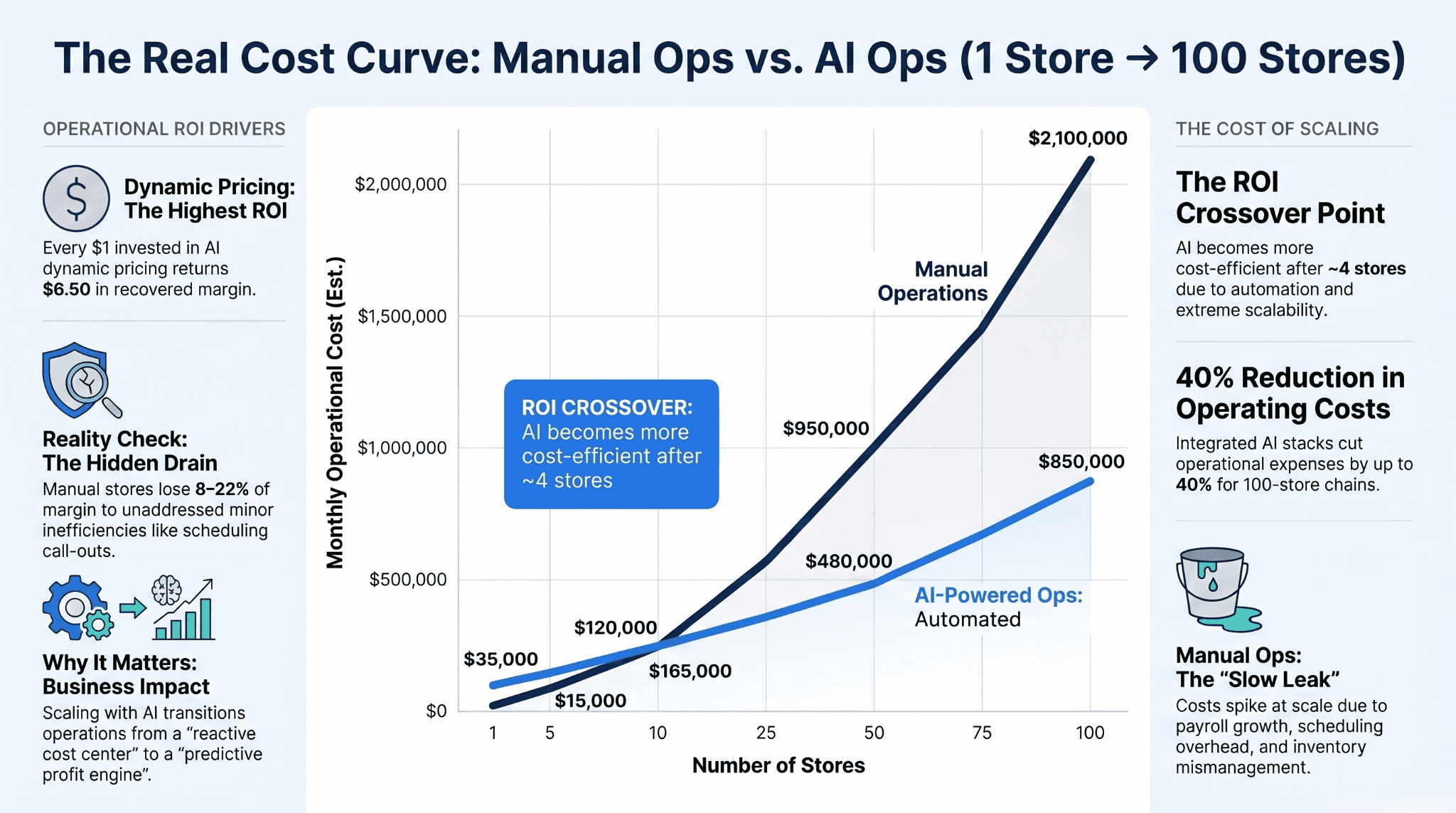
None of these are catastrophic. All of them happen every week. Together they're costing your chain something between 8% and 22% of operating margin - the kind of leak that doesn't kill the business but quietly bleeds it.
AI retail operational excellence is the discipline of using AI to plug those leaks: forecasting demand more accurately, scheduling labor more tightly, deflecting 70% of customer service calls, catching shrinkage in real time. McKinsey's 2026 retail data puts the prize at $400–$660 billion in annual value across the global industry. This guide breaks down the 10 operational plays that move the numbers most - with the cost-reduction range, ROI math, and deployment difficulty for each.
- 89% of retailers are now actively using AI - 95% report decreased operating costs and 89% report increased revenue (McKinsey, 2026).
- Inventory and demand forecasting captures 22.8% of all retail AI spend - the single biggest category.
- Best-in-class deployments deliver 20–70% cost reductions across 8 operational categories, with customer service leading at 35–70%.
- AI-driven dynamic pricing returns $6.50 per $1 invested - the highest ROI of any retail AI use case.
- The 10 plays in this guide cover ~$3.7B of retail AI spend across inventory, labor, voice, vision, and supply chain.
- See the AI ops stack in action: supermia.ai/industries/retail/ - Voice + chat + analytics in one platform. 48-hour deployment.
What is AI retail operational excellence?
AI retail operational excellence is the systematic use of artificial intelligence to optimize every layer of retail operations - inventory forecasting, labor scheduling, customer service, shrinkage prevention, and supply chain - with the goal of reducing operating costs 20–40% while improving service levels. Unlike experimental AI pilots, operational excellence treats AI as production infrastructure: deployed at scale, integrated with existing systems, and measured against operational KPIs like fill rate, schedule efficiency, and cost per transaction.
Key takeaways
- Operational excellence isn't one tool - it's a coordinated stack across 8–10 use cases.
- Customer service AI delivers the fastest payback (90 days or less) for most retailers.
- Inventory and demand forecasting captures the largest budget share at 22.8% of AI spend.
- Voice AI and dynamic pricing deliver the highest ROI multipliers ($4.20–$6.50 per $1).
- Most retailers underspend AI - 77% allocate 5% or less of tech budget to it (NRF, 2026).
Where the $18.4B in retail AI spend is actually going
Before walking through the 10 plays, here's how retail leaders are allocating their $18.4B in AI budgets in 2026. Inventory and demand forecasting takes the lion's share - not because it's the flashiest use case, but because it's the one with the most predictable ROI and the longest deployment track record.
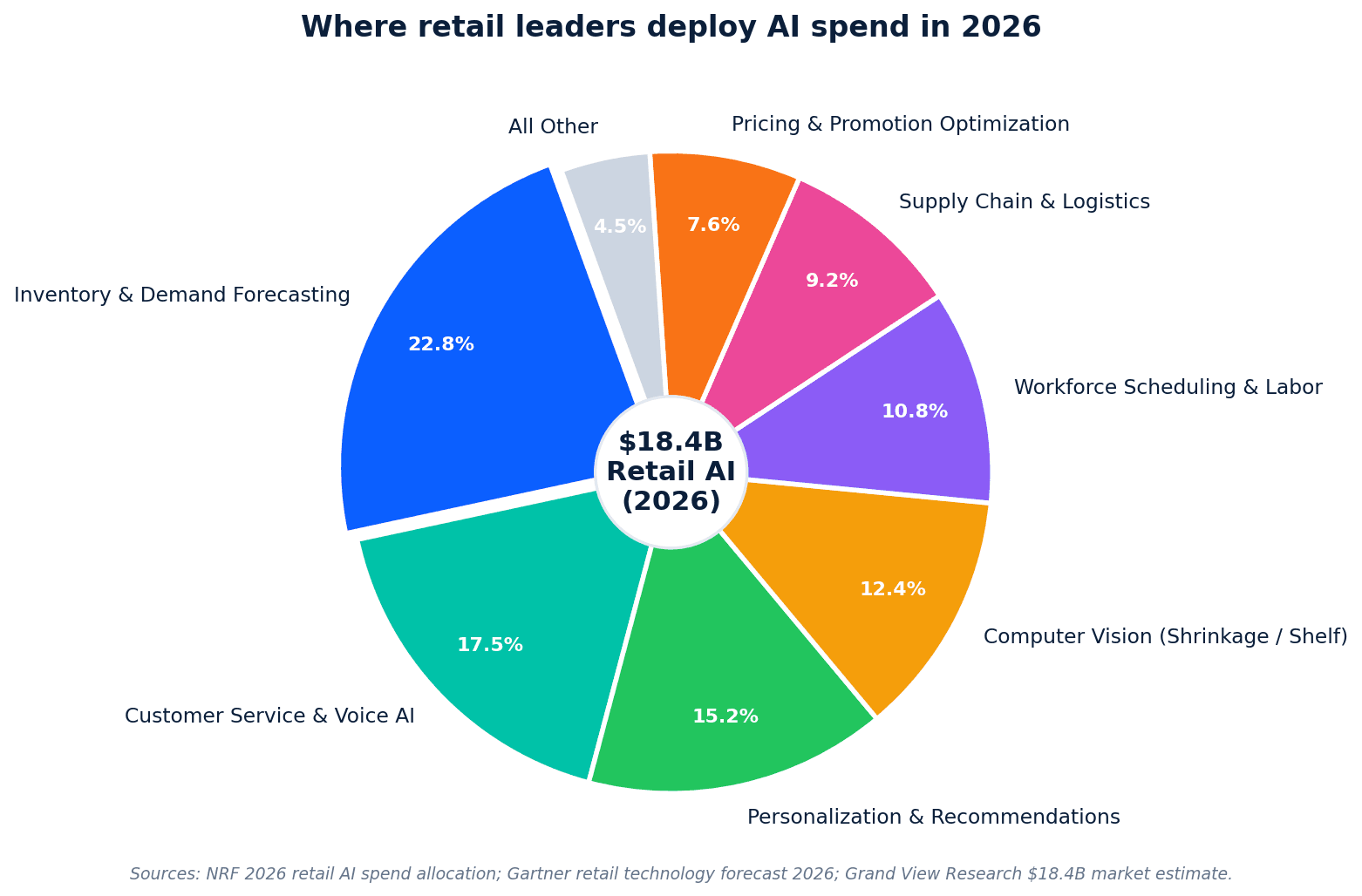
The pie tells two stories. First: there's no single dominant use case. The top three categories together (inventory, customer service, personalization) account for 55% of spend - meaning the other 45% is fragmented across operational layers most retailers haven't even started on. Second: customer service and voice AI captured 17.5% of spend in 2026, up from roughly 8% in 2024. That growth rate is the leading indicator. Voice and chat are the easiest deployments with the fastest payback, which is why they're scaling fastest.
The 10 AI retail operational excellence plays that move the numbers
These ten plays are ranked by combined impact (cost reduction × deployment speed × ROI multiplier). Most retailers should run them in sequence, not in parallel - each play depends on data infrastructure built by the prior ones.
1. AI demand forecasting (the foundation play)
Cost reduction: 15–50% lower inventory carrying cost. ROI: $4.80 per $1.
Every other play in this list depends on knowing what your customers will buy next week. Traditional forecasting uses last year's same-week data adjusted for trend. AI forecasting uses 30+ signals - weather, local events, social trends, competitor pricing, even traffic patterns - and updates daily instead of weekly. McKinsey reports 65% fewer stockouts and 20–30% leaner inventories for retailers running AI-driven forecasting at scale. ASOS publicly attributes its forecasting accuracy gains to ML models. Walmart's AI forecasting reportedly cuts overstock by ~30% in apparel.
Start here because every other operational decision - labor scheduling, replenishment, promotion timing - inherits accuracy from your forecast. Garbage in, garbage out applies to the entire ops stack.
2. AI inventory optimization & dynamic replenishment
Cost reduction: 20–30% inventory reduction. ROI: $4.80 per $1 (combined with forecasting).
Forecasting tells you what to expect. Inventory optimization tells you where to put it. AI control towers dynamically rebalance stock across stores, distribution centers, and dropship vendors based on real-time demand signals. The result: 5–8% improvement in fill rates without adding inventory dollars.
For chain operators, the bigger win is markdown reduction. AI flags slow-movers earlier, suggests cross-store transfers before clearance is necessary, and recommends targeted promotions to clear seasonal inventory at the right margin floor. Done well, this is 3–5 percentage points of gross margin recovery on a typical chain.
3. AI workforce scheduling & labor optimization
Cost reduction: 12–25% labor cost reduction. ROI: $2.90 per $1.
Manual labor scheduling is one of the worst time sinks in retail ops. An assistant manager rebuilds a 40-person store schedule three times a week because someone called out, the forecast changed, or a promotion got pulled forward. AI scheduling tools generate optimal schedules in minutes based on traffic forecasts, employee availability, skill requirements, and labor law constraints - then re-optimize automatically when shifts change.
The cost reduction comes from three places: better matching of staff to traffic (cuts overstaffing), reduced overtime (smarter shift handoffs), and lower turnover (employees get more consistent schedules with their preferences honored). The ROI multiplier is the lowest in the list ($2.90 per $1) because the upfront integration with your POS and HRIS is non-trivial - but the payback period is consistently under 6 months for chains over 50 locations.
4. Voice AI for inbound calls (24/7 coverage)
Cost reduction: 35–70% per-contact cost. ROI: $4.20 per $1. Deployment: 48 hours.
Customer calls don't keep store hours. A retailer running 50+ locations gets 6,000–12,000 inbound calls a week asking about product availability, store hours, return policies, order status, and curbside pickup details. Even with 24/7 coverage from a contact center, ~40% of those calls go to voicemail or hold-out queues. Voice AI handles the call autonomously - looks up orders in your OMS, checks inventory across stores, books appointments, transfers to humans only when needed.
This is the play with the fastest payback. Most retailers see ROI within 60–90 days. Voice AI also doubles as overflow protection during holiday rushes and weather events, when traditional contact centers buckle under volume spikes. SuperMIA's voice agent platform for retail handles 70% of these calls autonomously, with one-tap escalation to your existing contact center for edge cases.
See it handling order-status, store-locator, and return-policy calls live.
15-minute demo. No sales pitch.
Book a retail voice AI demo →5. AI chat agents for customer service deflection
Cost reduction: 50–70% support volume. ROI: $3.50 per $1.
Voice handles phone. AI chat agents handle your website widget, mobile app, WhatsApp, and SMS. For most retailers, chat volume is 3–6x phone volume, and the deflection rate from a properly configured AI chat agent runs 50–70% - meaning a 12,000-monthly-message volume drops to 4,000–6,000 actually requiring a human touch.
Where this play breaks down: chat agents trained on outdated FAQ data hallucinate prices, misrepresent return windows, or recommend out-of-stock SKUs. The architectural fix is RAG-grounded chat - the agent reads from your live product catalog and order system, not from a snapshot of last quarter's policies. Ask vendors: 'Is the bot grounded on my live data, or trained on a snapshot?' Acceptable answer is grounded.
6. Computer vision for shrinkage detection & shelf compliance
Cost reduction: 18–32% shrink reduction. ROI: $3.80 per $1.
"I just happened to watch the video of yesterday's shift and found that my manager of 10 years stole over $200 of chocolate plus bags of supplies. Watching her do this on video, it doesn't look like it's the first time."
Internal shrinkage is the half of the problem nobody puts on a slide. Computer vision systems running on existing IP cameras flag suspicious behavior in real time - cashier voids without manager approval, return manipulation, gift card fraud patterns, employee bag checks. The same systems also monitor planogram compliance (are products on the right shelves?) and out-of-stock detection (is the front row of the shelf empty?).
Walmart's deployment of computer vision for shrinkage prevention is well-documented. The math at chain scale: a $500M retailer with 1.5% shrink loses $7.5M annually. Cutting that by 30% recovers $2.25M. Vision AI deployments typically cost $80–$200K per year for a 50-location chain. That's a 10–28x return.
7. AI-driven dynamic pricing & promotion optimization
Cost reduction: variable. ROI: $6.50 per $1 - highest in the list.
Dynamic pricing isn't price-gouging - it's matching prices to real-time demand, competitor moves, inventory position, and weather. Best-in-class retailers run dynamic pricing on 15–40% of their SKU mix, with the rest held at psychological price anchors. Amazon famously updates prices millions of times a day; mid-market retailers run AI pricing on smaller SKU subsets but capture similar percentage margin lifts.
Promotion optimization is the underrated half. AI flags which promotions cannibalize regular-margin sales versus pull genuinely incremental volume. The result: 3–5 fewer 'wasted' promotions per quarter, with the same overall promotional revenue at higher net margin. The $6.50 per $1 ROI reflects this combined effect - it's the highest in our chart and consistently the highest in industry studies.
8. Predictive maintenance for refrigeration, HVAC & equipment
Cost reduction: 12–25% maintenance spend. ROI: $3.20 per $1.
Refrigeration failures are the silent killer in grocery, c-store, and pharmacy. A single freezer failure during a weekend can spoil $15,000–$50,000 of inventory. Predictive maintenance uses sensor data (temperature variance, vibration, energy draw) to flag failures 48–120 hours before they happen - enough time to schedule a repair instead of triaging an emergency.
The ROI calculation is straightforward: cost of one prevented refrigeration failure typically pays for 18–24 months of the predictive maintenance subscription. Larger chains add HVAC, lighting, and POS hardware to the same monitoring stack - each additional system is incremental cost but compounding savings.
9. AI supply chain optimization & last-mile routing
Cost reduction: 5–20% logistics cost. ROI: built into total ops savings.
This is where store ops meets distribution. AI supply chain tools optimize truck routing (5–8% fuel reduction), warehouse capacity (7–15% throughput gain), and last-mile delivery sequencing (10–20% delivery time reduction). For retailers running same-day or next-day delivery, this play is non-negotiable - the alternative is unprofitable delivery economics.
The deployment difficulty is high - supply chain integration touches your WMS, TMS, and OMS - but the payback compounds over multi-year contracts. Most chains see this play as a 12–18 month implementation, not a 90-day quick win.
10. AI returns & reverse logistics optimization
Cost reduction: 15–30% returns processing cost. ROI: built into margin recovery.
Returns are 16.5% of US retail sales by dollar value (NRF 2025). Most chains process returns the same way regardless of product condition, original margin, or resale value - a $500 jacket and a $20 shirt go through the same workflow. AI-driven dispositioning routes each returned item to its highest-value outcome - restock, resale via secondary channel, refurbish, or recycle.
The savings split two ways. First: lower processing cost (15–30% reduction by automating decision flow). Second: higher value recovery (10–20% more recovered margin per returned item). Combined, this is a top-5 margin lever for any chain with material return volume - apparel, electronics, and home goods specifically.
The math: cost reduction range across all 10 plays
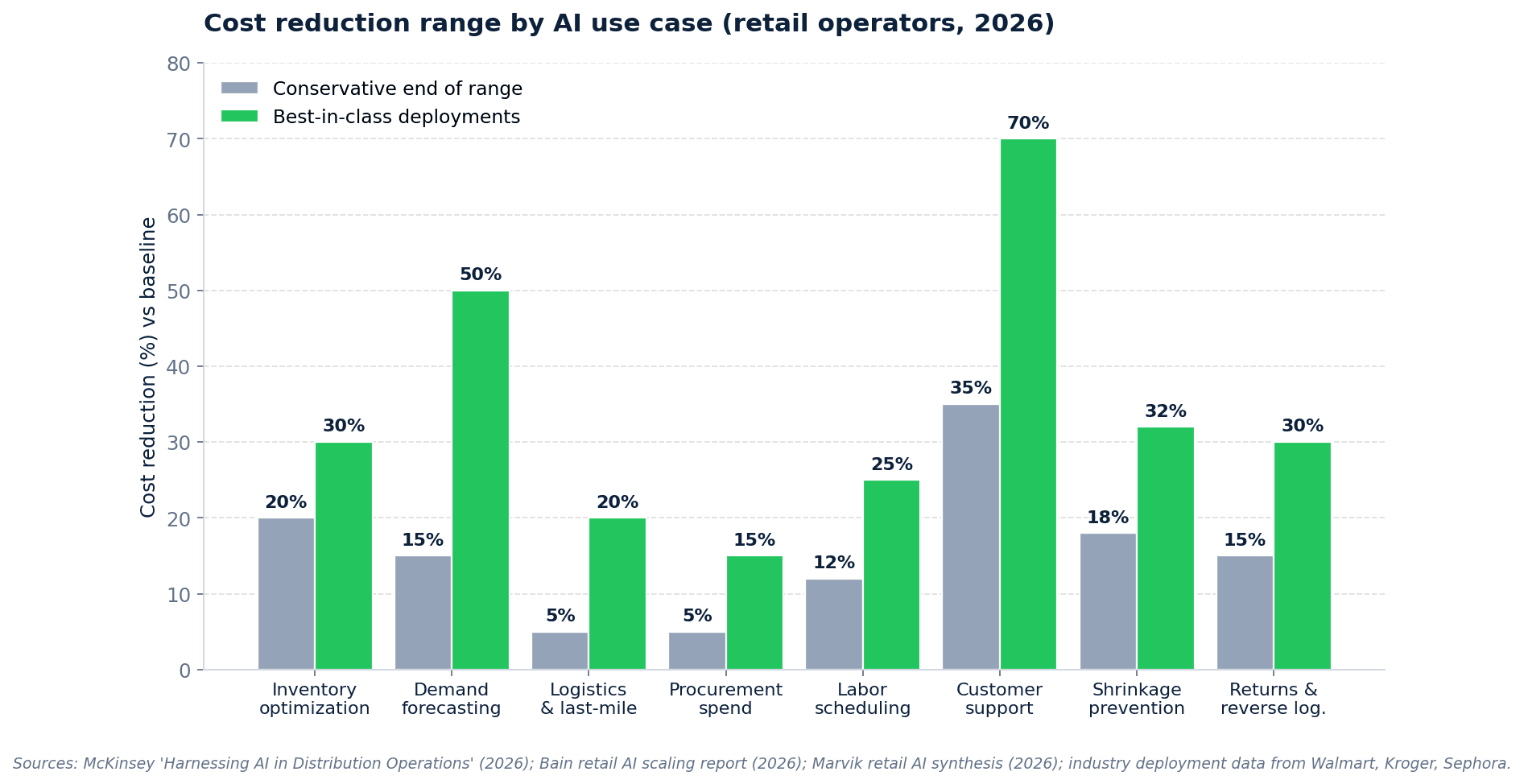
Two patterns to notice. First: the spread between conservative and best-in-class is widest in customer support (35% to 70%) and demand forecasting (15% to 50%). That gap is the difference between a tactical deployment and an integrated one. Second: every play delivers at least 5% cost reduction at the conservative end - meaning even a poorly-implemented version of any one of these pays for itself.
Where the highest-ROI plays sit
Cost reduction tells you what you save. ROI per dollar invested tells you which plays to prioritize when budget is tight.
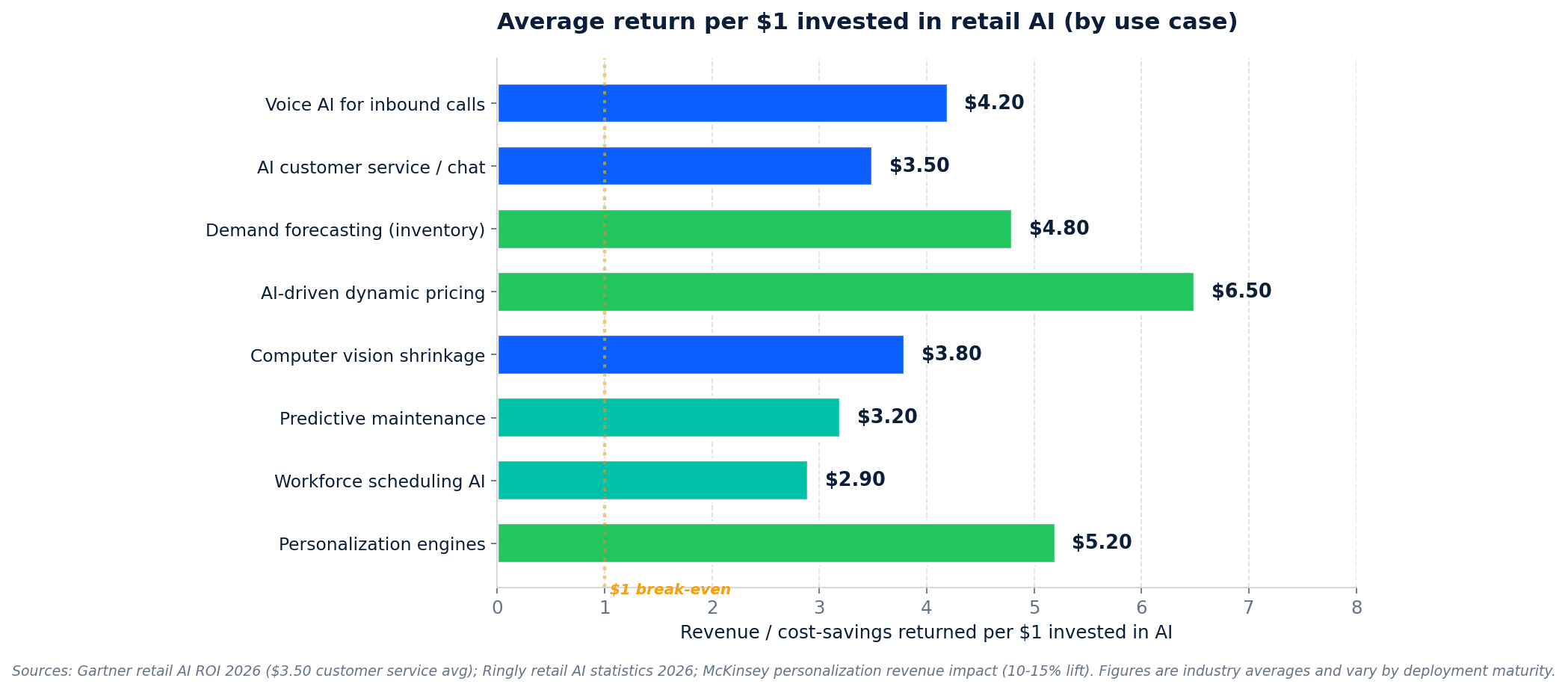
Dynamic pricing leads at $6.50 per $1 - the most underused high-ROI play in mid-market retail. Personalization at $5.20 confirms the hyper-personalization trend McKinsey has tracked for three consecutive years. Demand forecasting at $4.80 is the most strategic foundational play. Voice AI at $4.20 is the fastest-payback play. Workforce scheduling at $2.90 has the lowest ROI in the list - not because it doesn't work, but because integration costs eat into the first-year math.
How retail operations AI vendors approach the stack
Most retailers don't buy a single 'operational excellence' platform - they assemble 3–5 vendors across the 10 plays. Here's how the most cross-shopped vendors stack on the dimensions retail ops directors evaluate:
| Vendor | Best-fit play | Deployment time | Pricing model | Vertical depth |
|---|---|---|---|---|
| Blue Yonder | Forecasting + supply chain | 6–12 months | Enterprise license | Deep retail |
| Microsoft Cloud for Retail | Personalization + analytics | 3–9 months | Azure consumption | Broad horizontal |
| Oracle Retail | Inventory + pricing | 9–18 months | Enterprise license | Deep retail |
| Manhattan Associates | Supply chain + WMS | 6–12 months | Enterprise license | Deep supply chain |
| SuperMIA | Voice + chat + customer service | 48 hours | Credit-based | Multi-vertical |
SuperMIA fits in the customer-service / voice / chat layer of the stack, alongside (not replacing) enterprise platforms for forecasting, supply chain, and WMS. The play here is composability: own the customer touchpoint while letting your existing supply chain stack do supply chain.
One honest caveat
77% of retailers allocate 5% or less of their tech budget to AI (NRF, 2026), and the most common failure mode is buying tools without budgeting change management. Even the best-built AI deployment fails if your store managers don't understand what changed in their daily workflow. Budget at minimum 15–20% of your AI tooling spend for training, change management, and ongoing optimization. Skip this and you'll have a platform nobody uses by month four.
Case study: a mid-market specialty retailer's 12-month rollout
The following is a composite drawn from typical mid-market specialty retail deployments. Specific named SuperMIA retail customers are available under NDA - contact the team for references.
A 67-location specialty retailer (apparel + accessories, ~$180M annual revenue) ran the 10 plays in a sequenced 12-month rollout. The team prioritized fast-payback plays in months 1–3 to fund the harder integrations in months 6–12.
Months 1–3: Voice AI + AI chat (the cash-flow plays)
- Voice AI deployed to inbound store-locator + order-status calls. 70% deflection rate. ~$240K annual savings on contact center spend.
- AI chat deployed to website widget. 57% deflection on tier-1 inquiries. Customer service NPS up 8 points.
- Total cash recovery in 90 days: ~$310K. Used to fund the next phase.
Months 4–6: Demand forecasting + dynamic pricing
- AI forecasting integrated with existing ERP. Stockout rate dropped from 12% to 5%. Carrying inventory down 18%.
- Dynamic pricing on 25% of SKU mix. Margin lift of 280 bps on those SKUs.
- Combined annual impact at this stage: ~$2.1M of recovered margin and inventory cost.
Months 7–12: Computer vision + workforce scheduling + returns
- CV shrinkage detection across 23 highest-loss locations. Shrink rate cut from 1.8% to 1.1%. ~$840K recovered annually.
- AI scheduling rolled chain-wide. Labor cost down 9% with same service levels. Manager time saved: 5–7 hours per store per week.
- AI returns dispositioning. Returns processing cost down 22%. Recovered value per returned item up 14%.
12-month total
~$4.2M of operating margin recovery. Total AI tooling spend: ~$420K. ROI: 10x. Payback period for the full stack: 84 days.
Where SuperMIA fits in the operational stack
SuperMIA isn't a forecasting platform or a WMS - those are 12-month enterprise deployments with their own ecosystems. SuperMIA is the customer-touchpoint layer of your operational stack: voice and chat agents that handle the inbound calls, web messages, and SMS that would otherwise consume your contact center budget.
- Voice agents for store inquiries - 24/7 phone coverage that resolves order status, store hours, returns, and curbside pickup without holding humans for tier-1 traffic.
- Chat agents on web + WhatsApp + SMS - same intelligence as voice, deployed to whatever channel your customers actually use.
- Catalog-grounded responses - RAG architecture means agents read live inventory and order data, no hallucination.
- 48-hour deployment promise - standard workflows ship in 2 days; enterprise integrations in 2–4 weeks.
- Bundled compliance - GDPR and HIPAA (for healthcare-adjacent retail) included in the Enterprise tier.
Explore SuperMIA for retail, or compare pricing tiers against your projected call volume.
Frequently Asked Questions
Stop the bleed.
Back to Tuesday morning. The shrink number is high. The schedule fell apart. The voicemail backlog is 14 hours deep. None of these are catastrophic. All of them happen every week. Together they're costing you 8–22% of operating margin.
None of the 10 plays in this guide are net-new technology. The retailers winning at operational excellence aren't using AI nobody else has - they're sequencing the deployments correctly, budgeting for change management, and refusing to buy point solutions that don't integrate. Voice AI in 90 days. Forecasting in 6 months. Vision in 9. Dynamic pricing in 12. The 12-month total: 20–40% of operating cost recovered.
The competitive gap between retailers running this stack and retailers still running 2019 ops is widening every quarter. The faster-payback plays exist to fund the slower ones. Start there.
Start with the fastest-payback play.
SuperMIA deploys to retail voice and chat in 48 hours. See it live with your use case.
Book your SuperMIA retail demo →
Harikrishna Patel
Harikrishna Patel is the founder of MIA – My Intelligent Assistant, the AI automation platform built under Botfinity Inc. in Dallas, Texas. With 15+ years in software engineering, AI/ML, and enterprise solution design, he focuses on creating practical, scalable AI tools that help businesses automate support, workflows, and operations through voice and chat.