
Table of Contents
- Quick Answer
- What Is an AI Marketing Campaign Generator?
- The 10-Minute Campaign Build (Step-by-Step)
- What You Get From One Brief: The Deliverable Matrix
- Old Marketing Manager Day vs New
- Jasper vs Copy.ai vs ChatGPT vs SuperMIA
- Where AI Campaign Generators Are NOT the Right Fit
- How Campaign Generators Fit Into Your Stack
- Frequently Asked Questions
The Solo Marketer Math Problem
A senior marketing manager at a Series A B2B SaaS posted on r/marketing about being the entire marketing department for a 35-person company. Product had 15 engineers shipping features she didn't have time to market. Sales had a pipeline she didn't have time to feed. The thread filled with 146 other solo and lean marketers saying the same thing: the math doesn't math. You can't ship 8 campaigns a quarter when each campaign takes a full work week to stitch across email, social, ads, landing pages, and blog posts.
Meanwhile, in a separate thread, a B2B marketer wrote that marketing is "slowly turning into engineering" - noting the rise of "marketing engineer" as a job title, joining growth engineer, content engineer, and lifecycle engineer. The post wasn't complaining; it was naming a real shift. Modern marketing operations require building, orchestrating, and shipping at engineering pace. The people doing it know they need new infrastructure.
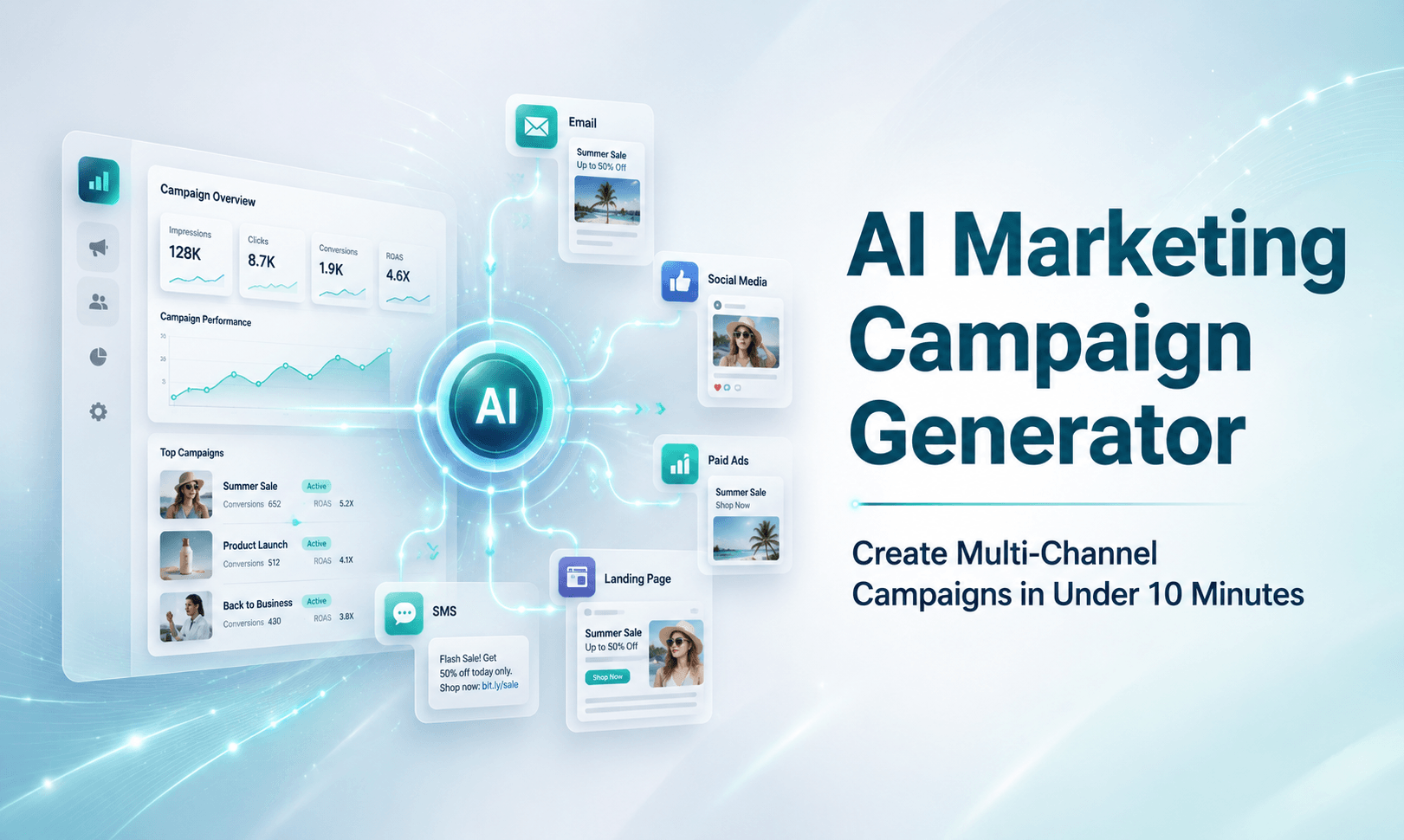
This guide walks through one of those new pieces of infrastructure - the AI marketing campaign generator. Not as a vendor pitch and not as another listicle, but as a literal product walkthrough: minute-by-minute build of a real campaign showing what a marketing manager sees on screen at each step. By minute 10, the campaign is shipped: email sequence drafted, five social posts written, two ad variants live, landing page generated, blog outline produced, all visual prompts ready. The same campaign that used to take a full work week.
The platform under the hood is the AI marketing campaign generator. Inside this guide: how AI campaign generators differ from AI copy tools like Jasper and Copy.ai, the 10-minute step-by-step build, the full multi-channel deliverable matrix from one brief, a before-and-after workflow comparison, an honest 4-vendor comparison, and where the AI gets it right and where it doesn't.
Generate your first campaign free.
One brief in, a full multi-channel campaign out.
Generate your first campaign free →Quick Answer
An AI marketing campaign generator is software that takes a campaign brief (product, audience, channels, goal) and produces a full multi-channel campaign - email sequence, social posts, ad copy variations, landing page draft, blog outline, and visual prompts - from a single input in under 10 minutes. It differs from AI copy tools like Jasper and Copy.ai, which generate text for one channel at a time. Campaign generators orchestrate the whole campaign in one pass.
What Is an AI Marketing Campaign Generator?
An AI marketing campaign generator is software that produces a complete multi-channel marketing campaign from a single brief. Output typically includes email sequences, social posts, ad variants, landing pages, and blog outlines - all consistent in brand voice and aligned to one strategic angle. Build time: under 10 minutes per campaign.
- AI copy tools (Jasper, Copy.ai) write text one channel at a time - campaign generators orchestrate the whole campaign.
- Typical output from one prompt: 1 email sequence + 5 social posts + 2 ad variants + 1 landing page + 1 blog outline + image prompts.
- Build time: 8–10 minutes per campaign once the brief is captured.
- Best fit: solo marketers, lean B2B marketing teams, agencies with concurrent client load.
- Where not fit: enterprise marketing teams with strict legal review cycles (AI generation then legal queue is still slow).
Key Takeaways
- The bottleneck for solo and lean marketing teams is throughput, not ideas - campaign generators solve throughput.
- Channel-specific rewriting is the most-cited time sink in r/marketing threads - generators kill that step.
- Brand voice consistency across channels improves with generators because all assets come from one source.
- Visual prompts are now table stakes - you don't need to write 'midjourney prompt for hero image' yourself.
- ROI math is dominated by campaign volume increase (3–6x more campaigns per quarter), not just time saved per campaign.
The 10-Minute Campaign Build (Step-by-Step Walkthrough)
Worked example: a Series A SaaS marketing manager needs to launch a campaign for a new AI feature targeting marketing ops leaders. Here's what the next 10 minutes look like.
| Minute | Step | What happens on screen |
|---|---|---|
| 0–2 min | Input campaign brief | Fill 5 fields: product, target audience, campaign goal, channels, key proof points. Optional: paste your brand voice guide. |
| 2–4 min | AI generates 3 strategic angles | Three campaign concepts appear side-by-side: problem-focused, outcome-focused, competitive-positioning. Pick one. |
| 4–6 min | Multi-channel content expansion | Selected angle expands automatically into channel-specific drafts: email sequence, social posts, ad copy, landing page, blog outline. |
| 6–8 min | Visual prompts + brand voice check | AI generates Midjourney/DALL-E prompts for each visual asset. Brand voice score per asset. |
| 8–10 min | Review + push | Review each asset, edit inline, approve. One-click push to scheduler, ESP (HubSpot, Mailchimp), or CMS. |
Inside Minutes 0–2: The Campaign Brief
This is the only step that requires marketer judgement. Five fields:
- Product: 'Series A SaaS - AI feature for marketing campaigns'.
- Target audience: 'Marketing ops leaders at 50–500 employee B2B SaaS'.
- Goal: 'Drive demo signups; secondary, build authority on AI marketing'.
- Channels: Email, LinkedIn, Twitter, ad copy (LinkedIn + Google), landing page, blog.
- Proof points: '10-minute build time, $487K saved per migration, 3–6x campaign volume'.
Two minutes from blank-page to ready-to-generate. The marketer's job at this step is sharp brief writing - the AI is downstream of how good the brief is. Vague brief in, vague campaign out.
Inside Minutes 2–4: Three Strategic Angles
| Angle | Hook | Best for |
|---|---|---|
| 1. Problem-focused | 'Marketing managers shipping 8 campaigns/quarter while running everything else' | Audiences feeling acute pain |
| 2. Outcome-focused | 'Ship 3x the campaigns. Spend 90% less time stitching channels.' | Audiences ROI-motivated |
| 3. Competitive-positioning | 'Jasper writes copy. Campaign generators ship campaigns. Here's the difference.' | Audiences in active vendor evaluation |
The marketer picks one. The selection determines the rest of the campaign - hook, framing, emotional register, and CTA pattern all flow from this choice. If unsure, the marketer can have the AI generate all three campaigns in parallel and A/B test.
Inside Minutes 4–6: Multi-Channel Content
Once the angle is locked, the AI generates channel-specific content in parallel. Outputs aren't reformatted copies of one master - each channel gets channel-native length, tone, and structure. LinkedIn doesn't read like an email; emails don't read like ad copy.
What You Get From One Brief: The Deliverable Matrix
| Channel | Format | Length | Notes |
|---|---|---|---|
| 3-step sequence (announcement, nudge, last-call) | 80–140 words each | Subject line variants for A/B included | |
| 2 posts (founder voice + corporate voice) | 150–220 words each | Hook-driven, formatted with line breaks | |
| Twitter/X | 3 posts - single tweet + thread + reshare | Single 250 chars + thread 7 tweets | Hook tweet optimized for engagement |
| Instagram / Facebook | 1 carousel caption + 1 feed post | Carousel 9 slides; feed 120–180 words | With hashtag block (10–12 tags) |
| Ad Copy | 2 variants × 2 platforms (LinkedIn + Google) | 30-char headline + 90-char description | Multiple variants for A/B |
| Landing Page | Full page draft | 800–1,200 words | H1 + hook + 3 proof sections + FAQ + CTA |
| Blog Outline | H2/H3 outline + suggested word counts | 1,500–2,000 words target | SEO H1 + meta + suggested internal links |
| Image Prompts | 6 visual prompts (Midjourney/DALL-E format) | 20–40 words each | One per hero asset (email, ad, social, etc.) |
| Brand Voice Score | Consistency score 0–100 per asset | - | Flags any asset that drifts from brand voice |
That's nine deliverables from one 5-field brief. The marketing manager who used to spend a work week assembling this stack now has the same stack in 10 minutes, ready for inline editing and approval.
For campaigns that need personalized variants by audience segment (industry, role, account tier), pair the campaign generator with personalized AI for segmented campaigns. For campaigns that need lead capture and qualification, layer an AI chatbot for campaign lead capture on the landing page.
Old Marketing Manager Day vs New Marketing Manager Day
| ❌ Old workflow - 5–8 hours per campaign | ✅ AI-assisted - 10 minutes per campaign |
|---|---|
| 09:00 - Stare at blank doc, gather product launch brief notes | 09:00 - Open campaign generator, paste 5-field brief |
| 09:30 - Write email draft in Jasper. Edit for tone. | 09:02 - Pick from 3 strategic angles |
| 10:30 - Rewrite for LinkedIn. Try 3 hooks. | 09:04 - 9 deliverables generated in parallel |
| 11:30 - Switch to ad copy. Open Copy.ai. Try variants. | 09:06 - Visual prompts ready for Midjourney/DALL-E |
| 12:30 - Lunch. Brain mush. | 09:08 - Review each asset, inline edit |
| 14:00 - Open Webflow. Build landing page section by section. | 09:10 - One-click push to scheduler + ESP + CMS |
| 15:30 - Switch to blog. Outline. Get distracted. | 09:11 - Move to next campaign (or strategic work) |
| 17:00 - Half-done. Carry over to tomorrow. | - |
The math: at 5–8 hours per campaign, a solo marketer ships 1–2 campaigns per week. At 10 minutes per campaign with AI assistance, the same marketer ships 3–6 campaigns per week and uses the recovered time for strategy, customer research, and performance analysis. The campaign volume increase is the ROI, not just the time savings on any single campaign.
Try the 10-minute build on your real campaign.
Your brief, your brand voice, your channels - generated live.
Try the 10-minute build →Jasper vs Copy.ai vs ChatGPT vs SuperMIA: Honest Comparison
Most 'AI marketing tools' listicles conflate copy tools and campaign generators. They're different products.
| Dimension | Jasper | Copy.ai | ChatGPT (DIY) | SuperMIA |
|---|---|---|---|---|
| Product type | AI copy tool | AI copy tool | General-purpose LLM | Campaign generator |
| Output from one prompt | One asset (email OR ad OR post) | One asset | Whatever you prompt for | 9 deliverables across all channels |
| Channel orchestration | Manual rewriting per channel | Manual rewriting | Manual rewriting | Channel-native auto |
| Strategic angle generation | Limited | Limited | Depends on prompt skill | 3 angles, side-by-side compare |
| Brand voice consistency | Strong (brand voice trainer) | Strong | Needs prompt engineering | Cross-asset consistency score |
| Image prompt generation | Limited | Limited | Manual | Native (Midjourney/DALL-E format) |
| Pricing (starter) | From $39/mo (Creator) | From $49/mo | Free / $20/mo (Plus) | Usage-tier from $300/mo (full stack) |
| Best for | Single-asset copy | Single-asset copy + workflows | Tinkering, ideation | End-to-end campaign generation |
| Best avoided when | Need full campaign orchestration | Need full campaign orchestration | Need template structure | Need standalone single-asset tool |
Honest read: Jasper and Copy.ai are excellent AI copy tools - their brand voice trainers and templates beat ChatGPT for any single-asset writing job. ChatGPT is the right choice for tinkering and ideation. Campaign generators like SuperMIA fit a different problem: when you need to ship multi-channel campaigns repeatedly at volume, the orchestration layer matters more than per-asset copy quality. Use Jasper if you have a copywriter who needs better tools. Use SuperMIA if you have a marketer who needs more campaigns shipped.
For full SuperMIA pricing across tiers, see SuperMIA pricing for marketing teams.
Where AI Campaign Generators Are NOT the Right Fit
Honest assessment - where you should NOT use SuperMIA's campaign generator:
- Strict legal review cycles. Pharma, finance, and other heavily-regulated verticals run every asset through legal review. AI generation then legal queue is still slow because the bottleneck is legal, not creative.
- Annual flagship campaigns only. If you ship 6 campaigns per year and want every word hand-crafted by a senior copywriter, generators are overkill. A great copywriter with Jasper beats a campaign generator on craft.
- Account-based marketing (ABM) for enterprise deals. Enterprise B2B campaigns selling $500K–$5M deals lean heavily on ABM personalization, sales enablement, and account-specific content. Generators help on supporting content; the named-account stuff still needs human craftsmanship.
- Creative-led brand marketing. If 80% of your marketing output is creative-led (brand films, signature events, original research), AI generators support the surrounding campaign but don't replace the centerpiece work.
How Campaign Generators Fit Into Your Stack
Campaign generators don't replace your marketing stack - they replace the 5–8 hours of stitching across it. The integration pattern most marketing teams use:
- Generation layer: Campaign generator (SuperMIA, future contenders) for the creative and multi-channel build.
- Voice layer: Brand voice trainer / asset library (your brand guidelines, past winners).
- Distribution layer: Email service provider (HubSpot, Mailchimp, Customer.io), CMS (Webflow, WordPress), ad platforms (LinkedIn, Google, Meta), social scheduler (Buffer, Hootsuite).
- Measurement layer: Analytics (GA4, HubSpot, Mixpanel) closing the loop on what worked.
For automating the handoff from campaign generation to distribution (campaign generated, then ESP loaded, then social scheduled, then ads launched, then CRM updated), pair the campaign generator with no-code automation for campaign delivery workflows.
Sources
- HubSpot - State of Marketing Report.
- Content Marketing Institute - content benchmarks.
- Jasper - published pricing (verify current rates).
- Copy.ai - published pricing (verify current rates).
Frequently Asked Questions
The Bottom Line for Solo and Lean Marketing Teams
The r/marketing post that opened this guide wasn't a complaint. It was a math problem. A solo senior marketing manager at a 35-person SaaS, scaling revenue 5x, didn't have a path to ship enough campaigns to keep up with product velocity. The shape of that problem is the shape of modern marketing for everyone outside Fortune 500 teams: lean structures, multi-channel demand, no time for the stitching work.
AI campaign generators are not a replacement for marketing judgement. They're a throughput multiplier on the work that doesn't need senior judgement - the channel-specific rewriting, the format conversion, the visual prompt drafting, the brand voice policing. By collapsing those 5–8 hours into 10 minutes, generators let solo marketers ship 3–6x more campaigns per quarter, and let lean teams focus their senior judgement on strategy, customer research, and performance analysis instead of stitching channels.
If you want to see your real next campaign generated in 10 minutes from your real brief - with your brand voice, your proof points, your channels - book a call below. The 15-minute demo runs on your actual campaign, not a canned example.
Generate your first campaign free.
Your real brief, your brand voice - generated in 10 minutes.
Generate your first campaign free →
Harikrishna Patel
Harikrishna Patel is the founder of MIA – My Intelligent Assistant, the AI automation platform built under Botfinity Inc. in Dallas, Texas. With 15+ years in software engineering, AI/ML, and enterprise solution design, he focuses on creating practical, scalable AI tools that help businesses automate support, workflows, and operations through voice and chat.