
Table of Contents
- Is dental AI HIPAA compliant?
- What counts as PHI on a dental AI call?
- BAAs: the contract that makes AI compliant
- What a strong AI BAA must include
- Call-recording risks (the costly mistake)
- State two-party consent laws
- What HIPAA violations actually cost
- The 2026 Security Rule update (still proposed)
- Questions to ask any dental AI vendor
- Frequently asked questions
Important: this article is educational information, not legal advice. HIPAA obligations depend on your specific workflows and state law. Validate decisions with compliance counsel.
Quick Answer
Dental AI can be HIPAA compliant, but only with the right safeguards and contracts. You need a signed BAA, encryption in transit and at rest, minimum-necessary access controls, audit logging, and correct call-recording consent handling. There is no such thing as a HIPAA-certified AI product; compliance comes from implementation plus governance, and the practice remains accountable.
Key takeaways
- A routine dental booking call can capture multiple PHI elements in under two minutes.
- A signed BAA is required before any AI vendor handles patient data on your behalf.
- Call recording is a high-risk area: consent rules, encryption, and retention policy must be explicit.
- "HIPAA certified" is marketing language, not an official compliance status.
- Penalty exposure can be substantial, and enforcement risk is real.
Is dental AI HIPAA compliant?
Dental AI is not automatically compliant or non-compliant. It becomes compliant only when contractual, technical, and operational safeguards are in place. If a system touches PHI, it must be governed under HIPAA controls regardless of whether the tool is new or "AI" branded. This applies whether you use an AI dental assistant or broader healthcare AI workflows, and it is a core consideration in any dental practice AI deployment.
The distinction matters because vendors love the phrase "HIPAA compliant" on a landing page, but there is no government body that certifies a product as HIPAA compliant. Compliance is a property of how a system is configured, contracted, and operated in your specific environment - not a badge a product carries out of the box. A dental voice AI that answers patient calls can be fully compliant in one practice and a liability in another, depending entirely on whether the BAA, encryption, access controls, and consent handling are actually in place. The burden of confirming that sits with you as the covered entity.
What counts as PHI on a dental AI call?
PHI is individually identifiable health information. In real dental call flows, that usually includes name, phone, date of birth, appointment reason, treatment context, insurance details, and contact identifiers. Per HHS HIPAA guidance, identifying context is what determines PHI scope.
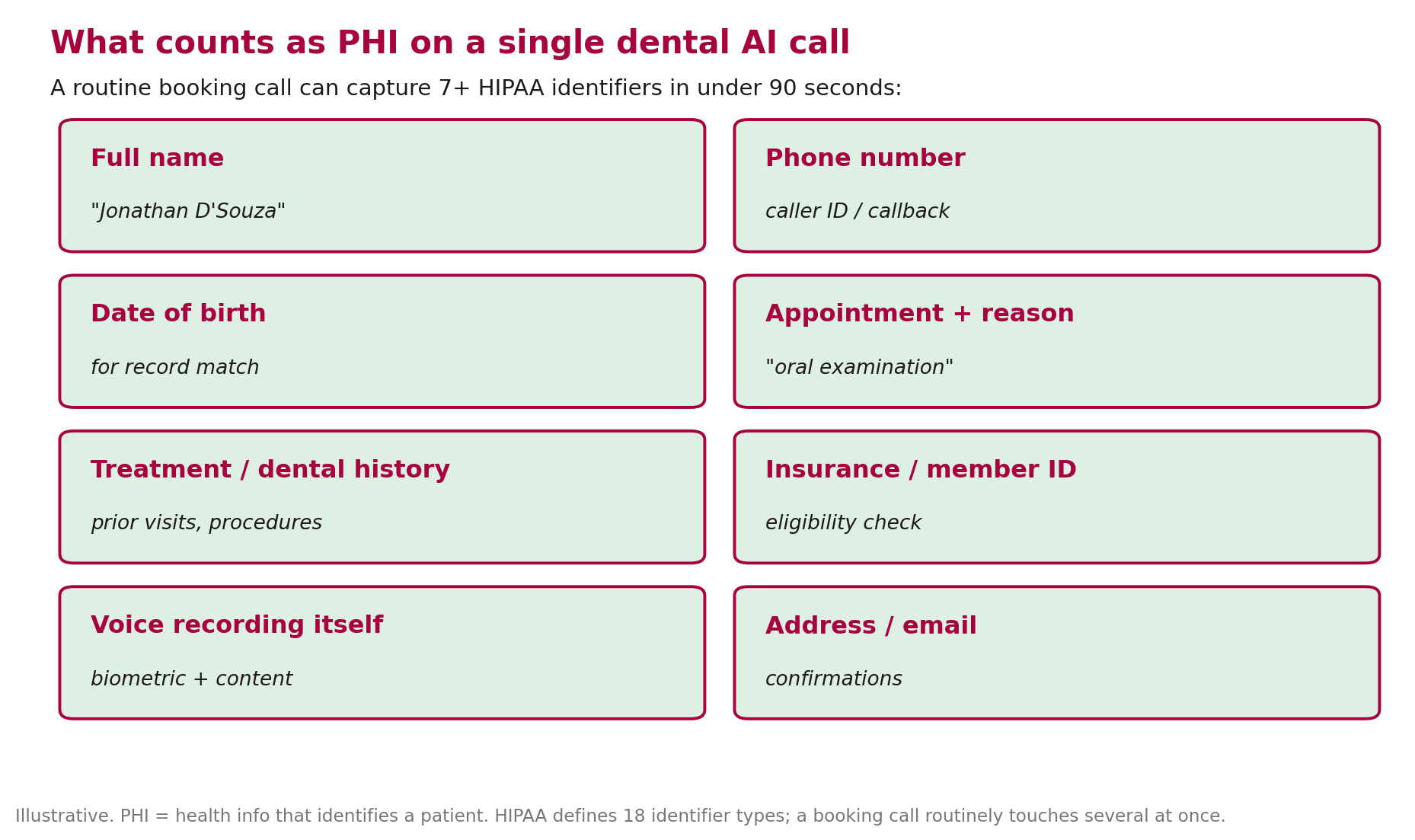
Figure 1. PHI elements captured during a routine dental AI call.
The voice recording itself can be PHI when it contains identifying or health-related information. Once recording starts, HIPAA safeguards and consent workflows must already be active.
It's easy to underestimate how fast PHI accumulates. A single routine booking call - "Hi, this is Jane Doe, date of birth March 3rd, I need to come in because my crown came loose, and here's my Delta Dental member ID" - captures a name, a date of birth, a treatment reason, and an insurance identifier in under a minute. Each of those is an individual identifier under HIPAA, and together they are unambiguously PHI. The lesson for any AI deployment is that there is no "low-risk" portion of a patient call you can leave outside your safeguards; from the moment the AI answers, it should be operating inside the same compliance envelope as your clinical records, including transcripts, recordings, and any structured data the system extracts.
BAAs: the contract that makes AI compliant
A Business Associate Agreement is the legal mechanism that allows a vendor to create, receive, maintain, or transmit PHI on your behalf. If a dental AI vendor handles PHI without a BAA, that is a major compliance gap. A practical rule: if a vendor will not sign a BAA, do not move PHI through that system.
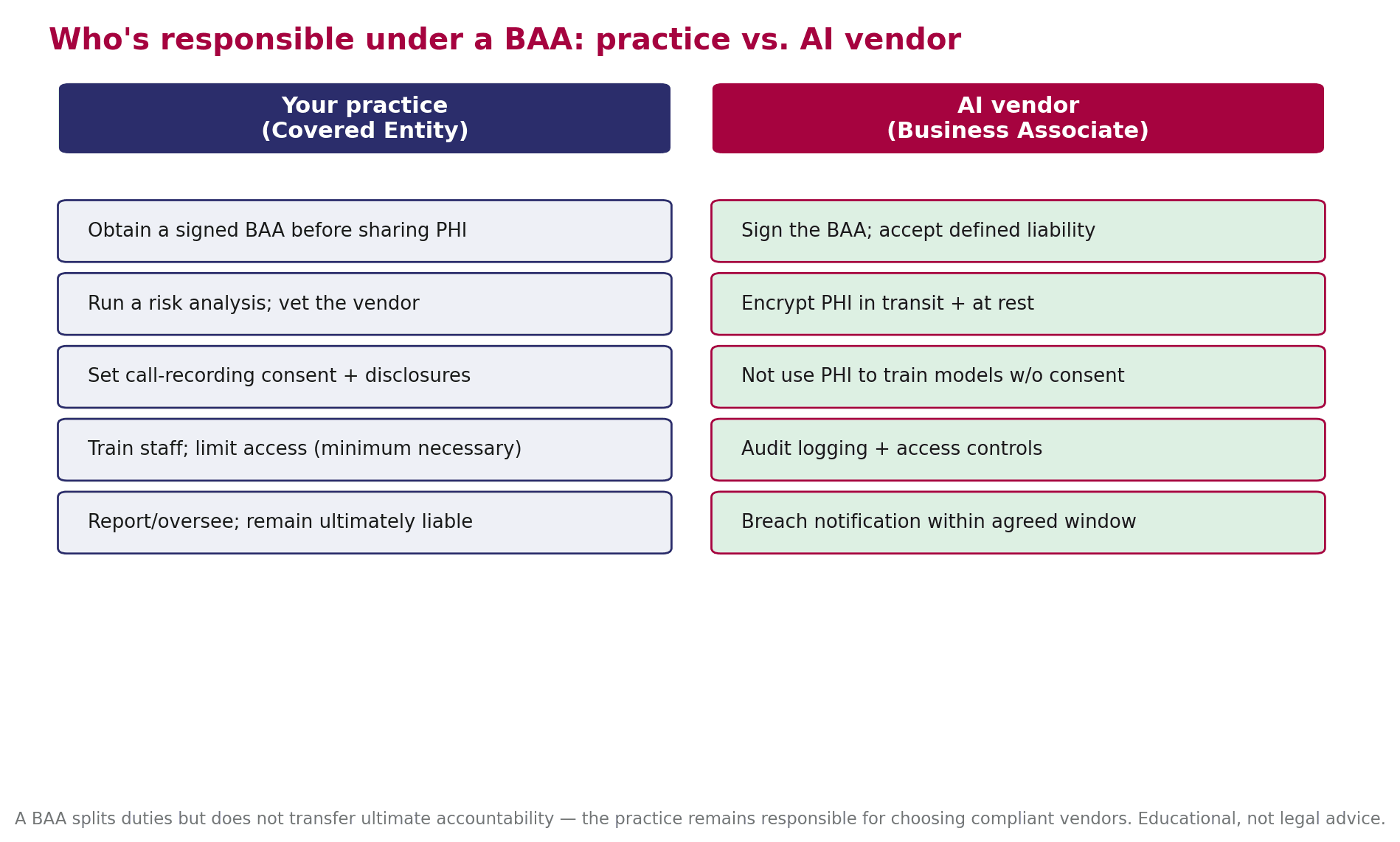
Figure 2. Responsibility split under a BAA.
A BAA allocates responsibility, but it does not remove accountability from the dental practice. Vendor oversight remains your job as the covered entity.
It's worth understanding what the BAA actually does and doesn't cover. Per HHS sample BAA provisions, the contract obligates the business associate to safeguard PHI, report breaches, and return or destroy data at termination - but the covered entity still carries the duty to vet the vendor, monitor the relationship, and ensure the safeguards are real rather than promised. A signed BAA with a vendor that has weak technical controls is not protection; it is a paper trail of shared liability. That is why the contract and the technical due diligence have to go together. Read the BAA closely for three things in particular: whether subcontractors are flowed down the same obligations, whether the vendor can use de-identified data for its own purposes, and what happens to your recordings and transcripts when you cancel.
One clause deserves special scrutiny in the AI era: model training. Many AI vendors reserve the right to use customer data to improve their models. For a dental practice, PHI flowing into a shared training pipeline is a serious exposure. A strong BAA explicitly prohibits training on your PHI without consent and confirms that any analytics are performed on properly de-identified data.
What a strong AI BAA must include
- Explicit business-associate designation and limited permitted use.
- Required safeguards: encryption, access control, audit logging.
- An explicit clause preventing cross-client model training on your PHI without consent.
- Clear breach notification timing and data return/destruction obligations at termination.
Call-recording risks (the costly mistake)
Recording helps quality control, but recordings are sensitive and must be handled as PHI when they contain identifiable patient information. The high-cost failures usually come from missing disclosure, weak consent handling, poor retention controls, or broad internal access.
The mechanics matter. A recorded call that captures a patient's name, date of birth, and reason for visit is PHI the moment it exists, so the same encryption, access limits, and retention rules that apply to a chart apply to the audio. Two failure patterns recur. The first is retention sprawl - recordings accumulate indefinitely in a vendor's cloud with no defined deletion schedule, multiplying the data exposed in any breach. The second is over-broad access - every staff member, or the vendor's support team, can replay any call. A disciplined practice sets a retention window, restricts playback to a named few, and confirms recordings are deleted on schedule and on termination. If you run a voice AI on your phone lines, confirm the vendor lets you configure retention and access rather than defaulting to indefinite storage.
State two-party consent laws
HIPAA governs security/privacy obligations; state law governs whether and how call recording consent must be obtained. Many states require all-party consent. Build a recording disclosure and consent checkpoint before collecting clinical details.
This is a layer most practices underestimate, because it is independent of HIPAA. A system can be perfectly HIPAA-compliant and still break a state wiretapping law if it records a patient in an all-party-consent state without an upfront disclosure. The safe default is to announce recording at the very start of every call - "this call may be recorded for quality and scheduling" - and capture acknowledgment before any clinical detail is discussed. That single disclosure satisfies the strictest states and removes the need to detect a caller's location mid-call. For multi-location practices that take calls across state lines, applying the strictest standard everywhere is far simpler and safer than maintaining per-state logic. Confirm your approach with counsel, since consent statutes vary and carry their own penalties separate from HIPAA.
| Commonly cited all-party states | Operational requirement |
|---|---|
| CA, CT, FL, IL, MD, MA, MI, MT, NH, PA, WA | Announce recording at call start and capture consent before PHI collection |
What HIPAA violations actually cost
Civil penalties are tiered by culpability. As summarized by HIPAA Journal (reflecting 2026 adjusted ranges), exposure spans from low-tier per-violation penalties to multi-million-dollar annual caps for severe categories. The HHS OCR enforcement record shows that settlements frequently target the failures that are easiest to avoid: missing BAAs, no risk analysis, and inadequate access controls.
The tiers scale with intent. A violation you didn't know about and couldn't reasonably have prevented sits at the bottom; one caused by willful neglect that you failed to correct sits at the top, with the largest per-violation amounts and annual caps. For a dental practice, the practical takeaway is that documentation is a defense. If you ran a risk analysis, signed BAAs, and can show the controls you put in place, you land in a far lower tier than a practice that simply never addressed AI vendor risk. The most expensive penalties are rarely about a single technical slip - they follow from a pattern of having ignored the obligation altogether.
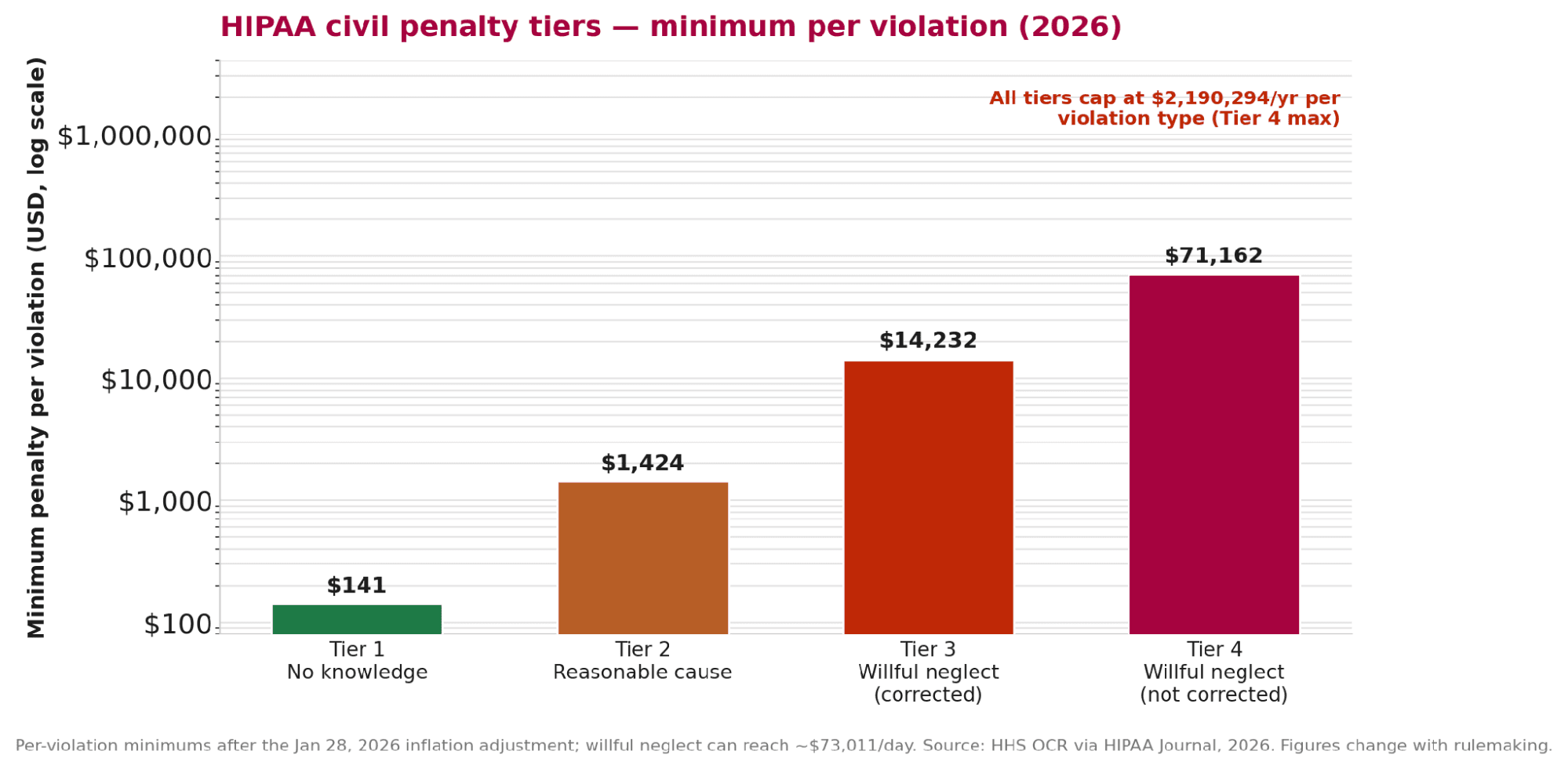
Figure 3. HIPAA civil penalty tiers (2026 ranges).
The 2026 Security Rule update (still proposed)
The 2026 tightening discussed in the market remains proposed, not finalized, as of mid-2026. Practices should continue meeting current Security Rule requirements now while tracking final-rule updates from HHS OCR Security Rule resources.
The proposed direction is worth understanding even before it finalizes, because it signals where enforcement attention is heading: stronger encryption expectations, mandatory and more frequent risk analyses, tighter access management, and clearer requirements around documenting safeguards. None of these are new in spirit - they are the existing Security Rule made more explicit and less optional. A practice that builds its AI vendor process around encryption, least-privilege access, audit logging, and a documented annual risk analysis today will be well-positioned regardless of how the final rule lands. The worst position is to treat the proposed rule as a reason to wait; the current rule already requires the fundamentals, and "we were waiting for the update" is not a defense.
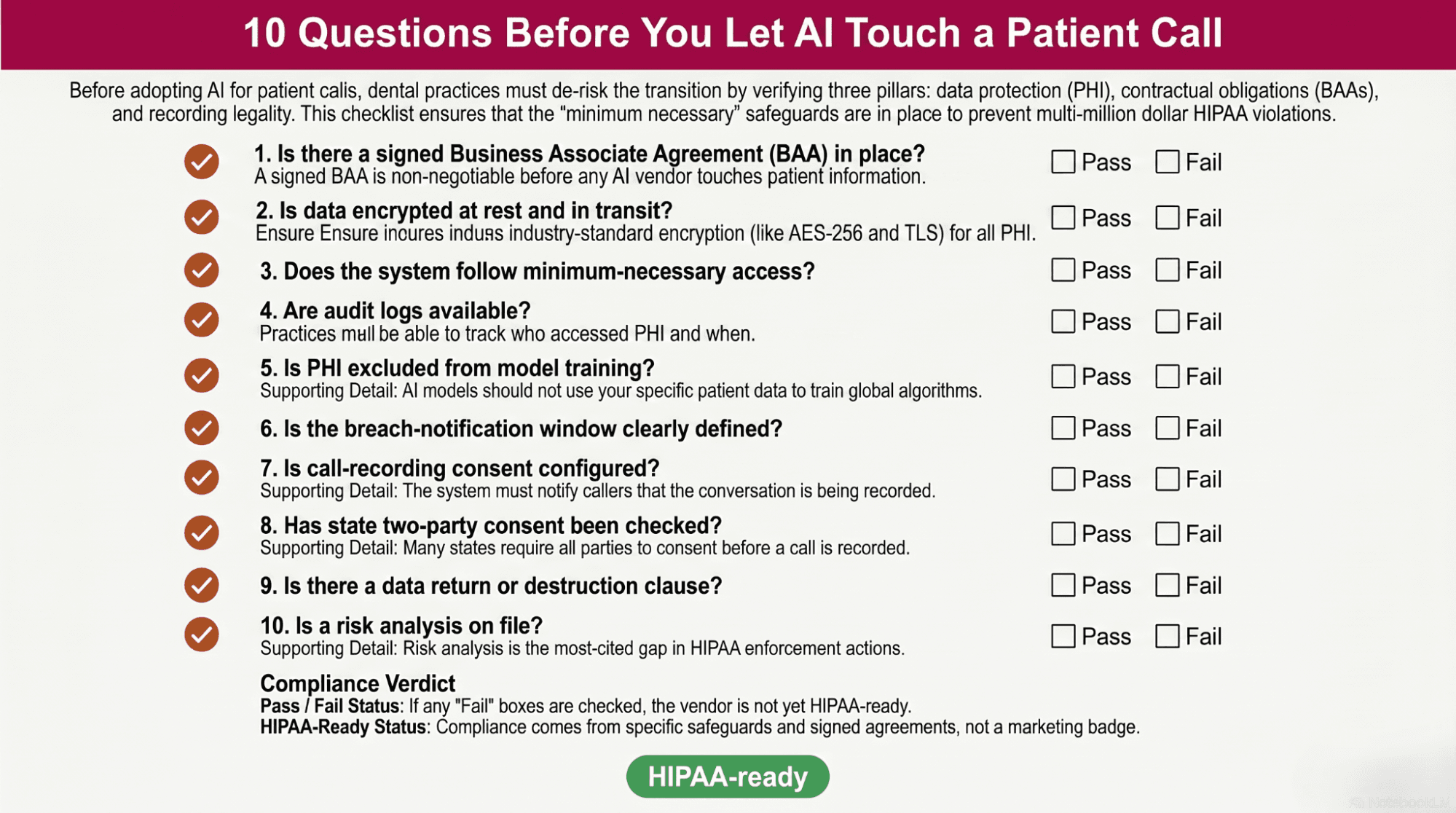
Questions to ask any dental AI vendor
- Will you sign a BAA before any PHI is processed?
- Is data encrypted at rest and in transit, and where is it hosted?
- Do you use client PHI for model training by default?
- How do you enforce recording consent by state?
- What is your breach-notification SLA and data-destruction process?
How SuperMIA approaches HIPAA
Apply the same checklist to every vendor, including us. SuperMIA is designed for HIPAA-aligned workflows with encryption, access controls, auditability, and BAA availability on eligible plans. The SuperMIA platform handles voice and chat under one governed setup, so the same safeguards, consent logic, and audit trail apply whether a patient calls or messages. You can review deployment fit, safeguards, and commercial details across pricing and a live workflow review.
Ask us about BAA terms and safeguards.
Bring your current process, and we will map data flow, consent logic, and controls before rollout.
Book a compliance review →Frequently asked questions

Harikrishna Patel
Harikrishna Patel is the founder of MIA – My Intelligent Assistant, the AI automation platform built under Botfinity Inc. in Dallas, Texas. With 15+ years in software engineering, AI/ML, and enterprise solution design, he focuses on creating practical, scalable AI tools that help businesses automate support, workflows, and operations through voice and chat.