
Table of Contents
- The short answer on Synthflow pricing in 2026
- What Synthflow actually charges (the per-minute stack)
- The 2026 model change most guides missed
- The real cost at 1,000, 10,000 and 100,000 calls
- The hidden cost drivers most guides skip
- Where PAYG stops making sense
- Synthflow vs SuperMIA — modular vs bundled
- Which one is right for you
- Frequently asked questions
Synthflow now offers two plans to new customers: Pay-As-You-Go and Enterprise (the old Pro and Growth tiers are closed). Under PAYG you assemble a per-minute rate from a voice engine at $0.09, an LLM, telephony and optional add-ons, landing effectively around $0.11–$0.24 a minute. Past roughly 10,000 minutes a month, Enterprise — custom, annual, from about $30K a year — takes over.
Compare the real numbers for your use case — book a 15-minute demo →
Key takeaways
- The pricing changed in 2026. New customers get PAYG or Enterprise only. Pro/Growth/Agency are legacy — if a guide quotes them, it’s out of date.
- You assemble your own per-minute rate. $0.09 voice engine + LLM + telephony + add-ons — effectively ~$0.11–$0.24/min, or up to ~$0.37 with BYOK provider fees.
- Cheap to start, steep at scale. Great for pilots; past ~10,000 min/mo it pushes you to a custom Enterprise annual commitment (~$30K/yr floor).
- Watch the hidden drivers. Concurrency is $20/call/mo beyond 5; routing add-ons stack $0.08/min; and 5 chat messages count as 1 voice minute.
- It’s voice-only. As of 2026, Synthflow handles phone calls — chat and other channels need separate tooling.
The short answer on Synthflow pricing in 2026
If you’ve read other Synthflow pricing guides, start here, because a lot of them are quoting plans you can’t actually buy. Synthflow simplified its pricing in 2026. New customers now choose between just two options:
Pay-As-You-Go: no platform fee, no contract. You assemble a per-minute rate from a voice engine, a language model and telephony, and pay only when calls run. Best for pilots and deployments under roughly 10,000 minutes a month.
Enterprise: custom, annual, aimed at 10,000+ minutes a month. Required if you need HIPAA, a guaranteed uptime SLA, minute rollover or unlimited concurrency. Independent analysis references an annual commitment starting around $30,000 — though that’s a floor reference, not a quoted price.
⚠️ The tiers you may have seen elsewhere — Starter $29, Pro $99, Growth $449, Agency $899 — are legacy plans. Existing customers can stay on them, but new customers can’t choose them any more. If a comparison article is leading with ‘Pro at $99/month’, it’s describing pricing that’s no longer on the table.
What Synthflow actually charges (the per-minute stack)
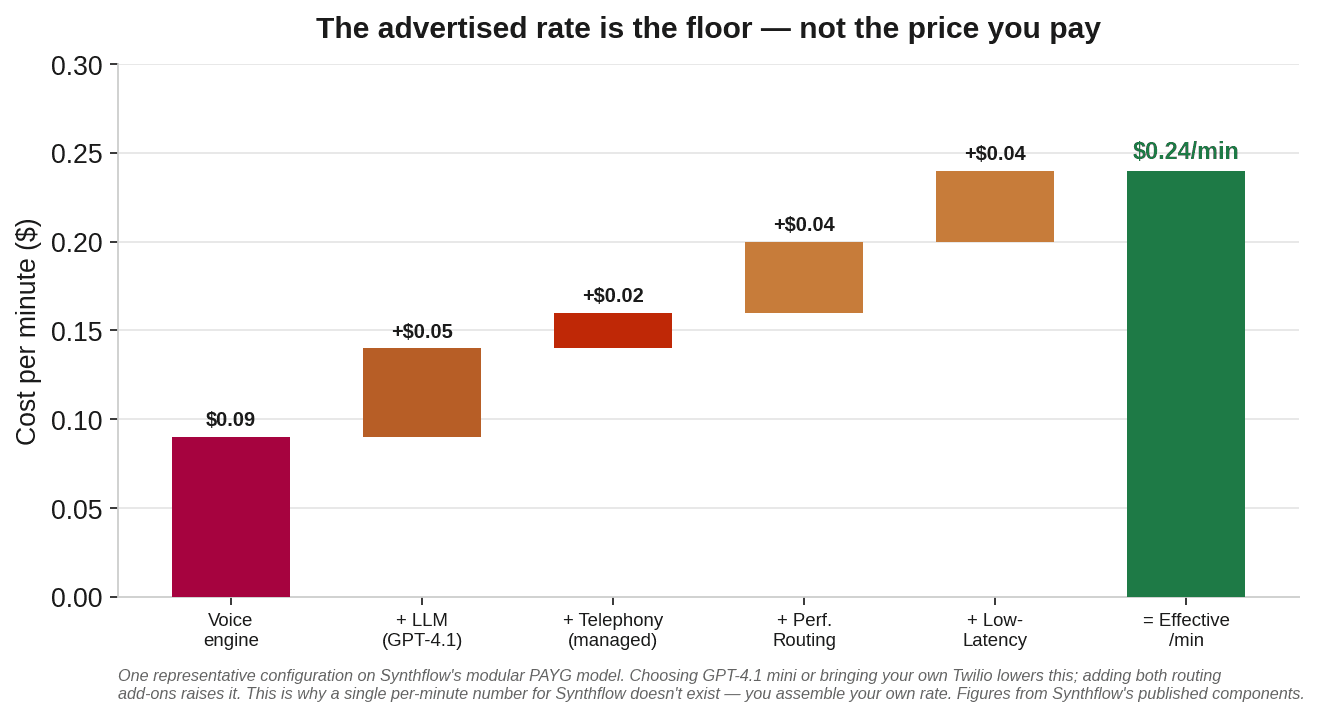
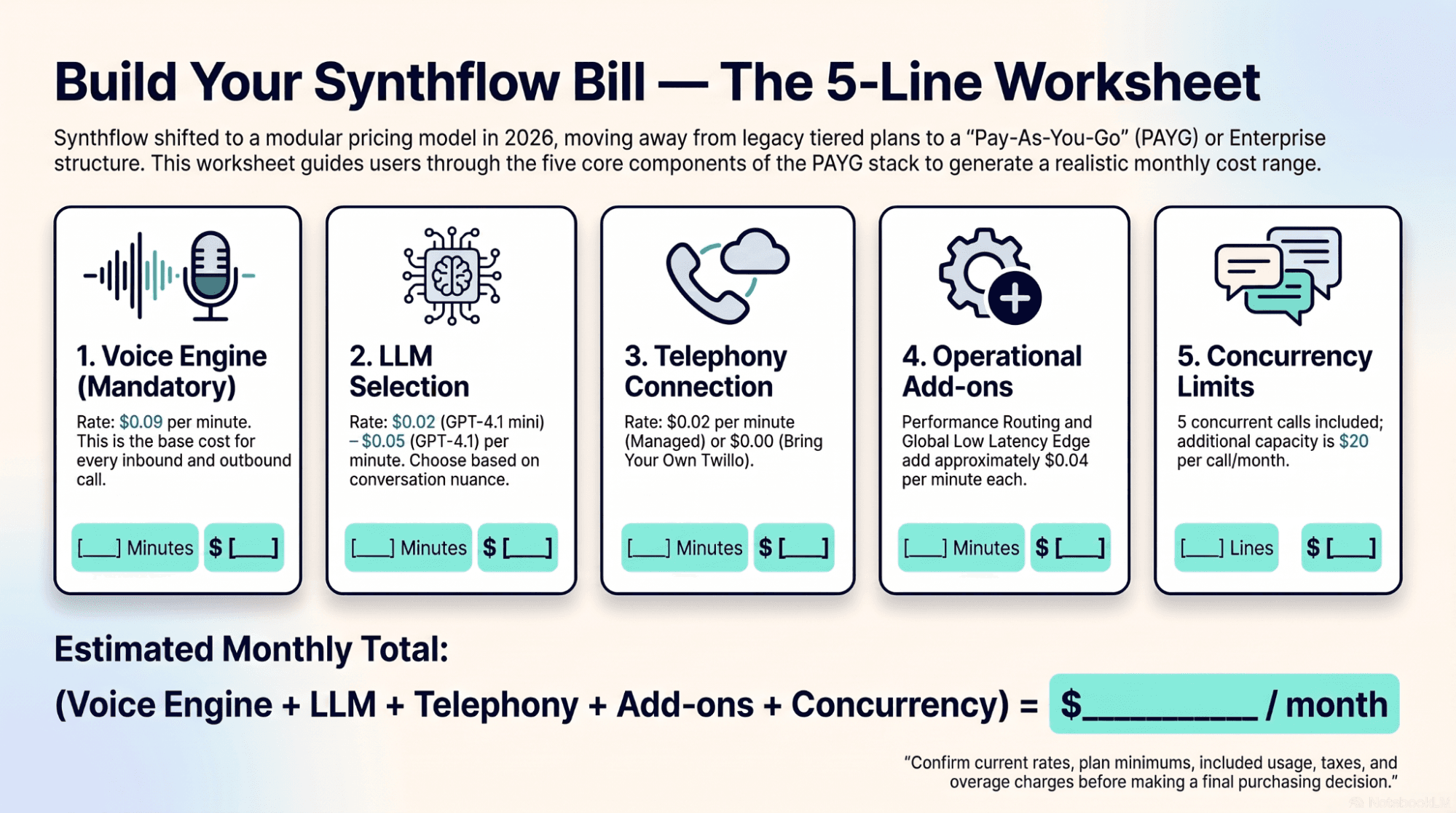
Here’s the thing that makes Synthflow pricing feel slippery: there is no single per-minute price. Under Pay-As-You-Go you build your own rate from components, and the total depends on the choices you make.
Voice engine, LLM, and telephony
Three base components sit on every call:
| Component | Rate | Notes |
|---|---|---|
| Voice engine | ~$0.09/min | Always present, inbound and outbound — the one cost you can’t remove |
| Language model | ~$0.02–$0.05/min | Your choice: a lightweight model (~$0.02) for simple booking, a stronger model (~$0.05) for nuanced conversations |
| Telephony | ~$0.02/min (managed) or $0.00 (BYO Twilio) | Bring your own Twilio and this line is zero on Synthflow’s side — Twilio still bills you directly |
So a mid-range configuration — voice engine, a capable model, managed telephony — is already around $0.16 a minute before any extras. You can read the current component rates on Synthflow’s own pricing page and in Synthflow’s pricing documentation. This modular approach mirrors the pattern we broke down in detail for another platform — how Vapi’s real per-minute cost breaks down — where the advertised base rate is only the starting point.
The 2026 model change most guides missed
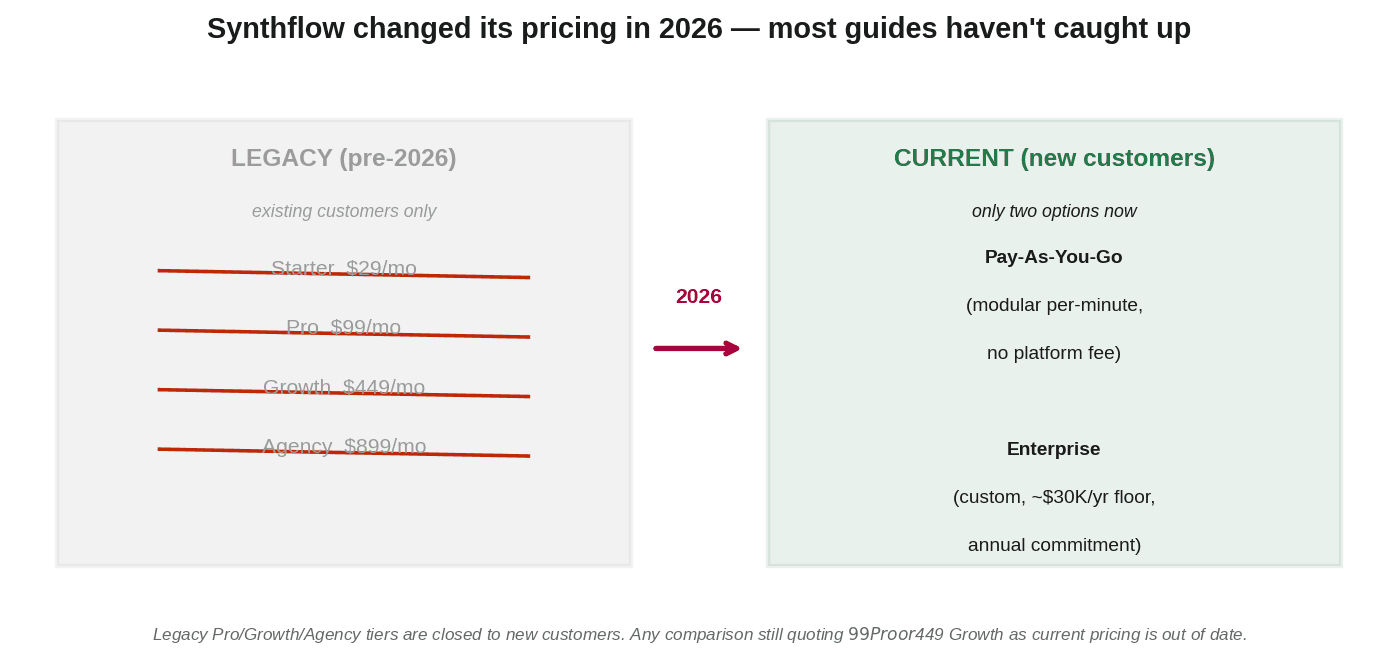
It’s worth repeating the model change here, because it’s the single most common error in the current crop of Synthflow pricing articles. The tiered subscription plans are gone for new customers. If you’re evaluating Synthflow today, your decision is Pay-As-You-Go versus Enterprise, and everything below is built on that reality.
The real cost at 1,000, 10,000 and 100,000 calls
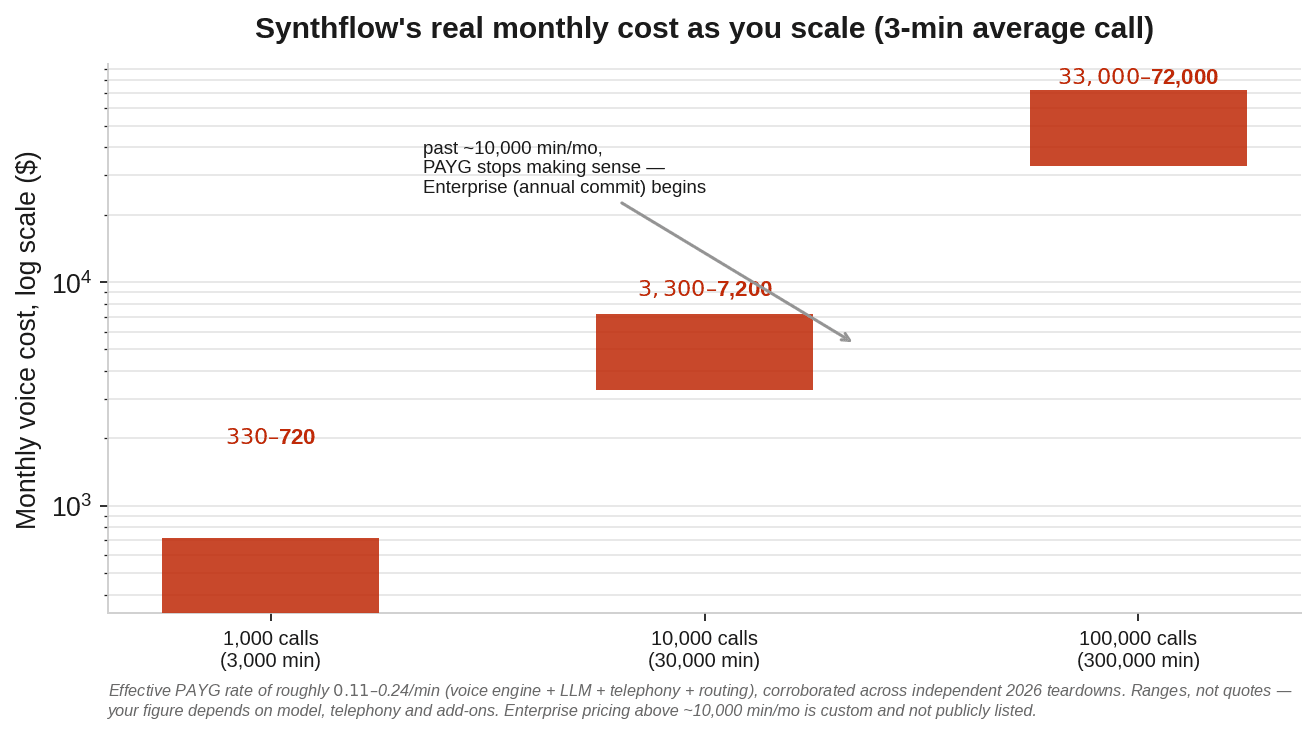
This is what you actually came for: not a per-minute rate, but a monthly bill at your volume. Assuming a three-minute average call and an effective PAYG rate in the $0.11–$0.24 range, here’s how it scales.
| Monthly volume | Approx. minutes | Estimated monthly cost | Realistic plan |
|---|---|---|---|
| 1,000 calls | ~3,000 min | ~$330–$720 | Pay-As-You-Go |
| 10,000 calls | ~30,000 min | ~$3,300–$7,200 | Enterprise territory (past the ~10K-min threshold) |
| 100,000 calls | ~300,000 min | ~$33,000–$72,000 | Enterprise (custom, annual) |
Read these as ranges, not quotes. Your real figure depends on your model choice, whether you bring your own telephony, and which add-ons you enable. And at the top of the table, remember these are Synthflow-side costs — add your bring-your-own-key provider fees (ElevenLabs, your LLM, a transcriber) and the effective rate can climb toward $0.37 a minute, per independent teardowns. The point of the table isn’t a precise invoice — it’s the shape of the curve.
The hidden cost drivers most guides skip
The base stack is only part of the story. Three things quietly move the number, and they’re the ones budgets tend to miss.
- Concurrency. PAYG includes 5 simultaneous calls. Need more? It’s $20 per additional line per month, up to 50. And if you hit your limit, excess calls don’t queue — they’re rejected outright with an error. For a business with any call clustering, this is a real line item, and a real risk.
- Routing add-ons. Performance Routing and Global Low Latency Edge each add about $0.04 a minute. Enable both — which sales teams often do for call quality — and you’ve added $0.08 to every single minute, turning a $0.11 configuration into $0.19.
- The chat conversion. Synthflow’s messaging isn’t a separate channel with separate pricing — messages count against your voice minutes at 5 messages per minute. If you’re planning to lean on chat, model it as voice usage, because that’s how it’s billed.
That last point connects to a bigger one: as of 2026, Synthflow is voice-only. It handles phone calls well, but if your reality is multichannel — a customer who starts in chat and continues by phone — that’s worth understanding before you commit, because why voice-only can be a limitation is a genuine architectural consideration, not just a feature checkbox.
Where PAYG stops making sense
Synthflow is genuinely inexpensive to start — no platform fee, no contract, pay only when calls run. That’s a real strength for pilots, and it’s why it’s popular for testing voice AI feasibility. But there’s a cliff, and it’s worth seeing before you drive off it.
Past roughly 10,000 minutes a month, Pay-As-You-Go stops making economic sense, and Synthflow’s own structure pushes you toward Enterprise — which means a custom quote and an annual commitment, referenced around $30,000 a year as a floor. On top of that, several things you might assume are standard are Enterprise-only: HIPAA compliance, a guaranteed uptime SLA, minute rollover, native telephony, and unlimited concurrency. If you’re in healthcare, or you can’t tolerate calls being rejected during a spike, you’re on the Enterprise path from day one, regardless of volume.
This is the honest tension in Synthflow’s pricing: the thing that makes it attractive to start (cheap, modular, no commitment) is the opposite of what you get once you’re serious (custom, annual, tier-gated features). For a fuller sense of how that compares across the market, our comparison of 12 voice agent platforms and our Retell pricing breakdown both put these numbers in context.
Synthflow vs SuperMIA — modular vs bundled
Here’s where we come in, and we’ll be straight about the trade, because it’s a genuine philosophical difference rather than one being a trick.
| Synthflow (modular PAYG) | SuperMIA (bundled) | |
|---|---|---|
| Pricing shape | Assemble your own rate from components | One plan, published on a public page |
| What’s included | Voice engine; you add LLM, telephony, routing, concurrency | Voice and chat, telephony, integrations, analytics in the plan |
| Channels | Voice-only (2026) | Voice + chat, one agent, shared context |
| Compliance | HIPAA is Enterprise-only | Built in — no separate tier required* |
| Best for | Agencies, white-label resellers, teams who want granular control | Teams who want a predictable bill and multichannel out of the box |
*Verify current SuperMIA plan details on the pricing page — features evolve.
The honest framing: Synthflow’s modular model is genuinely powerful if you want control over every component and you’re building, say, a white-label agency offering — that’s an area where Synthflow is legitimately strong. A bundled model like SuperMIA’s plans and pricing trades that granular control for a predictable number and multichannel in one place. Neither is ‘cheaper’ in the abstract — it depends entirely on your volume, your channels, and how much you value a single, readable bill over per-component control.
Which one is right for you
Choose Synthflow if: you’re an agency or reseller who wants white-label control, you want to hand-pick every component of your stack, your volume is modest enough that PAYG stays economical, and you’re voice-only by design.
Look at a bundled platform if: you want a predictable monthly number you can read on a public page, you need voice and chat working together rather than voice alone, you’d rather not manage separate provider keys and add-on toggles, or you want compliance included without an Enterprise commitment.
If the second description fits, SuperMIA’s AI voice agent is worth a look — the telephony, integrations, analytics and chat come in the plan rather than as components you assemble and meter. And you can see transparent, bundled pricing without a sales call. The best way to compare is on a real call with your own use case in front of you.
Compare the real numbers for your use case — book a 15-minute demo →
Frequently asked questions
How much does Synthflow cost per minute?
There is no single per-minute price, because Synthflow’s Pay-As-You-Go model assembles the rate from components: a voice engine at about nine cents a minute, a language model from roughly two to five cents, telephony at about two cents if Synthflow manages it, and optional add-ons. In practice most configurations land between about eleven and twenty-four cents a minute, and up to around thirty-seven cents once you include the separate provider fees for bringing your own keys.
Does Synthflow still have the Pro and Growth plans?
Not for new customers. As of 2026, Synthflow offers new customers two options, Pay-As-You-Go and Enterprise. The older Starter, Pro, Growth and Agency tiers are legacy plans that existing customers can remain on but new subscribers can no longer choose. Any pricing guide still presenting those tiers as current options is out of date.
Is Synthflow expensive?
It depends on your volume. Synthflow is inexpensive to start, with no platform fee on Pay-As-You-Go and charges only when calls run, which suits pilots and smaller deployments well. At scale it becomes more costly, and past roughly ten thousand minutes a month it effectively pushes you onto a custom Enterprise plan with an annual commitment starting around thirty thousand dollars a year. The modular add-ons and bring-your-own-key provider fees also raise the effective rate above the headline voice-engine figure.
What is Synthflow’s enterprise pricing?
Synthflow’s Enterprise pricing is custom and not publicly listed. It is aimed at teams handling more than about ten thousand minutes a month and is required for HIPAA compliance, a guaranteed uptime SLA, minute rollover, native telephony and unlimited concurrency. Independent analysis references an annual commitment starting around thirty thousand dollars, but that figure is a floor reference rather than a quoted price, so you would need to speak to their sales team for an actual number.
Does Synthflow handle chat as well as voice?
As of 2026, Synthflow is a voice-only platform focused on inbound and outbound phone calls. It does offer a web chat and messaging capability, but messages are converted into voice-minute usage at a rate of five messages per minute rather than being a separate channel. Teams that need genuine multichannel support, where voice, chat and messaging share one agent, generally need additional tooling or a different platform.

Urvil Dhanani
Urvil Dhanani is the AI/ML Lead at SuperMIA, focused on the architecture behind reliable conversational AI - agent design patterns, voice and chat orchestration, and platform evaluation. He writes practical, vendor-neutral guides that help technical teams build and choose AI systems that hold up in production.