
Table of Contents
Vapi and Retell solve the same problem with opposite philosophies: Vapi is developer-first and built to give engineers control over every layer; Retell is turnkey and telephony-first, built to get a non-technical team live in minutes. Choose Vapi if you have engineers and want to own the stack. Choose Retell if you need a production phone agent fast. Both still make you assemble and maintain that stack yourself.
See the third option handle a live call — book a 15-minute demo →
Key takeaways
- It’s build vs buy, not better vs worse. Vapi is for teams who want to build voice AI; Retell for teams who want to buy it.
- Retell ships faster. Visual builder, telephony and compliance in the box — a non-technical team can be live the same day.
- Vapi gives more control. Pick every provider, own every layer — ideal if you’re shipping voice as a product and have the engineers.
- Real cost converges. Both land around $0.13–$0.33/min all-in. Vapi’s HIPAA is a reported add-on; Retell bundles compliance.
- Both share a blind spot. You still assemble and maintain the stack — and neither does true multichannel.
The honest short answer
Before the detail, the verdict — because you searched for one, and most pages make you dig for it (then hand you their own product instead).
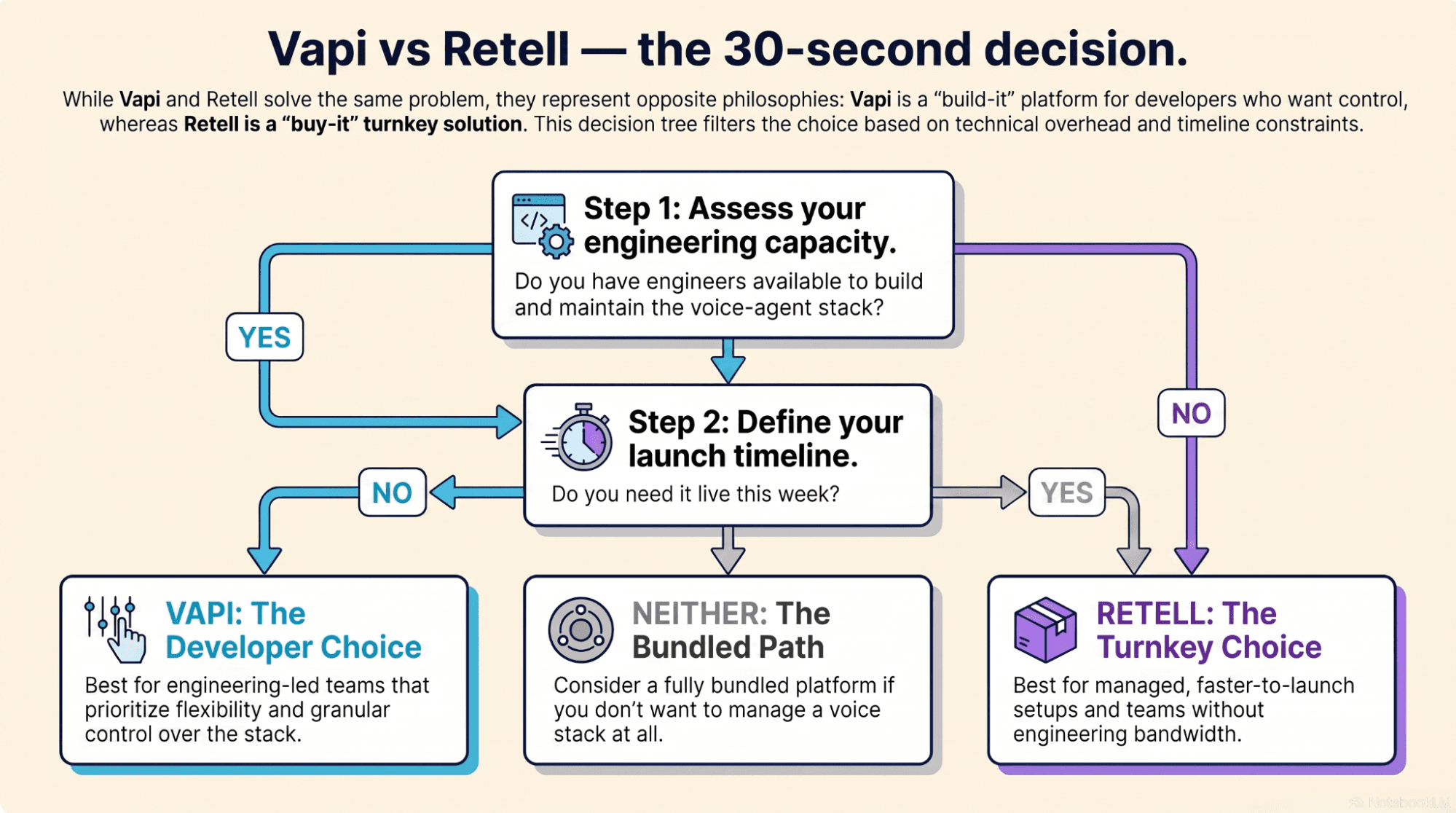
If you have engineers and want to build a custom voice product: Vapi. If you need a production phone agent live this week and nobody on your team writes code: Retell.
That’s the whole decision, and everything below is just the evidence for it. If you stop reading here, you’ve got what you came for.
One thing worth saying up front, because it colours every other comparison you’ll read: we’re SuperMIA, and we sell neither Vapi nor Retell. That’s deliberate. It means we can give you the straight answer that Retell’s own ‘Retell vs Vapi’ page and the various third-party pages — each of which somehow concludes that the author’s product wins — structurally can’t. We’ll mention where we fit at the very end, once you already have your answer. Until then, this is about the two platforms you actually searched for.
Two platforms, two philosophies
Every useful comparison of these two lands in the same place, and it’s the right place: Vapi is for teams who want to build voice AI; Retell is for teams who want to buy it. They’re not three versions of the same product — they’re two philosophies about who does the work.
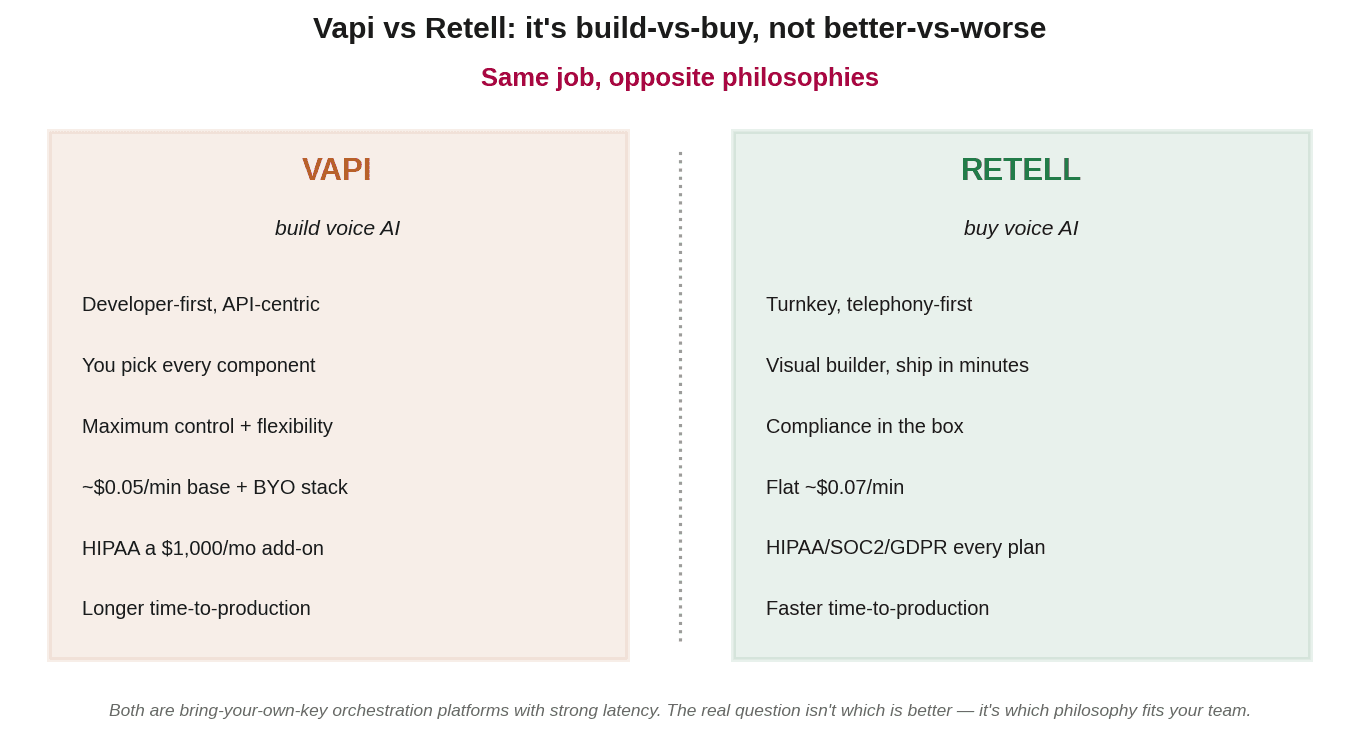
Vapi is developer-first and API-centric. Its whole design gives engineers control over every layer of the call stack — you choose your speech-to-text, your language model, your voice provider, your telephony, and you wire the logic yourself. That’s enormous flexibility, and for the right team it’s exactly right. The cost is that you need that team. With Vapi you are, in effect, the telephony lead, the ML engineer and the on-call operator — which is a feature if you want the control and a liability if you don’t.
Retell is turnkey and telephony-first. It ships a visual builder, a pre-optimised voice pipeline, and the production telephony most teams actually need — warm transfer, SIP trunking, branded caller ID, batch calling — in the base product rather than as things you assemble. A non-technical team can build a working agent through a drag-and-drop interface and be running test calls the same day. The trade is the mirror image of Vapi’s: less low-level control, far less time to launch.
Pricing — what they advertise vs what you pay
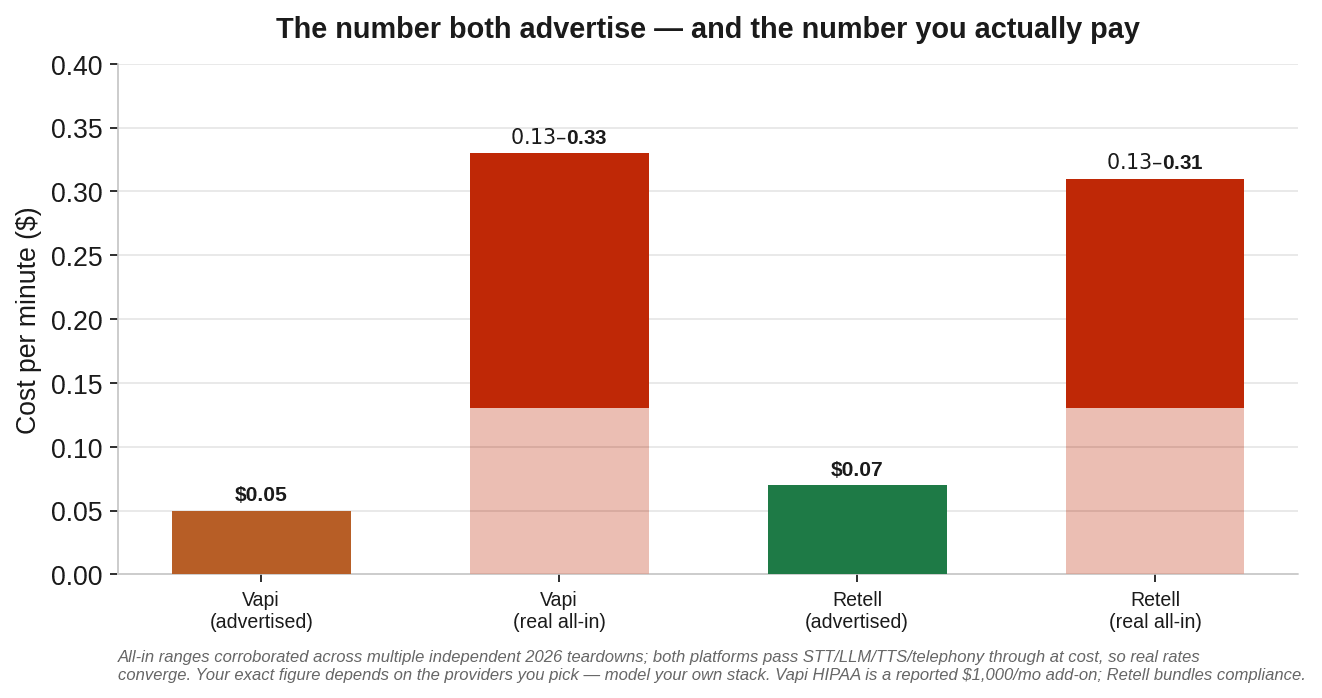
Both advertise a low base rate. Both cost more than that in production. Here’s the honest version.
| Vapi | Retell | |
|---|---|---|
| Advertised base | ~$0.05/min (hosting) | Flat ~$0.07/min |
| What’s included | Orchestration only — BYO STT/LLM/TTS/telephony | STT, verified numbers, batch calling included |
| Phone numbers | Variable | ~$2/mo standard, ~$5/mo toll-free |
| HIPAA / compliance | HIPAA a reported $1,000/mo add-on | HIPAA + SOC 2 + GDPR on every plan |
| Real all-in | ~$0.13–$0.33/min | ~$0.13–$0.31/min |
| Billing | Multiple line items / providers | Fewer line items — more bundled |
The headline gap — $0.05 vs $0.07 — is misleading, because both platforms pass through the same speech, language-model and telephony providers at cost, so the real numbers converge. Independent teardowns put both in roughly the same $0.13–$0.33 per minute range once the stack is added. You can read Vapi’s published pricing and Retell’s published pricing directly, and if you want to work Vapi’s true figure out line by line, how to work out Vapi’s real per-minute cost walks through it — as does the full Retell pricing breakdown for Retell.
The one genuine cost difference: compliance. Vapi charges a reported $1,000 a month for HIPAA; Retell includes HIPAA, SOC 2 and GDPR on every plan. If you’re in a regulated industry, that single line can outweigh the per-minute difference entirely — and it’s the clearest pricing distinction between the two.
Latency, and why you should distrust the numbers
You’ll see a lot of confident latency figures in other comparisons — ‘200 to 300 milliseconds’, ‘sub-500’, ‘Vapi runs 1,000 to 1,500’. Treat almost all of them with suspicion, because almost every one is published by a party with a stake in the answer — usually Retell, or a rival positioning itself against both.
Here’s the honest version. Retell is frequently described as faster out of the box, and that’s plausible: it ships a pre-optimised, opinionated pipeline, so you get low latency without tuning. Vapi’s latency depends more on how you configure it — with a well-chosen provider stack it can match Retell, and with a careless one it won’t. But here’s the part the benchmark wars leave out: both platforms use the same underlying speech and voice providers. The floor is set by Deepgram, ElevenLabs, OpenAI and the rest — not by Vapi or Retell themselves. Which means the realistic gap between them is smaller than any vendor’s chart suggests, and it depends almost entirely on your setup.
⚠️ The only latency advice worth taking: measure your own stack, on your own providers, with your own prompts. Don’t buy a platform on the strength of a millisecond figure published by someone selling one. We’re not going to add our own number to the pile — we haven’t measured yours.
Who wins — by situation
There is no abstract winner. There’s a winner for your situation, and it’s usually obvious once you’re honest about your team. Here’s the neutral version — no thumb on the scale, because we’re not selling either one.
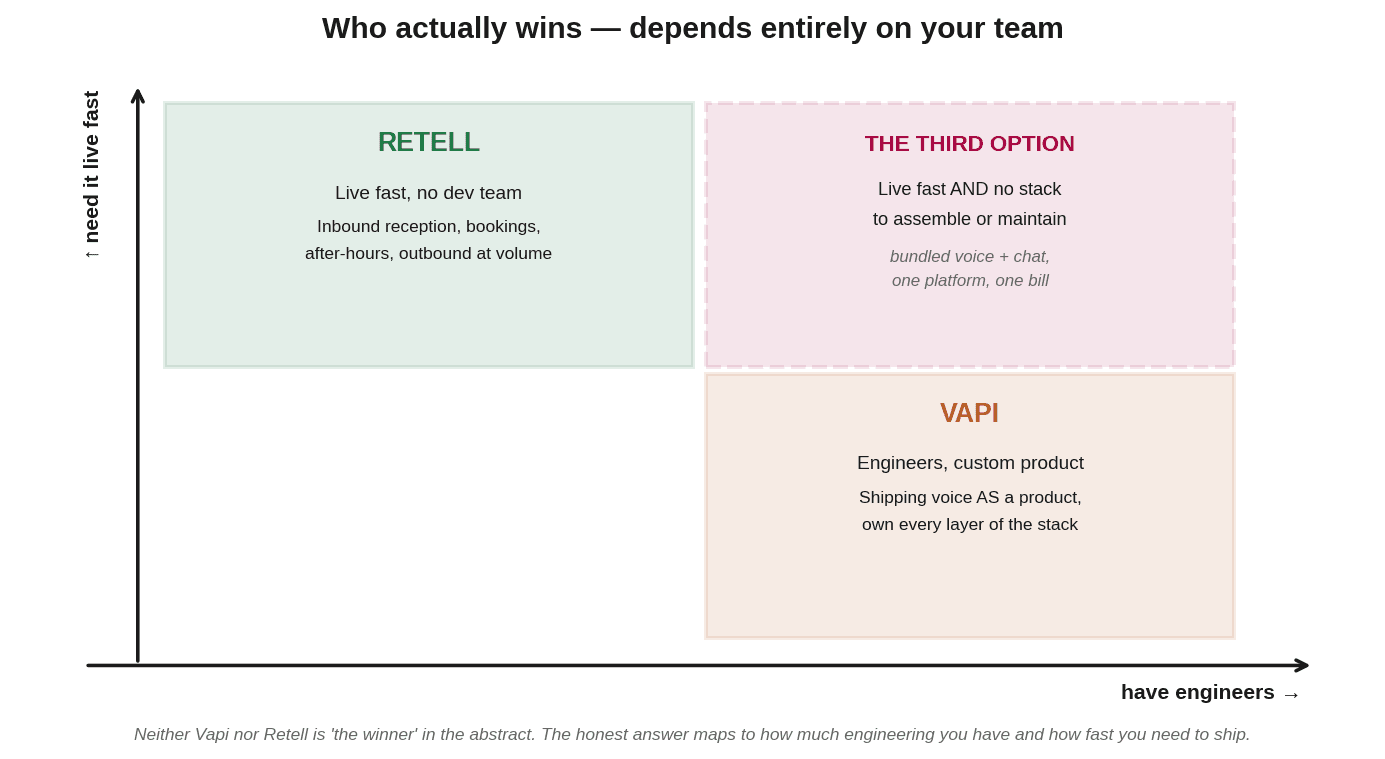
Choose Vapi if…
- You have engineers who want to own every layer of the stack — and the bandwidth to maintain it.
- You’re shipping voice AI as a product to your own customers, not just using it internally.
- You need to bring your own models — a fine-tuned LLM, self-hosted inference, a specific provider combination.
- You want A/B testing, simulated test suites, and granular control over voice persona across markets.
- Control matters more to you than time-to-launch.
Choose Retell if…
- Your team doesn’t write code, and you need an agent live in days, not sprints.
- Your use case is inbound reception, after-hours cover, appointment booking, or outbound qualification at volume.
- You want production telephony — warm transfer, SIP, branded caller ID — without building it.
- You’re in a regulated industry and want HIPAA, SOC 2 and GDPR included rather than as add-ons.
- Time-to-launch matters more to you than owning every layer.
If you want to see how these two sit within the wider field — Bland, Synthflow, PolyAI, Telnyx and the rest — rather than just against each other, our comparison of 12 voice agent platforms covers the whole category.
The blind spot both of them share
Here’s the thing neither platform’s page will tell you, and that even the honest third-party comparisons only mention in passing. Whichever one you choose, two things stay true.
First: you still own the stack. Both Vapi and Retell are, underneath, orchestration platforms — they help you assemble speech, a model and a voice into a running agent, but the assembling, tuning, prompt-engineering, failure-handling and ongoing monitoring are still yours. As the more honest comparisons put it, that ongoing work — not the per-minute rate — is the real cost, and it doesn’t go away because you picked the turnkey option. Retell shortens the first build; it doesn’t eliminate the maintenance.
Second: neither is genuinely multichannel. Both are voice platforms first. Retell has added a chat capability, but neither is built so that a customer can start in chat, continue by phone, and have the context carry across — one agent, one set of workflows, every channel. If your support or sales reality is omnichannel, that gap matters, and it’s why voice, chat and IVR solve different problems is worth understanding before you commit to a voice-only tool.
To be clear: neither of these is a reason not to pick Vapi or Retell. If you want to own a voice stack, own it — they’re both good at what they do. The blind spot only matters if owning the stack, or running voice-only, was the part you were trying to avoid. If it was, that’s worth knowing before you sign up — which brings us, finally, to where a different kind of platform fits.
Where a third option fits (if the blind spot is your problem)
Now we’ll mention ourselves — briefly, and only because you’ve already got your Vapi-vs-Retell answer.
If, reading the last section, you realised that owning and maintaining a voice stack is exactly the work you were hoping to avoid — or that you need voice and chat on one platform rather than a voice-only tool — then the category to look at isn’t another orchestration platform. It’s a bundled one. SuperMIA’s AI voice agent is a bundled voice and chat platform where telephony, integrations, analytics and compliance come in the plan, and where the same agent handles a call and a chat with shared context — the multichannel piece both Vapi and Retell leave out.
And the honest limit, because this whole page is built on honesty: if what you want is maximum low-level control over every provider and every layer, a bundled platform gives you less of that than Vapi — by design. The trade is the same one Retell makes, taken a step further: you hand over the assembly to get the speed and the single bill. Whether that’s the right trade is exactly the build-vs-buy question this whole page is about — just asked one layer up.
If that sounds like your situation, you can read SuperMIA’s plans and pricing on a public page, or see it running on a real call.
See the third option handle a live call — book a 15-minute demo →
Frequently asked questions
Is Vapi or Retell better?
Neither is better in the abstract; they suit different teams. Vapi is developer-first and gives engineers control over every layer of the voice stack, which fits teams building a custom voice product. Retell is turnkey and telephony-first, with a visual builder and compliance included, which fits teams that need a production phone agent live quickly without writing code. The honest answer depends on your engineering capacity and how fast you need to ship.
Is Retell cheaper than Vapi?
The advertised base rates differ — Vapi from around $0.05 per minute, Retell a flat $0.07 — but real all-in costs converge, because both pass through the same speech, language model and telephony providers at cost. Independent teardowns put both in roughly the $0.13 to $0.33 per minute range in production. The clearest cost difference is compliance: Vapi charges a reported $1,000 per month for HIPAA, while Retell includes HIPAA, SOC 2 and GDPR on every plan.
Which has lower latency, Vapi or Retell?
Be cautious with the latency numbers you see online, because most are published by an interested party. In practice both platforms can achieve similar, low latency with a well-chosen provider stack, since they rely on the same underlying speech and voice services. Retell is often described as faster out of the box because it ships a pre-optimised pipeline, while Vapi’s performance depends more on how you configure it. Measure your own setup rather than trusting a published figure.
Can you use Vapi and Retell together?
You generally would not run both for the same agent, because they occupy the same layer — each is an orchestration platform that stitches your speech, language model and voice together. You would choose one. What you can mix is the layer beneath them; both can use the same voice providers, such as ElevenLabs, so the choice between them is about the platform experience, not the underlying voice.
Do Vapi and Retell handle chat as well as voice?
Both are primarily voice platforms. Retell has added a chat capability, but neither is built as a unified multichannel platform where voice, chat and messaging share one agent and one set of workflows. Teams that need genuine omnichannel — a customer who starts in chat and continues by phone with context preserved — usually find that requirement points them toward a different category of platform.

Urvil Dhanani
Urvil Dhanani is the AI/ML Lead at SuperMIA, focused on the architecture behind reliable conversational AI - agent design patterns, voice and chat orchestration, and platform evaluation. He writes practical, vendor-neutral guides that help technical teams build and choose AI systems that hold up in production.