
Table of Contents
- What is an AI chatbot for hotels?
- The two jobs it does for your hotel
- The real ROI: winning back OTA commission
- How much front-desk volume can a chatbot really cut?
- What a hotel chatbot still can’t do
- Integrations — the PMS, the booking engine, and the channels
- How much does a hotel chatbot cost, and is it worth it?
- Frequently asked questions
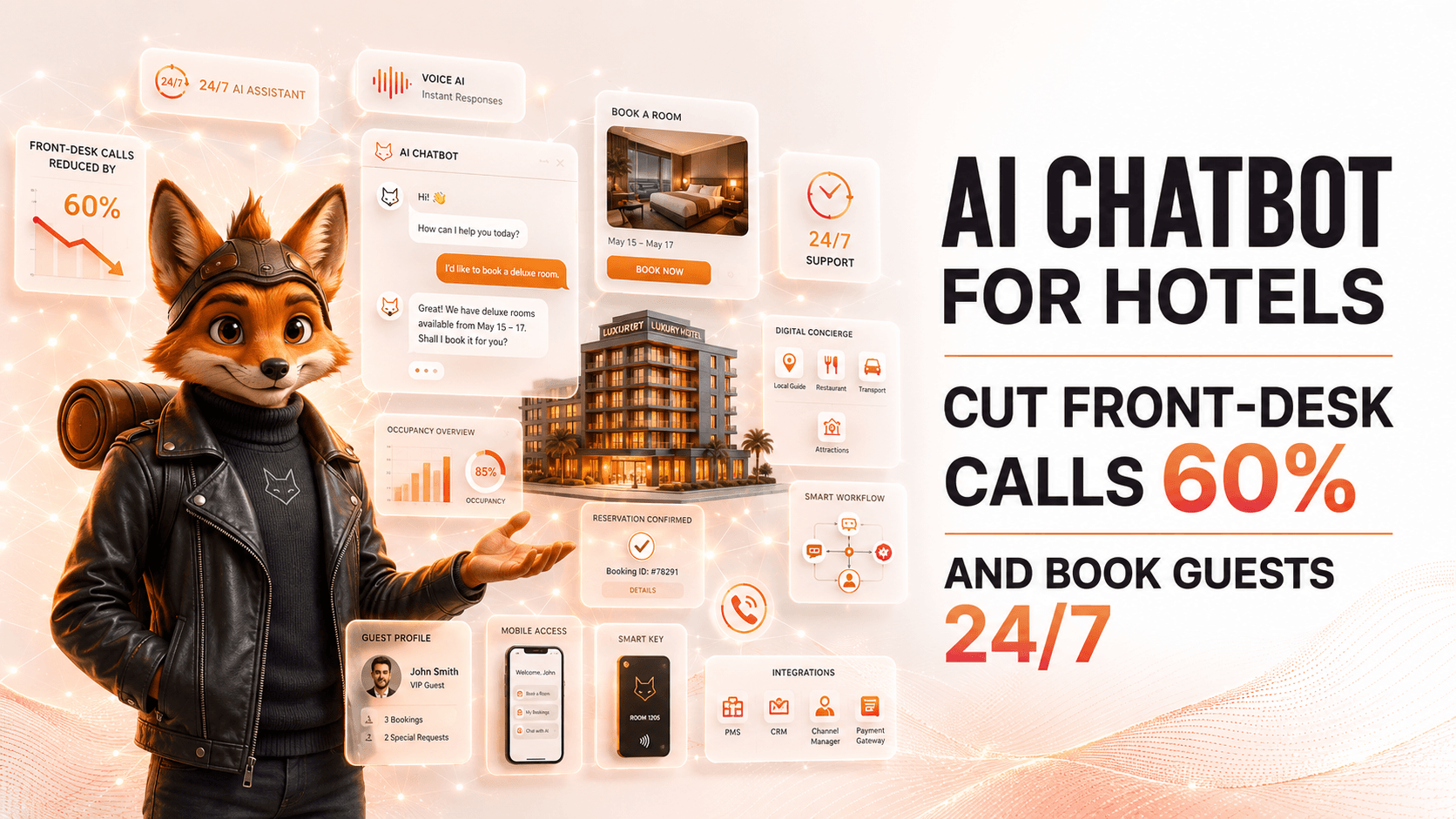
An AI chatbot for hotels is a virtual assistant that answers guest questions instantly, 24/7, across your website, WhatsApp, and SMS. It absorbs the high-volume, repetitive inquiries — availability, directions, parking, policies — and can complete direct bookings when connected to your PMS and booking engine, so your team focuses on the guest interactions that need a person.
Book a demo — and see it handle a guest inquiry →
Key takeaways
- It does two jobs. Cut front-desk call and chat volume, and book guests 24/7 — on the same system, across your website, WhatsApp and SMS.
- The ROI is OTA commission. Every booking recovered directly instead of through an OTA avoids a 15–25% commission — roughly $65 on an illustrative $180 ADR, two-night stay at 18%.
- The 60% is an industry range, not a promise. Industry figures typically cite 50–70% of guest queries as automatable; where your property lands depends on your guest mix and how well the chatbot is trained.
- It can’t replace your front desk. Complaints, billing disputes, VIP guests and overbooking judgment still need a person — the clean handoff is the point, not a limitation.
- Integrations decide the value. The PMS for live availability, the booking engine for direct reservations, and the guest channels where people already message.
Picture your front desk on a busy afternoon. One agent is checking in a family, another is on the phone explaining the Wi-Fi password for the third time today, and meanwhile a potential guest on your website is waiting for someone to answer a question about availability — a question your booking engine already knows the answer to. That guest gives up, flips to an OTA, and you pay 15–25% commission on a booking you could have taken directly.
That gap is exactly what an AI chatbot for hotels is built to close. It answers the repetitive questions instantly, around the clock, so your team can focus on the guests standing in front of them. If your property is exploring AI across more of the guest experience, our AI for hospitality overview is the broader starting point.
What is an AI chatbot for hotels?
An AI chatbot for hotels is a virtual assistant that answers guest questions instantly, 24/7, across the channels guests actually use — your website, WhatsApp, and SMS. Rather than a scripted decision tree, a modern hotel chatbot understands natural language, pulls real-time data from your property management system (PMS), and either resolves the question itself or hands the conversation to a person with the context attached.
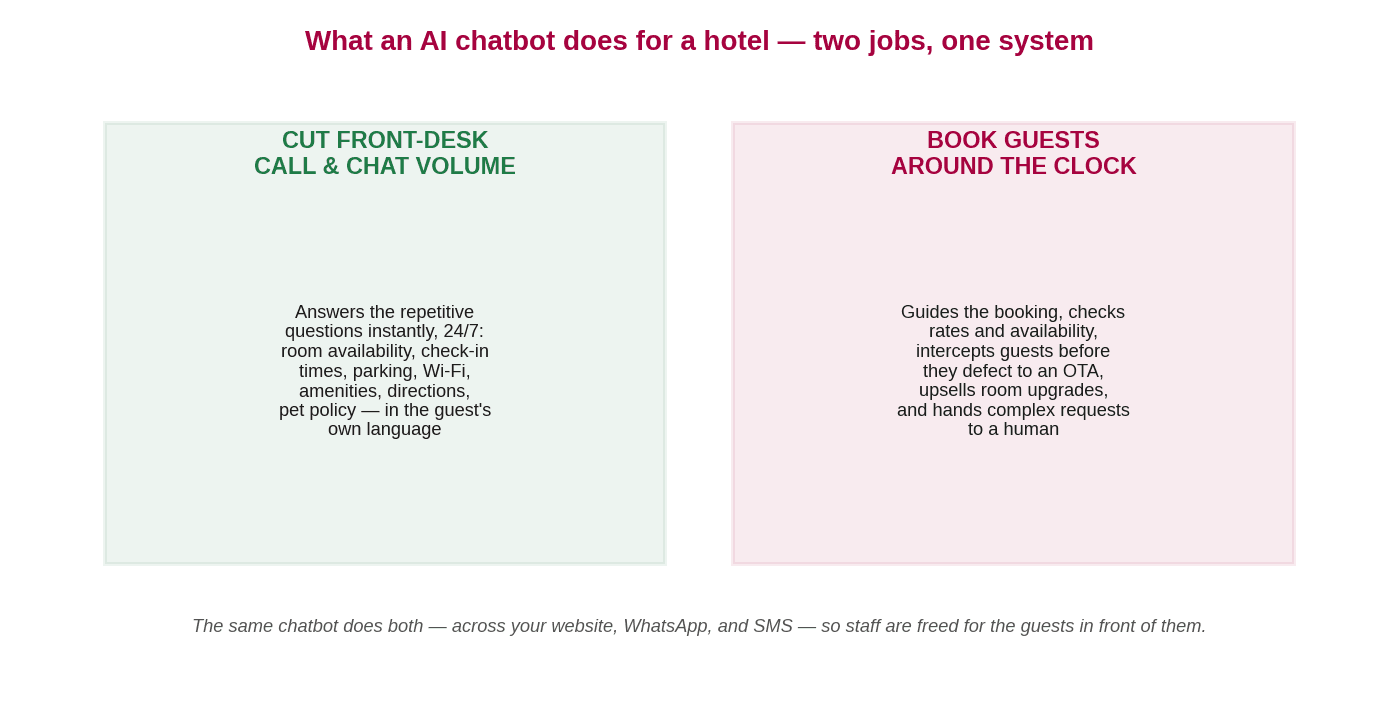
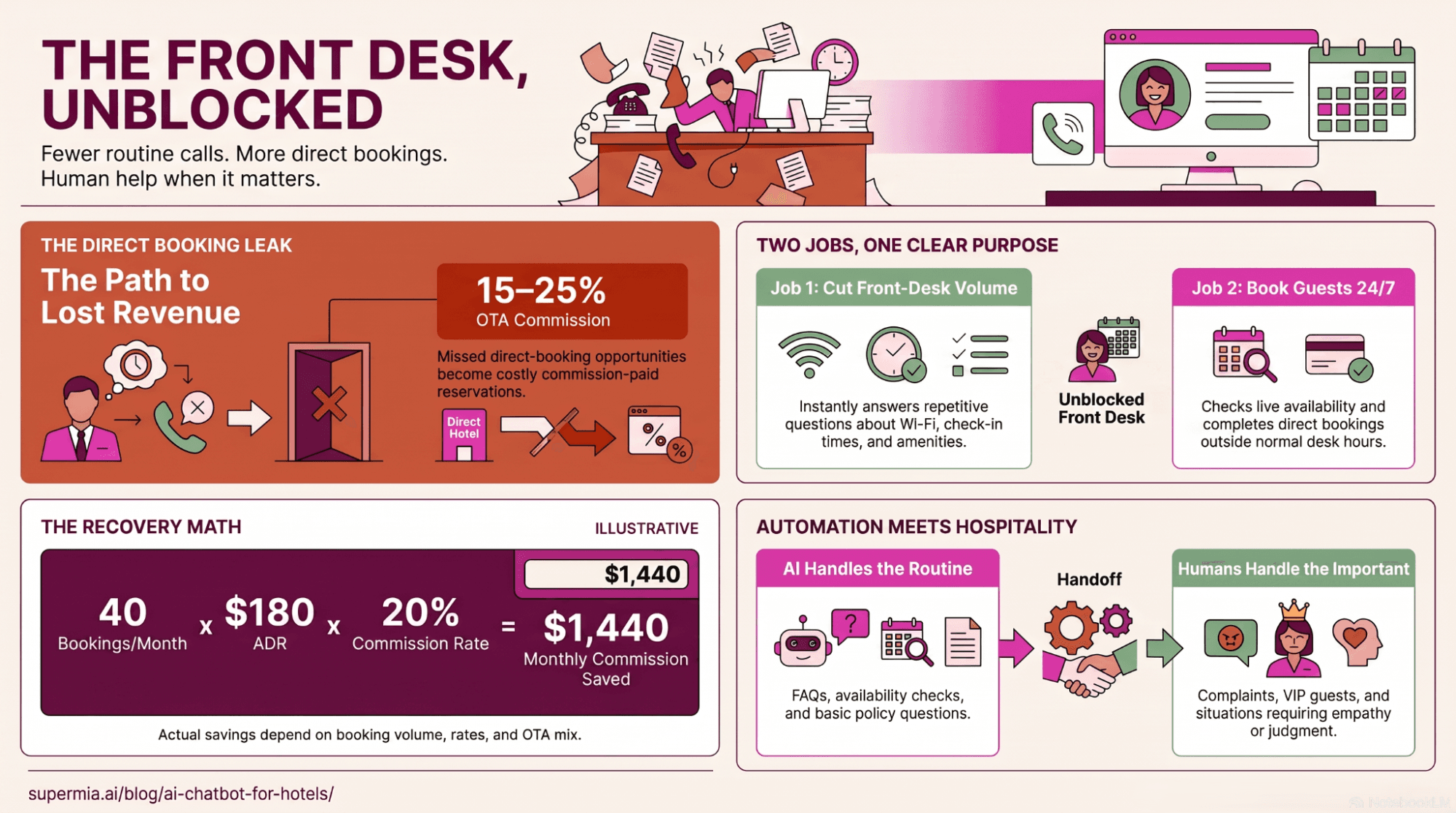
The clearest way to think about it is in terms of two jobs, shown in the chart above. Everything a hotel chatbot does falls into one of these — and the best setups do both at once, on the same AI chatbot platform.
The two jobs it does for your hotel
Cutting front-desk call and chat volume
Most of what comes into a front desk is repetitive: directions, parking, Wi-Fi, check-in and check-out times, pet policy, whether the pool is open, availability for next weekend. Important to the guest asking, but not a good use of your team’s time for the hundredth answer. A chatbot handles these instantly, in real time, from the same data your front desk would consult — so the answer is always current, and your staff gets those minutes back.
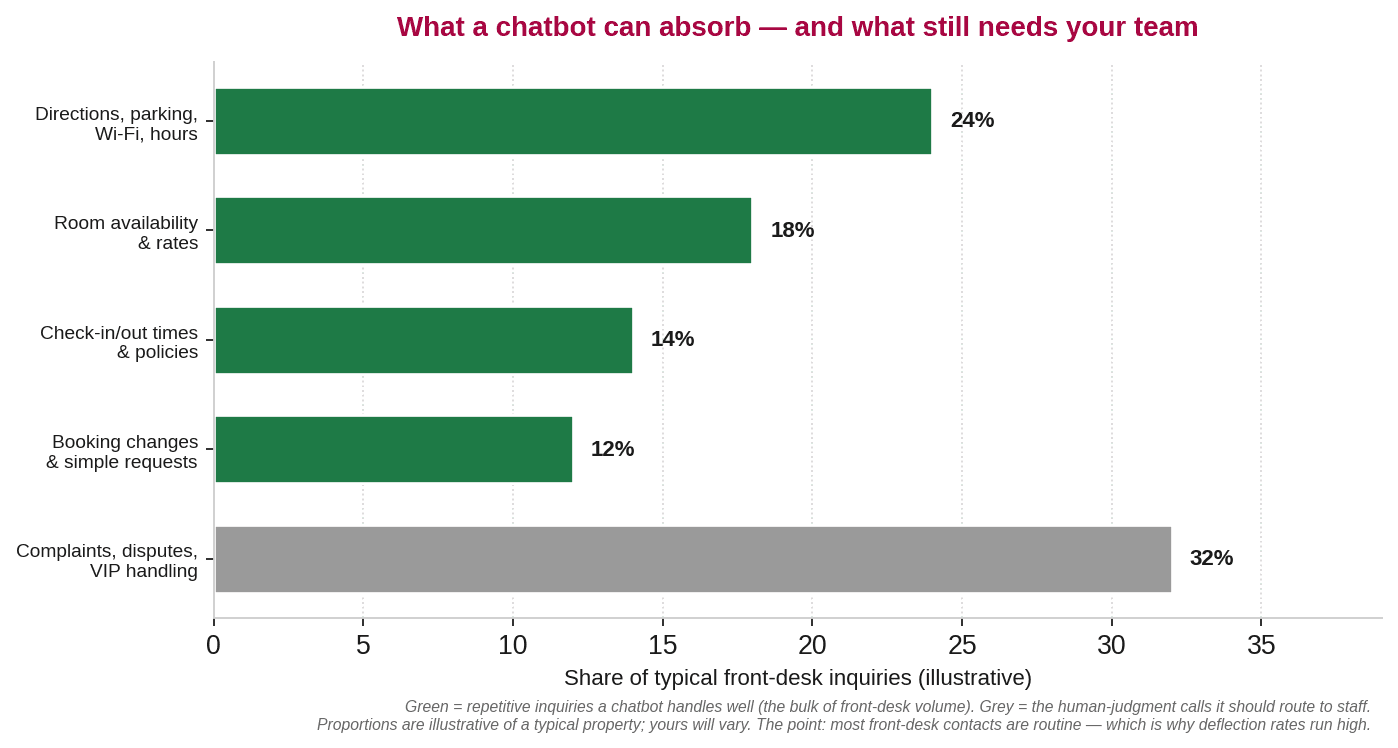
The chart above breaks down what that looks like. The large majority of front-desk contacts are the routine kind a chatbot handles well; a smaller share — complaints, billing exceptions, VIP guests, overbooking decisions — genuinely needs human judgment. Industry figures typically cite 50–70% of guest queries as automatable; the exact number depends on your property type, your guest mix, and how well the chatbot is trained. The 60% in this guide’s title sits in that range as a reasonable reference point.
Booking guests 24/7
The second job is where the money is. A hotel chatbot connected to your booking engine can check live rates and availability, guide a guest through room selection, and complete the reservation — at 2am on a Sunday, from a WhatsApp message, in the time it takes to type a few replies. If a guest asks about handling group bookings, the chatbot can capture the details and route it to your groups desk with everything attached.
The real ROI: winning back OTA commission
Here’s the number that makes a hotel chatbot pay for itself. When a guest can’t get a fast answer on your own website and defaults to an OTA, you don’t just lose the booking — you pay 15–25% commission on it. That is revenue you already earned, handed to a middleman because your direct channel was slower. A chatbot that answers instantly and books directly recovers some of those bookings at zero commission.
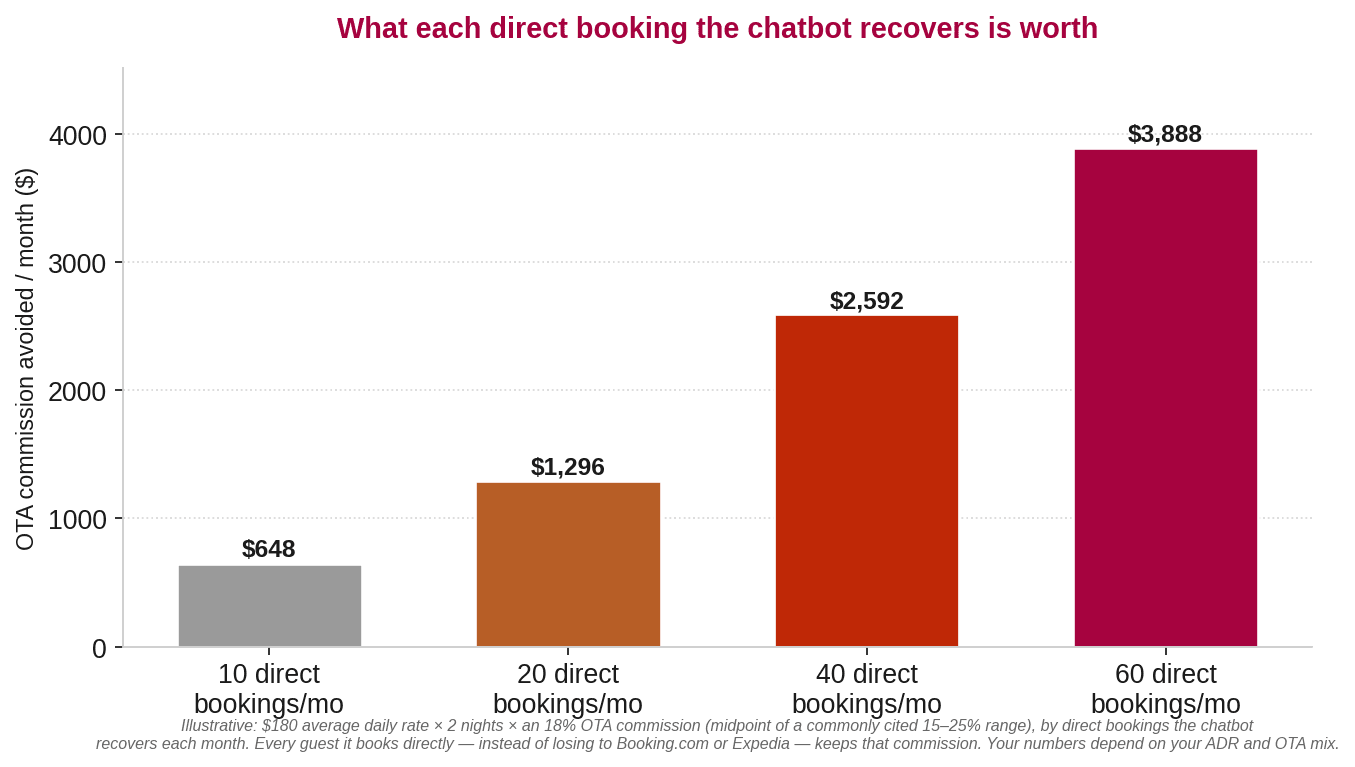
Put a number on it. Say your average daily rate is around $180, a typical stay is two nights, and OTA commission sits at 18% — the midpoint of a commonly cited 15–25% range. Each booking you recover directly instead of through an OTA saves you roughly $65. Recover twenty of those a month and you are saving around $1,300; at forty it is roughly $2,600. These are illustrative, not promises — your actual ADR, length of stay, and commission rate will shift the numbers — but the structure of the math is consistent: every direct booking a chatbot captures is revenue that would otherwise go to commission.
How much front-desk volume can a chatbot really cut?
Short answer: a lot, but the honest answer is a range. Because the majority of front-desk contacts are routine — the availability, parking, directions, policy questions shown in the chart above — industry figures typically cite 50–70% of guest queries as automatable, and the 60% in this guide’s title sits within that range as a reasonable reference. Where your property lands depends on your guest mix, the types of questions you receive, and how well the chatbot is trained on your specific content. The figure is an industry framing, not a SuperMIA promise.
What a hotel chatbot still can’t do
Any vendor who tells you their chatbot replaces your front desk is overselling. Here’s where you still want a person — and where the best setups route conversations to one.
- Real complaints and service recovery. A guest whose room wasn’t ready, or whose booking got tangled, needs empathy and authority to make it right. A chatbot can log the issue and escalate it, but the recovery is a human job.
- Billing disputes and edge-case refunds. Anything involving money that isn’t a clean transaction — a contested charge, a goodwill credit — belongs with someone who can make a judgment call.
- VIP and high-touch guests. Your best guests expect a human who knows them. A chatbot can tee up the details, but the relationship is handled by your team.
- Overbooking and waitlist judgment. A chatbot reading your PMS won’t promise a room you don’t have, but deciding who gets walked, or how to handle a waitlist, is a judgment call with reputational stakes.
None of this is a reason to skip a chatbot — it’s a reason to deploy it honestly. Let it own the high-volume, repetitive inquiries and the straightforward bookings, and let it hand the rest to someone who can actually help. That handoff, done well, is better for the guest than either a slow human reply or a bot pretending to handle something it can’t.
Integrations — the PMS, the booking engine, and the channels
The difference between a chatbot that answers questions and one that grows revenue is what it’s connected to.
- Your property management system (PMS). So the chatbot reads live availability and guest context — the foundation for accurate answers and real bookings. Opera, Mews, Cloudbeds, and others all have integration paths.
- Your booking engine. So it can check rates and complete direct reservations, not just describe them — this is what turns it into a direct-booking channel and what makes the OTA-commission math work.
- Your guest channels. Website chat, WhatsApp, and SMS — meeting guests where they already message. WhatsApp in particular sees very high open rates in hospitality. If your property also handles restaurant phone calls alongside rooms, the same platform can cover both.
- A clean human handoff. The most important integration is the exit — when a conversation needs a person, the chatbot transfers it to the right team member with the full context, not a cold dump.
Set up this way, you get the coverage and the direct-booking recovery without the cold-robot experiences guests complain about. You can see how our chatbot works for the platform side, or explore our hospitality solution for how it fits across the guest experience.
How much does a hotel chatbot cost, and is it worth it?
Pricing varies by provider. Most hotel chatbots are sold as a monthly subscription that scales with your property size and message volume, and pricing ranges are wide enough that quoting a single figure would be misleading — verify directly with any vendor you shortlist. What matters more than the sticker price is the return: if a chatbot recovers even a modest number of direct bookings each month that would otherwise go through an OTA at 15–25% commission, the maths works quickly. Add the staff hours freed from repetitive calls, and the 24/7 coverage that no staffing plan can match cost-effectively, and the case is usually straightforward for any property with meaningful direct-channel traffic.
Where does SuperMIA fit? We’re one option among several, and we’d rather be the right fit than the loudest pitch. SuperMIA is a conversational platform that handles guest inquiries across chat and voice, books directly into your systems, and hands conversations to your team when a human is needed. The most useful next step isn’t reading more — it’s watching it answer a real guest question from your own property.
Book a demo — and see it handle a guest inquiry →
Frequently asked questions
What is an AI chatbot for hotels?
An AI chatbot for hotels is a virtual assistant that answers guest questions instantly, 24/7, across your website, WhatsApp, and SMS. It absorbs the high-volume, repetitive inquiries — availability, directions, parking, policies — and can complete direct bookings when connected to your PMS and booking engine, so your team focuses on the guest interactions that need a person.
Can a hotel chatbot take bookings?
Yes, if it is connected to your booking engine and PMS. A capable hotel chatbot checks live rates and availability, guides the guest through room selection, and completes the reservation directly — bypassing the OTA and saving you the commission. Without those integrations, it can only describe what is available and point the guest to your booking page.
How much does a hotel chatbot cost?
Most hotel chatbots are priced as a monthly subscription that scales with your property size and message volume, and pricing varies widely by provider. The return depends on how many direct bookings it recovers (saving 15–25% OTA commission each time) and how much front-desk time it frees. Verify pricing directly with any vendor you evaluate.
Do hotel chatbots reduce front-desk workload?
Yes. Most front-desk contacts are routine — directions, parking, Wi-Fi, check-in times, availability — which a chatbot can answer instantly, 24/7. Industry figures typically cite 50–70% of guest queries as automatable. The remainder — complaints, billing, VIP guests, overbooking — routes to your team with the context attached.
How do hotel chatbots handle overbooking or waitlist issues?
A chatbot connected to your PMS reads live availability, so it will not confirm a room you do not have. For waitlist or overbooking situations that require judgment — who gets walked, what compensation to offer — it escalates to your team. That handoff is a feature, not a limitation.
What can’t a hotel chatbot do?
It is not a replacement for front-desk staff on complex complaints, billing disputes, or VIP guests who need human judgment. The right setup uses the chatbot for high-volume routine inquiries and direct bookings, and routes everything that needs a person to one — with the conversation context attached.

Vicky Lalwani
Vicky Lalwani is Marketing Manager at SuperMIA, focused on practical AI education, buyer's guides, and solution explainers that help business teams evaluate and adopt conversational AI across support, sales, and operations.