
Table of Contents
- Quick Answer
- What Is a Property Management Answering Service?
- What Each Missed Call Actually Costs
- When PM Calls Actually Come In
- The 3-Call-Type Playbook
- AI Voice Agent vs Human Answering Service vs Voicemail
- Integration Reality: AppFolio, Buildium, Rent Manager, Yardi
- How Much Does a PM Answering Service Cost?
- How SuperMIA Answers Every PM Call
- Frequently Asked Questions
Quick Answer
A property management answering service handles the three calls that flood a PM's office — leasing inquiries, maintenance requests (routine and emergency), and tenant service — 24/7. Missing them is expensive: a lost leasing call can mean a month of vacancy ($1,500–$2,000), and a missed emergency turns a small leak into a claim. You can use a human call center or an AI voice agent that answers every call, books tours, and writes work orders straight into AppFolio, Buildium, or Rent Manager.
Key Takeaways
- 3 call types, not one. Leasing, maintenance, tenant service — each needs a different playbook.
- A missed leasing call is a vacant unit. $1,500–$2,000/month, per unit — the biggest hidden leak in most portfolios.
- Emergencies escalate fast. A voicemail leak becomes a mold claim; correct dispatch keeps costs 3–5× lower.
- Integration is the dealbreaker. If it doesn't write into AppFolio, Buildium, Rent Manager, or Yardi, it's a message service, not answering.
- AI voice handles the load humans miss. Instant pickup, unlimited concurrent calls, no per-minute fees.
Do the math on your portfolio.
Book a 15-minute demo and hear MIA book a tour and dispatch an emergency.
Book a demo →What Is a Property Management Answering Service?
A property management answering service answers calls on your behalf when your team can't — after hours, on weekends, during a leasing surge, and in the middle of an emergency. It captures leasing inquiries, dispatches maintenance requests, and handles tenant service, so no lead lands in voicemail and no emergency waits until morning.
It can be staffed by human receptionists or an AI voice agent — or a combination — and the good ones do more than take messages: they book tours, create work orders, and update your property management platform in real time.
What Each Missed Call Actually Costs
The same missed call has wildly different costs depending on the call type. A missed leasing call costs about $1,500–$2,000 in lost monthly rent because the prospect calls the next available unit. A missed emergency turns a $200 fix into a $2,000–$5,000 damage claim. A missed service call costs almost nothing — until enough of them stack up and a tenant doesn't renew.
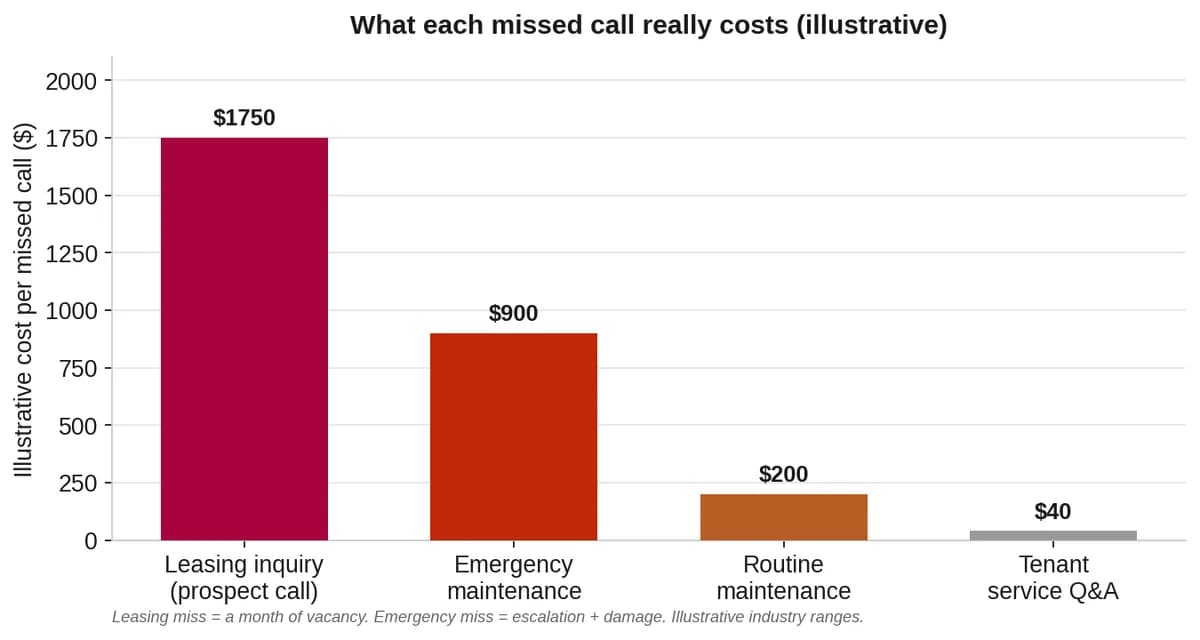
The missed-call formula for property managers
- Monthly leasing leak = missed leasing calls × 20–30% base conversion × average monthly rent
- Monthly emergency risk = after-hours emergencies missed × 3–5× escalation cost
- Annual leak = (both) × 12, plus renewal churn from unanswered tenants
Example: a 200-door portfolio gets ~40 leasing calls/month, misses 25% (10 calls). At 25% conversion and $1,800 rent, that's $54,000 in vacant-unit revenue per year — before you count emergency escalations and lost renewals. A single leasing call captured usually pays for the whole service.
When PM Calls Actually Come In
Property management calls don't respect office hours. About a quarter to a third arrive outside 8–5, and emergencies skew even later — exactly when your staff is off and traditional voicemail is on.
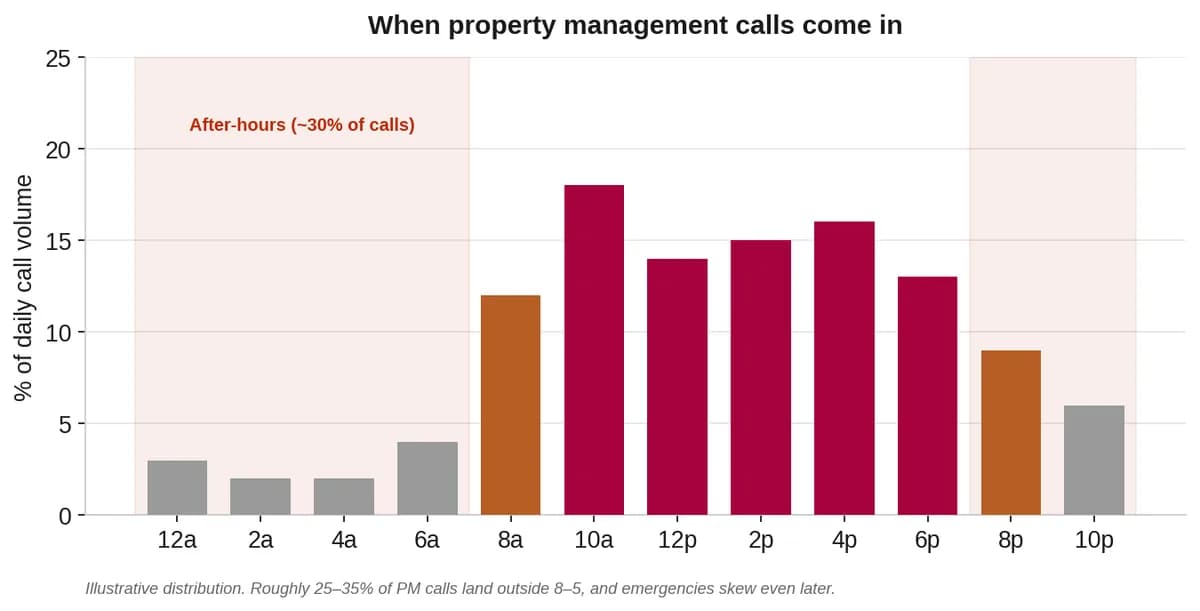
Leasing calls peak at lunch and after work when prospects are house-hunting. Maintenance calls spike when tenants get home and see a problem — or wake up to one. Emergencies happen when they happen. A great PM answering service covers all of it without you or your team being on-call.
The 3-Call-Type Playbook
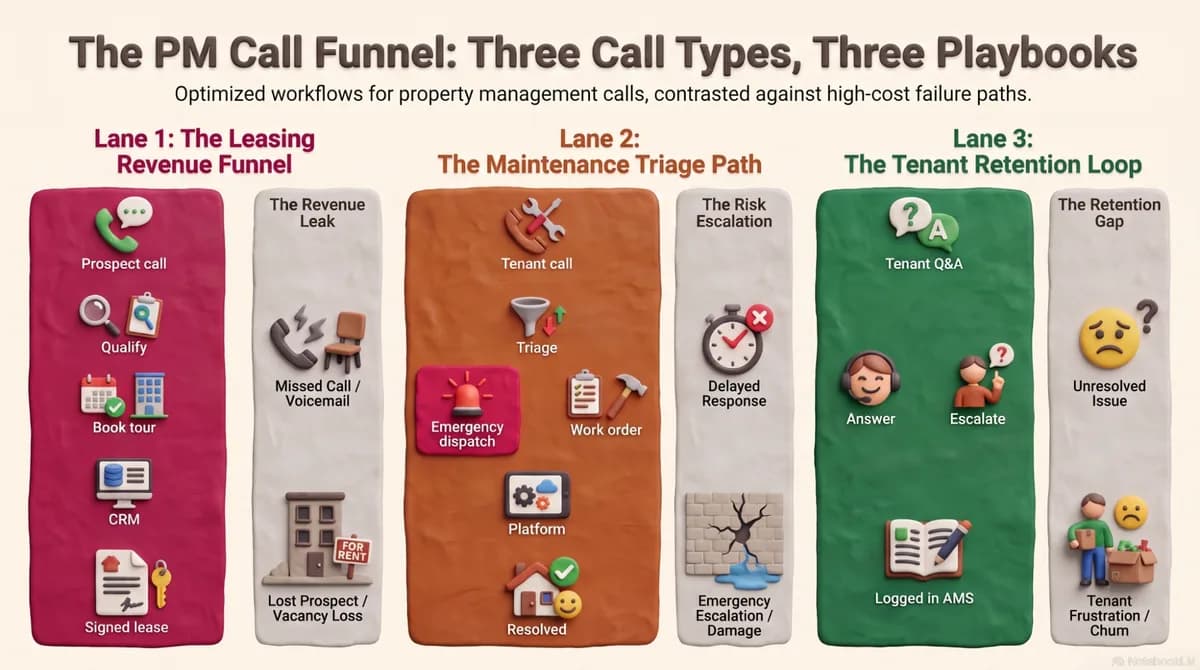
Every PM call falls into one of three buckets: leasing inquiries (the revenue calls), maintenance requests (routine and emergency), and tenant service (the retention calls). Each needs a different playbook.
1. Leasing inquiries (the revenue calls)
These are the calls that fill vacant units. Multifamily research shows leasing inquiries convert 20–30% when answered quickly and under 5% after a 24-hour delay — speed is everything. The playbook: answer within one ring, qualify (budget, timeline, must-haves), match to available units, book the tour on the leasing agent's calendar, and log the lead in your CRM. Also worth pairing with an AI chatbot for your leasing website to catch prospects who start online.
2. Maintenance requests (routine + emergency)
The playbook here is triage. Every call gets categorized before anything else: emergency (water, no heat in winter, security, lockout in extreme weather), urgent (partial-service issue like one broken burner), or routine (leaking faucet, appliance replacement). Emergencies get dispatched to your on-call tech immediately with the address and issue details. Urgent goes into the next-business-day queue. Routine is logged as a work order in your platform. This is the same triage logic HVAC contractors use for after-hours calls — the difference is the destination system.
3. Tenant service (the retention calls)
The unglamorous calls that decide whether tenants renew: rent questions, portal help, pet policy, lease term clarifications, amenity hours. Individually, they're small. Collectively, unanswered service calls are why tenants don't renew — the #1 reported reason tenants leave is a lack of consistent communication (a pattern property management research keeps confirming). The playbook: answer the FAQs directly, log the interaction, escalate the ones that need a person.
See the playbook run on your calls.
A 15-minute demo — leasing, maintenance triage, and tenant service.
Book a demo →AI Voice Agent vs Human Answering Service vs Voicemail
An AI voice agent answers instantly and handles unlimited simultaneous calls; a human service adds a personal touch for complex conversations; voicemail loses the lead. Here's the honest comparison for property managers.
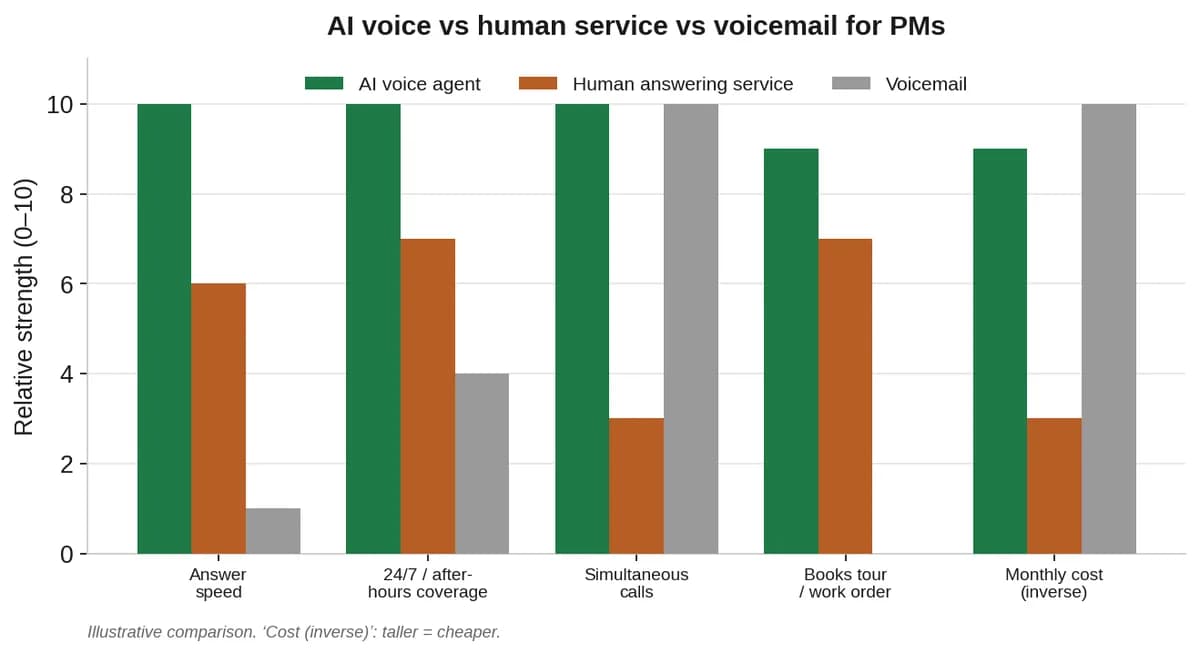
| Factor | AI voice agent | Human service | Voicemail |
|---|---|---|---|
| Answer speed | Under 1 second | 3–4 rings, longer at peak | N/A |
| 24/7 / after-hours | Always, at same cost | Yes but usually per-plan | 'Free' but zero coverage |
| Simultaneous calls | Unlimited (a heat wave, a leasing surge) | Limited by staff | — |
| Books tours / creates work orders | Yes, into your platform | Sometimes, depends on training | No |
| Monthly cost | Flat, low | Per-minute / $250+ | 'Free' but loses leases |
| Complex judgment | Good + escalates | Best | None |
Many PM operators use an AI voice agent for property management for speed and coverage, and escalate the rare complex call to a person. You stop losing the 6pm leasing call and the 2am emergency — the calls a human service misses too during peak load.
Integration Reality: AppFolio, Buildium, Rent Manager, Yardi
If it doesn't write into your property management platform, it's just a message service. The single biggest buyer question about any PM answering service is: does it actually create the work order or tour in AppFolio, Buildium, Rent Manager, or Yardi — or does someone on my team still have to key it in?
| Integration | What it should do | Red flag |
|---|---|---|
| Property management platform | Create work orders + tenant records | Only sends email/SMS to you |
| Calendar / CRM | Book tours on the leasing agent's schedule | Sends a call summary, no booking |
| Dispatch (SMS + call to on-call tech) | Auto-page the right person by protocol | Manual forward-and-hope |
| Recording + audit trail | Full call record with tenant ID | 'We'll email a note' |
Behind the scenes, this is where real workflow automation earns its keep — it's the layer that turns 'call answered' into 'work order created and dispatched' across your stack.
How Much Does a PM Answering Service Cost?
Human PM answering services typically start around $250/month and bill per minute or per call; AI voice services often start under $50/month with flat pricing that scales predictably. Both cost far less than a full-time receptionist (~$3,000–$4,500/mo), and both usually pay for themselves with one captured lease.
| Option | Typical cost | Trade-off |
|---|---|---|
| Voicemail | "Free" | Loses leasing calls + emergencies |
| Human answering service | $250+/mo or per-minute | Personal, but capped capacity + overage at peak |
| AI voice agent | Flat monthly, often <$100 entry | Instant + unlimited concurrent + writes to platform |
| Full-time receptionist | $3,000–$4,500/mo | Business hours only, one call at a time |
The ROI math for PMs is dominated by one number: one captured lease pays for the service for over a year. See plans and pricing.
⚠️ Cost ranges are industry-reported and vary by provider, call volume, and plan — confirm current pricing before deciding.
How SuperMIA Answers Every PM Call
SuperMIA is SuperMIA's voice bot for PMs — an AI voice agent that answers every call in under a second, day or night. It greets callers in your property's name, qualifies leasing prospects and books tours on your leasing agent's calendar, triages maintenance requests (emergency vs routine) and writes work orders into your PM platform, and handles the routine tenant service Q&A that would otherwise fill your day. During a heat wave or a leasing surge it answers 50 calls at once without a hold queue. For the rare call that needs a person, it escalates with full context.
Hear MIA handle a PM call.
Book a 15-minute demo — a live leasing inquiry and a maintenance emergency.
Book a 15-minute demo →Frequently Asked Questions

Harikrishna Patel
Harikrishna Patel is the founder of MIA – My Intelligent Assistant, the AI automation platform built under Botfinity Inc. in Dallas, Texas. With 15+ years in software engineering, AI/ML, and enterprise solution design, he focuses on creating practical, scalable AI tools that help businesses automate support, workflows, and operations through voice and chat.