
Table of Contents
- Quick Answer
- What Is a Salon Virtual Receptionist?
- Why the Salon Phone Is Where the Money Leaks
- Playbook 1 - Cut No-Shows (the Reduction Ladder)
- Playbook 2 - Book After Hours on Autopilot
- The Salon-Platform Integration Reality
- AI Virtual Receptionist vs Human Answering Service
- How Much Does a Salon Virtual Receptionist Cost?
- How SuperMIA Runs Your Salon Phone
- Frequently Asked Questions
Quick Answer
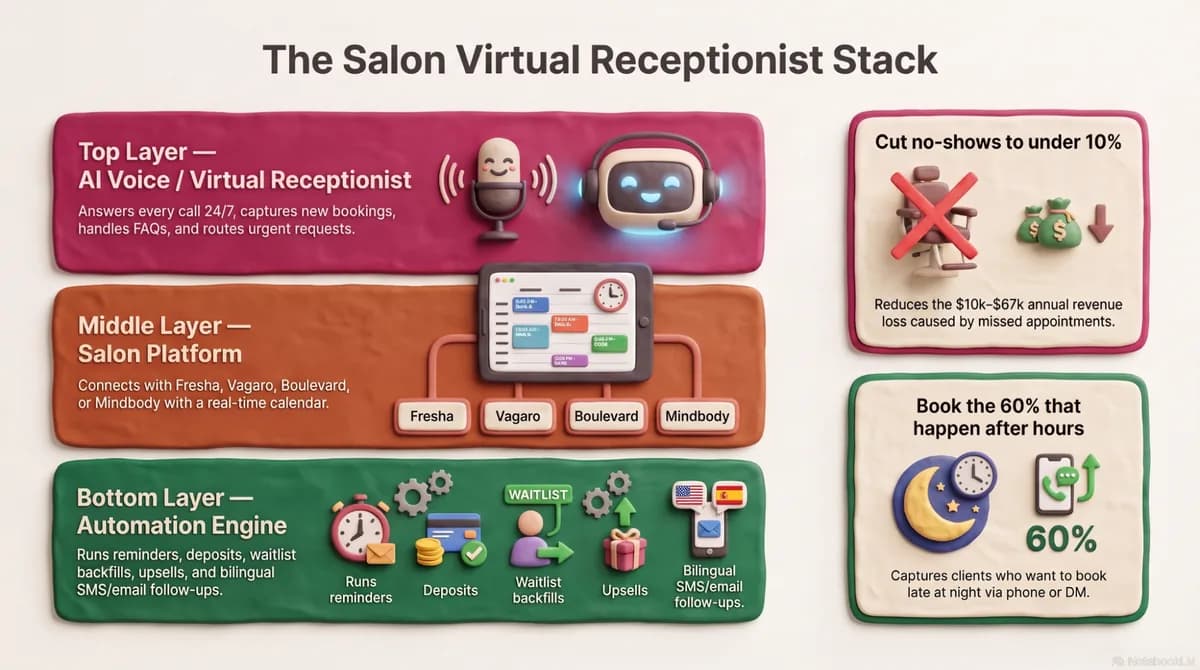
A salon virtual receptionist answers every call 24/7, books appointments directly into your salon platform (Fresha, Vagaro, Boulevard, Mindbody), and sends automated reminders that cut no-shows. Top salons use it to solve two specific problems: capture the ~60% of bookings that happen after hours, and cut the industry-average 20–30% no-show rate that quietly drains $10,000–$67,000 per year. It runs on autopilot alongside your existing staff, powered by an AI voice agent and your salon software.
Key Takeaways
- Two problems, one system. Top salons fix no-shows AND after-hours booking together.
- No-shows are 20–30% by default. A reminder + deposit + waitlist stack can cut that to under 10%.
- ~60% of bookings happen after hours. Clients scroll Instagram at 10pm and want to book NOW.
- Salon-platform integration is table stakes. If it doesn't book into Fresha/Vagaro/Boulevard, it's an answering service, not a receptionist.
- AI runs it on autopilot. Instant pickup, bilingual, pays for itself with one recovered color booking.
See the no-show ladder run for your salon.
Book a 15-minute demo and hear MIA book a color and turn a cancellation into a reschedule.
Book a demo →What Is a Salon Virtual Receptionist?
A salon virtual receptionist is a service that answers your salon's calls 24/7, books appointments directly into your salon platform, and sends automated reminders that cut no-shows. It can be an AI voice agent, a human answering service, or a hybrid — the point is that no client hits voicemail and no booking is missed.
What separates a real virtual receptionist from a message-taking answering service is one thing: does it actually book the appointment on your calendar, or does someone on your team still need to key it in?
Why the Salon Phone Is Where the Money Leaks
Stylists can't answer phones mid-color, and clients don't leave voicemails — they call the next salon. Industry data shows 35–67% of salon calls go unanswered during peak hours, and 52% of clients hang up after just three minutes on hold. Every one of those calls is a $70–$550 booking walking to a competitor.
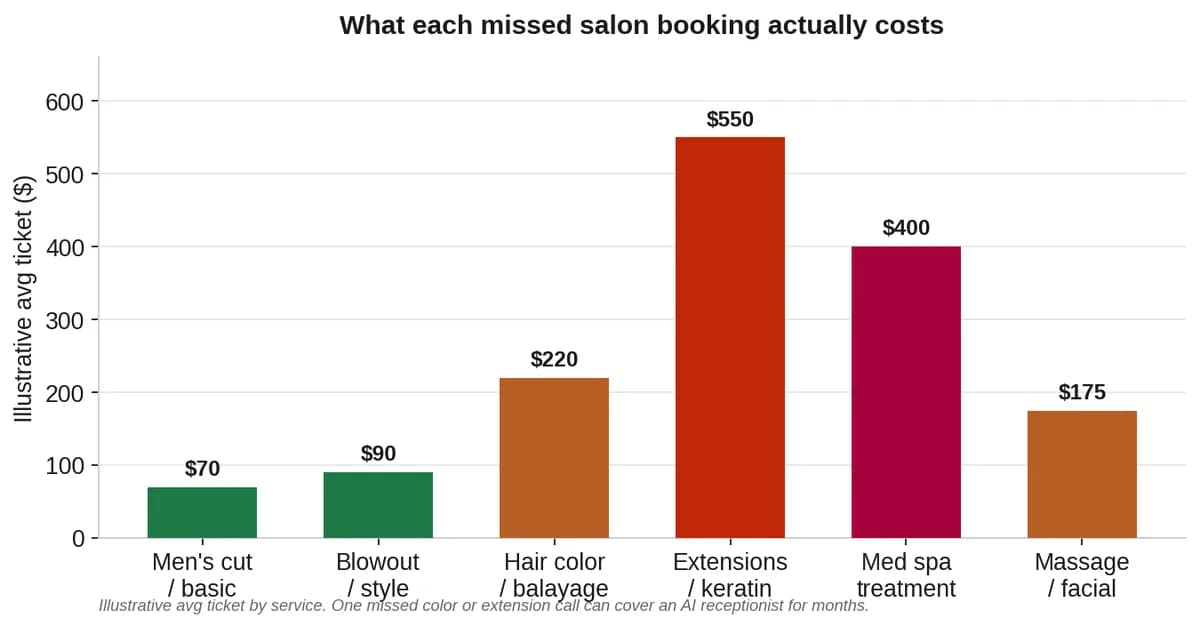
On top of that, no-shows run 20–30% by default — which costs the average salon $10,000–$67,000 a year. Add both together and the salon phone is quietly the biggest revenue leak in the business.
Playbook 1 - Cut No-Shows (the Reduction Ladder)
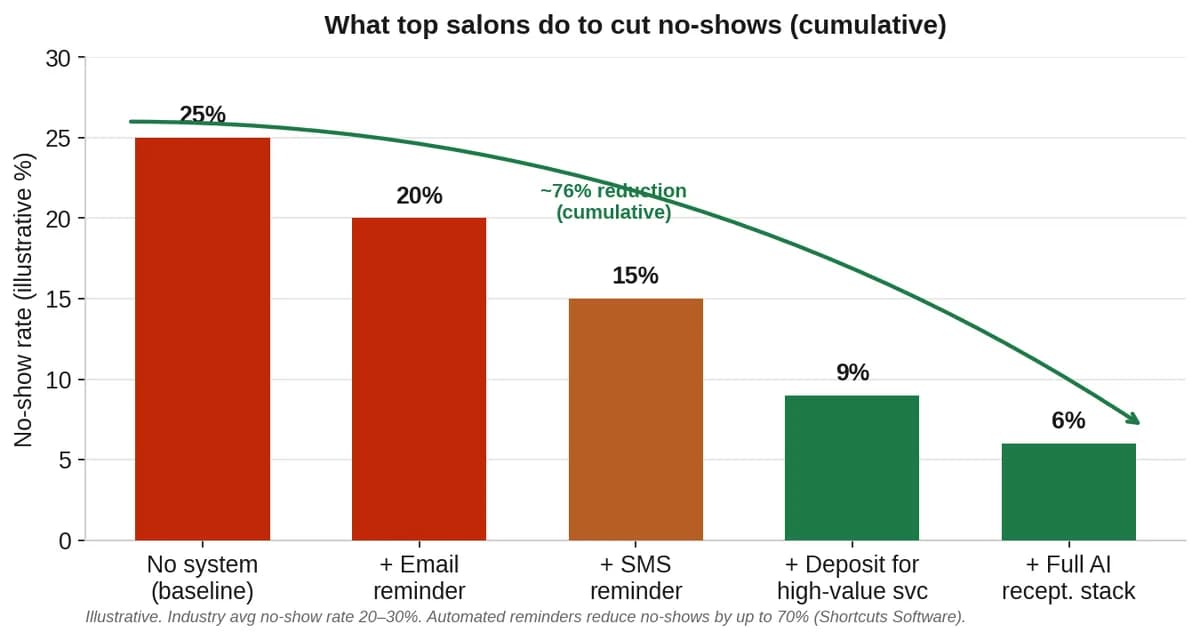
Top salons don't cut no-shows with one silver bullet — they stack layers. Each layer compounds. The result: a default 25% no-show rate can drop below 10%.
Layer 1: The automated reminder sequence
The foundation. Automated email at 48 hours before the appointment; SMS at 24 hours; a one-tap confirm/reschedule link on both. Reminders alone are the single biggest lever — industry data shows they can cut no-shows by up to 70%. Set this up in your salon platform first, then wire it into a reminder-and-deposit workflow so it runs consistently across every service.
Layer 2: Deposits and card-on-file for high-value services
This one is where top salons separate from the rest. Require a deposit (usually 25–50%) or a card-on-file with a clear cancellation policy for color, extensions, keratin, and any service over 90 minutes. The bookings that will no-show self-select out during the deposit step — and the ones who do commit rarely cancel.
Layer 3: Waitlist and instant reschedule
When someone does cancel (or worse, no-shows), the empty chair costs you every minute it sits open. Maintain an active waitlist by service type. The moment a cancellation happens, automated SMS goes to the waitlist — first to confirm gets the slot. Modern salon platforms handle this automatically once you turn it on.
Layer 4: The AI receptionist that closes the loop
The last mile. When a client calls to cancel, an AI virtual receptionist for salons offers a reschedule first — it converts cancellations into future bookings before they become no-shows. It also proactively calls unconfirmed clients 24 hours out to lock the appointment. This layer catches everything the reminders and deposits didn't.
See the no-show ladder running for your salon.
A 15-minute demo on your services, stylists, and platform.
Book a demo →Playbook 2 - Book After Hours on Autopilot
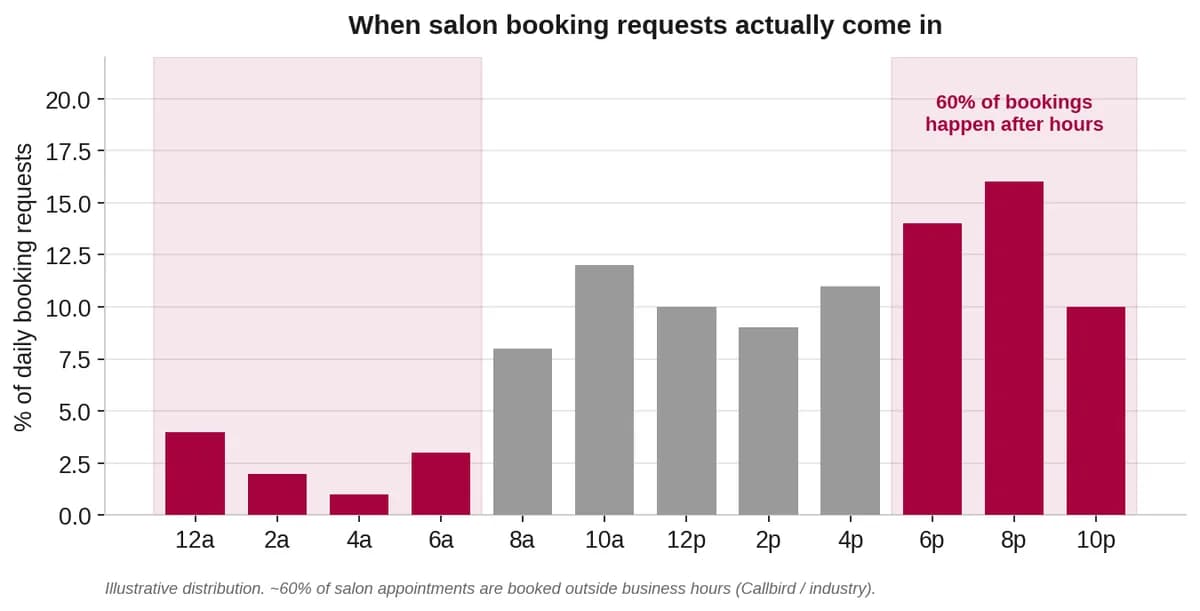
About 60% of salon appointments are booked outside business hours. Clients scroll Instagram at 10pm, see a photo of a balayage, and want to book NOW. If they can't, they book with whoever answers first tomorrow morning.
The 24/7 pickup mechanism
You can't have a human at the front desk at 10pm. But an AI voice agent picks up in under a second, greets the caller by your salon's name, and books the appointment directly into your calendar. Every night. Every weekend. Every holiday.
Bilingual and multi-channel (call, SMS, Instagram)
Salons serve diverse communities, and clients book on the channel they're already on. A real after-hours system covers: voice (bilingual English/Spanish detected automatically), SMS (one-tap booking), and Instagram/website DMs. Pair the voice bot with an AI chatbot for Instagram DMs and web to catch the client who saw your work in a story and wants to book from the DM thread.
Real-time salon calendar sync
The mechanism only works if the booking actually lands on the calendar. That means real-time two-way sync with your salon platform (Fresha, Vagaro, Boulevard, Mindbody, Booker, Mangomint) — not a nightly export, not a message emailed to your manager. If it's not writing to the calendar in real time, it's not solving the after-hours problem.
The Salon-Platform Integration Reality
If it doesn't book into your salon platform, it's not a virtual receptionist. The whole difference between an answering service and a virtual receptionist is the calendar write. When you evaluate any option, check this list.
| Feature | What it should do | Red flag |
|---|---|---|
| Salon-platform integration | Writes bookings directly to Fresha/Vagaro/Boulevard/Mindbody | 'Sends us the details, we book manually' |
| Real-time calendar | Two-way sync, no double-booking | Nightly export or CSV import |
| Service catalog aware | Knows balayage = 3hrs, men's cut = 30min | Generic time-block bookings |
| Stylist matching | Books with the right stylist by service | One 'next available' slot only |
| Deposits + no-show policies | Enforces card-on-file rules at booking | Deposits collected later by staff |
AI Virtual Receptionist vs Human Answering Service
Both exist for the same reason — you can't have a person at the front desk 24/7. The trade is different for salons.
| Factor | AI virtual receptionist | Human answering service |
|---|---|---|
| Answer speed | Under 1 second | 3–4 rings, longer at peak |
| 24/7 / after-hours | Always, at same cost | Yes but usually per-plan |
| Salon service knowledge | Trained on your services | Depends on training + turnover |
| Books into salon platform | Yes, in real time | Sometimes, depends on training |
| Bilingual (Eng/Spa) | Automatic | Depends on staffing |
| Monthly cost | $25–$200 flat | $250+ per-minute |
Most salons using AI use it as the always-on front desk and let staff handle in-person clients. The same trade plays out in adjacent verticals — how HVAC contractors handle after-hours calls and how property managers cover 24/7 calls show the same pattern.
How Much Does a Salon Virtual Receptionist Cost?
AI receptionists for salons typically cost $25–$200/month depending on call volume and features; entry plans often start under $50. Human answering services usually start around $250/month; a full-time front desk hire is $3,000–$4,500/month before benefits.
| Option | Typical cost | Trade-off |
|---|---|---|
| Voicemail / no coverage | "Free" | Loses ~60% of after-hours bookings |
| AI virtual receptionist | $25–$200/mo flat | 24/7, bilingual, books into salon platform |
| Human answering service | $250+/mo or per-minute | Personal touch but capped capacity |
| Full-time front desk | $3,000–$4,500/mo | In-person warmth but business hours only |
ROI math for salons is dominated by one number: recover one color or extension booking a month, and you've covered the AI receptionist for a year.
⚠️ Cost ranges are industry-reported and vary by vendor and volume. Confirm current pricing before deciding.
How SuperMIA Runs Your Salon Phone
SuperMIA is SuperMIA's voice bot for salon owners — an AI virtual receptionist that answers every salon call in under a second, day or night. It greets callers in your salon's name (English or Spanish), books the right service with the right stylist directly on your calendar, sends confirmation and reminder texts, offers reschedule when someone tries to cancel, and calls unconfirmed clients 24 hours out. During a peak Saturday rush it handles 30 concurrent calls without a hold queue. For the rare call that needs a human touch, it escalates with full context.
Hear MIA answer a salon call.
Book a 15-minute demo — a live color booking and a cancellation-turned-reschedule.
Book a 15-minute demo →Frequently Asked Questions

Harikrishna Patel
Harikrishna Patel is the founder of MIA – My Intelligent Assistant, the AI automation platform built under Botfinity Inc. in Dallas, Texas. With 15+ years in software engineering, AI/ML, and enterprise solution design, he focuses on creating practical, scalable AI tools that help businesses automate support, workflows, and operations through voice and chat.