
Table of Contents
Quick Answer
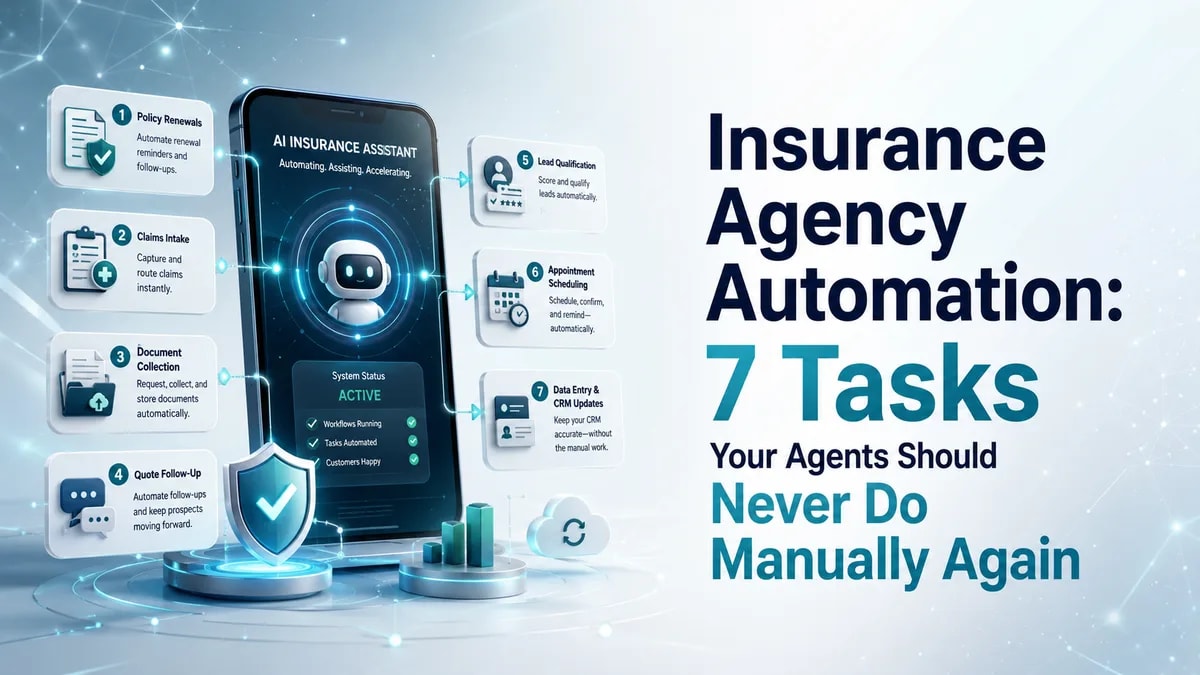
Insurance agency automation uses software to handle the repetitive, rules-based tasks that fill an agency's day — so producers can sell and service instead of doing data entry. The seven tasks to automate first are lead follow-up, policy renewals, claims intake (FNOL), certificates of insurance, document management, cross-system data entry, and routine customer service. Together they can give a team back hundreds of hours a month, and automation works alongside your existing AMS rather than replacing it.
Key Takeaways
- Automate tasks, not judgment. Rules-based admin gets automated; advising clients and underwriting stay human.
- Start with follow-up and renewals. They protect revenue directly — lost follow-up and missed renewals are lost commission.
- It works with your AMS. Automation layers on top of EZLynx, Applied, HawkSoft — you don't rip anything out.
- Three layers do the work. A voice agent for calls, a chatbot for web, and workflow automation for the back office.
- The ROI is hours. Agencies report hundreds of staff hours recovered per month.
See these automations running for your agency.
Book a 15-minute demo and watch a renewal and an FNOL run end to end.
Book a demo →What Is Insurance Agency Automation?
Insurance agency automation uses software to handle the repetitive, rules-based tasks that fill an agency's day — follow-up, renewals, claims intake, documents, data entry — so your team can sell and advise instead. It's not about replacing producers. It's about removing the admin that keeps them off the phone and out of the pipeline.
The best part: it works with the systems you already run. Automation sits on top of your AMS, rater, and CRM and moves work between them — no rip-and-replace.
Why Agencies Are Drowning in Manual Work
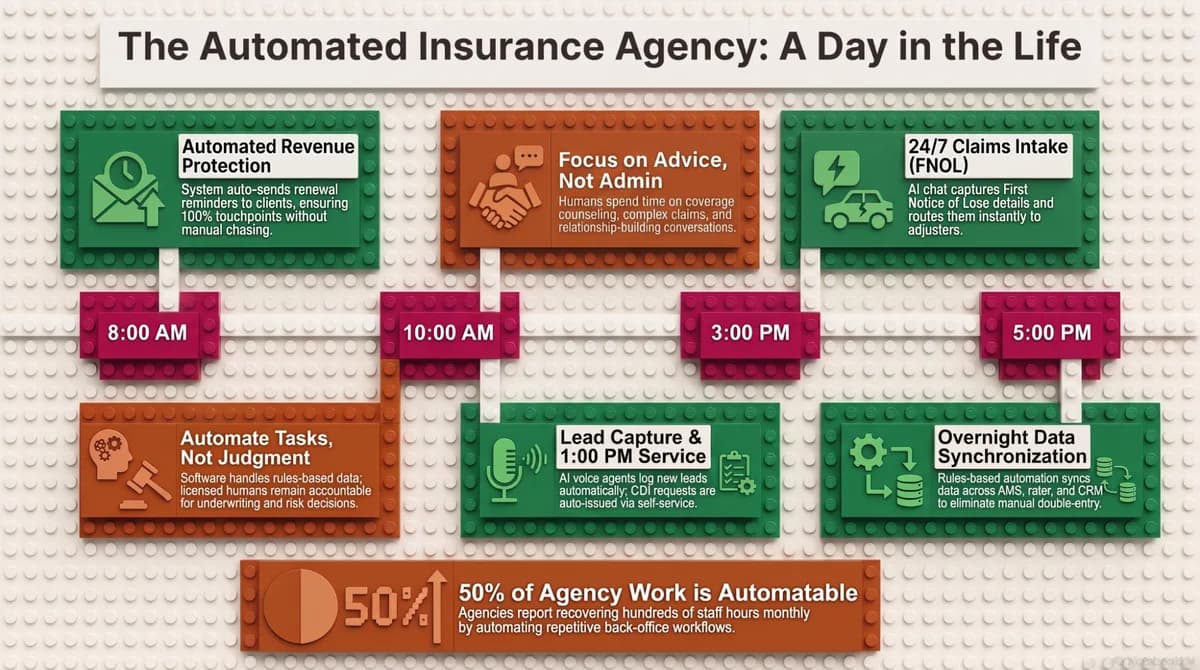
The average agency loses hours every day to work that doesn't require a licensed professional — re-keying the same data into three systems, chasing renewals, issuing COIs. It's necessary, but it's not the work that grows the book.
McKinsey research on work automation has estimated that around half of all work activities can be automated — and in an agency, most of that half is admin. The cost isn't just time; the #1 reason clients leave an agency is a lack of consistent communication, which is exactly what automation keeps from slipping.
The 7 Tasks to Automate First
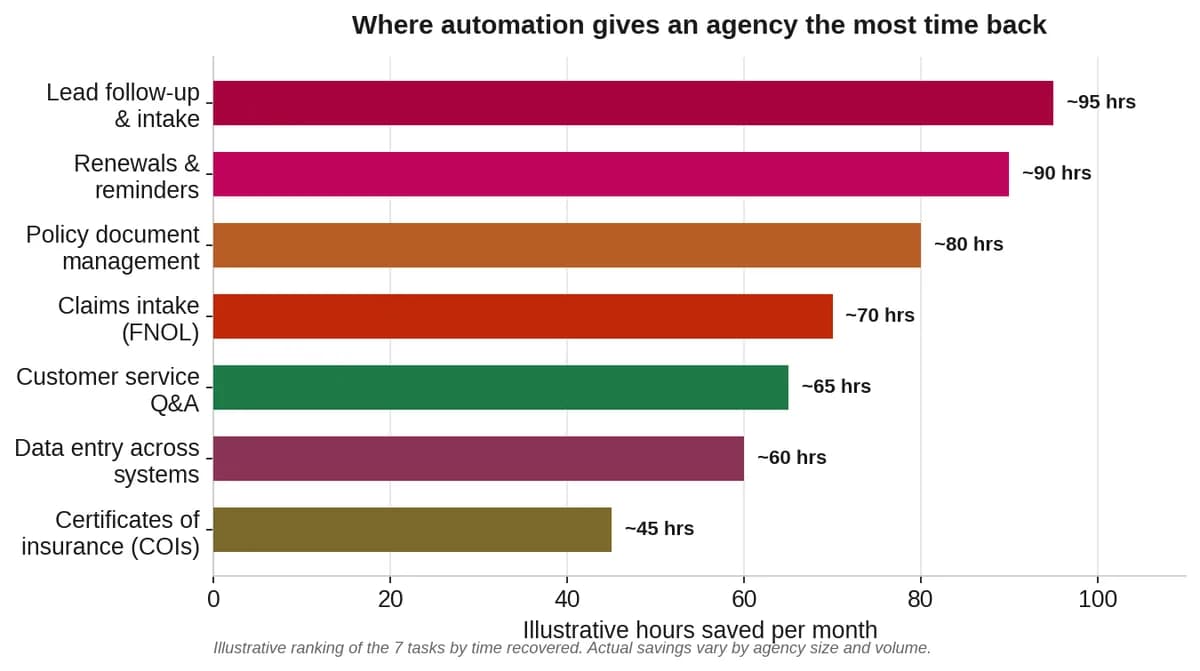
The seven tasks to automate first are lead follow-up, policy renewals, claims intake (FNOL), certificates of insurance, document management, cross-system data entry, and routine customer service. Here they are, ranked by the time they give back.
1. Lead follow-up & intake
Speed to lead decides who wins the policy. Automated follow-up texts and calls reach a new lead in seconds, qualify them, and log everything in your CRM — no producer required for the first touch. An AI voice agent for inbound and outbound calls can even handle the call.
2. Policy renewals & reminders
Missed renewals are lost commission. Automation flags every upcoming renewal, sends the client reminders by their preferred channel, and only escalates the high-risk or high-value ones to a human. You touch 100% of renewals without chasing them.
3. Claims intake (FNOL)
First notice of loss is time-sensitive and emotional. Automated intake captures the claim 24/7 by phone or chat, creates the case, gathers the required details, and routes it to the right adjuster — so nothing waits until Monday.
4. Certificates of insurance (COIs)
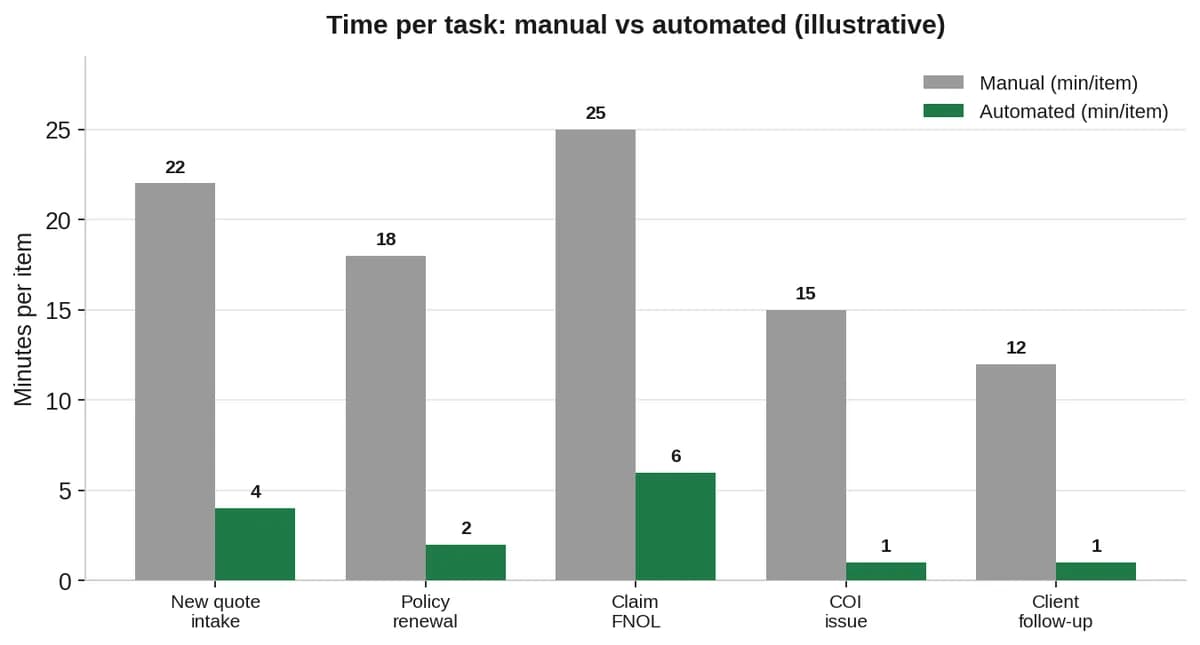
COI requests are constant and formulaic. Automation issues standard certificates on request, pulls the policy data, and delivers them instantly — turning a 15-minute task into a self-service one.
5. Document management
ACORD forms, loss runs, applications — automation ingests, names, files, and extracts data from documents, then updates the record. It automates the back-office workflow so nobody re-types a PDF again.
6. Cross-system data entry
The quiet time-killer: entering the same client data into the AMS, the rater, and the CRM. Automation syncs it once across all of them, eliminating double entry and the errors it creates.
7. Routine customer service
'What's my deductible?' 'Can you send my ID card?' These repeat endlessly. An AI chatbot on your website answers them instantly, day or night, and escalates the ones that need a person.
See these automations running for your agency.
A 15-minute demo on your workflow — follow-up, renewals, and FNOL.
Book a demo →The 3 Layers of Agency Automation
The seven tasks fall into three layers: a voice agent for calls, a chatbot for the web, and workflow automation for the back office. You rarely need all three at once — start with the layer where your leaks are biggest.
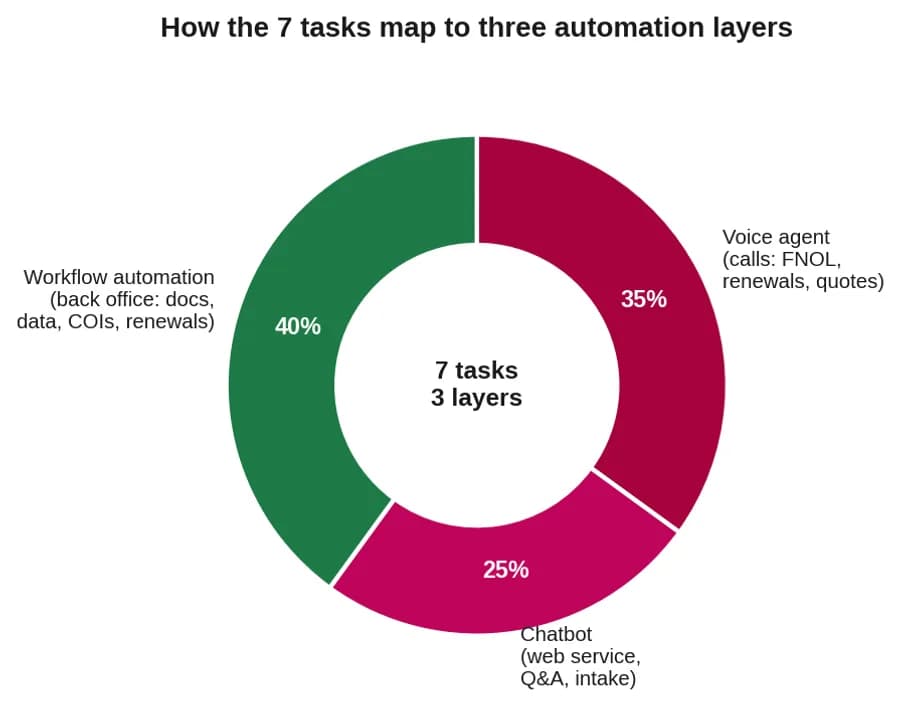
| Layer | Handles | Best for |
|---|---|---|
| Voice agent | Inbound/outbound calls: FNOL, renewals, quote intake, follow-up | Agencies losing calls or doing phone tag |
| Chatbot | Website service, Q&A, lead capture, claim start | Agencies with web traffic and repetitive questions |
| Workflow automation | Back office: documents, data entry, COIs, renewal logic | Every agency — the foundation layer |
What NOT to Automate
Automate the admin, not the advice. Some parts of the business should stay human — and pretending otherwise damages trust.
- Underwriting judgment. Automation can gather and pre-fill; a human owns the risk decision.
- Complex or contested claims. Sensitive, high-dollar, or disputed claims need a person.
- Relationship and advisory conversations. Coverage counseling and the tough calls are why clients stay.
- Compliance sign-off. Automation enforces steps; a licensed human remains accountable.
How to Start Without Disrupting Your AMS
Start with one high-volume task and layer automation on top of your existing stack — don't replace your AMS. A simple path:
- Pick your biggest leak. Usually follow-up, renewals, or after-hours calls.
- Choose the layer. Voice, chat, or workflow, based on where that task lives.
- Integrate, don't replace. Connect it to your AMS/rater/CRM. If you're evaluating platforms, compare the top workflow automation tools first.
- Measure hours saved. Baseline the task, then track the time recovered and expand to the next one.
How SuperMIA Automates Your Agency
SuperMIA covers all three layers in one place. Its workflow automation platform handles the back office — documents, data sync, COIs, renewal logic — while its voice and chat agents answer calls and web questions, capture FNOL, and follow up on leads around the clock. It connects to the AMS, rater, and CRM you already use, so you keep your systems and lose the manual steps between them. Producers get their week back; clients get faster, more consistent service.
Book a 15-minute demo for your agency.
See all three layers on your stack — or check plans and pricing.
Book a 15-minute demo →Frequently Asked Questions

Harikrishna Patel
Harikrishna Patel is the founder of MIA – My Intelligent Assistant, the AI automation platform built under Botfinity Inc. in Dallas, Texas. With 15+ years in software engineering, AI/ML, and enterprise solution design, he focuses on creating practical, scalable AI tools that help businesses automate support, workflows, and operations through voice and chat.