
Table of Contents
- Quick Answer
- What Is an HVAC Answering Service?
- What Does a Missed HVAC Call Actually Cost?
- Why HVAC Businesses Miss So Many Calls
- AI Voice Agent vs Human Answering Service vs Voicemail
- What a Great HVAC Answering Service Must Do
- How Much Does an HVAC Answering Service Cost?
- How SuperMIA Answers Every HVAC Call
- Frequently Asked Questions
Quick Answer
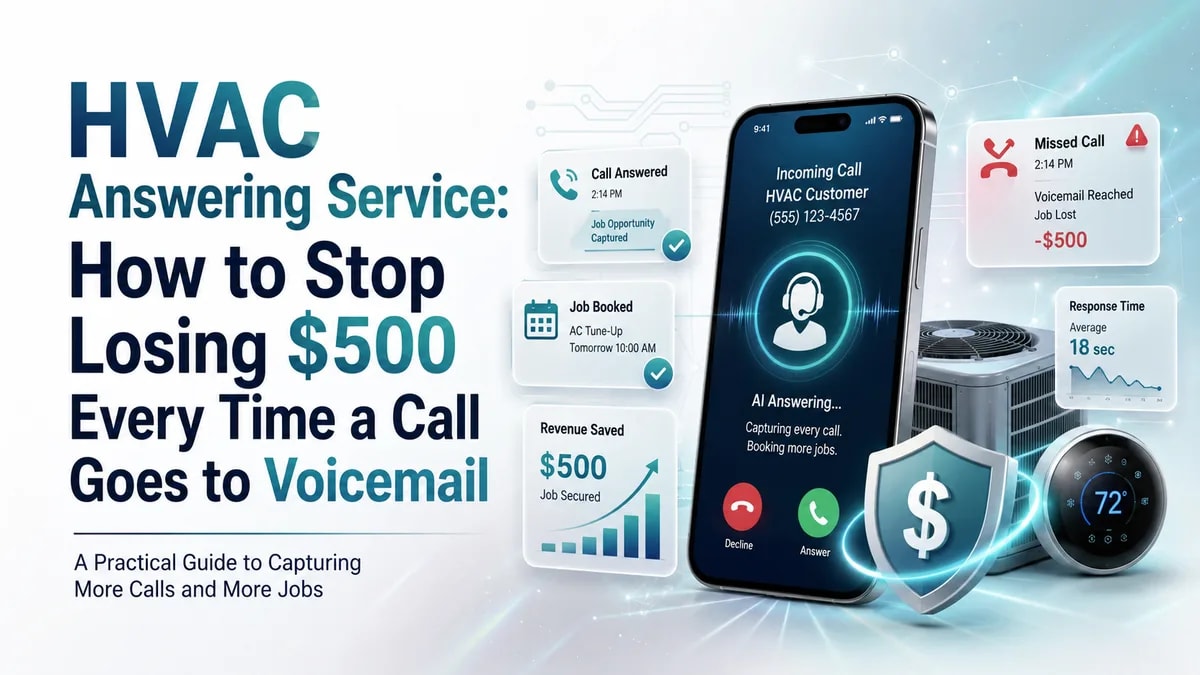
An HVAC answering service answers your calls when your team can't — after hours, on weekends, and during peak-season surges — so no lead goes to voicemail. It matters because HVAC businesses miss 27–62% of calls, 85% of callers who hit voicemail never call back, and each missed call is worth roughly $350–$1,200. You can use a human call center or an AI voice agent that answers instantly, books the job, and costs far less.
Key Takeaways
- Every voicemail is a lost job. 85% of callers who reach voicemail never call back — they call the next HVAC company.
- A missed call costs $350–$1,200. Emergency and replacement calls run even higher.
- Most calls come when you can't answer. 31–42% are after-hours, and peak weeks spike 2–4×.
- AI voice answers what humans miss. Instant pickup, unlimited simultaneous calls, no per-minute fee.
- Integration is the dealbreaker. It must book into ServiceTitan or Housecall Pro, not just take a message.
Calculate your leak, then plug it.
See MIA answer a live HVAC call — book the 15-minute demo.
Book a demo →What Is an HVAC Answering Service?
An HVAC answering service answers calls on your behalf when your team can't — after hours, weekends, and during peak-season surges — so leads don't die in voicemail. It captures caller details, triages emergencies (a no-heat call in January isn't a filter question), and, at its best, books the job directly on your calendar. It can be staffed by human receptionists or by an AI voice agent.
For a trade where the phone drives the business, that coverage is the difference between a full schedule and a slow week.
What Does a Missed HVAC Call Actually Cost?
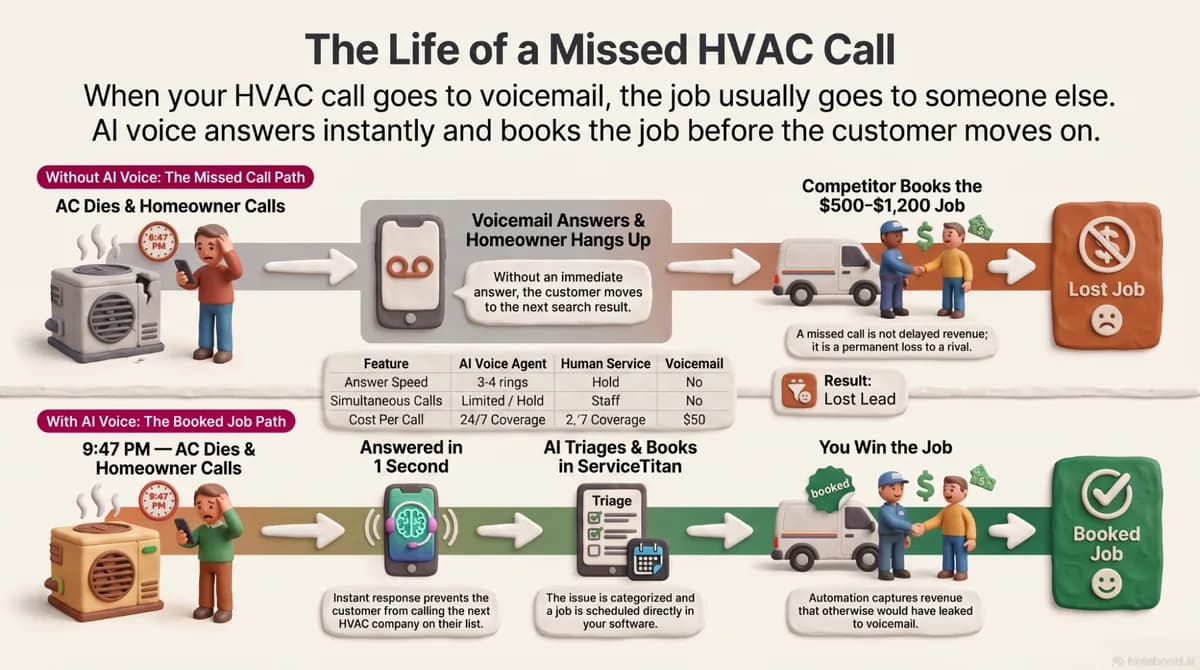
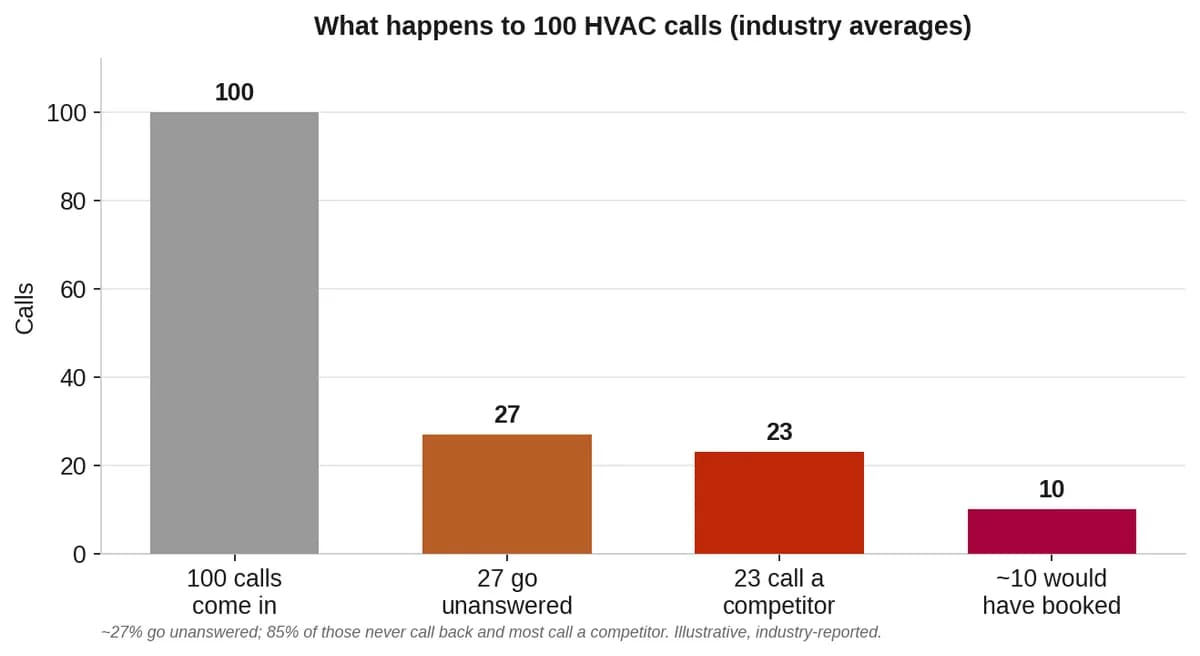
A missed HVAC call costs roughly $350–$1,200 in lost revenue — and most callers who hit voicemail never call back. Industry data shows about 85% of voicemail-reachers hang up and call a competitor instead. So a missed call isn't delayed revenue; it's gone.
The missed-call formula
Here's the math on your own numbers:
- Weekly missed calls = weekly inbound calls × your miss rate (industry avg ~27%)
- Lost jobs = missed calls × your close rate
- Weekly revenue leak = lost jobs × your average ticket
- Annual leak = weekly leak × 52
A real example
A 2-truck shop takes ~30 calls/week and misses ~27% — that's 8 missed calls. If even 4 would have booked at a $500 average ticket, that's $2,000/week, or over $100,000 a year leaking straight to voicemail — before you count emergency premiums, repeat business, and referrals.
Why HVAC Businesses Miss So Many Calls
HVAC businesses miss calls for structural reasons, not laziness — your team is on a roof, in a crawlspace, or asleep. Three forces stack up:
- Techs can't answer while working. 27–62% of calls go unanswered simply because everyone is on a job site.
- Most calls come after hours. 31–42% of HVAC calls land outside 8–5, when a furnace dies at 9pm.
- Peak season overwhelms everyone. The first heat wave can push call volume to 2–4× baseline — including your office staff and any human answering service.
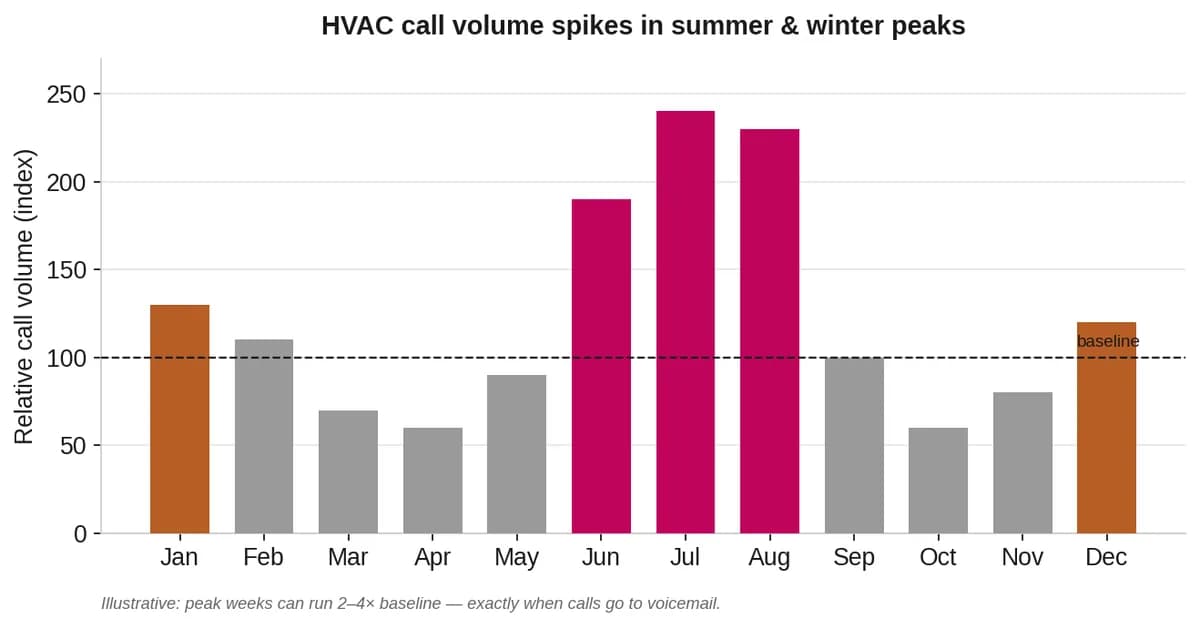
Voicemail isn't a safety net — caller patience dropped to about 2 seconds in 2026, and speed-to-lead research shows the first business to respond usually wins the job. Even a website helps: add a website chat agent to catch the leads that start online. But the phone is where HVAC jobs are booked.
AI Voice Agent vs Human Answering Service vs Voicemail
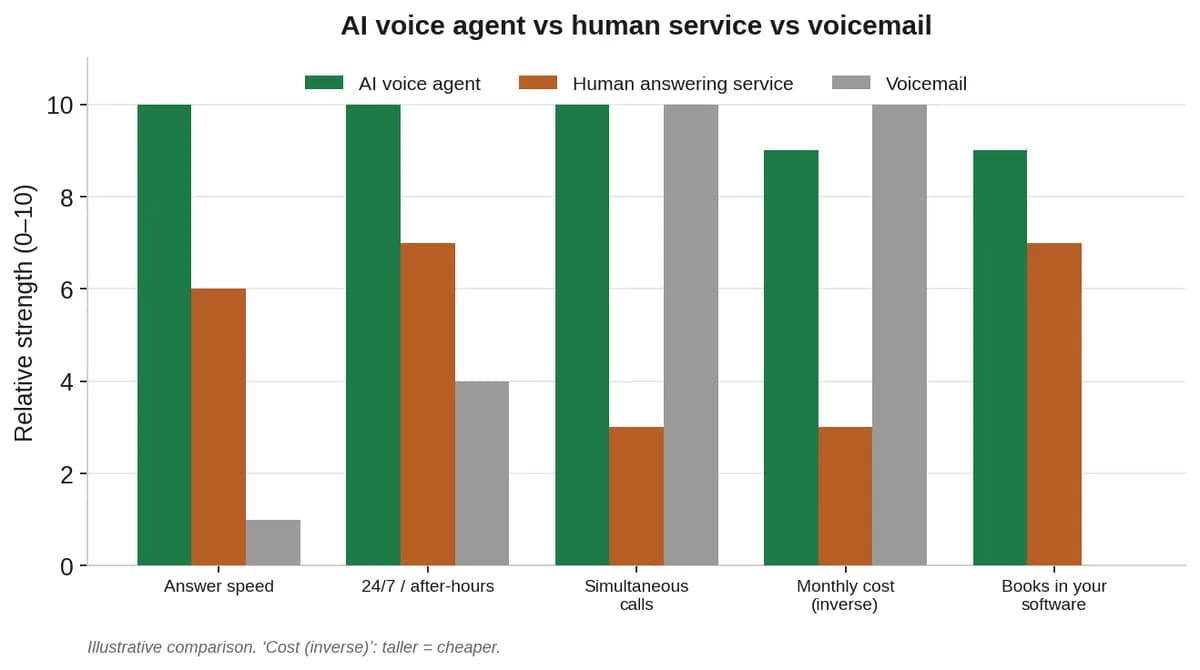
An AI voice agent answers instantly and handles unlimited simultaneous calls; a human service adds a personal touch for complex calls; voicemail loses the lead. Here's the honest comparison.
| Factor | AI voice agent | Human service | Voicemail |
|---|---|---|---|
| Answer speed | Under 1 second | 3–4 rings, hold at peak | N/A — no answer |
| After-hours / 24-7 | Always | Usually (per plan) | No |
| Simultaneous calls | Unlimited | Limited by staff | — |
| Monthly cost | Flat, low | Per-minute / $235+ | 'Free' but loses jobs |
| Books in your software | Yes, instantly | Sometimes | No |
| Complex judgment | Good + escalates | Best | None |
Many HVAC shops use an AI voice agent that answers every call for speed and coverage, and escalate the rare complex call to a person. You stop losing the 2am emergency and the heat-wave overflow — the calls a human service misses too.
What a Great HVAC Answering Service Must Do
Judge any 24/7 AI voice answering service — human or AI — on five things. If it can't do these, it's just an expensive voicemail.
- Answer 24/7, instantly. Every call, including nights, weekends, and holidays.
- Triage emergencies. Tell a no-heat emergency from a routine question and route accordingly.
- Book into your software. Write the job into ServiceTitan or Housecall Pro, not a message pad. Pair it with tools that automate dispatch and follow-up.
- Scale for peak season. Handle the heat-wave surge without dropping calls or charging overage.
- Sound like your business. Your greeting, your service area, your brand — not a generic call center.
How Much Does an HVAC Answering Service Cost?
Human HVAC answering services typically start around $235–$350/month or bill per minute; an AI voice agent is usually a flat fee at a fraction of the cost. For context, a full-time receptionist runs $2,800–$4,000/month before benefits — and still only covers business hours.
| Option | Typical cost | Trade-off |
|---|---|---|
| Voicemail | "Free" | Loses ~85% of after-hours leads |
| Human answering service | $235–$350+/mo or per-minute | Personal, but limited capacity + overage at peak |
| AI voice agent | Flat monthly fee (often lowest) | Instant, unlimited calls, books jobs; escalates the rare complex one |
| Full-time receptionist | $2,800–$4,000/mo | Business hours only, one call at a time |
The ROI math is simple: if capturing even one extra $500 job a month covers the cost, the service pays for itself immediately. See plans and pricing.
⚠️ Cost ranges are industry-reported and vary by provider, call volume, and plan — always confirm current pricing.
How SuperMIA Answers Every HVAC Call
SuperMIA is SuperMIA's voice bot for HVAC — an AI voice agent that answers every call in under a second, day or night. It greets callers in your business's name, triages emergencies, answers common questions, and books the job straight into your scheduling software. During a heat wave, it answers 50 calls at once without a hold queue. It never sleeps, never takes a lunch break, and costs a fraction of a human call center. For the rare call that needs a person, it escalates with full context.
Hear MIA answer an HVAC call.
Book a 15-minute demo and listen to it triage and book a live emergency.
Book a 15-minute demo →Frequently Asked Questions

Harikrishna Patel
Harikrishna Patel is the founder of MIA – My Intelligent Assistant, the AI automation platform built under Botfinity Inc. in Dallas, Texas. With 15+ years in software engineering, AI/ML, and enterprise solution design, he focuses on creating practical, scalable AI tools that help businesses automate support, workflows, and operations through voice and chat.