
Table of Contents
- Quick Answer
- The One Thing Every Roofer Misses About Lead Gen
- The 7 Best Channels to Get More Roofing Leads (Ranked)
- Residential vs Commercial Roofing Leads
- How to Actually Close the Leads You Get
- The Storm-Season Problem (and How to Survive It)
- What Roofing Leads Should Actually Cost
- How SuperMIA Answers Every Roofing Lead in 1 Second
- Common Mistakes to Avoid
- Frequently Asked Questions
Quick Answer
To get more roofing leads without door-knocking, combine three channels: a fully built-out Google Business Profile with reviews, Google Local Services Ads (LSAs), and local SEO. Layer PPC and Facebook Lead Ads for speed and referrals for compounding. But getting leads only works if you close them: the first roofer to respond wins about 40–50% of the time, and the industry average is 1.7 days. Fix the response gap with an AI voice agent that answers every call in under 1 second, 24/7.
Key Takeaways
- Getting leads is half the job. The other half — closing them — is where most roofers leak money.
- Speed wins. The first roofer to respond wins ~40–50% of the time; industry average is 1.7 days.
- Rank channels by CPL and speed, not just tactic count. GBP + referrals are cheap but slow; LSAs + PPC cost more but work in days.
- Storm season breaks capacity. Even well-staffed shops cap ~100 calls/week; the rest go to competitors.
- An AI voice agent is the speed-to-lead system. Sub-1-second answer, unlimited concurrent calls, books the inspection.
See the speed-to-lead system in action.
Book a 15-minute demo and hear MIA answer a roofing call in under a second.
Book a demo →The One Thing Every Roofer Misses About Lead Gen
Every roofing-leads guide tells you the same 15 tactics: build your GBP, run LSAs, do SEO, get reviews, ask for referrals. All good advice. Then they bury the actual problem in a footnote: the first roofer to respond wins ~40–50% of the time, and the average roofer takes 1.7 days.
If you’re calling back leads a day later, no amount of marketing spend fixes it. You’re just funding leads for the roofer who answers first.
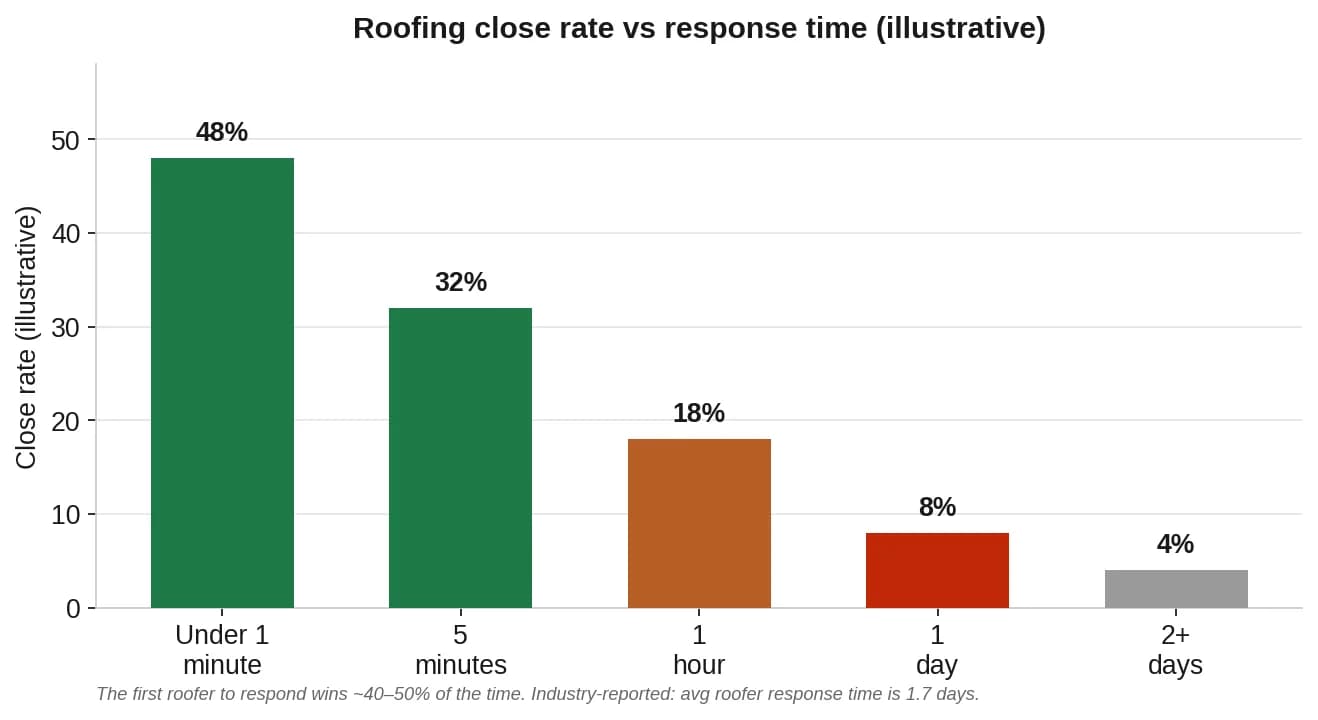
Read the chart. That’s the whole game. The rest of this guide covers the channels honestly — then the close system that makes those channels pay off.
The 7 Best Channels to Get More Roofing Leads (Ranked)
Ranked by a mix of CPL, speed to results, and effort. There’s no single best channel — the winning play is 2–3 layered, with your close system on top.
| # | Channel | Typical CPL | Speed to Work | Best For |
|---|---|---|---|---|
| 1 | Google Business Profile (GBP) | $0–$10 | Weeks | Local homeowners — highest ROI free channel |
| 2 | Google Local Services Ads (LSAs) | $40–$120 | Days | High-intent local search + Google Guaranteed trust |
| 3 | Local SEO + service-area pages | $15–$75 | 3–6 months | Compounding organic traffic |
| 4 | Referrals + past-customer activation | ~$0 | Weeks | Highest close rate, hardest to scale |
| 5 | Facebook Lead Ads | $25–$80 | Days | Cold demand, seasonal offers |
| 6 | Google PPC (search) | $60–$200 | Days | Storm keywords, urgent repair intent |
| 7 | Strategic partnerships | ~$0 | Months | Real estate, HVAC, insurance restoration |
1. Google Business Profile (GBP)
The single highest-ROI free channel. Fully complete every field — services, service area, hours, photos, offers — and actively earn reviews. Homeowners searching “roofer near me” see the local 3-pack first, and photos + reviews decide the click. Also worth pairing with an AI chatbot on your website to catch prospects who click through and start on the site.
2. Google Local Services Ads (LSAs)
Fastest way to get inbound calls from high-intent local searchers. LSAs sit above the map pack with a Google Guaranteed or Google Screened badge — the trust signal is doing most of the work. Pay per lead, not per click. The catch: leads come as phone calls, so if you don’t answer in seconds, you paid for nothing.
3. Local SEO + service-area pages
The compounding channel. Build city and service-area pages, publish local roofing content (storm damage, insurance claims, tile vs shingle), and earn local citations. Slow — 3–6 months to see traction — but the leads keep coming without ongoing ad spend.
4. Referrals and past-customer activation
Referrals convert 2–3× better than any paid channel, but they don’t scale on their own. Systematize: ask for a review and referral after every completed job, send a thank-you email 30 days later (email nearly doubles repeat business vs calls), and stay in touch quarterly with seasonal maintenance tips.
5. Facebook Lead Ads
Underrated for cold demand. Lead Ads let homeowners submit their info without leaving Facebook — lower friction than a landing page. Best for storm-season targeting, seasonal offers, and free-inspection campaigns in specific ZIPs.
6. Google PPC (search)
Higher CPL than LSAs but essential for two things: storm-related keywords (“hail damage roof repair”, “emergency roof leak”) and specific service pages (“metal roof installation”). Bid on high-intent keywords only — broad match will burn budget fast.
7. Strategic partnerships (real estate, insurance, HVAC)
Cross-referrals with real estate agents (inspection referrals), HVAC contractors (attic access finds), and insurance restoration adjusters (claim work). Low cost, high close rate. If HVAC is one of your partners, they face the same after-hours problem — how HVAC contractors handle after-hours calls is the same play for them.
Residential vs Commercial Roofing Leads
They’re different games with different playbooks. Residential is speed + trust; commercial is process + relationships.
| Factor | Residential | Commercial |
|---|---|---|
| Sales cycle | Days to weeks | Weeks to months |
| Best channels | GBP, LSAs, PPC, referrals | LinkedIn, direct outreach, property-manager relationships |
| What decides | Speed + reviews + free inspection | Experience + references + insurance/bonding |
| Deal size | $8K–$25K | $50K–$500K+ |
| Close mechanism | Same-hour response + inspection booking | Slow nurture + capability demos |
How to Actually Close the Leads You Get
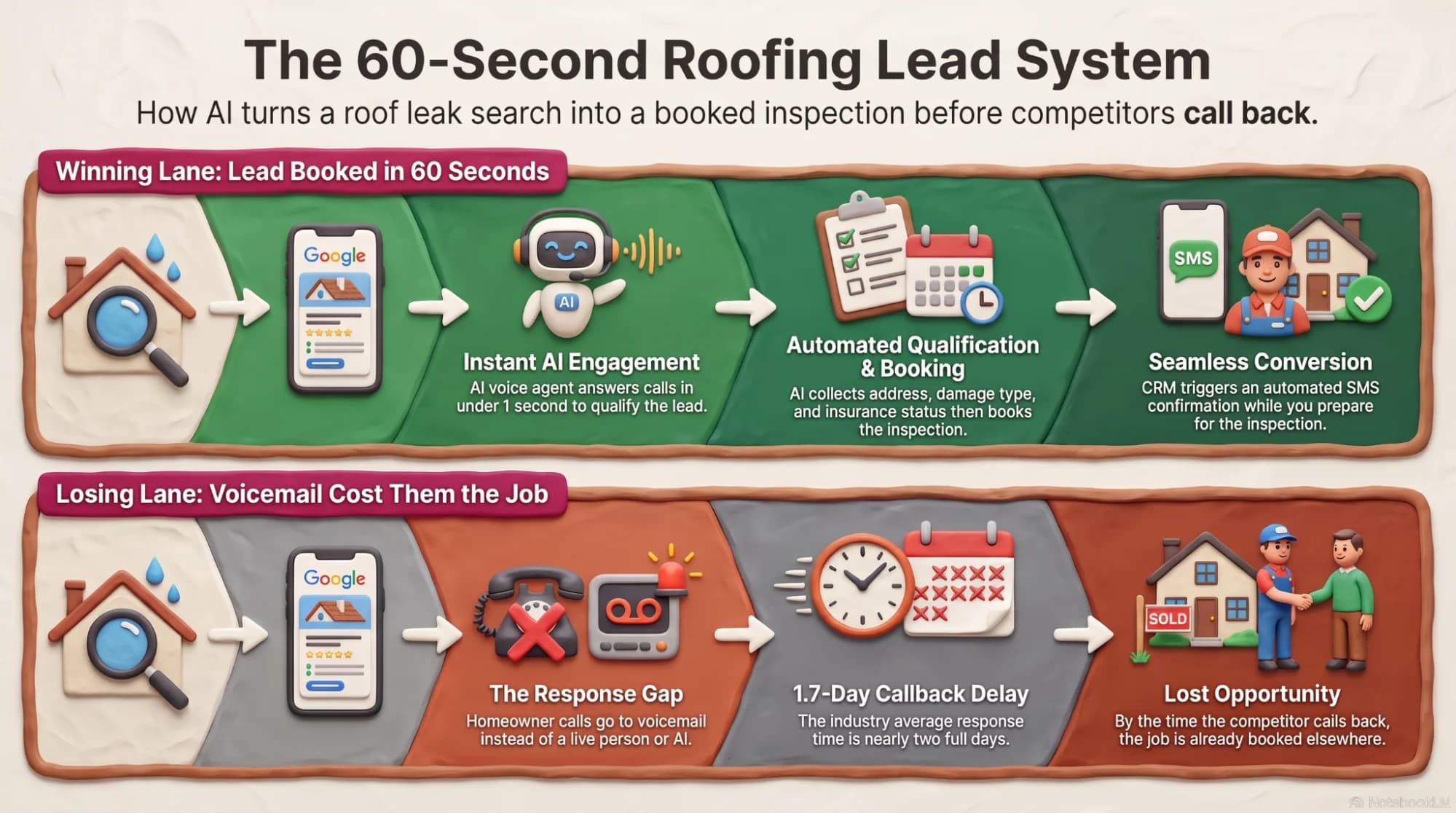
The first roofer to respond wins the job 40–50% of the time. Everything else — the estimate, the pitch, the pricing — comes second. Here’s the 4-step system.
- Answer every inbound call in under 60 seconds. Not one ring at your desk while you’re on a roof — pickup, day or night.
- Qualify on the call, not later. Address, damage type, homeowner or renter, insurance involved.
- Book the free inspection on the call. Don’t take a message. Put it on your calendar right now.
- Trigger automated follow-up in your CRM. Confirmation SMS, next-day reminder, post-inspection follow-up. Use workflow automation to trigger follow-up so nothing falls through.
Steps 1–3 are where every roofer breaks down. You’re on a job site; you can’t answer. The fix isn’t hiring a receptionist for $3,500/month — it’s an AI voice agent for roofers that answers every call in under a second, qualifies, and books the inspection. Same play as how property managers cover 24/7 calls.
See how a roofing call gets answered in 1 second.
Book a 15-minute demo and hear MIA qualify a storm-damage lead live.
Book a demo →The Storm-Season Problem (and How to Survive It)
Storm season is when lead gen either wins you a great year or breaks your business. The calls hit in a wave — hail, wind, flood — and even a well-staffed shop caps out around 100 calls/week. Every call past that is a competitor’s job.
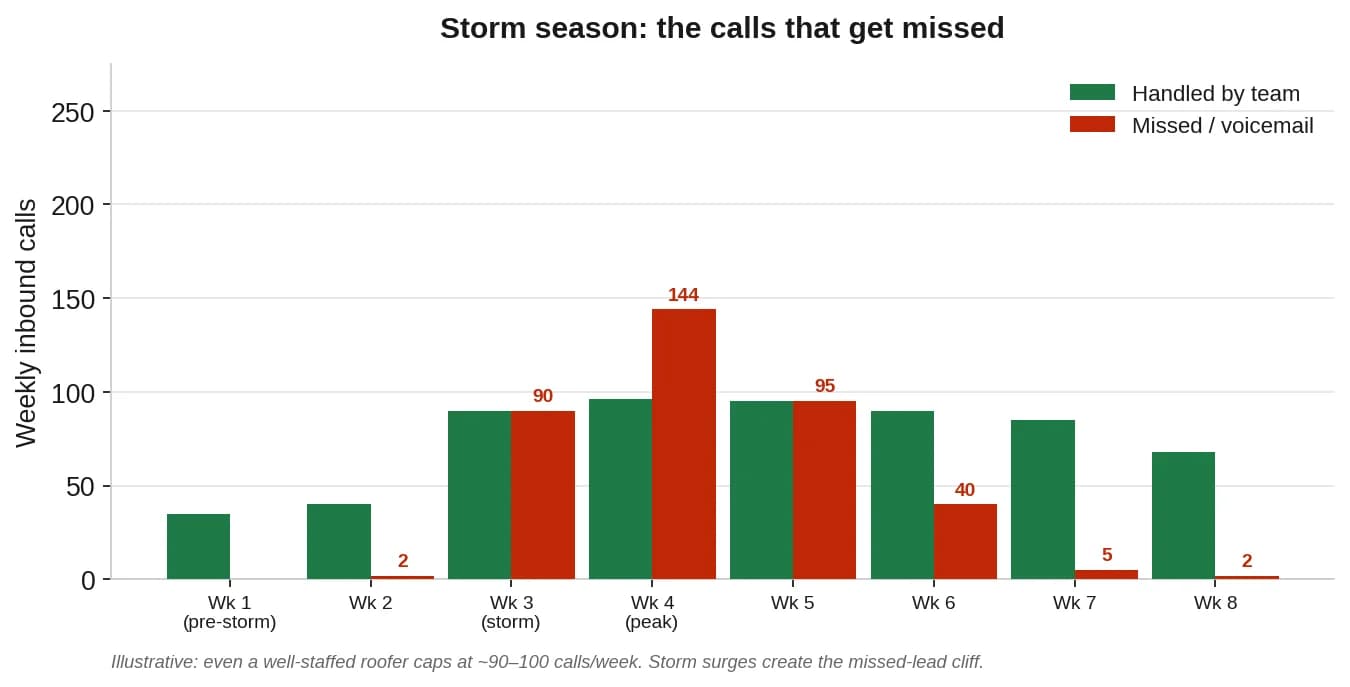
An AI voice agent is the only cost-effective way to handle that surge. Human answering services cap the same way (limited seats + per-minute pricing that spikes during a storm). Voicemail loses the lead entirely. AI voice takes unlimited concurrent calls at flat cost — the surge doesn’t touch your close rate.
What Roofing Leads Should Actually Cost
Roofing leads cost $15–$200 depending on channel. But CPL only matters relative to your close rate and average job value.
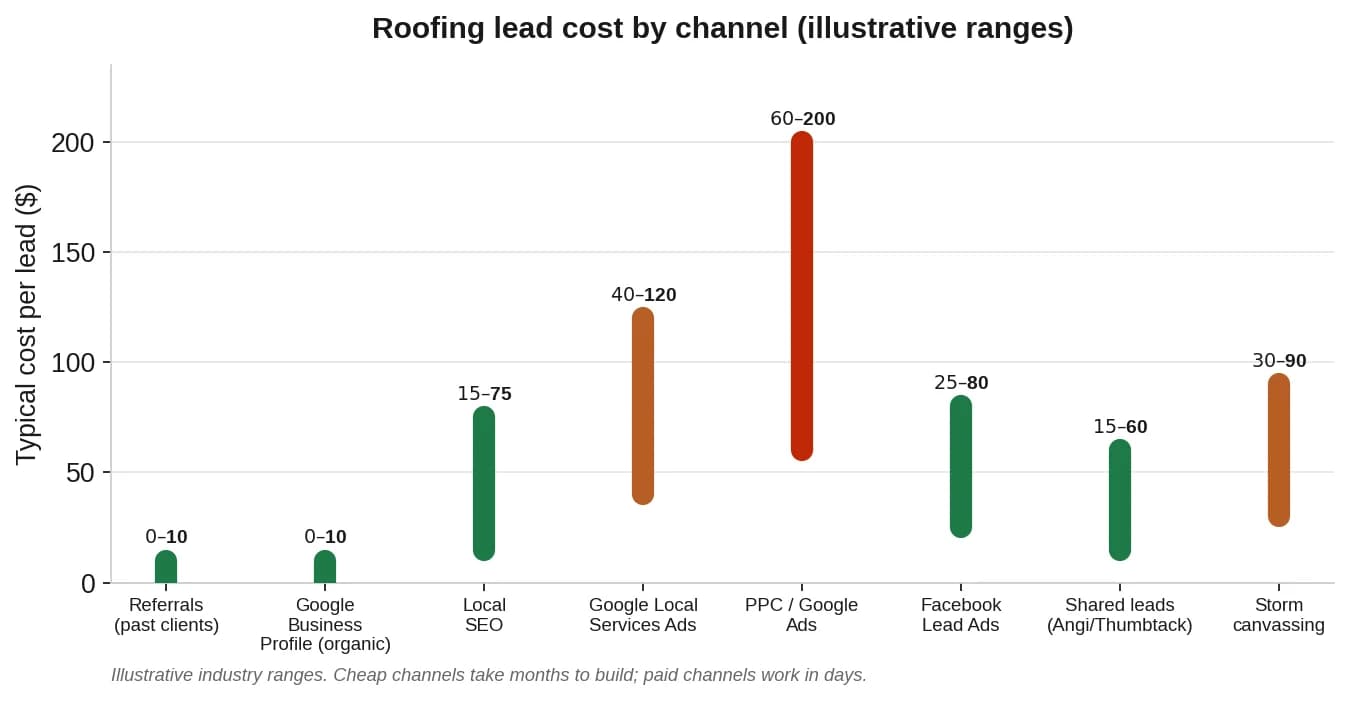
The right frame: cost per booked job, not per lead. If your average job is $8K and you close 1 in 4 leads, you can spend up to $2K per booked job (=$500 CPL) and stay profitable. Improve your close rate from 25% to 40% — which sub-60-second response can do — and every lead is suddenly worth more.
⚠️ CPL ranges are industry-reported and vary by market and season. Track your own numbers per channel per month — the averages are just a starting frame.
How SuperMIA Answers Every Roofing Lead in 1 Second
SuperMIA is SuperMIA’s voice bot for roofing — an AI voice agent that answers every inbound roofing call in under one second, day or night. It greets the caller in your business’s name, qualifies the lead (address, damage type, insurance involvement), books the free inspection on your calendar, and triggers confirmation SMS through your CRM. During a hail-storm surge it takes 50 calls at once, no hold queue, no overage fee. For the rare call that needs your judgment, it escalates with full context. The mechanism your lead-gen budget needs to actually pay off.
Book a 15-minute demo — hear it answer a roofing call.
See MIA qualify a storm-damage lead and book the inspection live.
Book a 15-minute demo →Common Mistakes to Avoid
- Chasing one “magic” channel. If LSAs get expensive or Facebook changes an algorithm, your pipeline goes to zero. Diversify.
- Buying shared leads without vetting. You pay whether you win or not, and you compete with 3–5 other roofers on the same lead.
- Ignoring past customers. Cheapest, warmest leads you’ll ever have. A quarterly touch-base outperforms most paid campaigns.
- Not tracking source-to-booked-job. “Leads” is a vanity metric. Booked jobs by source is the number that matters.
- Investing in more leads before fixing response time. The single biggest mistake. More leads + slow response = more waste.
Frequently Asked Questions

Harikrishna Patel
Harikrishna Patel is the founder of MIA – My Intelligent Assistant, the AI automation platform built under Botfinity Inc. in Dallas, Texas. With 15+ years in software engineering, AI/ML, and enterprise solution design, he focuses on creating practical, scalable AI tools that help businesses automate support, workflows, and operations through voice and chat.