
Table of Contents
- It's 12:47 on a Tuesday. Nobody picks up.
- What is an AI answering service?
- What retail customer calls are actually about
- Not all AI answering services deflect at the same rate
- What an AI answering service actually costs
- 5 things a good AI answering service does
- How AI answering services for retail compare
- How to evaluate an AI answering service
- What a typical retail deployment looks like
- Where SuperMIA fits
- Frequently asked questions
Quick Answer
An AI answering service is a voice AI system that automatically answers inbound business phone calls, handles routine customer inquiries, books appointments, and transfers complex issues to human staff - available 24/7 at roughly $0.40 per call instead of the $7–$12 per call cost of human agents.
It’s 12:47 on a Tuesday. Your store phone rings for the fourth time in an hour. Nobody picks up.
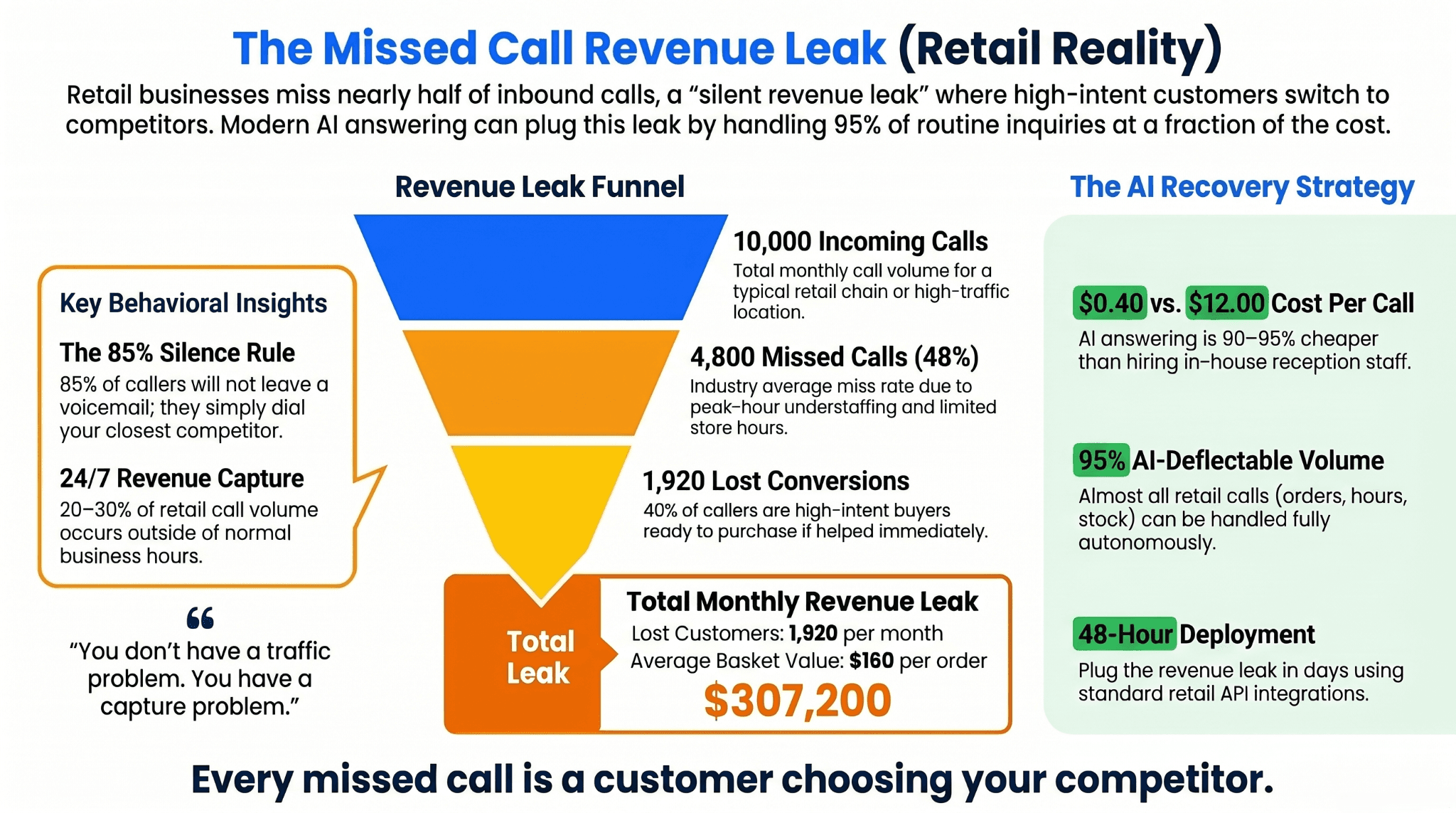
Your two floor associates are mid-conversation with customers. Your manager is in the back counting a return. The phone goes to voicemail. The caller — a woman three miles away wondering if you still carry her son’s size 11 basketball shoes — doesn’t leave a message. Data says 85% of callers don’t. She hangs up, opens Google, and dials your closest competitor. They pick up on the second ring. She drives to their store instead of yours.
That single missed call, at a $160 average basket with a 40% close rate, is $64 of revenue you will never get back. Multiply it across the 48% of calls retail businesses miss in a typical week (even with “someone at the desk”), and you’re staring at one of the biggest silent revenue leaks in your operation.
An AI answering service fixes the leak without adding headcount. It picks up on the second ring, 24/7, handles the calls your staff don’t have time for, and transfers only the ones that truly need a human. This guide breaks down what it actually is, how much it costs, which retail call types deflect best, how to spot a vendor that will work in production, and where voice AI fits in a modern retail service stack.
What is an AI answering service?
An AI answering service is a voice AI system that automatically answers inbound business phone calls, handles routine customer inquiries, books appointments, and transfers complex issues to human staff — available 24/7 at roughly $0.40 per call instead of the $7–$12 per call cost of human agents. Unlike traditional IVR (“press 1 for hours, press 2 for returns”), modern AI answering services hold natural conversations, remember context across the call, and pull real-time data from your order system, product catalog, and appointment calendar.
Key takeaways
- Missed retail calls are a $64–$300 revenue event each — not a minor inconvenience.
- AI answering handles 60%+ of retail calls fully autonomously; another 21% mostly autonomously.
- Pricing tiers run $199–$499/month for most retail chains under 5,000 calls.
- The quality gap between “basic” and “good” AI answering is 25–35 percentage points of deflection.
- Deployment in 48 hours is realistic for standard workflows — 2–4 weeks for complex integrations.
What retail customer calls are actually about (and how much is deflectable)
Before evaluating any AI answering service, look at what your customers actually call about. The call mix is surprisingly consistent across specialty retail, grocery, home goods, and multi-location chains:
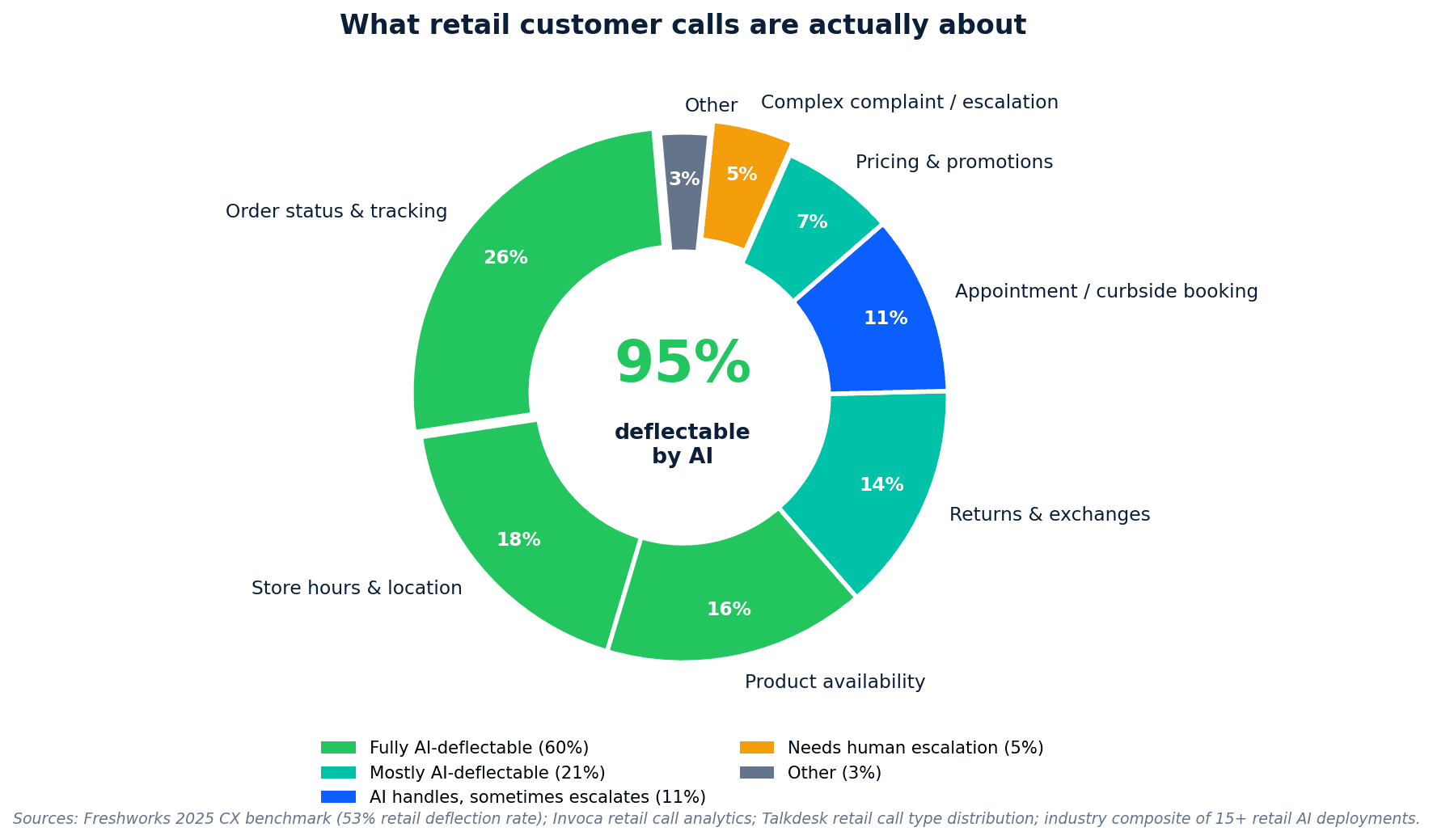
Three patterns matter here. First: 95% of retail call volume is AI-deflectable — only 5% truly requires human escalation (complex complaints, angry customers, legal issues). Second: the top three categories alone (order status, store hours, product availability) account for 60% of call volume, and all three are classic RAG-grounded AI wins. Third: the 11% “appointment booking / curbside pickup” slice is where AI stops being a cost-reduction play and becomes a revenue play — every booked appointment that would have gone to voicemail is recovered revenue.
Not all AI answering services deflect at the same rate
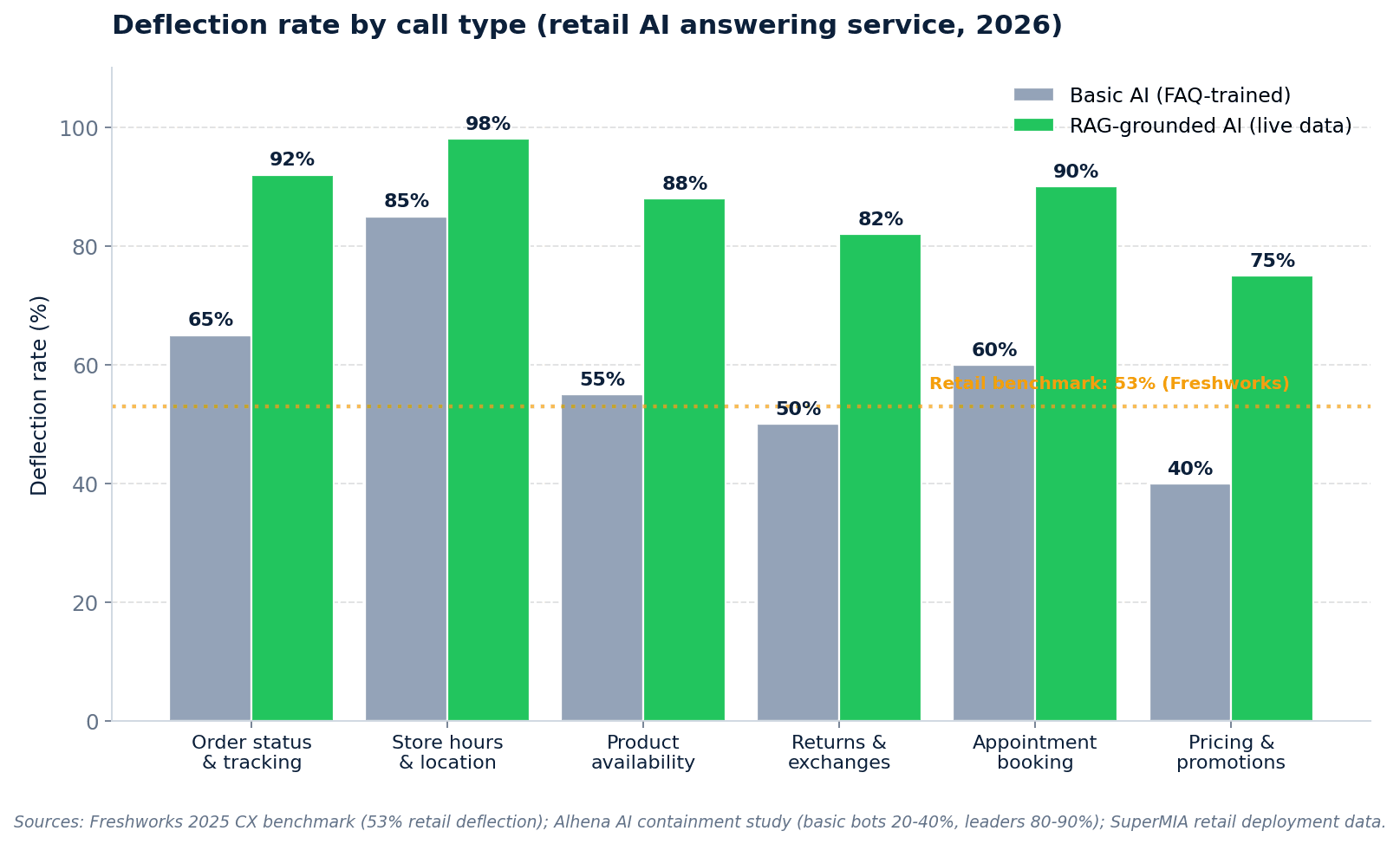
The gap between a mediocre AI answering service and a good one isn’t marketing — it’s architecture. Basic AI is trained on a snapshot of your FAQ document and tries to pattern-match customer questions to pre-written answers. RAG-grounded AI (short for retrieval-augmented generation) reads live from your product catalog, order database, and appointment calendar every time a customer asks a question. The deflection gap is significant:
Industry benchmark
Retail deflection rates average 53% across all call types (Freshworks 2025 CX benchmark). RAG-grounded AI consistently exceeds this benchmark by 25–35 percentage points on order-status, product availability, and appointment-booking categories.
Look at “pricing & promotions” specifically: basic AI deflects 40%, grounded AI deflects 75%. That gap is entirely about whether the system can read your current promotional calendar vs a snapshot from last month. Every time a customer asks “is the weekend sale still going?” and the basic bot hallucinates a wrong answer, you lose trust and escalate to a human anyway. Ask every vendor: “Is the AI grounded on my live data, or trained on a static snapshot?” The only acceptable answer is grounded.
What an AI answering service actually costs (and why it’s cheaper than you think)
Retail operators comparing answering-service options are usually weighing three models: hiring in-house reception staff, outsourcing to a live answering service (Ruby, Smith.ai, AnswerConnect), or deploying an AI answering service. Here’s what each model costs at three realistic call volumes:
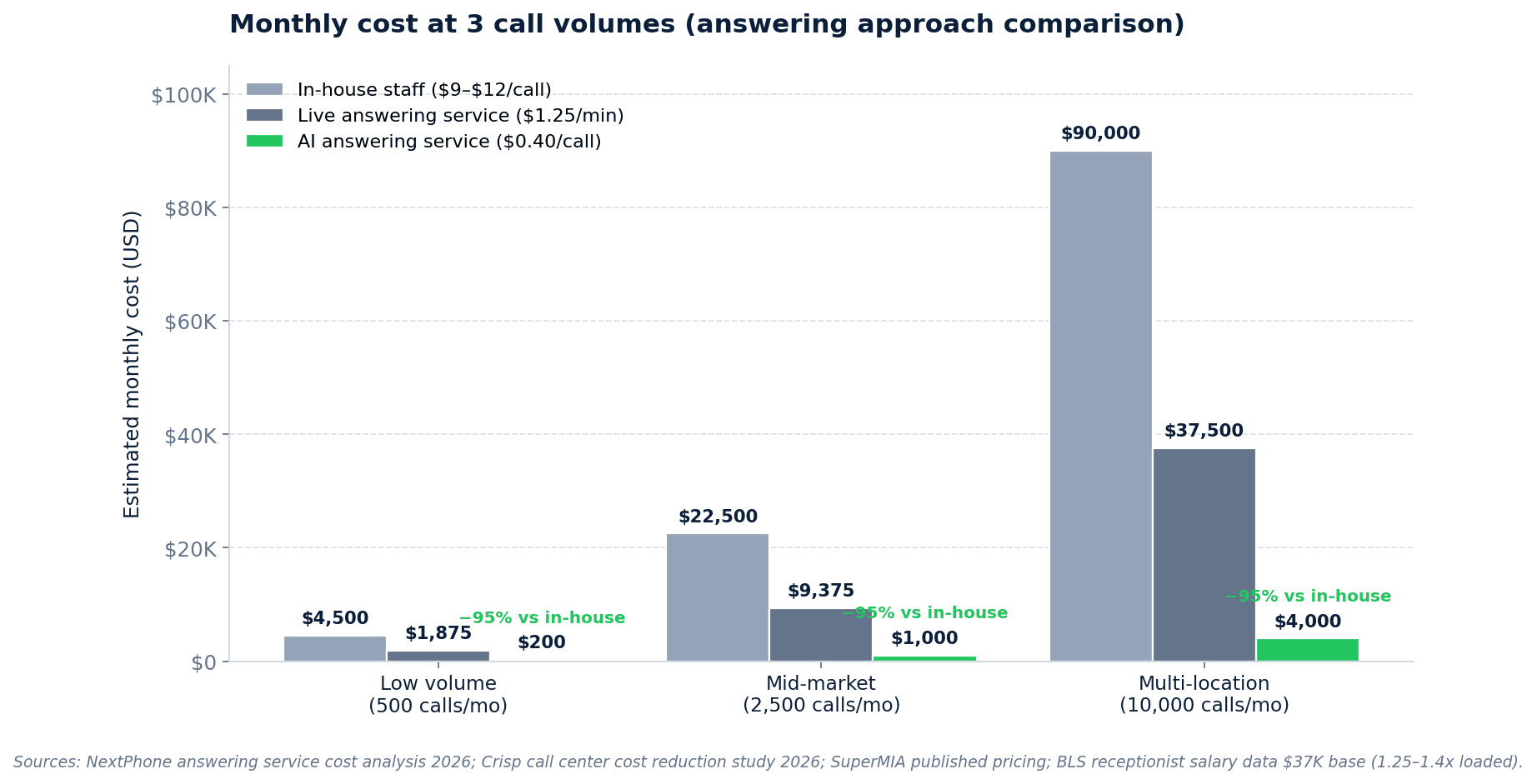
The economics are lopsided in AI’s favor, but the why matters. A live answering service charges $1.25/min with 3-minute average calls, landing at $3.75 per call. In-house staff at $37K base + 1.4x loaded cost = $52K fully loaded — spreading that across even 3,000 calls a month is $17 per call before overhead. AI answering at $0.40 per call beats both by 90%+, and the service runs 24/7 without breaks, turnover, or training overhead.
Honest limits
AI answering doesn’t replace humans completely. For complex complaints, legal escalations, and rare edge cases, you still need a human — just 5–10% of your volume instead of 100%. Most retailers run a hybrid: AI handles tier-1, in-house staff or a live answering service handles the remainder. AI is not the right tool for emotionally charged conversations, B2B relationship calls, or situations that require real human judgment.
See it handling order-status, store-hours, and curbside pickup calls live with your catalog.
15-minute demo. No sales pitch.
Book a 15-min retail AI answering service demo →5 things a good AI answering service does for a retail operator
1. Answers on the second ring, 24/7, no exceptions
Retail calls don’t keep store hours. 20–30% of call volume lands outside normal staffing windows. Weekends, holidays, evenings. An AI answering service answers every one. First-ring pickup changes caller behavior — the same customer who hangs up on ring three will stay on the line when someone answers immediately.
2. Reads from your live catalog and order system
A customer calling about “that blue sweater you had last week” needs the system to look at your actual inventory — not a stale CSV export. RAG-grounded answering services integrate with Shopify, Magento, BigCommerce, or your custom OMS via API, and pull stock levels, order statuses, and promotional calendars in real time. If a vendor can’t show you the integration, they’re selling you a snapshot.
3. Books appointments and curbside pickups directly
This is where AI answering turns into revenue. A good service doesn’t just “take a message” — it reads your appointment calendar, books the time slot, and confirms with the customer via text. Same thing for curbside pickup: collects order number, estimates pickup time, notifies the store. Every booked appointment that would have gone to voicemail is recovered revenue, not just a cost reduction.
4. Escalates cleanly, not messily
When AI reaches the edge of what it can handle, the handoff to a human has to be clean. That means: passing the conversation context (so the customer doesn’t repeat themselves), routing to the right person (store manager vs corporate customer service), and never dropping the call. The 5–10% of calls that genuinely need a human are often the highest-value calls — losing them on a bad handoff is worse than missing them entirely.
5. Reports the metrics that actually matter
Most retailers already track “call volume”. A good AI answering service reports deflection rate by call type, first-call resolution percentage, appointment-booking conversion, cost per resolved call, and escalation reasons. These are the metrics that tell you whether your stack is getting better over time — not just busier. If a vendor’s dashboard only shows “calls answered”, keep shopping.
How AI answering services for retail compare
Five vendors dominate the retail conversation when operators cross-shop AI answering services. Here’s how they stack on the dimensions that matter:
| Vendor | Best fit | Pricing model | Channels | Retail fit |
|---|---|---|---|---|
| Rosie AI | Small retail, voice-first | ~$0.30/min | Voice | Good for lightweight inbound coverage, less suited to multi-channel workflows |
| Smith.ai | SMB hybrid answering | ~$2.50/call | Live + AI voice | Strong for message taking and overflow, weaker on direct retail-system actions |
| Goodcall | Single-location operators | From $59/mo | Voice | Budget-friendly for simple store-hours and routing use cases |
| Nextiva AI Receptionist | Mid-market unified comms buyers | Bundled enterprise pricing | Voice | Fits teams already standardizing on Nextiva, with less retail-specific workflow depth |
| SuperMIA | Retailers wanting one stack for service automation | Credit-based, $49–$1,300/mo | Voice + chat + SMS | Best when you want inbound calling, web chat, and workflow automation on one platform |
Pricing and deployment times are current as of April 2026; verify with each vendor. SuperMIA differentiates on channel breadth (voice + chat + SMS from one credit pool) rather than pure voice depth — if you need voice-only with BYOT Twilio, Bland AI may fit better; compare here:
→ Bland AI vs SuperMIA | Retell AI vs SuperMIA
How to evaluate an AI answering service for your retail operation
Ignore the marketing. These are the four questions that separate production-ready AI from demo-ware:
1. “Is your AI grounded on my live data, or trained on a snapshot?”
If trained on a snapshot, it will hallucinate prices, misquote return windows, and recommend out-of-stock items. Non-negotiable: live integration with your OMS, product catalog, and appointment calendar.
2. “Can I see 90 days of call logs from a retail customer at my volume?”
Vendors who can show you real deflection rates, escalation reasons, and customer sentiment from a similar retailer at your volume are the ones worth working with. Vendors who show you a demo but can’t produce production data are selling you a prototype.
3. “What happens when the AI is wrong?”
The honest answer isn’t “that never happens.” It’s “here’s the escalation path, here’s how fast it routes to a human, and here’s the quality-assurance loop that catches errors in the weekly review.” No vendor has zero-error AI. The ones to work with are the ones who have error recovery designed into the system.
4. “What does the handoff to a human actually look like?”
Bad handoff: the customer gets told “transferring you to an agent” and has to explain their problem from scratch. Good handoff: the AI summarizes the conversation context, the customer’s name, and the specific question into a note that the human sees before picking up. Ask to see both scenarios during the demo.
What a typical retail deployment looks like
The following is a composite example drawn from typical multi-location specialty retail deployments. Named SuperMIA retail references available under NDA.
A 42-location specialty retailer (home goods + small appliances, ~$95M annual revenue) deployed an AI answering service in Q1 2026 to address a persistent problem: 11,000 monthly inbound calls across the chain, with a 43% answer rate and an estimated $180K/month in lost revenue from missed calls.
Week 1–2: Deployment and baseline
- 48-hour deployment for standard workflows: order status, store hours, product availability, curbside booking.
- Integration with Shopify OMS + Acuity scheduling via standard APIs.
- Baseline call volume measured: 11,000/month. Pre-AI answer rate: 43%. Pre-AI cost per answered call: $8.20.
Month 1–3: Optimization
- Answer rate: 43% → 98% across the full chain.
- Deflection rate: 67% overall (higher than initial target of 55%, driven by order status and store-hours categories).
- Cost per call: $8.20 → $0.60 (blended, including the 33% that still escalated to humans).
- Total monthly cost: $90,000 → $22,800 ($6,600 AI + $16,200 residual human cost).
- Recovered revenue from previously-missed calls: ~$147K/month (calculated from 5,400 additional calls/month answered at historical conversion rates).
- 12-month combined impact: ~$2.6M in recovered revenue + ~$810K in reduced answering costs = $3.4M total operating lift. AI tooling spend: ~$79K/year. Payback period: under 2 weeks. The operator now plans to extend AI to chat and SMS, running voice + chat + SMS from a single credit pool — the core architectural win of a multi-channel AI answering service.
Illustrative composite
42 locations. $95M revenue. 11K monthly calls. $3.4M annual operating lift on ~$79K AI spend. Payback: under 2 weeks.
Where SuperMIA fits
SuperMIA is a multi-channel AI answering service: voice, chat, and SMS from one credit pool, priced per workload instead of per channel. For retail operators, this means a single contract covers inbound phone, website chat widget, and SMS conversations — not three vendors and three invoices on separate systems. The architecture sits on the broader SuperMIA platform:
- RAG-grounded on live data — reads from your OMS, product catalog, and appointment calendar in real time, not from a stale snapshot.
- 48-hour deployment for standard retail workflows (order status, store hours, returns, curbside pickup, appointment booking).
- One credit pool across channels — a customer who starts on chat and escalates to voice uses the same credits, no channel re-integration.
- Bundled compliance — GDPR and HIPAA (for retail pharmacy or healthcare-adjacent ops) included in the Enterprise tier.
- Transparent per-call economics — credit-based pricing from $49/mo (Grow) to $1,300/mo (Business) with custom Enterprise beyond.
See SuperMIA for retail, explore the voice AI stack, or compare SuperMIA pricing tiers against your current answering-service spend.
Frequently asked questions
Stop missing the calls you’re already paying to earn.
Back to 12:47 on Tuesday. Phone ringing, nobody picking up. That one call, at your average basket, was worth $64 of lost revenue. You miss 50 more like it this week. That’s $3,200 gone — roughly equal to what a decent AI answering service costs for an entire year.
The economics aren’t subtle. Human agents cost $7–$12 per call. AI handles 95% of retail call types at $0.40 per call. The remaining 5% still needs a human, and that’s fine — humans are better at complex conversations anyway. What AI does is free your staff from the 95% of calls that are really just orders-of-operations: check order status, check store hours, book an appointment, confirm a return.
The retailers winning at customer service in 2026 aren’t running bigger contact centers. They’re running smaller ones, routing tier-1 to AI, and investing the savings in the human moments that actually matter: the complaint that deserves empathy, the regular customer who calls the owner directly, the wholesale prospect who wants a relationship. Everything else gets picked up in 2 seconds, 24/7, at $0.40 per call. Start there.
Never miss another retail call.
SuperMIA answers on the second ring, 24/7, at $0.40 per call. See it live with your catalog.
Book your SuperMIA retail demo →
Harikrishna Patel
Harikrishna Patel is the founder of MIA – My Intelligent Assistant, the AI automation platform built under Botfinity Inc. in Dallas, Texas. With 15+ years in software engineering, AI/ML, and enterprise solution design, he focuses on creating practical, scalable AI tools that help businesses automate support, workflows, and operations through voice and chat.