
Table of Contents
- What is an AI sentiment analysis tool? (for PR teams)
- How AI scores a piece of brand coverage
- Where automated sentiment still gets it wrong (and what to do about it)
- The PR coverage-scoring workflow
- The new frontier — how AI models describe your brand
- How to choose a sentiment tool for PR (evaluation framework)
- Frequently asked questions
What is an AI sentiment analysis tool? An AI sentiment analysis tool uses natural language processing to read text — news articles, social posts, transcripts — and classify the tone as positive, negative, or neutral. For PR teams, it scores brand coverage automatically: instead of reading every article by hand, you see at a glance whether earned media is favorable and get an early warning when negative sentiment spikes. The best tools show the reasoning behind each score, so a human can spot-check it.
See Sentinel AI score your brand coverage — try it on your own media →
Key takeaways
- Sentiment tools score coverage so you don't read it all by hand. They classify each mention positive, negative, or neutral — across news, broadcast, podcasts, and social.
- For PR, the job is scoring earned media, not just social. Is this article favorable? How's the tone of our coverage? That's a different question from social listening.
- Accuracy is a workflow, not a number. Tools still miss sarcasm, mixed sentiment, and industry context — the best ones show their reasoning so a human can correct the edge cases.
- The early-warning value is the real payoff. Catching a negative spike before it becomes a crisis is worth more than any single score.
- AI-model sentiment is the new frontier. How ChatGPT and Gemini describe your brand is now part of reputation — and part of what modern tools track.
What is an AI sentiment analysis tool? (for PR teams)
Every PR team hits the same wall eventually: there's too much coverage to read. A product launch, a funding announcement, or — worse — a bad news day generates more articles, posts, broadcast segments, and podcast mentions than any human can keep up with. You need to know one thing quickly: is this coverage helping us or hurting us? That's the question a sentiment analysis tool answers. It's closely related to how media monitoring works — monitoring finds the mentions; sentiment analysis tells you how they feel.
Under the hood, a sentiment analysis tool uses natural language processing (NLP) to read text the way a person would — but at a scale no person could match. It looks at tone, word choice, and context, and classifies each piece as positive, negative, or neutral toward your brand. This is sometimes called opinion mining, and modern tools apply it across social media, review sites, news, forums, support conversations, video transcripts, and podcasts, all at once.
For a PR team specifically, that translates into three jobs: measuring whether your earned media is broadly favorable, spotting a negative story early enough to respond, and reporting the tone of coverage to leadership without spending a week reading clippings. That's a different emphasis from a social team tracking campaign buzz — and it's the emphasis this guide is built around.
How AI scores a piece of brand coverage
It helps to see the actual pipeline, because it demystifies what the score means — and where to be skeptical of it.
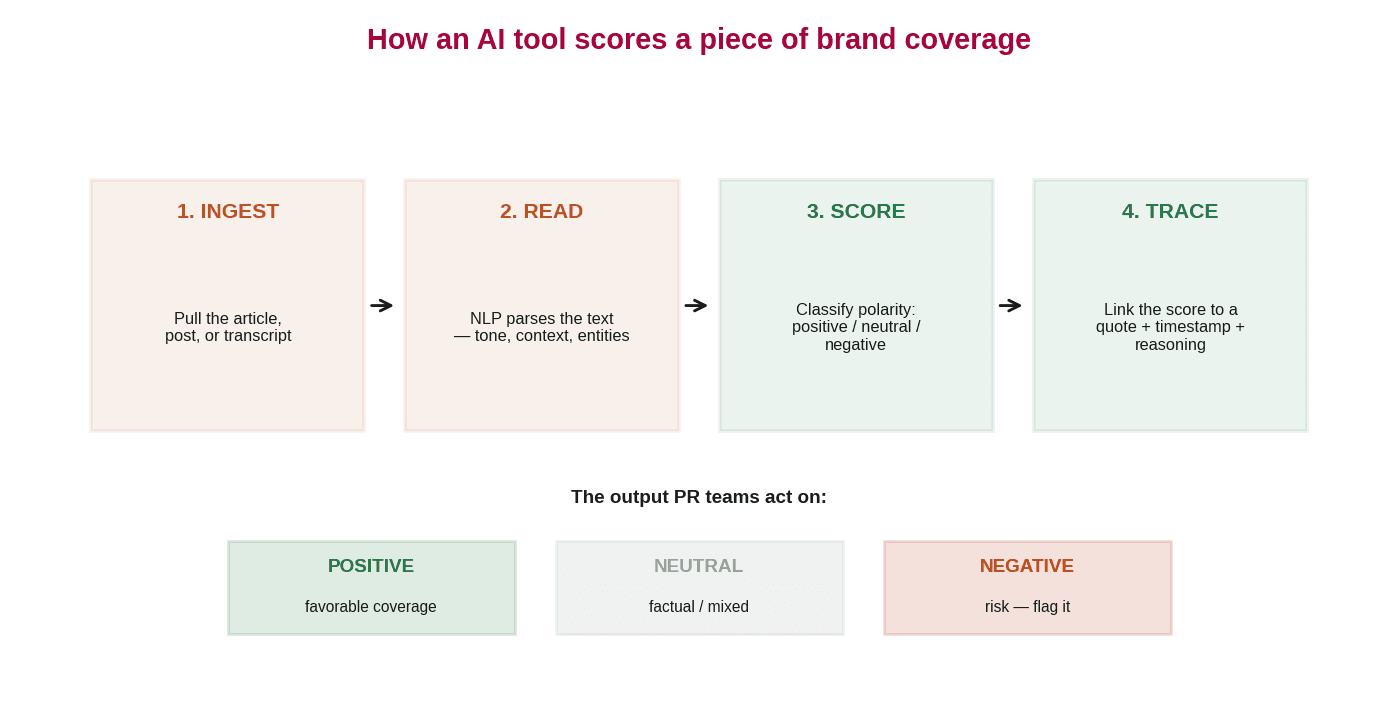
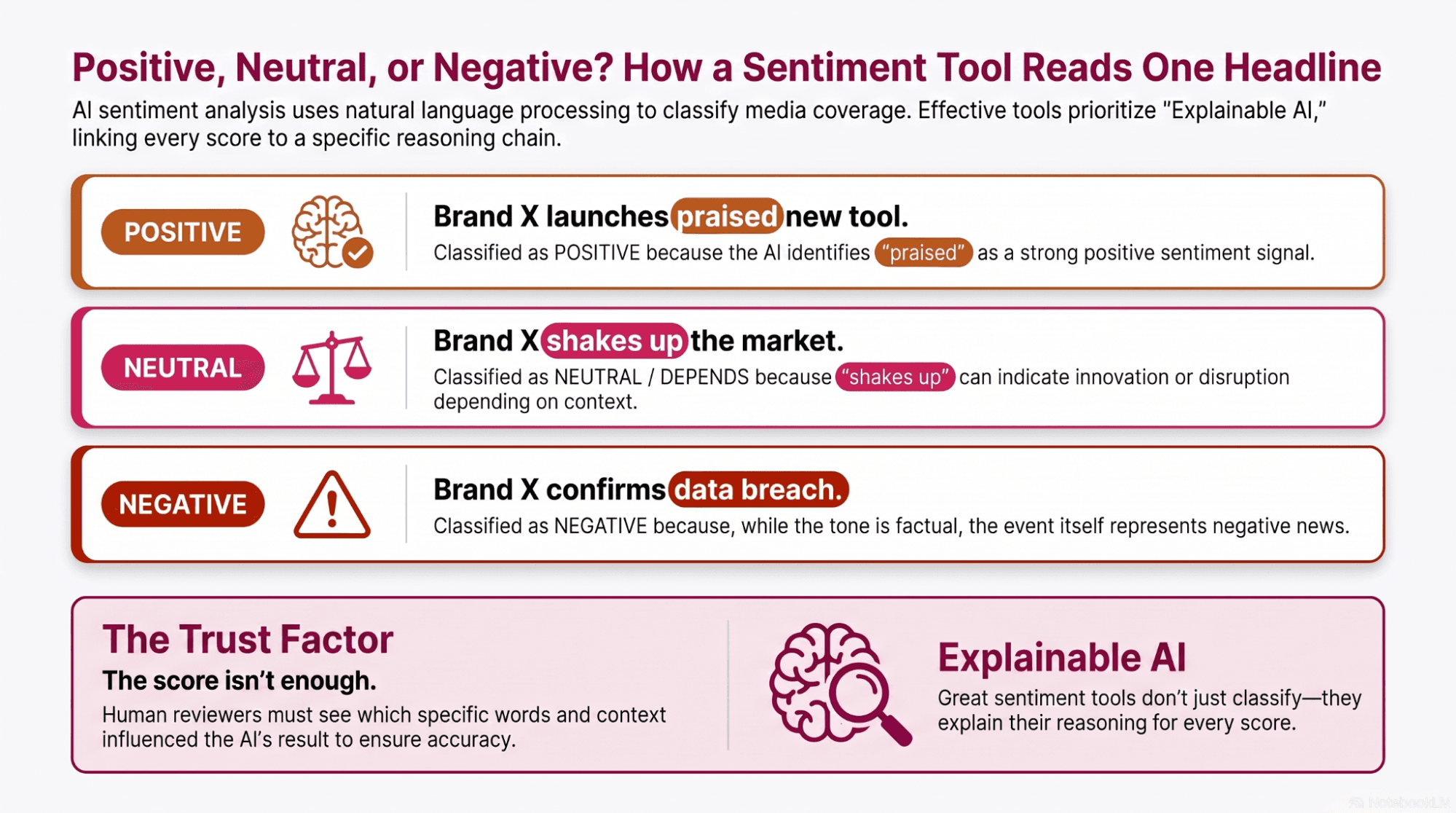
Step by step: first the tool ingests the content — pulls in the article, post, or transcript. Then it reads it: NLP parses the language, identifying tone, context, and which brand or entity the sentiment is actually about (important when an article mentions several companies). Then it scores the polarity — positive, negative, or neutral. And in the best tools, it traces that score: it links the classification to a specific verbatim quote, a timestamp, and the reasoning behind it.
The traceability standard — the one thing to insist on. A sentiment score you can't interrogate is just a number to argue about. The best platforms tie every label to the exact quote and the reasoning that produced it, so when the tool says an article is negative, you can see why in one click — and overrule it if it's wrong. When you're evaluating tools, this is the single most useful capability to look for. It's the difference between a black box and a system you can actually trust in a report to your CEO.
Where automated sentiment still gets it wrong (and what to do about it)
Here's the part most tool listicles skip — and the part that matters most if you're going to put these numbers in front of leadership. Automated sentiment is good and getting better, but it is not perfect, and knowing where it breaks is what separates a PR pro from someone who trusts a dashboard blindly.
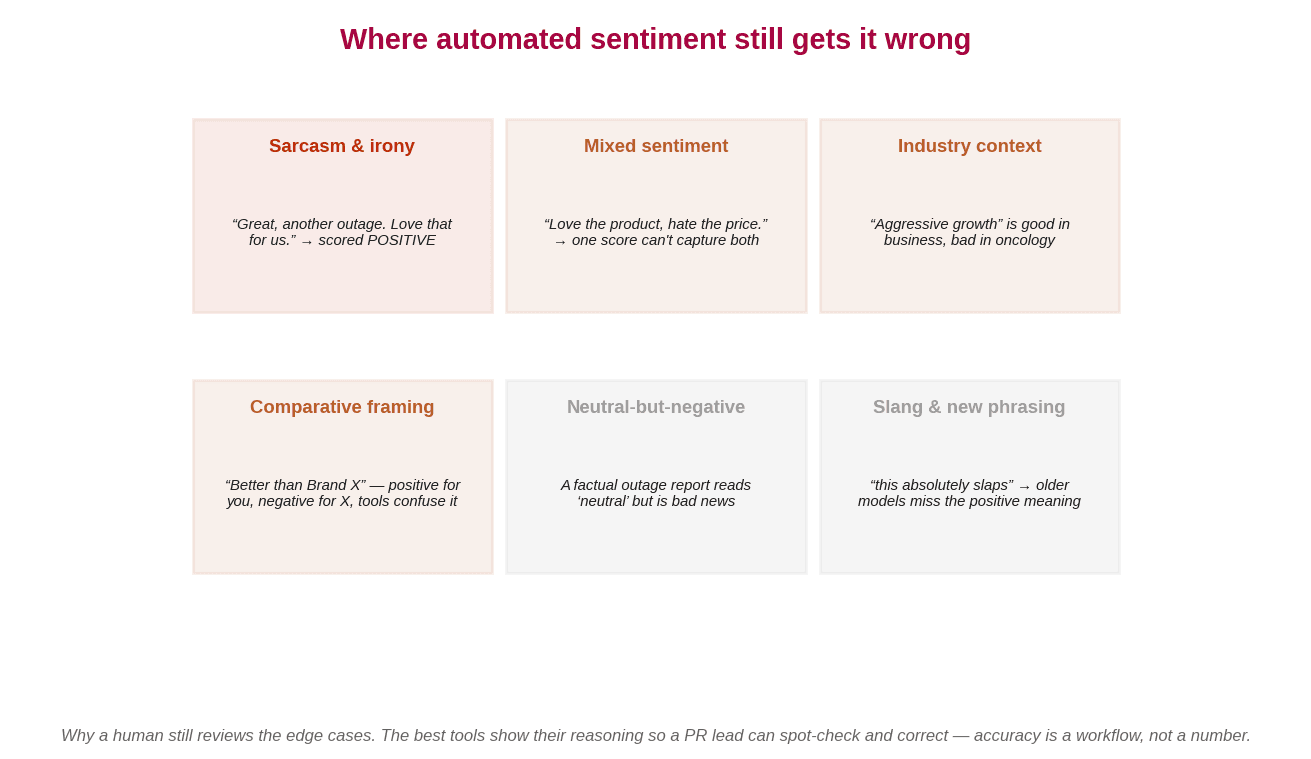
The recurring failure modes:
- Sarcasm and irony. 'Great, another outage. Love that for us.' A literal reading scores that positive. Humans hear the eye-roll; models often don't.
- Mixed sentiment. 'Love the product, hate the price.' One overall score can't capture both — you need aspect-level sentiment to see that the product is winning and pricing is the problem.
- Industry context. 'Aggressive growth' is a compliment in business and alarming in an oncology report. The same words carry opposite sentiment by field.
- Comparative framing. 'Better than Brand X' is positive for you and negative for your competitor — and a tool can attribute the sentiment to the wrong brand.
- Neutral-but-negative. A flat, factual report of a data breach or a lawsuit reads as 'neutral' in tone, but it's clearly bad news. Tone and impact aren't the same thing.
What to do about it: treat accuracy as a workflow, not a number. Use a tool that shows its reasoning (see traceability, above), have a human spot-check the ambiguous and high-stakes coverage, and watch trends rather than obsessing over any single classification. A tool that gets you 85% of the way there across thousands of mentions, with a human reviewing the 15% that matters, is far more valuable than pretending any tool is 100% right. The goal isn't to remove human judgment — it's to point it at the coverage that actually needs it.
The PR coverage-scoring workflow
Put it together and a practical PR workflow has four stages. This is where a sentiment tool stops being a curiosity and starts saving your team real time.
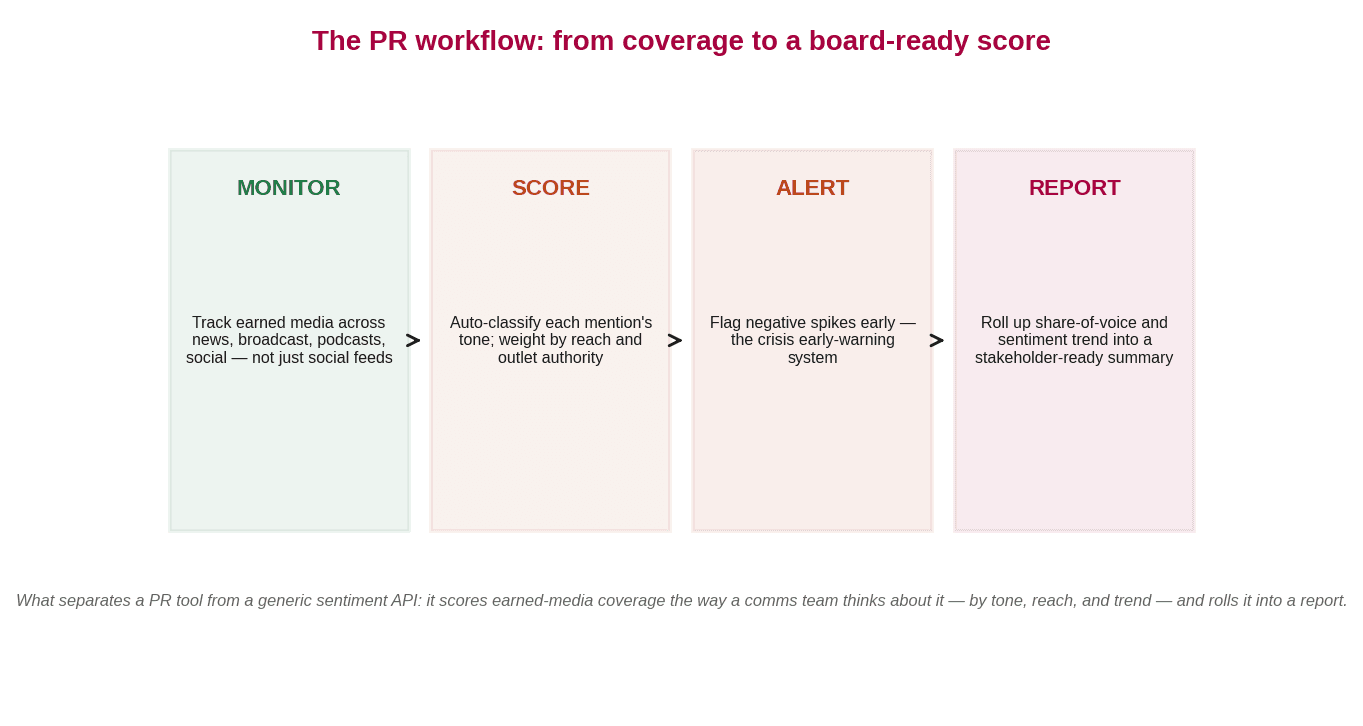
Monitor → Score → Alert → Report
- Monitor. Track earned media across news, broadcast, podcasts, and social — not just social feeds. This is the media-monitoring layer, and its breadth matters: coverage that isn't captured can't be scored.
- Score. The tool classifies each mention's tone and — ideally — weights it by the outlet's reach and authority, so a negative story in a major outlet counts for more than a neutral blog post.
- Alert. Set thresholds so a spike in negative sentiment triggers a notification. This is the highest-value part for most PR teams: catching a developing problem hours or days before it becomes a crisis.
- Report. Roll it all up — share of voice, sentiment trend over time, notable coverage — into a summary leadership can read in two minutes, with the reasoning behind the scores available if anyone wants to dig in.
That last step is where tools like Meltwater's GenAI Lens have leaned in — using generative AI to turn a month of sentiment data into a narrative a stakeholder actually reads. If you want the full comparison of platforms that do this monitoring-and-scoring work, the best social media monitoring tools breaks them down side by side — this guide stays focused on the sentiment-scoring layer that sits on top.
The new frontier — how AI models describe your brand
There's a reputation surface that didn't exist a few years ago, and in 2026 it's becoming impossible to ignore: what AI models say about you. When a customer asks ChatGPT, Gemini, or Perplexity for a recommendation, the model's answer shapes their perception of your brand — and those conversations happen entirely outside the social and news channels traditional monitoring covers. It's a natural extension of Sentinel AI's media-intelligence approach.
Why it matters for PR: if you ask an AI model about your category and it consistently describes your brand negatively — or repeats an outdated criticism, or omits you entirely — that's a reputation problem forming where you can't see it. A growing set of tools now tracks how AI models characterize and recommend brands, and the established players are catching up: both Brand24 and Meltwater added LLM monitoring capabilities across 2025 and 2026.
The honest take: this is genuinely new, and the tooling is still maturing — don't let anyone sell you AI-model monitoring as a solved science. But it belongs on a modern PR team's radar, because the cost of finding out late that an AI model has been steering customers away from you is high. Treat it as an emerging part of the monitoring stack, not a replacement for the coverage scoring that still does the heavy lifting.
How to choose a sentiment tool for PR (evaluation framework)
Most 'best tool' lists rank platforms on generic features. For a PR team, the criteria are more specific. Here's the framework we'd apply.
- Coverage breadth beyond social. Can it score earned media across news, broadcast, and podcasts — not just social feeds? For PR, earned media is the point.
- Tone accuracy with visible reasoning. Does it show why it scored something the way it did (the traceability standard), so you can spot-check and correct?
- Weighting by reach and authority. A negative story in a major outlet should count for more than a neutral blog — does the tool reflect that?
- Crisis early-warning. Can you set alerts on negative-sentiment spikes, and do they arrive fast enough to act on?
- Stakeholder-ready reporting. Does it roll up sentiment trend and share of voice into something leadership will actually read?
- AI-model monitoring (increasingly). Does it track how AI models describe your brand — the emerging reputation surface?
Where SuperMIA fits: Sentinel AI is built for the media-intelligence side of this — monitoring brand coverage and scoring its sentiment for comms and PR teams, with the reporting layer that turns it into something you can share. It's one option among several, and the honest way to judge it is against the criteria above and your own coverage. For a side-by-side of the broader monitoring platforms, see a full comparison of monitoring platforms; to see how Sentinel AI handles your actual coverage, the fastest route is a quick demo.
See Sentinel AI score your brand coverage — try it on your own media →
Frequently asked questions
What is an AI sentiment analysis tool?
An AI sentiment analysis tool uses natural language processing to read text, such as news articles, social posts, and transcripts, and classify the tone as positive, negative, or neutral. For a PR team, it scores brand coverage automatically: instead of reading every article by hand, you can see at a glance whether earned media is favorable and get an early warning when negative sentiment spikes. The best tools show the reasoning behind each score, so a human can spot-check and correct the edge cases.
How do PR teams measure the sentiment of media coverage?
PR teams use a media-monitoring or media-intelligence tool that ingests coverage across news, broadcast, podcasts, and social, then applies AI sentiment scoring to each mention. The output is usually a mix of overall sentiment (what share of coverage is positive, neutral, or negative), sentiment trend over time, and share of voice against competitors, often weighted by the reach and authority of each outlet. The best setups let a human review the reasoning behind individual scores and correct the ones the AI gets wrong before the numbers go into a report.
How accurate is AI sentiment analysis?
It is good and improving, but not perfect, and it should be treated as a workflow rather than a single number. Modern models handle straightforward positive and negative language well, but they still struggle with sarcasm, mixed sentiment such as loving a product but hating the price, industry-specific context where a word means different things in different fields, and comparative framing where praise for you is criticism of a competitor. The practical answer is to use a tool that shows its reasoning so a human can spot-check the ambiguous cases, and to look at trends rather than obsessing over any single score.
Can AI tell if news coverage is positive or negative?
Yes, for most coverage. An AI tool can read an article and classify it as positive, neutral, or negative toward your brand, and it does this across far more coverage than a human team could read manually. The nuance is that a factual, neutral-sounding article can still be bad news, for example a straight report of an outage or a lawsuit, so the smartest tools weight coverage by reach and let a PR lead adjust the classification. It is a powerful first pass that a human refines, not a replacement for judgment on the coverage that matters most.
What is the best sentiment analysis tool for brand monitoring?
There is no single best tool, because it depends on what you are measuring and where your reputation risk lives. Social-first platforms are strong when most conversation happens on social channels; media-intelligence platforms are better when you care about earned media across news, broadcast, and podcasts; and a newer category tracks how AI models like ChatGPT and Gemini describe your brand. For PR teams specifically, the priorities are broad earned-media coverage, tone accuracy with visible reasoning, crisis early-warning alerts, and stakeholder-ready reporting. Compare options against those criteria rather than a generic feature list.

Vicky Lalwani
Vicky Lalwani is Marketing Manager at SuperMIA, focused on practical AI education, buyer's guides, and solution explainers that help business teams evaluate and adopt conversational AI across support, sales, and operations.