
Table of Contents
An AI chatbot for business automates high-volume conversations across support, sales, and operations — and the ones that pay off fastest are tier-1 support deflection, order and status tracking, and lead qualification, each clearing positive ROI in weeks. The engine behind every use case is cost per conversation: $5–$15 with a human agent, cents with a chatbot. Start with high-volume deflection, then expand to sales and operations.
See which use case pays off first for you →
Key takeaways
- The fastest-payback use cases are tier-1 support deflection, order tracking, and lead qualification.
- The ROI engine is cost per conversation: $5–$15 with a human agent vs cents with a chatbot.
- First-year ROI typically runs 200–1,000%, with payback in weeks-to-months by conversation volume.
- Start with high-volume deflection, then expand to sales and operations — each use case multiplies the return.
- A chatbot only pays off if it resolves and integrates — a bot that can't act or escalate is a cost, not a return.
What an AI chatbot does for a business
An AI chatbot for business automates high-volume conversations across support, sales, and operations — deflecting routine questions, tracking orders, qualifying leads, booking appointments, recovering carts, and answering internal queries. The ones worth deploying don't just chat; they resolve the request and update your systems, so the bot completes work instead of only answering.
This guide skips the generic "chatbots are the future" framing. Below are 12 specific use cases, each tagged with the ROI metric it moves, which business type wins, and how fast it pays back — ranked so you know where to start.
For a broader, cross-vertical view, see 25 conversational AI use cases by industry. This list is powered by SuperMIA's AI chatbot, but the ROI logic is vendor-neutral.
The ROI engine: why chatbot use cases pay off
Every use case below runs on the same economics: the cost of a conversation. A fully loaded tier-1 support conversation costs $5–$15 with a human agent (salary, benefits, overhead, tooling). A chatbot handles the same conversation for cents — and the gap widens as volume grows.
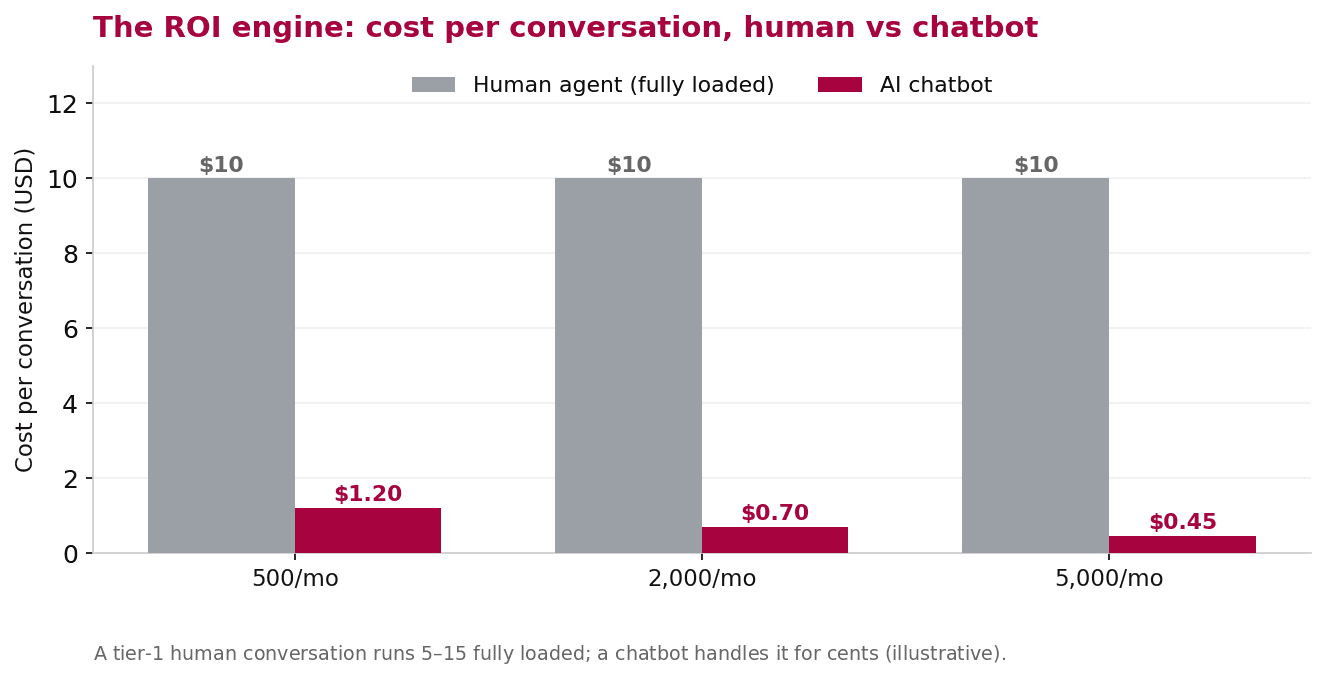
That's why first-year ROI typically lands between 200% and 1,000%. The question isn't whether a chatbot pays off — it's which use cases pay off fastest, so you deploy in the right order.
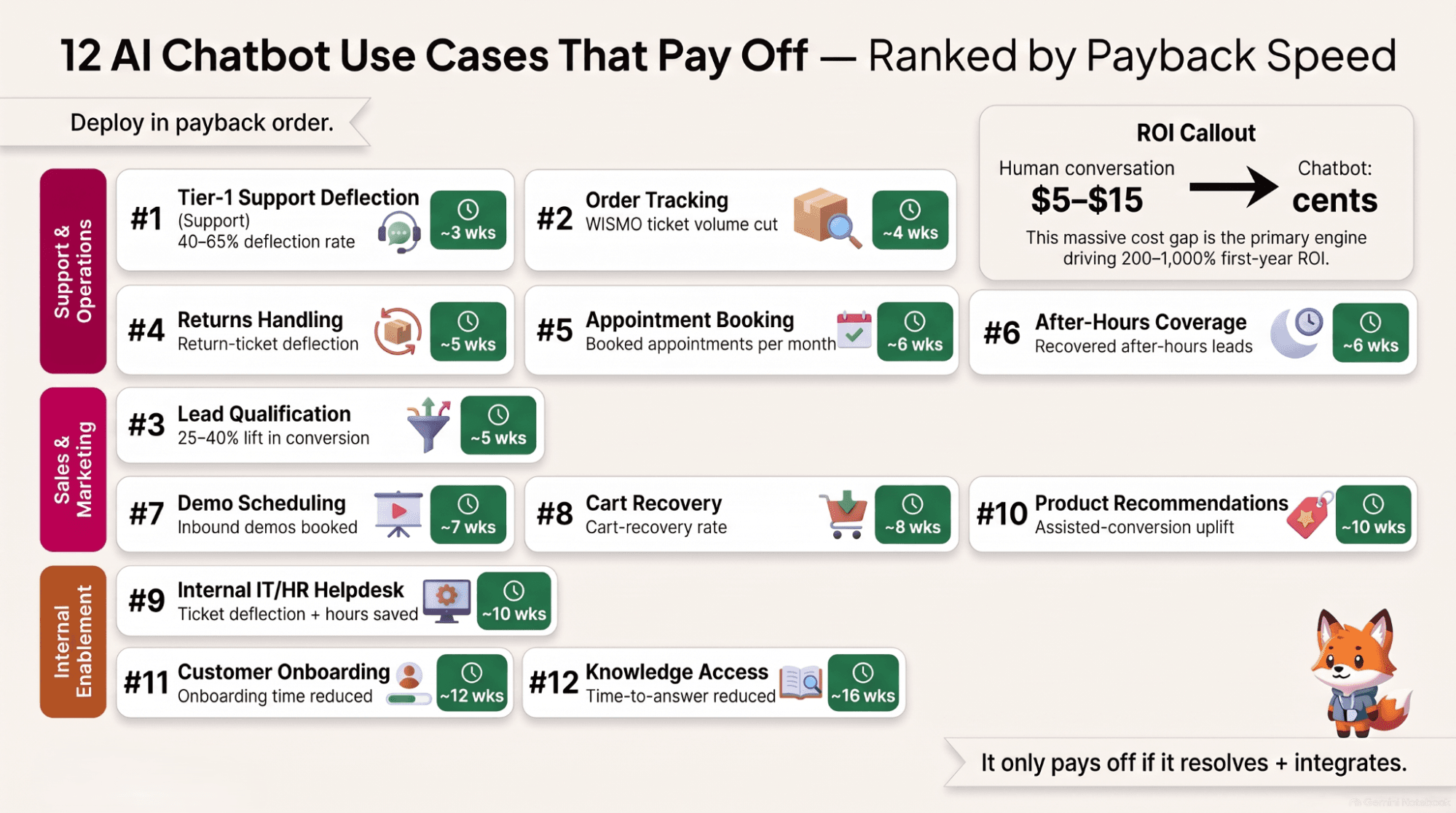
The 12 use cases, ranked by payback speed
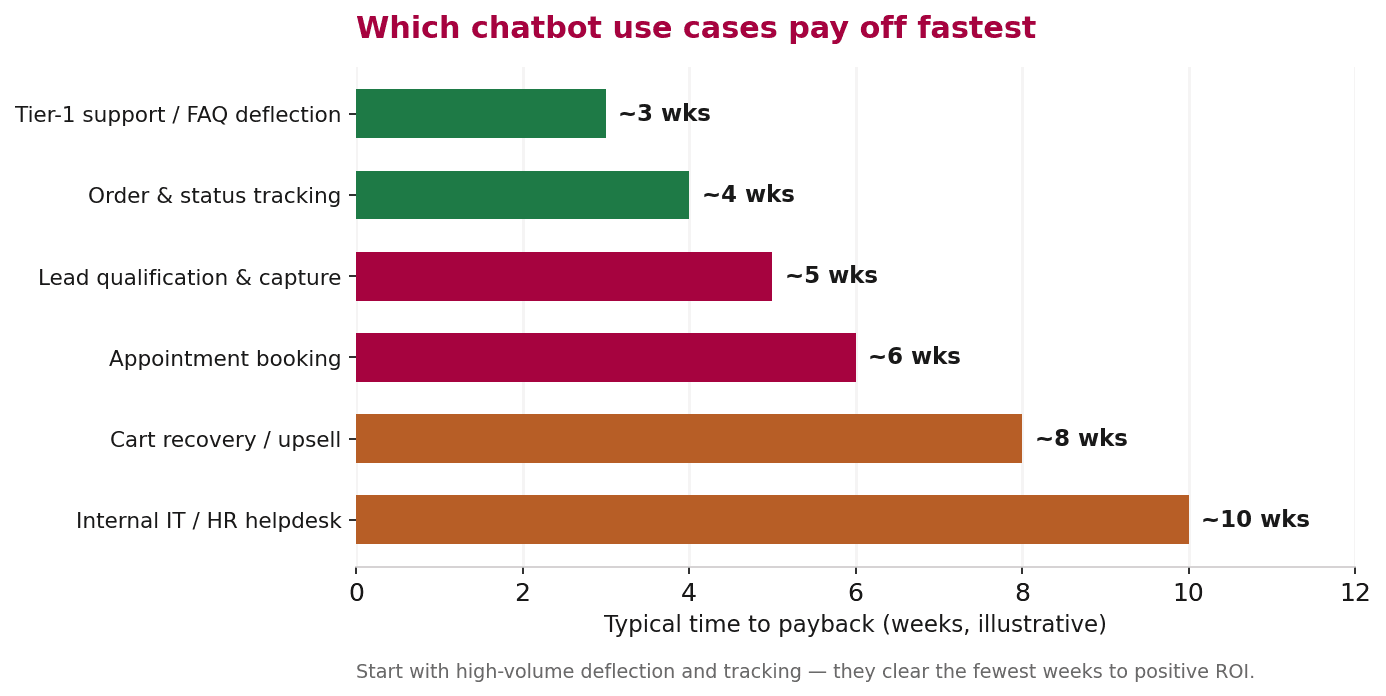
Deploy in payback order. The fastest returns come from high-volume, deterministic conversations; sales and internal use cases pay back a little slower but compound the return.
Customer support & operations (use cases 1–5)
- Tier-1 support & FAQ deflection — automates repetitive questions (hours, policies, how-tos). ROI metric: 40–65% deflection rate. Wins for: any business with a support inbox. Fastest payback.
- Order & status tracking — answers "where's my order?" 24/7. ROI metric: WISMO ticket volume cut. Wins for: e-commerce, logistics, retail.
- Appointment booking & rescheduling — books directly into the calendar. ROI metric: booked appointments per month. Wins for: clinics, salons, services, real estate.
- Returns & exchange handling — walks customers through the flow, cuts return-related tickets. ROI metric: return-ticket deflection. Wins for: retail, e-commerce.
- After-hours & overflow coverage — catches conversations your team can't. ROI metric: recovered after-hours leads. Wins for: any business losing off-hours contacts.
Support is the highest-ROI starting point — the customer-service chatbot ROI breakdown runs the full cost-per-ticket math.
Sales & marketing (use cases 6–9)
- Lead qualification & capture — replaces static forms with a real-time conversation. ROI metric: 25–40% lift in qualified-lead conversion. Wins for: B2B, SaaS, high-consideration services.
- Product discovery & recommendations — guides shoppers to the right product. ROI metric: assisted-conversion uplift. Wins for: e-commerce, retail.
- Cart recovery & upsell — re-engages abandoners with proactive messages. ROI metric: cart-recovery rate. Wins for: e-commerce.
- Demo & meeting scheduling — books sales calls with behavioral context. ROI metric: inbound demos booked. Wins for: B2B/SaaS.
Many of these live on your site — add an AI chatbot to your website covers the setup, cost, and ROI of the website deployment specifically.
Internal & back-office (use cases 10–12)
- Internal IT / HR helpdesk — answers employee questions (PTO, password resets, policies). ROI metric: internal-ticket deflection + hours saved. Wins for: mid-market and enterprise.
- Employee onboarding — guides new hires through setup and FAQs. ROI metric: onboarding time reduced. Wins for: growing teams.
- Knowledge access & data lookup — surfaces answers from internal docs on demand. ROI metric: time-to-answer reduced. Wins for: knowledge-heavy teams.
Map these use cases to your business — book a demo →
Where to start (and how to sequence)
Don't deploy all 12 at once. Sequence by payback and by consequence:
- Start with tier-1 support / FAQ deflection — highest volume, fastest payback, lowest risk. Prove the ROI here first.
- Add the tracking and booking use cases that fit your business (order status for e-commerce, appointments for services).
- Layer in the sales use cases — lead qualification and cart recovery — once support is stable and integrated.
- Expand to internal helpdesk and back-office last, where the payback is slower but the compounding is real.
When a chatbot doesn't pay off
Honest caveat: a chatbot is a cost, not a return, when it's deployed wrong. It won't pay off if:
- It only takes messages instead of resolving — a message-taker that can't book or act just adds a step.
- It doesn't integrate with your systems — if it can't read your CRM, calendar, or order data, it can't complete the work.
- It can't escalate cleanly — a bot that traps frustrated customers with no path to a human erodes CSAT and costs you the relationship.
- You deploy it on low-volume, high-complexity conversations first — those are the slowest to pay back and the easiest to get wrong.
The honest rule. A chatbot pays off when it resolves high-volume, repetitive conversations and updates your systems — and when it hands the complex ones to a human with context. Deploy it on the fastest-payback use cases first, integrate it properly, and the return compounds as you add use cases.
Frequently asked questions
What can an AI chatbot do for a business?
An AI chatbot automates high-volume conversations across a business: it deflects tier-1 support questions, tracks orders, qualifies and captures leads, books appointments, recovers abandoned carts, and answers internal IT and HR queries. The highest-value deployments resolve the request and update your systems rather than just answering, so the chatbot completes work instead of only chatting.
What is the ROI of an AI chatbot for business?
Most businesses see a first-year ROI between 200 and 1,000 percent, driven mainly by cost per conversation. A fully loaded tier-1 support conversation costs $5 to $15 with a human agent and cents with a chatbot. Payback typically lands in weeks to a few months depending on conversation volume, with higher volumes paying back fastest.
Which AI chatbot use cases have the fastest payback?
The fastest-payback use cases are high-volume and deterministic: tier-1 support and FAQ deflection, order and status tracking, and lead qualification and capture. These clear positive ROI in a few weeks because they handle large volumes of repetitive conversations that would otherwise consume agent time. Sales, cart recovery, and internal helpdesk use cases pay back a little slower but compound the return.
How much does an AI chatbot save a business?
Savings scale with volume. A business handling 1,500 tier-1 conversations a month that automates 75 percent of them saves roughly six figures a year in agent costs alone, before counting revenue gains from faster response and higher lead conversion. The formula is simple: monthly conversations multiplied by automation rate multiplied by cost per human conversation, minus the chatbot cost.
Are AI chatbots worth it for small businesses?
For most small businesses, yes. Even at low volume, a chatbot that captures after-hours leads, books appointments, and deflects routine questions usually pays for itself within a few months, because a single missed lead or booking often exceeds the monthly cost. The key is choosing use cases that resolve and integrate, not a bot that only takes messages.
Deploy the fastest-payback use case first
Pick your highest-volume, most repetitive conversation — usually tier-1 support — automate it, measure the deflection and the cost saved, then expand down the payback list. Each use case you add compounds the return, as long as it resolves and integrates.
Not sure which platform fits? How to pick the right chatbot walks the evaluation. When you're ready to see the use cases running on your business, book a demo and we'll show SuperMIA's AI chatbot in action.

Vicky Lalwani
Vicky Lalwani is Marketing Manager at SuperMIA, focused on practical AI education, buyer's guides, and solution explainers that help business teams evaluate and adopt conversational AI across support, sales, and operations.