
Table of Contents
Enterprise conversational AI is a platform that resolves customer and employee requests across voice and chat, under enterprise governance — SSO, RBAC, audit logs, and data residency — and integrates deeply enough to take action, not just answer. To evaluate one, score vendors on eight weighted criteria led by integration depth and security, watch for red flags during the sales call, and pilot with measurable success criteria before you sign.
Put SuperMIA through this checklist — book a demo →
Key takeaways
- Weight integration depth and security highest — NLU accuracy is now table stakes, not a differentiator.
- It's rarely the model: enterprise deployments stall on shallow integration and weak human handoff.
- Score vendors on eight weighted criteria and total the number — don't eyeball a feature list.
- Learn the red flags: "latency depends on your setup," "HIPAA is on our roadmap," "BYO keys not supported."
- Pilot with measurable baselines (resolution, latency, CSAT, escalation) before signing anything.
What is enterprise conversational AI?
Enterprise conversational AI is a platform that resolves customer and employee requests across voice and chat, under enterprise governance — SSO, RBAC, audit logs, data residency — and integrates deeply enough with your systems to take action, not just answer. If it can't enforce organizational governance and act through your tech stack, it's a consumer tool with an enterprise price tag.
The 2026 shift matters: foundational language models are commoditized, so NLU accuracy is no longer the differentiator. What separates platforms now is orchestration — how well the AI connects to your systems and completes multi-step work — and whether it holds up under enterprise security, scale, and compliance.
For what actually changes when conversational AI scales to the enterprise — governance, escalation architecture, observability — see what changes when conversational AI scales to the enterprise. This guide is the checklist you run to buy one. It's powered by SuperMIA's enterprise conversational AI platform, but the rubric below is vendor-neutral — it would fail a bad version of our own product.
Why enterprise projects stall (it's rarely the model)
Before the checklist, understand what you're actually evaluating against. Enterprise conversational AI projects rarely fail because the model wasn't smart enough. They stall on the unglamorous parts — the integration, the handoff, the observability.
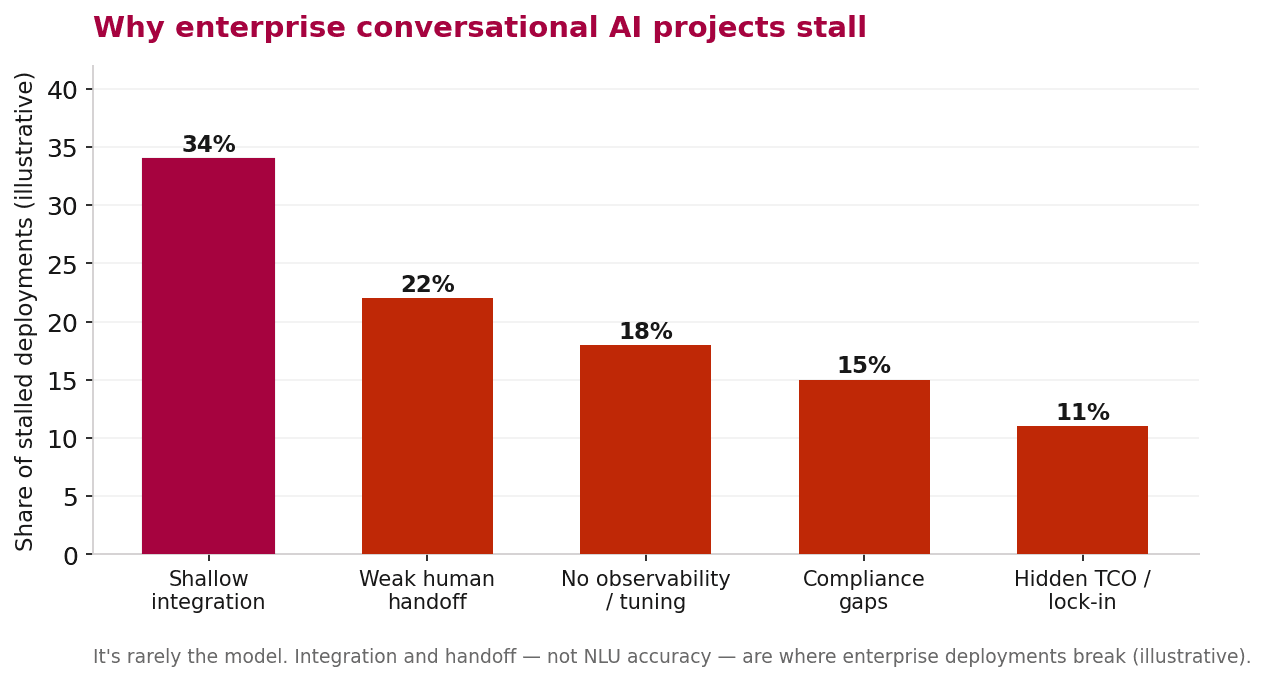
This is why the checklist weights integration and security highest and treats NLU accuracy as table stakes. You're not buying a model; you're buying whether the thing survives contact with your systems, your compliance team, and your peak load.
The scored buyer's checklist: 8 weighted criteria
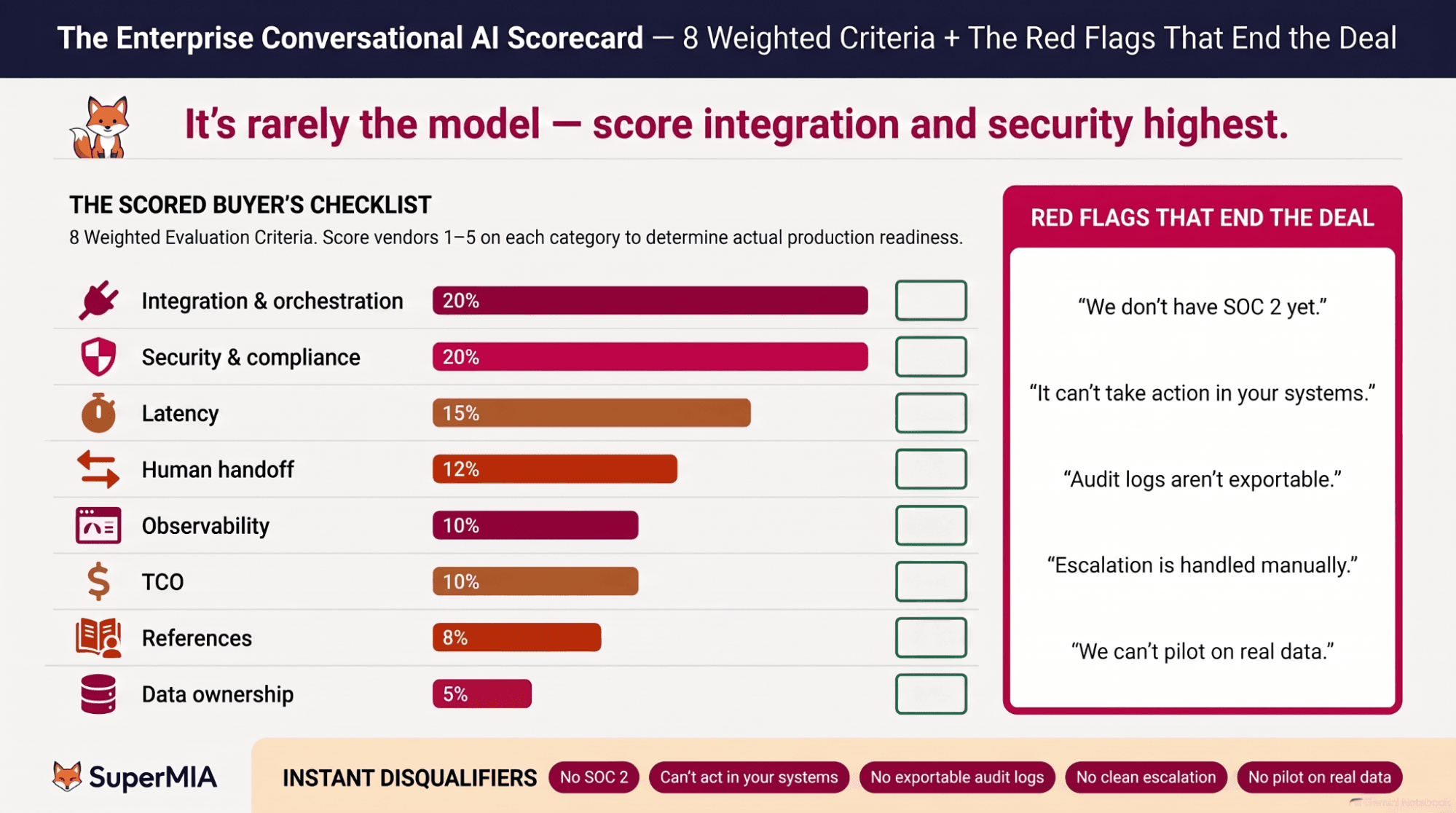
Score each finalist 1–5 on the eight criteria below, multiply by the weight, and total. Don't eyeball a feature grid — the weights are where the real decision lives.
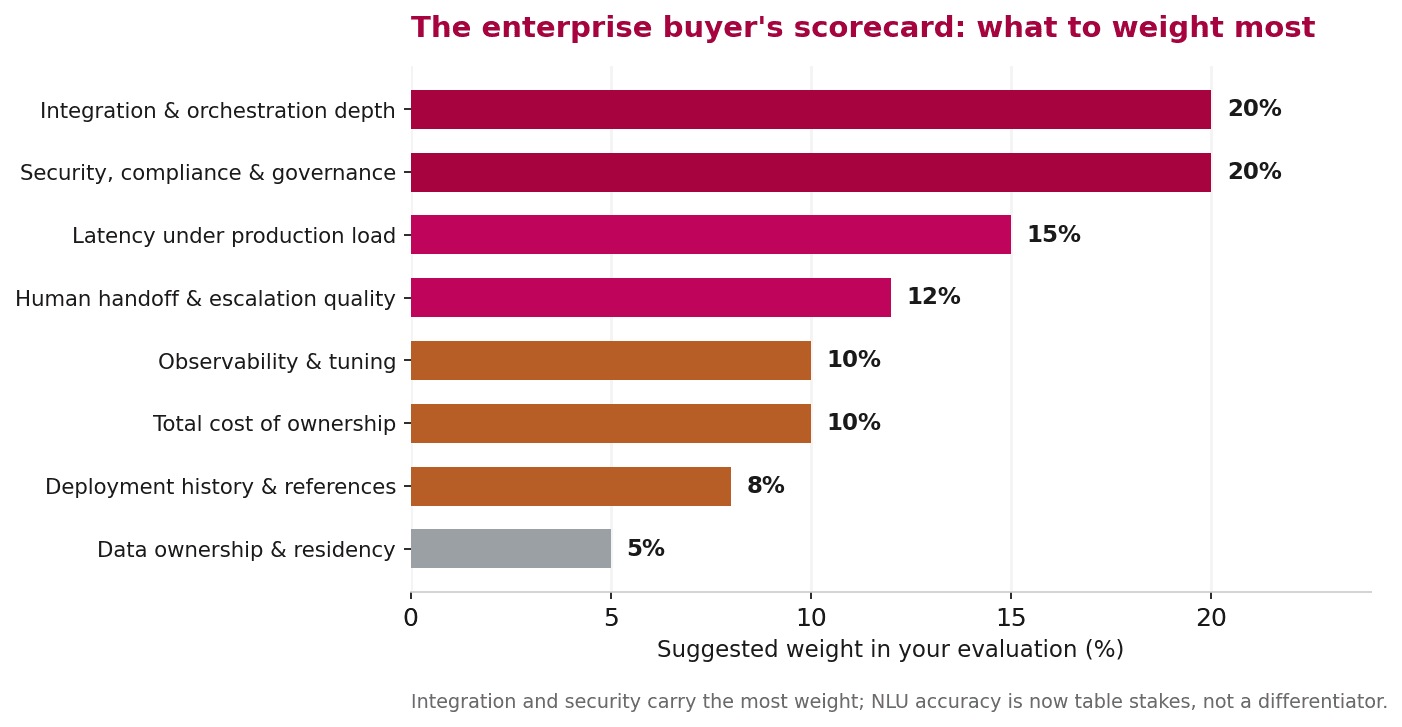
1. Integration & orchestration depth (weight 20%)
What good looks like: native connectors to your CRM, helpdesk, telephony, and data systems, plus the ability to orchestrate multi-step actions — not just answer. Ask: "Show me the AI completing a multi-system task, not just retrieving an answer." See enterprise workflow automation for how deep this goes.
2. Security, compliance & governance (weight 20%)
What good looks like: SOC 2 Type II, HIPAA BAA if you touch health data, GDPR support, SSO, RBAC, complete exportable audit logs, PII redaction, and data residency. Ask: "Is this enforced at the infrastructure level, or asserted in your terms of service?"
3. Latency under production load (weight 15%)
What good looks like: sub-800ms time-to-first-byte on a real phone call, with graceful degradation when a backend responds slowly. Ask: "Show me production logs at your concurrency, not a demo on a quiet line."
4. Human handoff & escalation quality (weight 12%)
What good looks like: the human agent receives full context — transcript, customer state, recommended next action. Ask: "What exactly does the agent see the moment a call escalates?"
5. Observability & tuning (weight 10%)
What good looks like: per-stage timing, call recordings and replays, and a way to tune behavior without rebuilding flows. Ask: "When something breaks in production, how do we see it and fix it — and who owns retraining?"
6. Total cost of ownership (weight 10%)
What good looks like: transparent pricing including implementation, customization, and ongoing optimization — configurable by your existing staff, not an army of engineers. Ask: "What's the all-in cost at our real volume, and what needs professional services?"
7. Deployment history & references (weight 8%)
What good looks like: real production deployments at your scale, with honest answers about what degraded and how they responded. Ask: "What did you underestimate on your last enterprise launch, and would that client pick you again?"
8. Data ownership & residency (weight 5%)
What good looks like: you own your data and transcripts, with clear boundaries on training and fine-tuning, and on-premises or regional options where required. Ask: "Is our data used to train your models, and can we opt out?"
Score SuperMIA on all eight — book a demo →
Red flags during the sales call
The scorecard tells you what to weigh. These phrases tell you when to walk. If you hear any of them, dig harder before you sign:
- "Our latency depends on your setup." → They've never measured it on a real call.
- "HIPAA is on our roadmap." → Don't deploy regulated or clinical workflows on it.
- "BYO keys aren't supported on our standard tier." → Lock-in by design.
- "We can't give you a trial without a credit card." → They lose too many trials to friction they don't want tested.
- "A bulk minute commitment is required." → You're financing their forecast, not buying on value.
- "NLU accuracy is 99%." → A commoditized metric used to distract from integration and handoff.
Instant disqualifiers
Some answers should end the evaluation on the spot — no scorecard needed:
- No SOC 2 Type II and no clear path to it, when you handle any sensitive data.
- Can't demonstrate the AI taking an action in your systems, only answering questions.
- No audit logs, or logs that can't be exported.
- No clean escalation-with-context to a human.
- Won't let you pilot on your real data and real call flow before a contract.
The honest rule. Buy for the failure modes, not the demo. A platform that integrates deeply, escalates cleanly, proves its compliance at the infrastructure level, and lets you pilot on your real data will outperform a smarter model wrapped in a rigid, locked-in product.
Run a pilot before you sign
Never buy enterprise conversational AI off a demo. Run a four-to-six-week pilot on your real environment with baselines set in advance:
- Define success up front — resolution rate, latency on real calls, CSAT, and escalation rate, measured against your current baseline.
- Pilot on a real, bounded use case with real data — not a sandbox and not a scripted happy path.
- Test the failure modes deliberately — slow backend, out-of-scope requests, escalation under load.
- Score the pilot against the eight criteria, then decide — and keep the exit clean if it doesn't clear the bar.
Frequently asked questions
What is enterprise conversational AI?
Enterprise conversational AI is a platform that resolves customer and employee requests across voice and chat, under enterprise governance such as single sign-on, role-based access, audit logs, and data residency, and integrates deeply enough with your systems to take action rather than just answer questions. If it cannot enforce organizational governance and act through your tech stack, it is a consumer tool with an enterprise price tag.
How do you evaluate an enterprise conversational AI platform?
Score vendors on eight weighted criteria: integration and orchestration depth, security and compliance, latency under production load, human handoff quality, observability and tuning, total cost of ownership, deployment history and references, and data ownership and residency. Weight integration and security highest, ask each vendor the disqualifying questions, and pilot with measurable baselines before signing.
What are the red flags when buying conversational AI?
Watch for answers like 'our latency depends on your setup,' which usually means they have never measured it on a real call; 'HIPAA is on our roadmap,' which means do not deploy regulated workflows on it; 'BYO keys are not supported on our standard tier,' which signals lock-in; and 'we cannot give you a trial without a credit card,' which signals friction they do not want tested.
What security and compliance does enterprise conversational AI need?
At minimum, expect SOC 2 Type II, a signed HIPAA Business Associate Agreement if you handle health data, GDPR support for data subject requests, single sign-on and role-based access control, complete and exportable audit logs, PII redaction, and clear data residency and retention policies. Compliance should be verifiable at the infrastructure level, not asserted in a terms-of-service document.
Why do enterprise conversational AI projects fail?
They rarely fail because of the model. Most stall on shallow integration that lets the AI answer but not act, weak human handoff that loses context on escalation, missing observability so no one can tune what breaks, compliance gaps discovered late, and hidden total cost or vendor lock-in. Evaluate for these failure modes, not for NLU accuracy alone.
Score the shortlist, then pilot the winner
Turn this into a one-page scorecard, weight the eight criteria, and have every finalist answer the disqualifying questions on the record. The platform that scores highest on integration and security — and lets you pilot on your real data — is the one that survives production.
Want to run this checklist against a live platform? Book a demo and put SuperMIA's enterprise conversational AI platform through all eight criteria on your real call flow.

Urvil Dhanani
Urvil Dhanani is the AI/ML Lead at SuperMIA, focused on the architecture behind reliable conversational AI - agent design patterns, voice and chat orchestration, and platform evaluation. He writes practical, vendor-neutral guides that help technical teams build and choose AI systems that hold up in production.