
Table of Contents
Customer service automation uses AI to resolve routine contacts — across voice, chat, and tickets — without a human, while routing complex or emotional ones to a person. The playbook that works: automate the high-volume, high-confidence contacts first, automate to resolve rather than just deflect, build the escalation handoff before you launch, and measure CSAT and resolution, not just deflection.
See cross-channel automation on your support stack →
Key takeaways
- Customer service automation is cross-channel — voice, chat, and tickets — not a chatbot project.
- Automate to resolve, not to deflect: deflection cuts cost but can tank CSAT; resolution does both.
- Automate the high-volume, high-confidence contacts first — order status, account access, policy questions.
- Never automate complaints, refund disputes, or emotional and high-stakes contacts — route those to a human.
- Build the escalation handoff first, and measure CSAT and resolution — a bot that can't escalate is a trust bomb.
What is customer service automation?
Customer service automation is the use of AI and software to resolve routine customer contacts across voice, chat, and tickets — without a human, while routing complex or emotional contacts to a person. It's not one channel and it's not one tool; it's an operating model that spans four layers: deflect (self-service), assist (help the agent), resolve (solve at the touchpoint), and reach out (proactive).
The word most guides get wrong is "chatbot." Automation isn't a bot you bolt onto your website. It's a decision — for every contact type and every channel — about what the machine handles and what a human does. Get that decision right and cost falls while satisfaction rises. Get it wrong and you cut cost while your CSAT quietly bleeds.
This playbook is powered by SuperMIA's AI workflow automation platform, which runs voice, chat, and ticket automation on one system — but the framework below is vendor-neutral.
Deflection vs resolution: the distinction that decides CSAT
This is the single idea that separates a playbook that works from one that backfires. Deflection pushes a customer away from a human — into a bot, a help article, a menu — and counts success when the contact stops. Resolution actually solves the problem at the touchpoint.
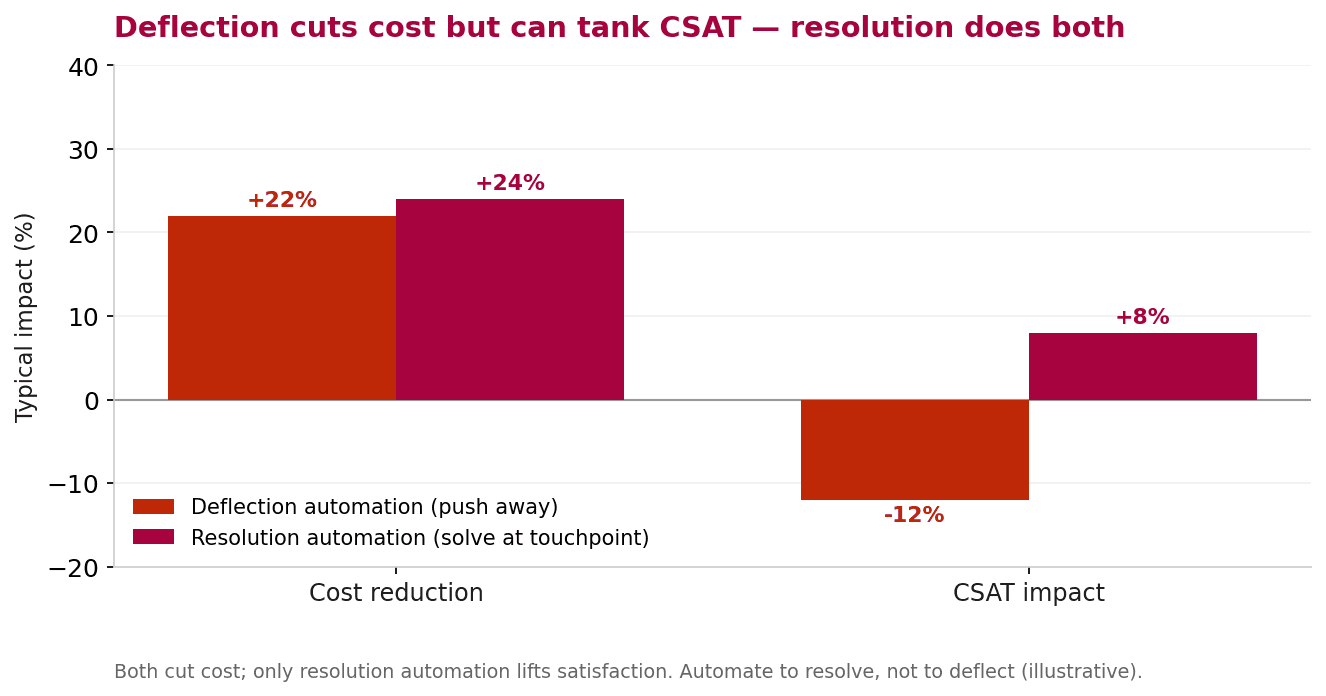
Both approaches cut cost. But deflection that traps a customer with no clean path to a person tends to drop CSAT, while resolution that solves and escalates cleanly lifts it. The rule for the whole playbook: automate to resolve, not to deflect.
What to automate first (and what to never automate)
Don't automate by channel or by vendor feature — automate by contact type, ranked by volume and confidence. Pull 90 days of contacts, cluster by type, and rank. The high-volume, high-confidence ones come first.
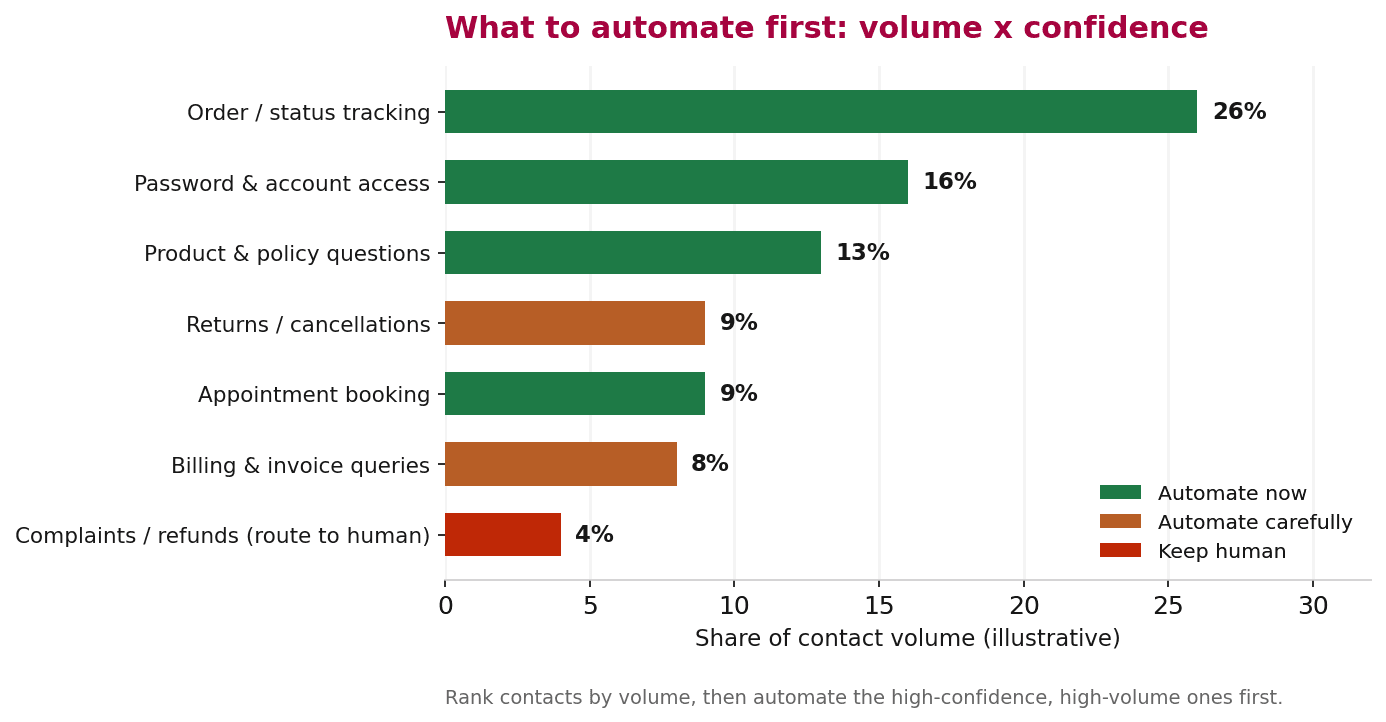
Automate now (high volume, deterministic): order and status tracking, password and account access, policy and product questions, appointment booking. Automate carefully (needs identity or nuance): returns and cancellations, billing and invoice queries.
Never automate. Complaints, refund disputes, cancellations of high-value accounts, and any emotional, sensitive, or high-stakes conversation. Automation can gather context and route these fast — but a human makes the call. Automating the routine majority is what frees your team for exactly this work.
The cross-channel map: voice, chat, and tickets
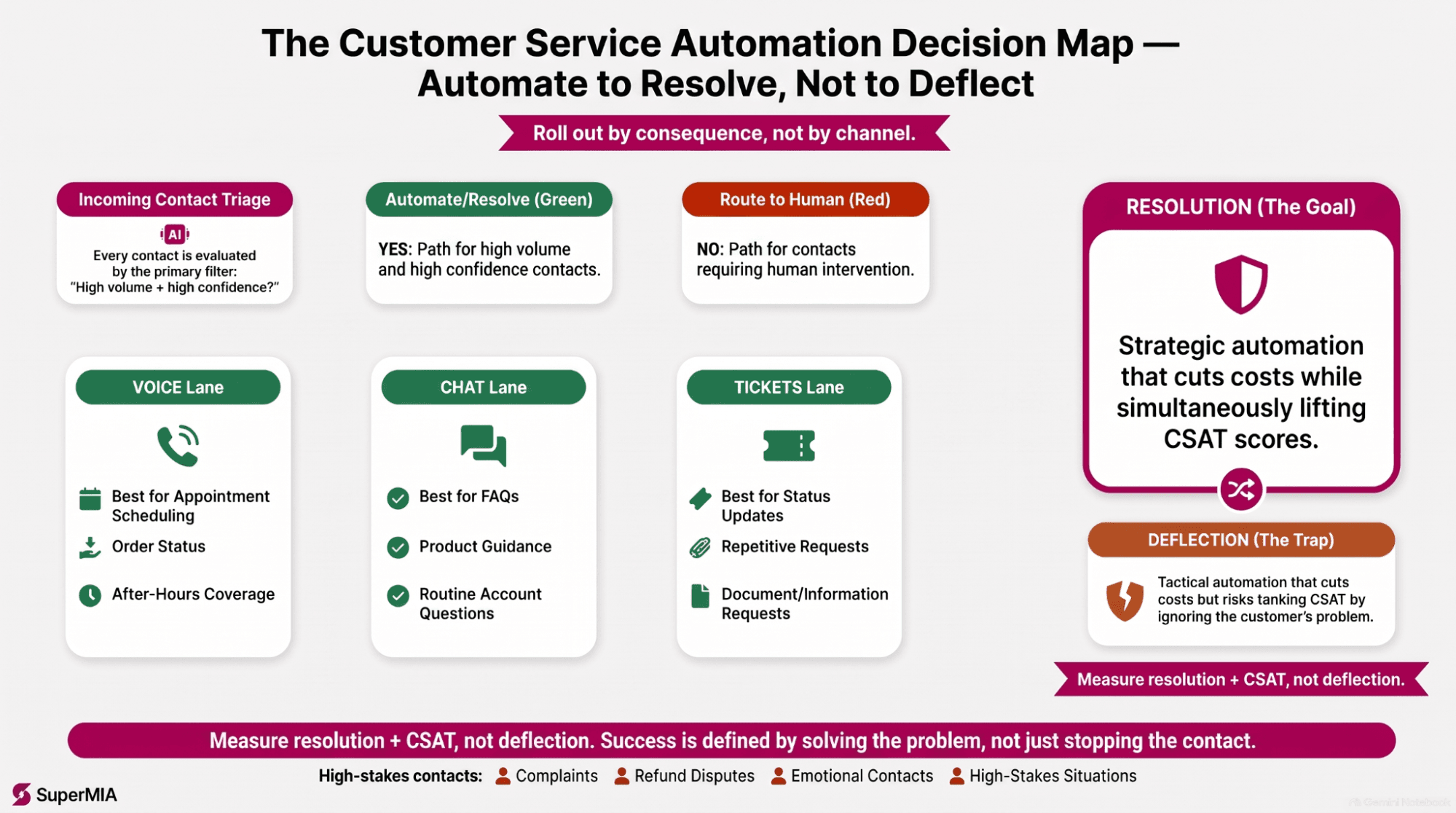
Here's what the chatbot-only playbooks miss: customer service isn't one channel. The same contact type behaves differently on the phone than in chat, and the automation follows the channel. Match the contact to the channel it already happens on — which channel fits which contact breaks that decision down in depth.
Voice
Phone is still a huge share of real customer service, and it's where most automation playbooks go quiet. A voice agent answers instantly, resolves routine calls end-to-end, and escalates with context — no hold music, no menu maze. Best for scheduling, order status, and after-hours coverage.
The deep guide is automated customer service with AI voice bots — pair it with an AI voice agent for the calls your team can't get to.
Chat & messaging
Web chat, SMS, and WhatsApp handle asynchronous, text-friendly contacts — WISMO, returns, product questions. The economics are strong when it resolves rather than deflects.
For the cost-per-ticket math, see the customer service chatbot ROI breakdown.
Tickets & email
For email and helpdesk tickets, automation triages intent, drafts source-backed replies for review, and auto-tags and routes. Start with read-and-draft (reversible) before letting it send autonomously on narrow, well-documented question types.
Map automation to your channels — book a demo →
The 90-day rollout sequence
You don't need a strategy document — you need one workflow, a baseline, and an escalation rule you wrote down before launch. Here's the staged sequence:
- Days 0–14 — Foundation. Pull 90 days of contacts, cluster by type, rank by volume × confidence. Audit your knowledge base. Write the escalation rule first.
- Days 15–45 — Pilot one workflow. Launch your highest-volume, highest-confidence contact type on one channel. Measure CSAT and resolution against the baseline.
- Days 46–75 — Expand by consequence. Add the next contact types and the next channel. Keep the human path visible; gate each expansion on CSAT holding.
- Days 76–90 — Instrument and scale. Add QA on automated conversations, tighten routing, and set the confidence thresholds that decide auto-resolve vs escalate.
What to measure (and the metric that misleads)
Deflection rate is the metric that misleads. A bot can frustrate a customer into giving up and post a great deflection number while your CSAT falls. Track the metrics that reflect the actual outcome:
- Resolution rate — did the contact actually get solved, not just stopped?
- CSAT — measured before, during, and after automation, not just at the end.
- First-contact resolution and escalation quality — did the handoff carry context?
- Cost per contact — the number that justifies the program, alongside CSAT so you never trade one for the other.
The honest rule. Roll out by consequence, not by channel or vendor feature. Start with reversible, high-confidence work, keep the human path visible, and measure CSAT and resolution — not deflection. A bot that can't escalate cleanly is a trust bomb.
Frequently asked questions
What is customer service automation?
Customer service automation is the use of AI and software to resolve routine customer contacts across voice, chat, and tickets without a human, while routing complex or emotional contacts to a person. It spans self-service deflection, agent assistance, full resolution at the touchpoint, and proactive outreach, and it works best when the escalation path to a human is built in from the start.
What should you automate in customer service first?
Automate the highest-volume, highest-confidence contacts first: order and status tracking, password and account access, and policy or product questions answerable from your documentation. These are deterministic, easy to get right, and make up the majority of inbound volume. Leave complaints, refund disputes, and emotional or high-stakes contacts to humans.
What is the difference between deflection and resolution?
Deflection pushes a customer away from a human agent, for example into a chatbot or a help article, and counts success when the contact stops. Resolution actually solves the customer's problem at the touchpoint. Deflection can cut cost while hurting satisfaction, whereas resolution automation cuts cost and lifts CSAT, so automate to resolve, not just to deflect.
What should you never automate in customer service?
Never fully automate complaints, refund disputes, cancellations of high-value accounts, billing disputes, or any emotional, sensitive, or high-stakes conversation. Automation can gather context and route these quickly, but a human should make the judgment call. The goal is to free your team for exactly this work by automating the routine majority.
Does customer service automation hurt CSAT?
It depends on how you do it. Deflection automation that forces customers into a bot with no clean path to a human tends to lower CSAT. Resolution automation that actually solves the problem, keeps a visible escalation option, and hands off with full context typically raises CSAT while cutting cost. Measure CSAT before, during, and after, not just deflection.
Start with one workflow, one channel
Pick your highest-volume, highest-confidence contact type, automate it on the channel it already happens on, and measure CSAT and resolution against a baseline. Prove it, then expand by consequence — never by channel or vendor feature.
Want to see the full cross-channel playbook running on your support stack? Book a demo and we'll show SuperMIA's AI workflow automation platform handling voice, chat, and tickets on one system.

Urvil Dhanani
Urvil Dhanani is the AI/ML Lead at SuperMIA, focused on the architecture behind reliable conversational AI - agent design patterns, voice and chat orchestration, and platform evaluation. He writes practical, vendor-neutral guides that help technical teams build and choose AI systems that hold up in production.