
Table of Contents
- What is a property management chatbot?
- What it can actually handle
- What to automate — and what to escalate
- How much does it cost?
- The ROI math for a real portfolio
- Chatbot vs answering service vs voicemail
- How to deploy one in 5 steps
- Do tenants actually want to use a chatbot?
- Frequently asked questions
A property management chatbot is an AI assistant — on a website widget, tenant portal, or SMS — that answers tenant and prospect questions in plain language. It takes and triages maintenance requests, answers rent and lease questions, handles leasing and availability inquiries, and escalates emergencies or complex issues to a person. It runs 24/7 and resolves most routine messages without adding staff.
See MIA answer a tenant question live — book a 15-minute demo →
Key takeaways
- A well-built property management chatbot resolves 65–75% of tenant and prospect messages on its own — payment and account questions run highest, complex or legal ones stay with people.
- It cuts inbound calls and emails to the office by 30–50%, freeing staff for tours and lease conversations.
- Typical cost is $2–$5 per unit per month (or $40–$500 flat for small portfolios) — payback usually in weeks.
- A chatbot is chat-first (widget, portal, SMS). For phone coverage, pair it with an AI resident desk for property management.
- The rule that makes it work: automate the routine and high-volume; escalate anything emotional, legal, or safety-critical to a human.
What is a property management chatbot?
A property management chatbot is an AI assistant that talks to tenants and prospects in natural language, usually through a website chat widget, a tenant portal, or text message. It answers questions and completes routine tasks on its own, and hands off to a person when it should.
The difference from an old FAQ widget is that a modern chatbot does the job, not just points at a help article. It writes a maintenance ticket into your system, pulls a balance, or books a tour — then logs what happened. SuperMIA runs this through its MIA Chat Agent.
It is chat-first by design. If you also need every phone call answered, that is a voice job — see how an AI resident desk for property management handles the phone line, and how AI phone answering compares.
What can a property management chatbot actually handle?
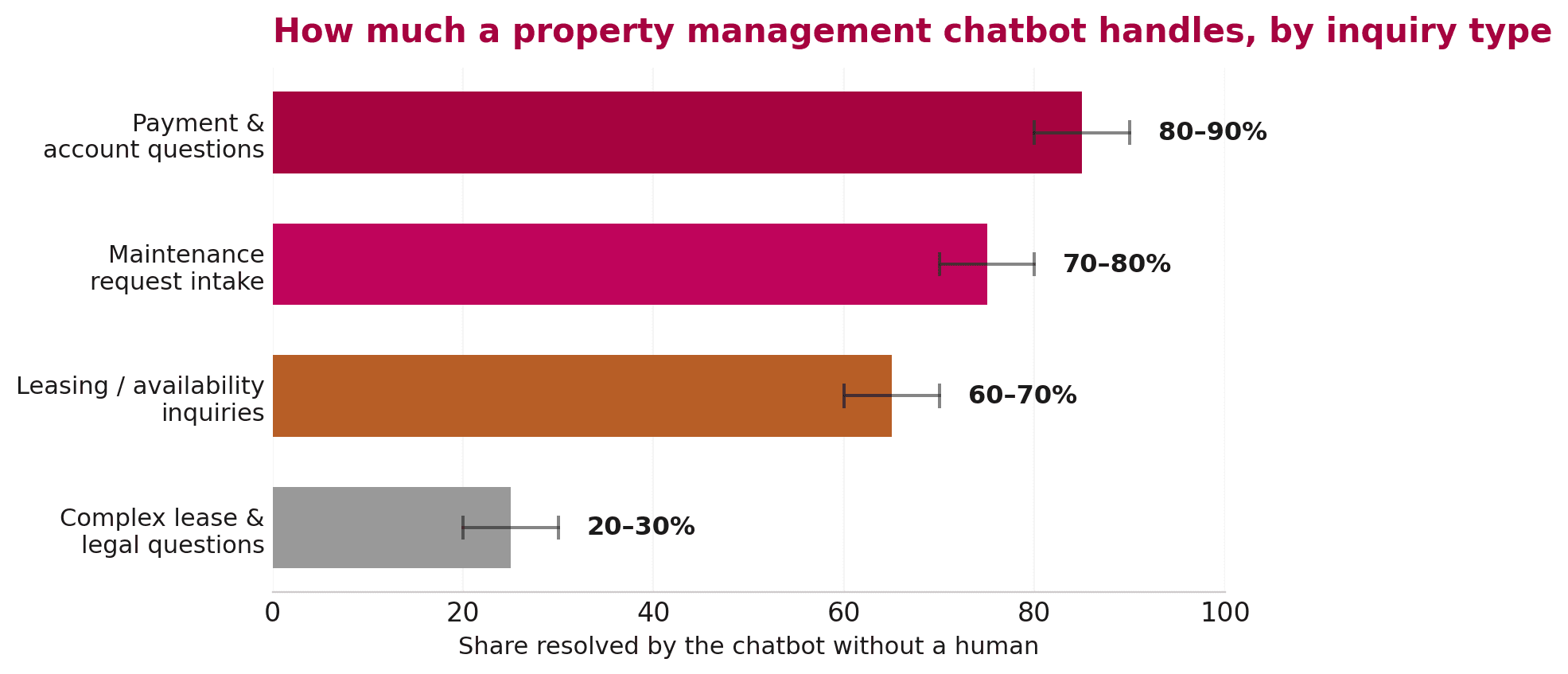
Most of what fills a leasing office's inbox is routine and repeatable — exactly what a chatbot is good at. Here is how much it resolves without a human, by inquiry type.
Maintenance request intake & triage
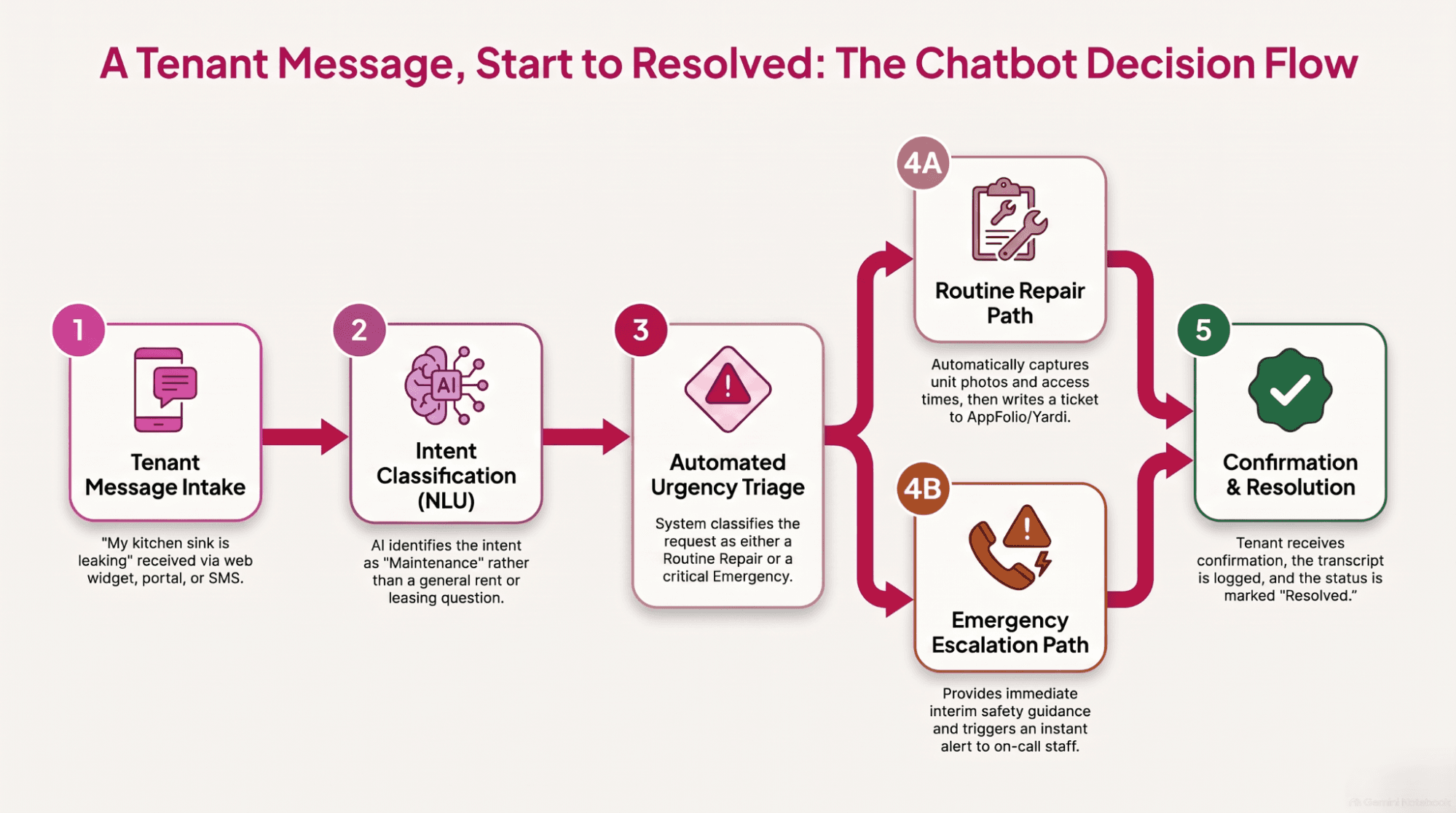
This is the highest-volume, most time-sensitive category — and the biggest win. The chatbot walks the tenant through a clean intake: what broke, which room, how bad, and when someone can get in. It can ask for a photo so maintenance diagnoses before arriving.
Then it classifies urgency. A slow drain becomes a routine ticket in AppFolio or Yardi for the morning. A flood, no-heat, or gas smell gets interim guidance plus instant escalation to on-call staff, with the unit and photos already attached.
Leasing & availability inquiries
Prospects ask the same things: what's available, how much, pet policy, parking, how to apply. The chatbot answers from live data, qualifies budget and move-in date, and books a tour for the strong ones — so leasing staff get pre-qualified leads, not raw inquiries.
Because it replies the moment interest is highest, it captures leads that would otherwise die in voicemail. Keep the scripting fair-housing-safe — same questions, same information, every prospect. For investor lead-qualification specifically, see our lead-qualification chatbot for investors.
Rent, payment & lease questions
With integration, the chatbot answers tenant-specific questions: current balance, when rent is due, how to set up autopay, what a charge is, when the lease ends. It points to the payment portal and walks a tenant through setup — the questions that eat a coordinator's afternoon.
What you should automate — and what to escalate
This is the part product pages skip, and it is the whole game. The honest rule: automate the routine and high-volume; escalate anything emotional, legal, or safety-critical to a person.
| Automate (routine, high-volume) | Escalate to a human (judgment, risk) |
|---|---|
| Maintenance intake & routine tickets | Complex or disputed maintenance |
| Availability, pricing, pet/parking policy | Lease negotiation & renewals with pushback |
| Rent due dates, balances, autopay setup | Eviction, legal, or collections disputes |
| Tour booking & lead qualification | Discrimination or ADA accommodation requests |
| Emergency detection + escalation | The emergency itself (a human takes over) |
| Status updates & confirmations | Anyone upset, grieving, or in crisis |
The failure mode to avoid: a bot that refuses to hand off. Design the escalation triggers first — frustration or repeated questions, emergencies, legal or lease disputes, and anything it can't answer with confidence — and pass the full conversation history so the tenant never repeats themselves.
How much does a property management chatbot cost?
Most property management chatbots cost about $2 to $5 per unit per month for multifamily portfolios, or a flat $40 to $500 per month for smaller operations. Enterprise portfolios often negotiate $1 to $3 per unit. Ranges reflect public 2026 vendor pricing; confirm current numbers on each provider's page.
What moves the price: number of doors, message volume, how deep the integration goes, and whether you need voice too. Against the staff hours saved, payback usually lands in weeks, not months. Compare SuperMIA plans on the pricing page.
The ROI math: what it saves a real portfolio
The value shows up in three places: recovered staff hours, fewer lost leads, and better retention. Here is the operational shift most portfolios see after deploying a chatbot.
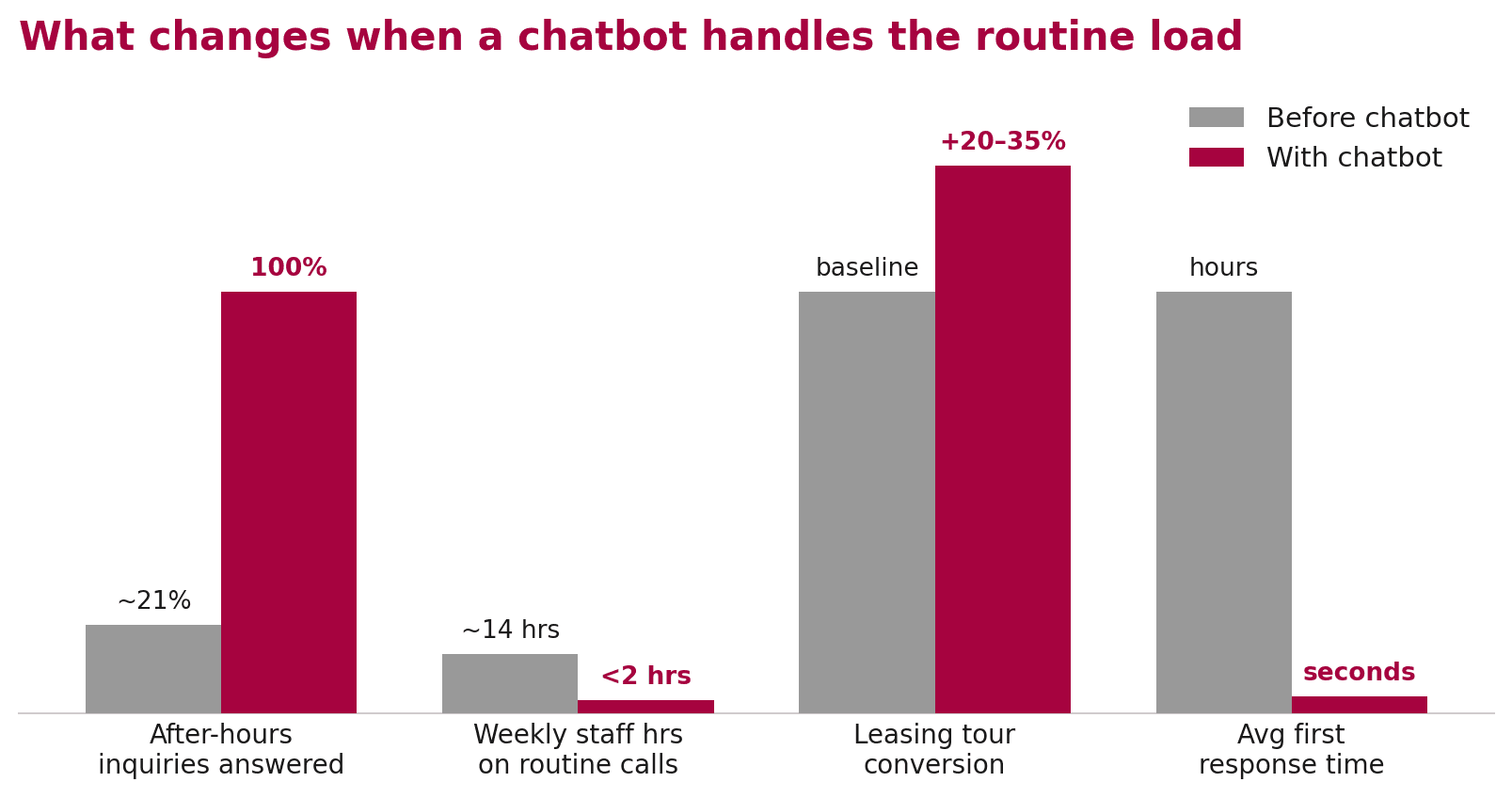
Put a dollar figure on it and the case is straightforward. For a 500-unit portfolio, the recovered staff time, avoided turnover, and after-hours coverage add up well past the platform cost.
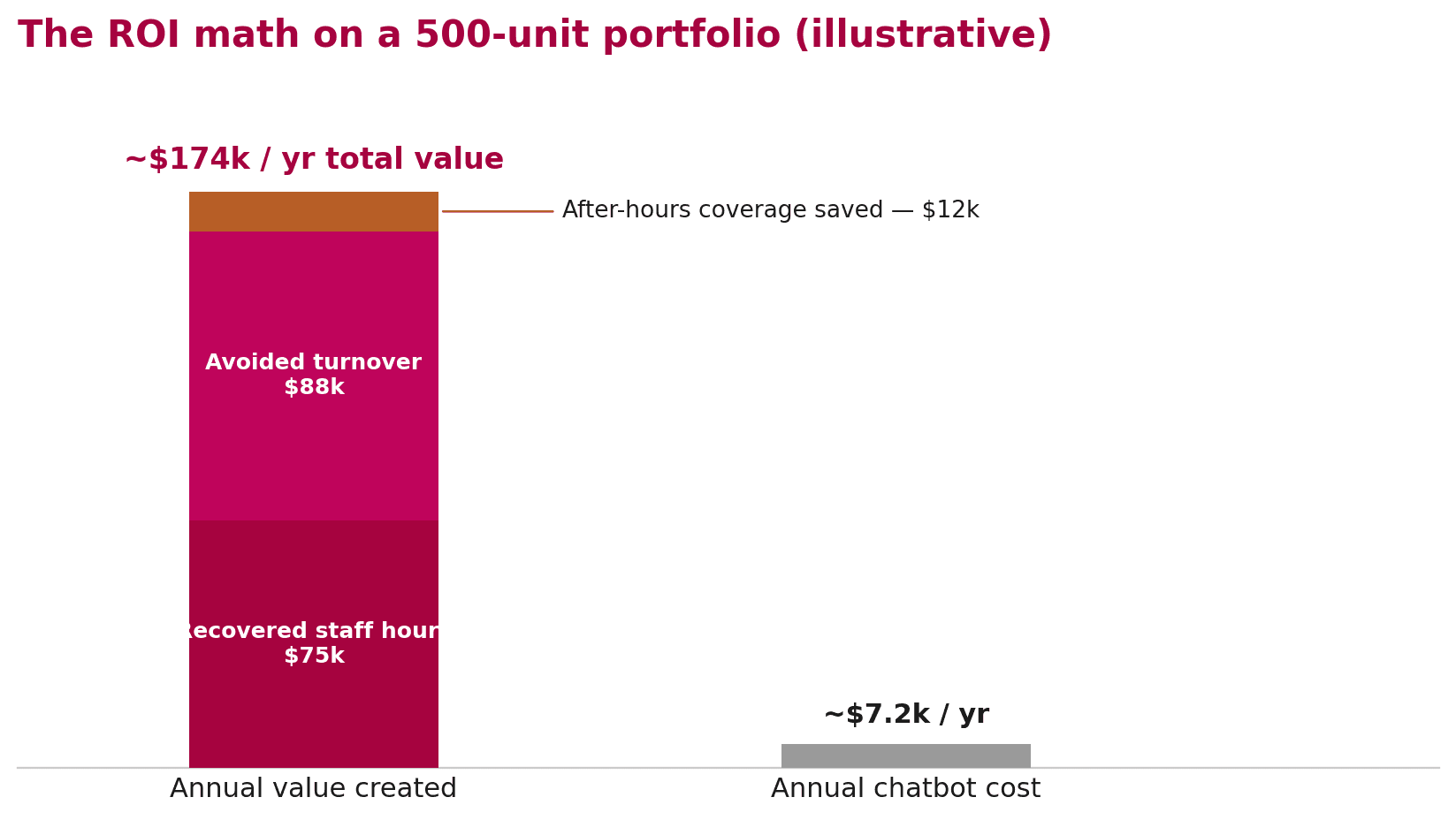
Run your own numbers. Take your monthly tenant + prospect messages, the share that's routine (usually 60–70%), your coordinator's loaded hourly cost, and your turnover cost per unit. Even at conservative inputs, the routine-message load alone tends to cover the platform cost several times over.
Chatbot vs. answering service vs. voicemail
A chatbot is one piece of the resident-communication stack. Here is where it fits next to the alternatives most managers already use.
| Capability | Voicemail | Human answering service | Property management chatbot |
|---|---|---|---|
| Answers routine questions 24/7 | — | Sometimes (extra fees) | Yes, instantly |
| Takes & triages maintenance | — | Takes a message | Yes, with urgency sorting |
| Books tours / qualifies leads | — | Rarely | Yes |
| Writes tickets to AppFolio / Yardi | — | — | Automatically |
| Works on web, portal & SMS | — | Voice only | All text channels |
| Cost to scale | Free, loses leads | Per-minute / per-door | Flat, no new hires |
The honest read: a chatbot owns text and self-service; a phone line still needs voice. Many managers run both — the chatbot on the website and portal, and add a voice line for callers. One platform, both channels.
How to deploy a property management chatbot in 5 steps
- Start with your highest-volume questions. Office hours, payment portal, maintenance intake, amenity info — the predictable ones. Prove accuracy here first.
- Train it on your property, not generic data. Upload your handbook, FAQs, policies, and emergency contacts so answers are yours, not boilerplate.
- Connect your property management software. Integrate AppFolio, Yardi, or Buildium so it reads balances and writes tickets and leads back — read and write, not read-only.
- Design the escalation triggers. Emergencies, frustration, legal or lease disputes, and low-confidence answers all hand off to a person with full context.
- Review logs weekly and expand. Watch what it misses, retrain, and widen its scope. Most portfolios gain 10–15 points of resolution rate in the first six months.
Do tenants actually want to use a chatbot?
Mostly yes — for routine questions, when the alternative is waiting for a callback. Satisfaction comes down to two things: the answers are correct and instant, and a human is easy to reach when needed.
What tenants dislike isn't the format — it's a bad bot that gives wrong answers or traps them in a loop. Get accuracy and escalation right and chatbot satisfaction matches or beats phone and email.
Frequently asked questions
What is a property management chatbot?
A property management chatbot is an AI assistant, usually on a website widget, tenant portal, or SMS, that answers tenant and prospect questions in natural language. It takes and triages maintenance requests, answers rent and lease questions, handles leasing and availability inquiries, and escalates emergencies or complex issues to a human, 24/7, without adding staff.
How much does a property management chatbot cost?
Most property management chatbots cost about $2 to $5 per unit per month for multifamily portfolios, or a flat $40 to $500 per month for smaller operations. Enterprise portfolios often negotiate $1 to $3 per unit. Against the staff hours a chatbot saves, payback is usually measured in weeks.
Can a property management chatbot handle maintenance emergencies?
Yes, for triage. A chatbot detects emergencies like floods, no-heat, or gas smell through keyword and urgency classification, gives the tenant immediate interim guidance, and escalates to on-call staff with full details. It should never be the only line for a true emergency — a human takes over from there.
What should a property management chatbot NOT do?
Keep it away from anything emotional, legal, or safety-critical: eviction and lease disputes, legal questions, discrimination or ADA accommodation requests, and final decisions on approvals. These need a human. Automate the routine and high-volume; escalate the rest.
Do tenants actually want to use a chatbot?
Most do, for routine questions, when the alternative is waiting for a callback. Satisfaction depends on two things: the chatbot gives correct answers instantly, and reaching a human is easy when needed. Poorly built bots that give wrong answers or trap people are what tenants dislike — not the format.
Does a property management chatbot integrate with AppFolio or Yardi?
The best ones do. Integration with AppFolio, Yardi, or Buildium lets the chatbot read lease dates, balances, and ticket status, and write new maintenance tickets and leads back into your system. Without it, a chatbot can only answer generic questions, not tenant-specific ones.
How long does it take to deploy a property management chatbot?
A basic chat widget trained on your FAQs and policies can go live in days. Full deployment with property-management-software integration and custom flows typically takes 2 to 4 weeks, with accuracy improving over the first few months as it learns from real conversations.
Where to start
Pick your highest-volume tenant question and let a chatbot own it. Prove the accuracy, connect it to your property software, and expand from there — keeping a human on anything emotional, legal, or urgent.
We'll put MIA on your real properties and policies so you can watch it answer, triage, and log an actual tenant message.

Vicky Lalwani
Vicky Lalwani is Marketing Manager at SuperMIA, focused on practical AI education, buyer's guides, and solution explainers that help business teams evaluate and adopt conversational AI across support, sales, and operations.