
Table of Contents
Can an AI voice agent really answer a restaurant’s phone? Yes. It answers every call on the first ring — during the dinner rush and after close — and handles the three jobs your phone actually does: booking reservations against live table availability, taking takeout orders into your POS, and recovering the calls that would otherwise hit voicemail. It routes complaints, big catering jobs and edge cases to a person.
Book a demo — and hear an AI voice agent handle a restaurant call →
Key takeaways
- It does three phone jobs. Reservations against live availability, takeout orders into the POS, and missed-call recovery — all on the same call.
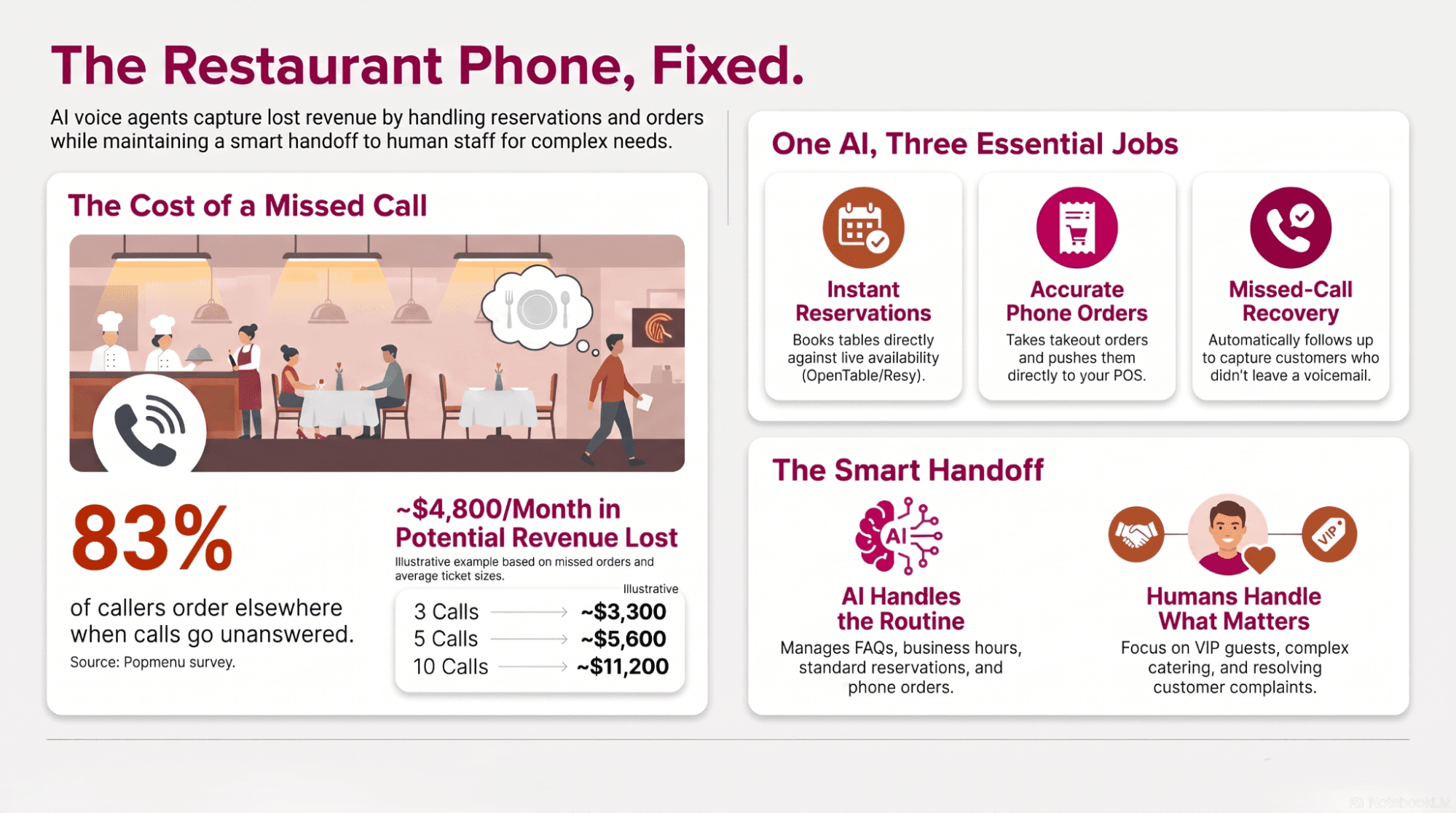
- Missed-call recovery is where the money is. Popmenu reports 83% of callers simply order from a different restaurant if they hit voicemail.
- The ROI math is about your ticket size. At an illustrative $45 average takeout ticket, five missed calls a night is roughly $5,600 a month.
- It still can’t do everything. Items 86’d mid-service, heavy modifications, and emotional calls belong with a person.
- Integrations decide whether it’s real. It has to read your reservation system and write to your POS — otherwise it’s an expensive answering machine.
Think about when your restaurant’s phone rings most. It’s 7:15 on a Friday, every table is seated, the kitchen is slammed, and the host is running two orders to the pass. The phone rings. Nobody can get to it. It rings again after you’ve closed, when someone’s trying to book a birthday dinner for next week. Those are the calls that turn into a lost order or an empty table — and they happen at exactly the moments no one is free to answer.
An AI voice agent is built for those moments. It answers the phone instantly, in a natural voice, and handles the three jobs your phone actually does: it books reservations, it takes orders, and it catches the calls you’d otherwise miss. This guide walks through how each of those works, does the honest math on what missed calls cost you, and — just as importantly — tells you plainly what this technology still can’t do well, so you know where you’ll still want a person. If you’re weighing this for a hotel or a larger property rather than a restaurant, our AI for hospitality overview is the wider starting point.
Can an AI voice agent really answer a restaurant’s phone?
Yes — and in 2026 this stopped being experimental. In February, Burger King began piloting an AI voice assistant nicknamed “Patty” across around 500 restaurants. When a chain that size puts AI on the phone at that scale, the question shifts from “does this work?” to “where does it work, and where does it still need a human?”
Here’s the honest version. A restaurant voice agent answers every call on the first ring, understands natural speech (“can I get a table for four around eight?”), and completes the common tasks end-to-end — without putting the caller on hold or bouncing them to voicemail. It’s genuinely good at the repeatable calls that make up most of your phone volume. It’s not a replacement for a warm human touch on a complaint or a complicated special request — and we’ll get specific about that below. For the deeper technical picture of how these systems work across industries, our AI voice agent platform guide covers the platform landscape; this page stays focused on the restaurant floor.
The three phone jobs it handles
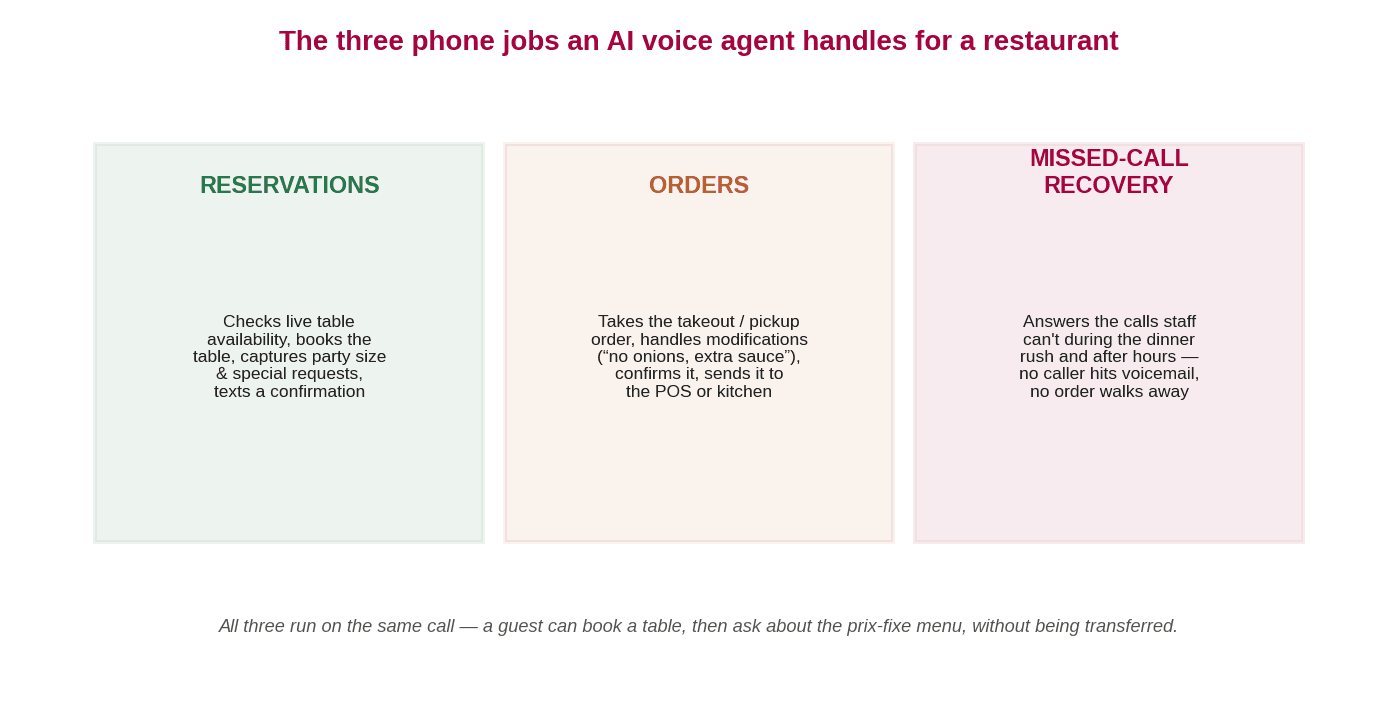
Almost everything that comes through a restaurant’s phone falls into three buckets. A good voice agent is built around all three — and can move between them on a single call, so a guest can book a table and then ask what’s on the tasting menu without being transferred.
The diagram above lays out the three side by side. Here’s what each one means in practice.
Reservations
The agent checks live table availability — not a static list — and books the table directly. It captures party size, time, and special requests (a high chair, a window table, an anniversary), then sends a text confirmation. Because it’s reading real availability, it won’t double-book your 8pm two-top or promise a table you don’t have. It can also take cancellations and changes by phone, which quietly frees up tables that would otherwise sit empty because a guest couldn’t reach anyone to cancel. The one thing to insist on: it has to write to your actual reservation system, so the floor sees the booking the moment it’s made.
Orders
For takeout and pickup, the agent takes the order over the phone, handles the everyday modifications (“no onions, extra sauce, sub fries”), reads it back to confirm, and pushes it to your POS so the kitchen gets a ticket the same way as any other order. It handles the high-volume, repeatable orders well; very complex or unusual custom builds should route to a person.
Missed-call recovery
This is the one that pays for the whole thing. Every call your staff can’t pick up — during the dinner rush, on a busy Saturday, after you’ve closed — gets answered instead of dumped to voicemail. The agent takes the booking or the order, or answers the hours-and-directions question, so the guest never has a reason to hang up and call the place down the street. It works the after-hours window too, capturing next-week reservations and catering inquiries at 11pm when no one’s in the building. If you already run an AI phone answering service for overflow, this is the restaurant-specific version of the same idea — tuned for bookings and orders rather than generic message-taking.
What missed calls actually cost you
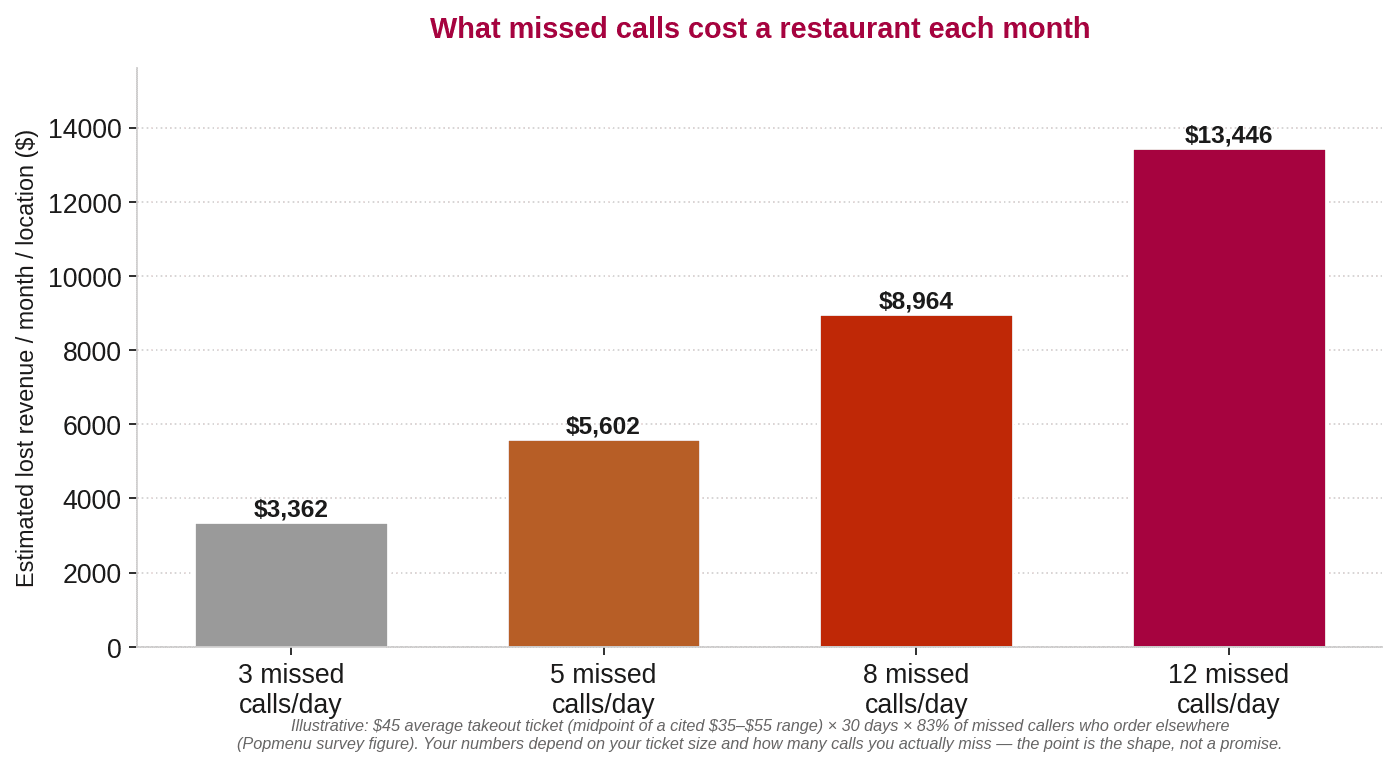
The reason missed-call recovery matters so much comes down to one widely cited number. According to Popmenu, 83% of customers will simply order from a different restaurant if their first call goes to voicemail. They don’t call back. They don’t leave a message. They call your competitor. So a missed call isn’t a delayed order — it’s usually a lost one.
Put a number on it. Say your average takeout ticket sits in the commonly cited $35–$55 range — call it $45. If you miss five calls a night, and 83% of those callers order elsewhere, that’s roughly $5,600 in lost revenue a month, from one location, from calls you never even knew came in. The chart above shows how that scales with how many calls you actually miss.
A note on this math: it’s illustrative, not a promise. Your real number depends on your ticket size, how many calls you genuinely miss, and how many of those would have converted. The point isn’t the exact figure — it’s the shape. Even a conservative version of this math usually clears the cost of the agent several times over, which is why the payback question for most restaurants isn’t “can I afford it” but “how many orders am I already losing.”
What restaurant voice AI still can’t do well
Any vendor who tells you their agent handles everything is selling, not explaining. Here’s where the technology genuinely still struggles in 2026 — and where you’ll want a person in the loop.
- Items 86’d mid-service. If you run out of the branzino at 8pm, the agent only knows that if it’s synced to your POS in real time. Without that sync, it can keep cheerfully selling a dish you’re out of. Ask any provider exactly how ‘86’d’ items get communicated.
- Heavy or unusual modifications. “No onions” is fine. A wedding-catering order with seven allergy substitutions and a plating request is not — that’s a conversation for a human, and the agent should hand it off rather than fumble it.
- Emotional or high-stakes calls. A guest who’s upset about a ruined anniversary dinner does not want an AI. They want a manager. The right setup recognizes the moment and routes it to a person immediately.
- Deep local nuance. Questions that depend on judgment — “is the patio warm enough tonight,” “can you squeeze in a party that’s running late” — are still better handled by someone who can see the room.
None of this is a reason to skip a voice agent. It’s a reason to set it up honestly: let it own the high-volume, repeatable calls it’s genuinely good at, and make sure it hands the rest to your team cleanly. Which brings us to integrations.
Integrations — and when to hand off to a human
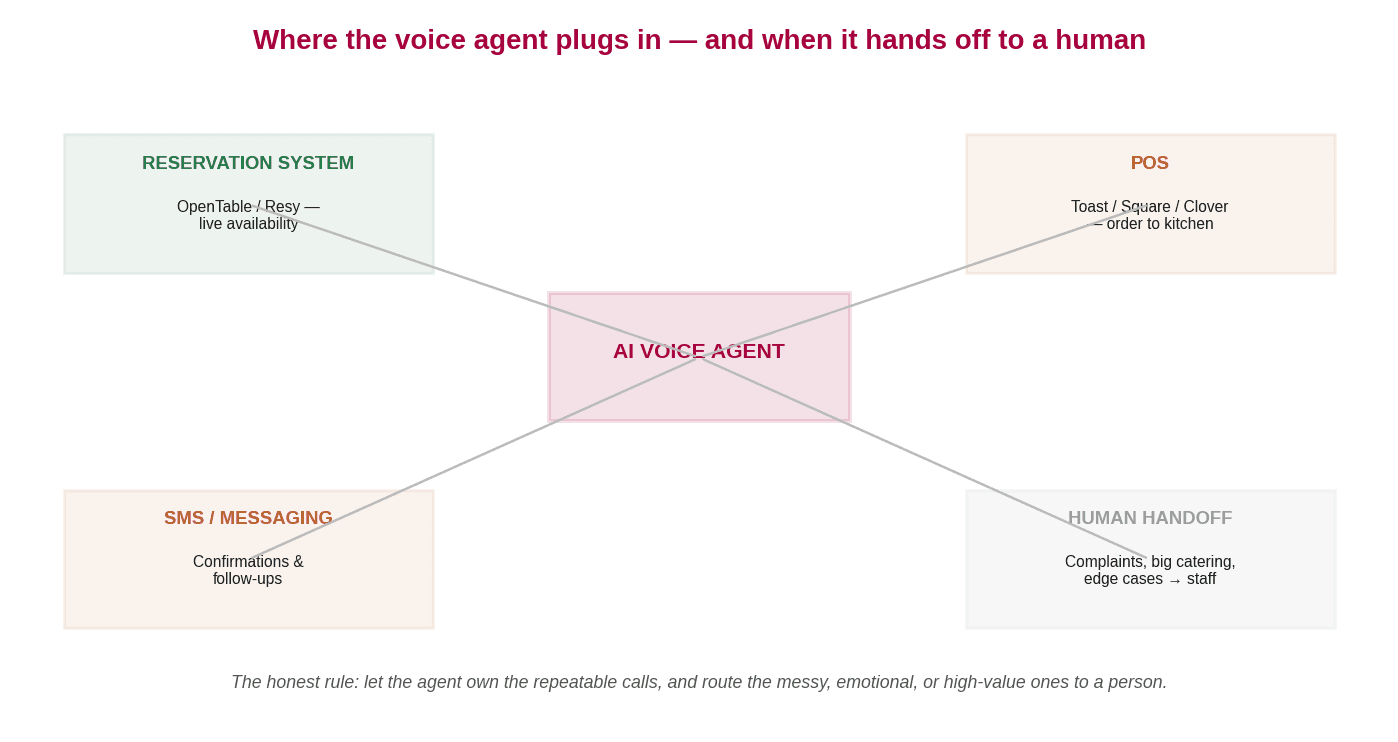
The difference between a real voice agent and an expensive answering machine is what it’s connected to. The diagram above maps it: the agent sits in the middle, wired into the systems you already run.
- Your reservation system. OpenTable, Resy, or whatever you use — for live availability, so bookings are real and the floor sees them instantly. OpenTable and Resy have both been adding AI-facing capabilities, but always confirm a provider supports your exact system.
- Your POS. Toast, Square, Clover — so phone orders flow to the kitchen automatically, the same as any other order.
- SMS. For confirmations and follow-ups, so the guest has the booking or order details in writing.
- A clean human handoff. The most important integration is the exit: when a call is a complaint, a big catering job, or an edge case, the agent transfers it to a person without making the guest repeat themselves.
The honest rule of thumb: let the agent own the repeatable calls, and route the messy, emotional, or high-value ones to a human. Set up that way, you get the coverage without the cold-robot horror stories. You can see how our AI voice bot works if you want the specifics of how those connections are configured.
How much does it cost, and is it worth it?
Pricing varies a lot by provider. Most restaurant voice agents are sold as a monthly subscription, frequently with usage-based call minutes on top, and the number moves with your call volume and which integrations you need. Rather than chase a single figure that’ll be out of date by the time you read it, do the comparison that actually matters: put the monthly cost next to what missed calls are costing you. For most restaurants, recovering a single takeout order a day covers the subscription — everything after that is upside.
Where does SuperMIA fit? We’re one option among several, and we’d rather be the right fit than the loudest pitch. SuperMIA is a conversational-voice platform that handles the restaurant workflows in this guide — answering calls, booking against live availability, taking orders, and recovering missed calls — as part of our broader hospitality solution. The most useful next step isn’t reading more; it’s hearing it. Put it on a call and judge it against your own phones.
Book a demo — and hear an AI voice agent handle a restaurant call →
Frequently asked questions
Can an AI voice agent answer phone calls for a restaurant?
Yes. An AI voice agent answers a restaurant’s phone instantly — during the dinner rush and after hours — and handles reservations against live table availability, takes takeout and pickup orders into the POS, and recovers calls staff would otherwise miss. It confirms by text and routes unusual calls, like complaints or big catering orders, to a person.
How much does an AI voice agent for a restaurant cost?
Most restaurant voice agents are priced as a monthly subscription, often with usage-based call minutes on top, and pricing varies widely by provider and call volume. The more useful number is the comparison: weigh the monthly cost against what missed calls cost you — for many restaurants a single recovered takeout order a day covers it. Confirm current pricing with any provider before you buy.
Can AI take restaurant reservations and orders at the same time?
Yes — on the same call. A capable agent checks live table availability to book a reservation and can take a takeout or pickup order into the POS, handling common modifications like “no onions.” The key is integration: it must read live availability from your reservation system and write orders to your POS, or it is just a message-taker.
What happens to the calls my restaurant misses?
Without a voice agent, missed calls go to voicemail — and a widely cited Popmenu survey found that 83% of callers will simply order from a different restaurant instead. A voice agent answers those calls during the rush and after hours, so the order or booking does not walk away to a competitor.
What can’t a restaurant voice agent do well?
It struggles with items 86’d mid-service unless it is synced in real time, very heavy or unusual menu modifications, and highly emotional calls like complaints. The right setup is honest about this: let the agent own the repeatable calls — reservations, standard orders, missed-call recovery — and route the messy or high-value ones to a person.
Which systems does a restaurant voice agent connect to?
The two that matter most are your reservation system (such as OpenTable or Resy, for live availability) and your POS (such as Toast, Square, or Clover, to send orders to the kitchen). SMS is used for confirmations. Always confirm a specific provider supports your exact systems before committing.

Urvil Dhanani
Urvil Dhanani is the AI/ML Lead at SuperMIA, focused on the architecture behind reliable conversational AI - agent design patterns, voice and chat orchestration, and platform evaluation. He writes practical, vendor-neutral guides that help technical teams build and choose AI systems that hold up in production.