

Table of Contents
- Is there a free AI answering service? The short answer
- The five kinds of 'free' (and which one is actually free)
- What a free AI answering service actually gets you — and what breaks first
- When a free AI answering service is genuinely the right call
- When to pay — the missed-call math
- What fair looks like when you're ready to pay
- Frequently asked questions
Is there a free AI answering service? Yes — free AI answering services are real, but 'free' means five different things, and only a permanent free tier is genuinely free forever. Most cap you at roughly 10–50 calls a month, answer in English only, and take a message rather than booking the appointment. For a solo operator with very light call volume that can be enough; once missed calls start costing real revenue, a paid plan usually pays for itself.
See SuperMIA handle a real call — book a 15-minute demo →
Key takeaways
- 'Free' means five different things. Permanent free tier, freemium-with-caps, limited trial, credit-card trial, or demo sandbox — only the first is free forever.
- Free answers the phone; it rarely finishes the job. You typically get call pickup and transcription — not booking, CRM records, multilingual, or clean handoff.
- The catch is usually a call cap. Roughly 10–50 calls/month is common; a busy week blows through it, and then calls go unanswered.
- Free can genuinely be the right call — sometimes. For a solo operator or appointment-only business with light volume, a free tier can be enough.
- The missed-call math decides it. Missed calls × average booking value. When that exceeds a plan price, paying is the cheaper option.
Is there a free AI answering service? The short answer
Yes — and if you're searching for one, you're asking a smart question. You want your missed calls handled without hiring a receptionist or buying a full phone system before you know what you need. Free AI answering services do exist, and for the right business they're a perfectly sensible place to start.
But here's the part most pages skip: 'free' isn't one thing. It can mean a permanent free tier, a limited trial, a trial that quietly needs a credit card, a demo that never touches your real phone line, or a freemium plan where the useful parts are locked behind a paywall. Each behaves completely differently once real calls start coming in. So instead of a list of 'best free tools,' this guide does something more useful: it decodes the five kinds of free, shows you honestly what each gets you and what breaks first, tells you when free is genuinely enough — and gives you the one calculation that decides when it's time to pay.
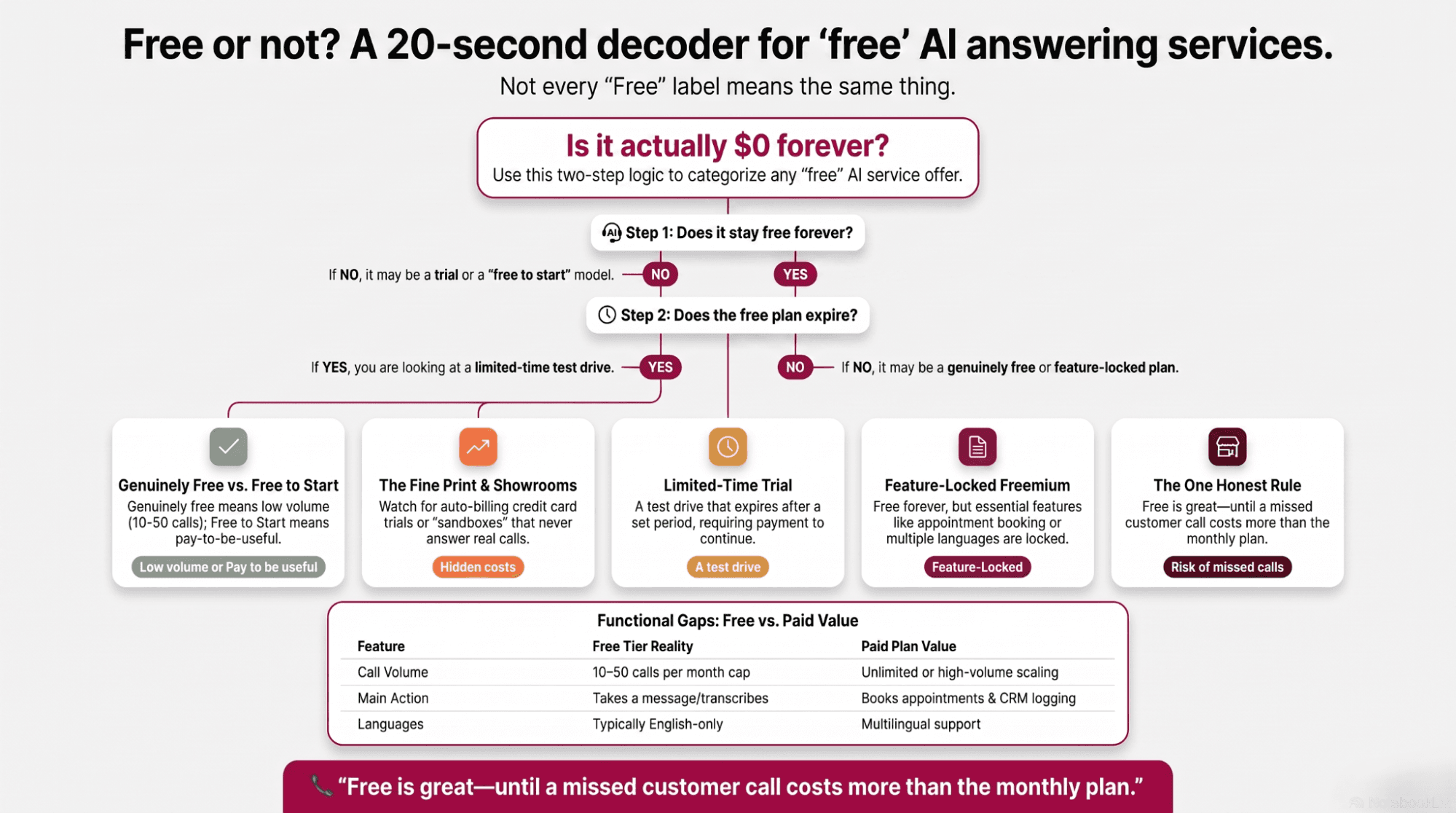
The five kinds of 'free' (and which one is actually free)
When a service says 'free,' it's almost always one of these five. Only the first is free forever — the rest are free to start.
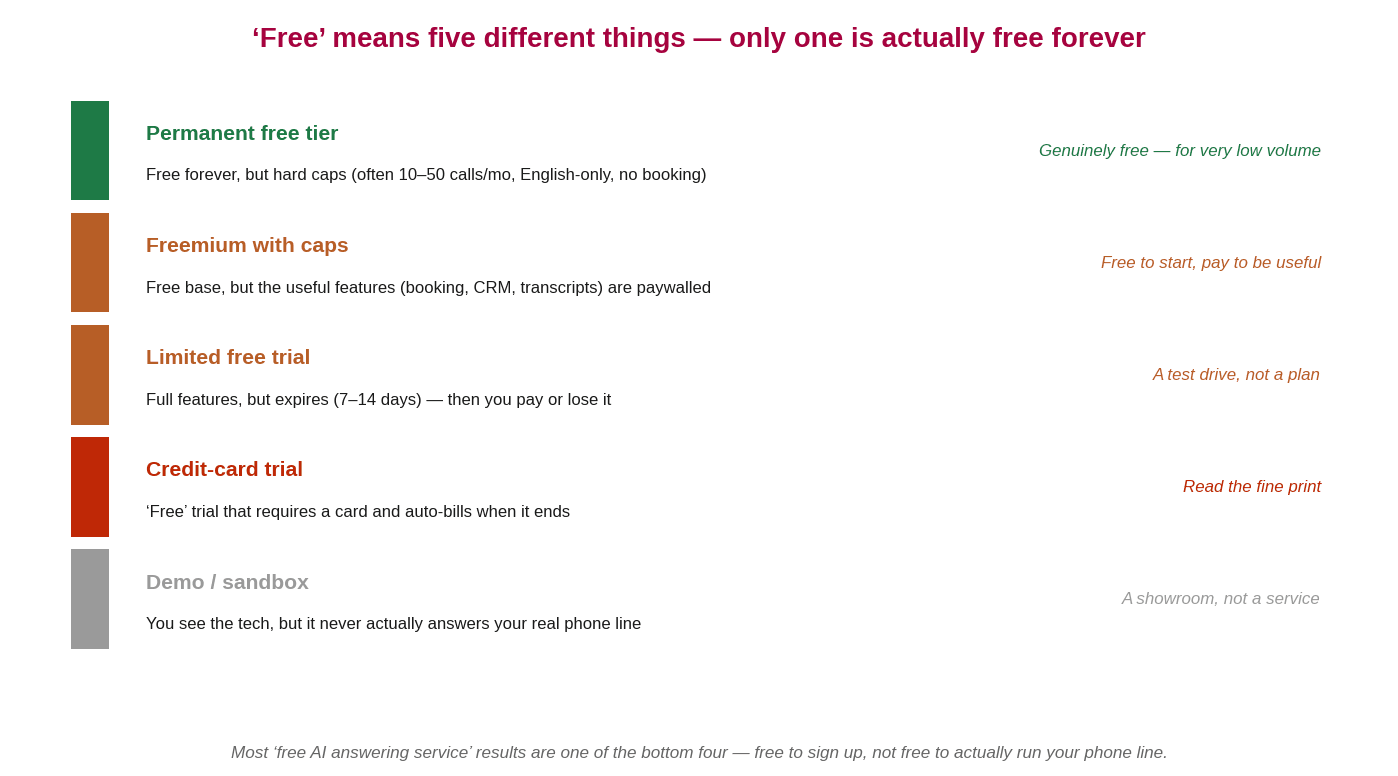
1. Permanent free tier — the only genuinely free one
This is free forever, no expiry and no card required, but it comes with hard caps. Typically that means a small number of calls per month (often somewhere between 10 and 50), English-only answering, a generic greeting, and message-taking rather than appointment booking. It's a real product, not a trick — it's just built for very low volume. For a solo operator who takes a handful of calls a month, it can be all you need.
2. Freemium with caps — free to start, pay to be useful
Here the base plan is free, but the features that actually finish the job — booking appointments, writing callers into your CRM, searchable transcripts, multilingual support — sit behind a paid tier. You can answer calls for free; you just can't do much with them until you upgrade. Perfectly legitimate, as long as you go in knowing the free plan is the on-ramp, not the destination.
3. Limited free trial — a test drive, not a plan
A full-featured trial that expires, usually after 7 to 14 days. This is the best way to genuinely evaluate a tool — you get the real thing for a short window — but it's not a way to run your phone line for free. When the trial ends, you either pay or lose access. Use the window deliberately: call after hours, try to book an appointment, test a caller who gives partial information, and read the transcript afterward.
4. Credit-card trial — read the fine print
A 'free' trial that requires a credit card up front and automatically bills you when it ends unless you cancel. There's nothing wrong with this model — many good services use it — but 'free trial' and 'no credit card' are not the same thing, and it's worth knowing which one you're signing up for. It's always worth understanding how free-trial terms and auto-renewals work before you hand over a card.
5. Demo / sandbox — a showroom, not a service
Some 'free' offers are really demonstrations: you can see the AI work in a sandbox, but it never actually connects to your real phone number and answers live calls. Useful for seeing whether the technology is any good — not useful as a working answering service. If you can't point your business number at it, it's a showroom, not a service.
What a free AI answering service actually gets you — and what breaks first
Across all the genuinely-free options, the pattern is remarkably consistent: a free tier is good at answering the phone, and not built to finish the front-desk job.
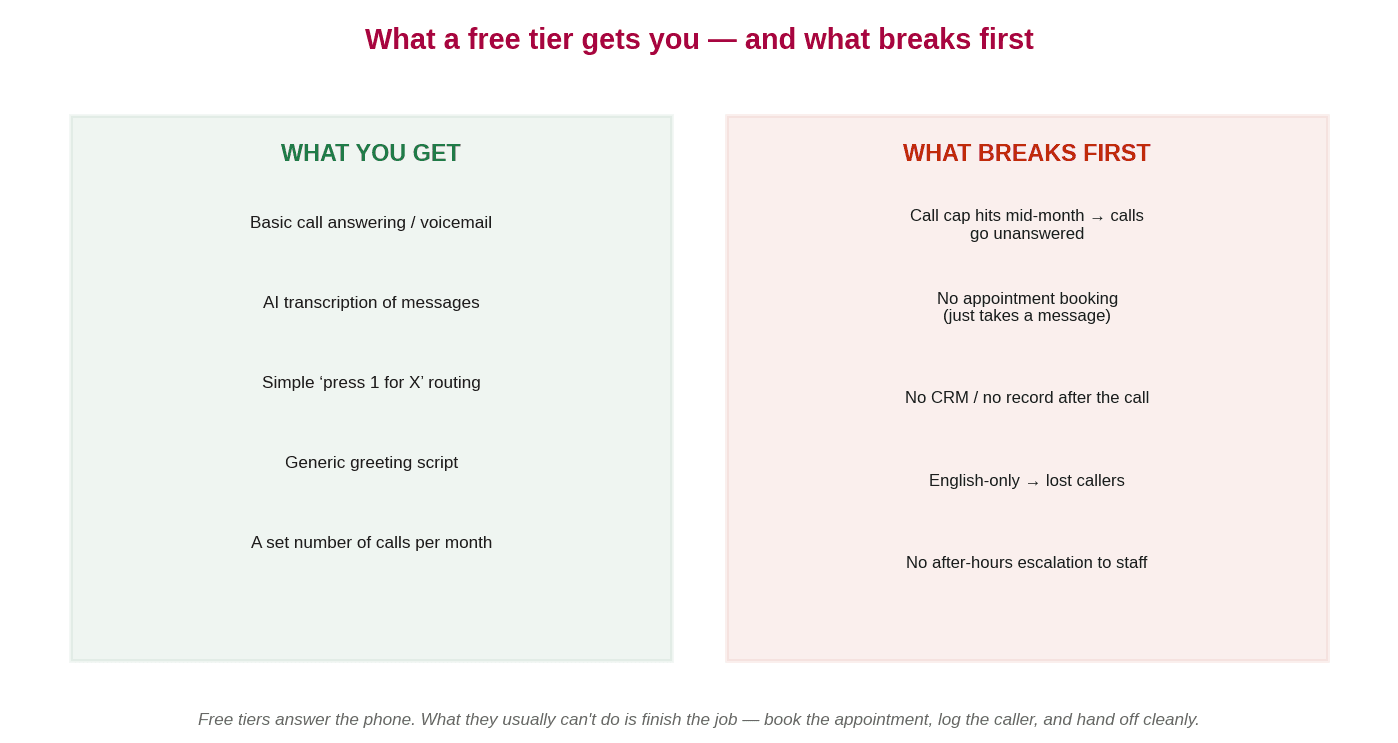
What you typically get: basic call answering, AI transcription of the message, simple menu-style routing ('press one for X'), a generic greeting, and a set number of calls per month. For light, simple call traffic, that genuinely covers the basics.
What breaks first: the call cap, usually. A busy week can exhaust a 10– to 50-call monthly limit in a couple of days, and after that, calls go unanswered or roll to voicemail — which defeats the point. Close behind are the things a free tier generally can't do: book the appointment (it takes a message instead), write the caller into a CRM so there's a record afterward, handle callers who don't speak English, or cleanly escalate an urgent call to a human. As Dialbox nicely frames it, the real question isn't 'can it answer?' — it's 'what happens after it answers?' A message in a voicemail box is not the same as a booked appointment and a logged contact.
When a free AI answering service is genuinely the right call
Let's be honest about this, because most guides won't be: sometimes free is exactly right, and paying would be a waste. A free tier is a sensible choice when all of these are true:
- Your call volume is genuinely low. You take a handful of calls a month, comfortably under the free cap.
- Most calls are simple messages. Callers are leaving information, not expecting to book an appointment on the spot.
- A missed call isn't a lost sale. If someone reaches voicemail, they'll wait for a callback, and you won't lose the business.
- You're testing the idea. You want to see whether AI answering suits your business at all before committing a budget.
The honest rule: if you're a solo operator, a very early-stage business, or an appointment-only service with light phone traffic, a permanent free tier can be a genuinely useful bridge. Start there. You can always upgrade when the phone gets busy enough to justify it — and the next section is how you'll know.
When to pay — the missed-call math
There's one calculation that settles the free-versus-paid question, and it has nothing to do with features. It's the missed-call math.
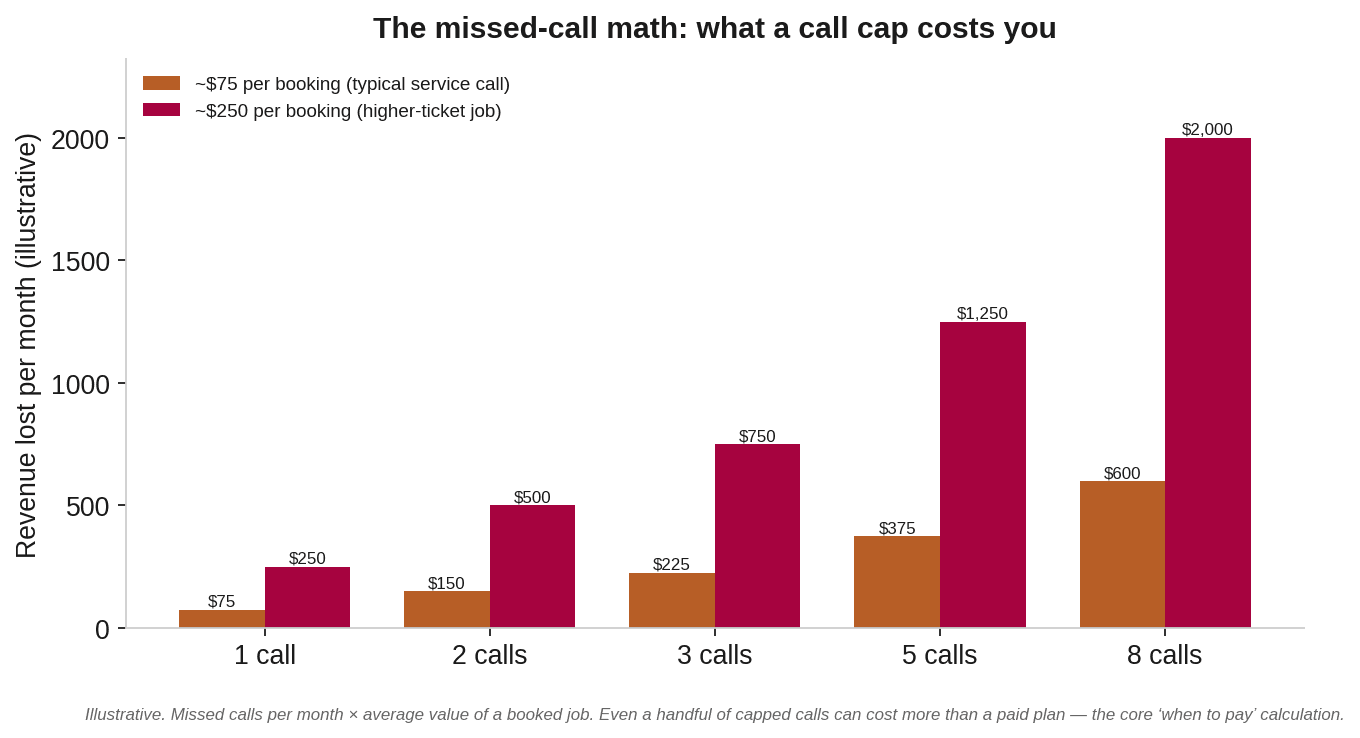
The math: estimate how many calls a month you'd miss on a free plan — either because you blow past the cap, or because it can't book or escalate the ones it does answer — and multiply by the average value of a booked job. That's your monthly cost of 'free.' If it's larger than the price of a paid plan, then 'free' is actually the more expensive option.
The tipping point tends to arrive fast for any business where calls turn into appointments, estimates, or urgent service — a clinic, a law office, a home-services company, a salon. When a single booked job is worth $75, $250, or more, it doesn't take many missed calls to outweigh a whole month of subscription. That's exactly the moment to look at what a paid solution does that a free tier can't: an AI voice agent that books, logs, and hands off, rather than one that just takes a message. If you want the full picture of paid options, our full AI phone answering service comparison breaks down the landscape.
What fair looks like when you're ready to pay
If the missed-call math says it's time, the goal isn't to spend the most — it's to pay fairly for a service that actually finishes the job. A few things to look for:
- A real trial, on honest terms. You should be able to test the actual service on your real calls before committing — and know up front whether a card is required.
- Fast, low-effort setup. You shouldn't wait weeks or need a developer. A good service gets you live quickly.
- It finishes the job. Booking, a logged record of every caller, multilingual answering, and clean escalation to a human when it matters.
- Transparent pricing. You can see what you'll pay and what you get, without a 'contact sales' wall for basic numbers.
That's the standard SuperMIA is built to — a genuine trial and a fast deploy, with SuperMIA's AI voice agent designed to book, log, and hand off rather than just take a message. You can see transparent plans and check how SuperMIA's pricing compares against how paid services like Ruby and Smith.ai compare. The honest bottom line: start free if your volume is light, and move to paid the moment a missed call costs more than a plan.
See SuperMIA handle a real call — book a 15-minute demo →
Frequently asked questions
Is there a free AI answering service?
Yes, free AI answering services are real, but the word free means five different things, and only a permanent free tier is genuinely free forever. Most free options cap you at roughly 10 to 50 calls a month, answer in English only, and take a message rather than booking the appointment or logging the caller. For a solo operator or an appointment-only business with very light call volume, that can be enough. Once missed calls start costing real revenue, a paid plan usually pays for itself.
What does a free AI answering service actually include?
Most free tiers include basic call answering, AI transcription of the message, simple menu-style routing such as press one for X, and a generic greeting, up to a set number of calls per month. What they usually do not include is the part that finishes the job: booking an appointment, writing the caller into a CRM, supporting languages other than English, and cleanly escalating urgent calls to a human. In short, a free tier answers the phone, but it rarely completes the front-desk task.
What's the catch with free AI answering services?
The most common catch is a call cap, often somewhere between 10 and 50 calls a month. A single busy week can exhaust it, after which calls go unanswered or roll to voicemail. Other catches include features you assumed were included being locked behind a paid tier, trials that quietly require a credit card and auto-bill when they end, and demo sandboxes that never actually connect to your real phone number. The tool is genuinely free to sign up for, just not always free to run your phone line with.
Is a free AI receptionist good enough for a small business?
It depends on your call volume and what a call is worth to you. If you take only a handful of calls a month, most are simple messages, and a missed call is not a lost sale, a free AI receptionist can be a sensible bridge. If you regularly take more calls than the free cap allows, if callers expect to book an appointment, or if a single missed call can cost you a high-value job, the free tier will usually cost you more in lost business than a paid plan would cost to run.
When should I pay for an AI answering service instead of using a free one?
Do the missed-call math. Estimate how many calls a month you would miss on a free plan, either because you exceed the cap or because it cannot book or escalate, and multiply by the average value of a booked job. When that number is larger than the price of a paid plan, paying is the cheaper option, not the more expensive one. In practice, the tipping point tends to arrive quickly for businesses where calls turn into appointments, estimates, or urgent service, because just one or two missed high-value calls can outweigh a whole month of subscription.

Urvil Dhanani
Urvil Dhanani is the AI/ML Lead at SuperMIA, focused on the architecture behind reliable conversational AI - agent design patterns, voice and chat orchestration, and platform evaluation. He writes practical, vendor-neutral guides that help technical teams build and choose AI systems that hold up in production.