

Table of Contents
- What is conversational AI?
- How does conversational AI work?
- Conversational AI vs generative AI vs rule-based chatbots
- The problem: conversations are bottlenecks
- Inside MIA: the technology that powers it
- Real-life use cases
- Why most conversational AI fails
- Why SuperMIA is different
- Getting started with MIA
- Frequently asked questions
- Conclusion
Quick answer. Conversational AI is technology that lets software understand human language and reply naturally across chat and voice. It works in a loop: it reads input with natural language processing, interprets intent with NLU, decides a response using context and data, and replies with NLG — then, in advanced systems like MIA, it takes action such as booking an appointment or updating a CRM.
Key takeaways
- Conversational AI combines NLP, NLU, NLG, and machine learning to hold real conversations, not scripted replies.
- It runs as a fast loop: understand, decide, respond, act — repeating each turn.
- The dividing line in 2026 is execution: basic bots answer; agents like MIA complete tasks.
- Most deployments fail on three things: context drift, robotic voice, and data that never reaches the CRM.
- MIA is a no-code platform running voice and chat agents; one dental deployment cut no-shows from 14.2% to 5.8%.
What is conversational AI?
Conversational AI is software that understands human language and responds naturally, across both chat and voice. It goes beyond keyword matching. It reads intent, holds context across a conversation, and improves over time. Think of it as the system behind a helpful MIA Chat Agent or phone agent that actually understands you — not a phone tree, and not a bot that loops the same three answers. It is the technology behind the smartest digital assistants businesses rely on today.How does conversational AI work?
It runs a fast loop. Each turn of a conversation moves through five steps, usually in well under a second: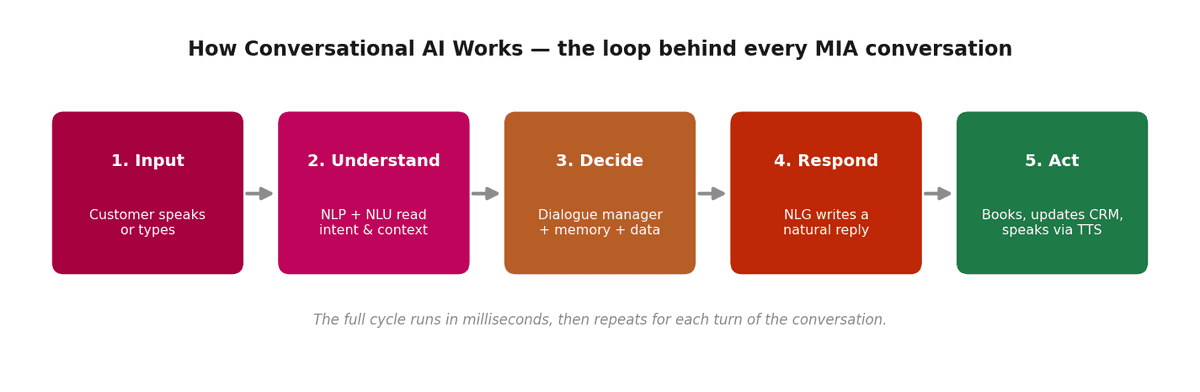
- Input. The customer speaks or types.
- Understand. NLP reads the words; NLU works out intent, context, and sentiment.
- Decide. A dialogue manager checks memory and connected data, then picks the response.
- Respond. NLG writes a natural reply in plain language.
- Act. Advanced agents take an action — book a slot, update a record, send a confirmation.
NLP & NLU: understanding what people mean
Natural language processing (NLP) turns messy human input into data the system can work with. Natural language understanding (NLU) goes a step further and reads the intent behind the words. So "I need to move my Tuesday appointment" is understood as a reschedule request, not a new booking. That single step is where most cheap bots break.Dialogue management & memory: deciding what to do
The dialogue manager is the brain. It remembers what was said earlier, looks up the customer in your CRM, applies your rules, and decides the next move. This is also where Personalized MIA tailors replies to a known customer.NLG: replying like a human
Natural language generation (NLG) writes the reply. Good NLG sounds natural and on-brand. Modern systems use large language models here, with guardrails so the agent stays accurate and on-topic.Voice: how MIA hears (ASR) and speaks (TTS)
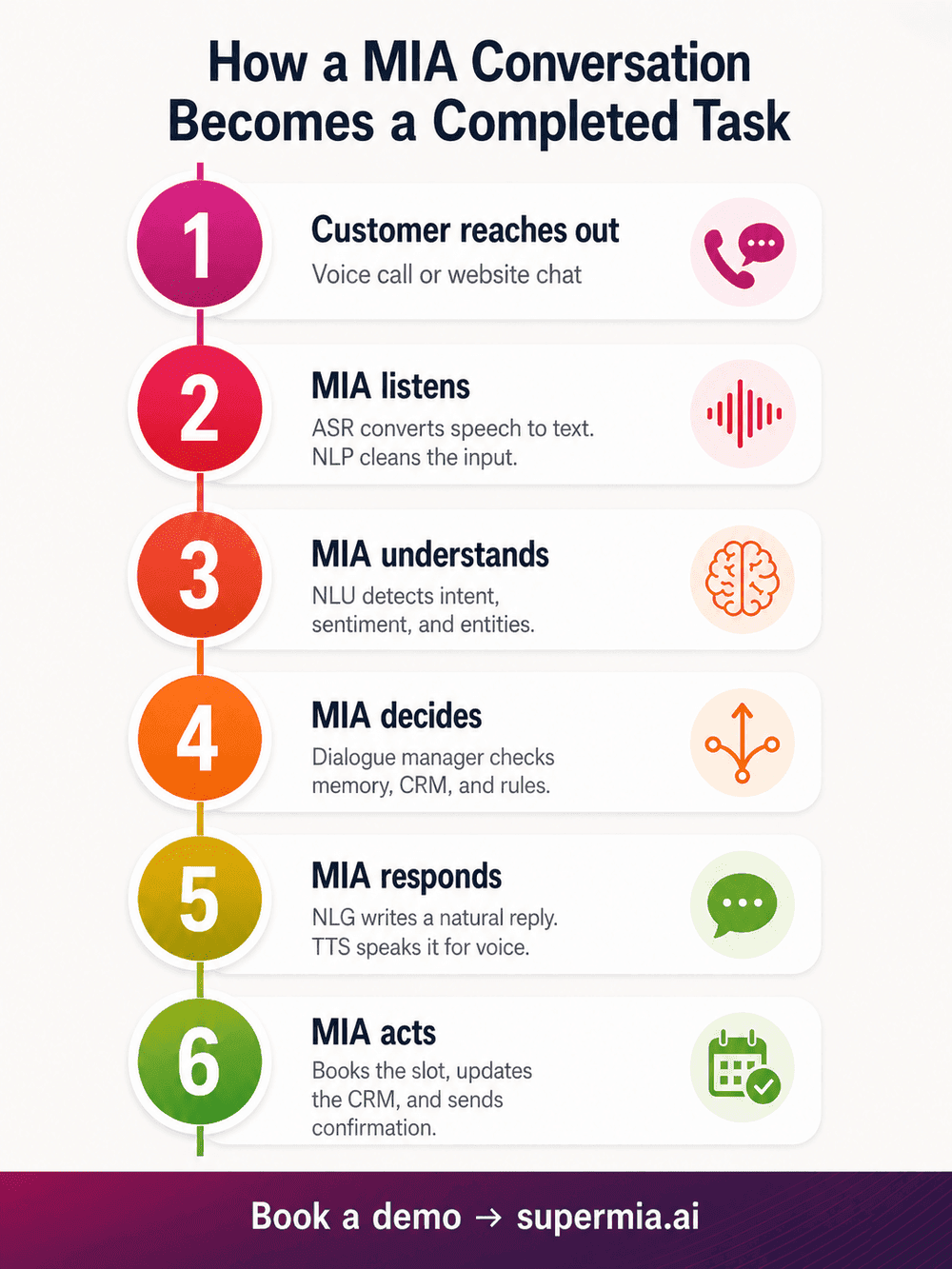
On a phone call, two more steps wrap the loop. Automatic speech recognition (ASR) turns speech into text. Text-to-speech (TTS) turns the reply back into a natural voice. The same MIA Voice Agent logic runs on calls, chat, and messaging — so answers stay consistent everywhere.The execution layer: how MIA takes action
Here is the part most guides skip. Answering is easy. Doing the work is hard. MIA agents call tools. They read from and write to CRMs, fetch data through APIs, trigger workflows, schedule appointments, process payments, and update databases. That turns a conversation into a completed task — not just a tidy reply.Conversational AI vs generative AI vs rule-based chatbots
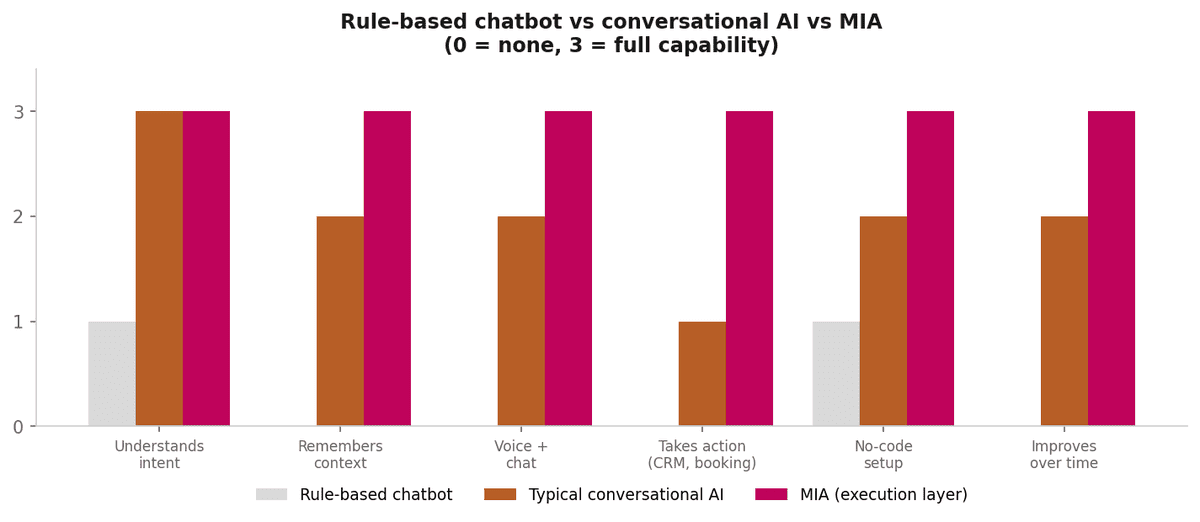
These three terms get mixed up constantly. Here is the clean version:| Rule-based chatbot | Generative AI | Conversational AI (like MIA) | |
|---|---|---|---|
| What it is | Scripted decision tree | A model that writes language | Full system that manages the whole dialogue |
| Understands intent | No | Partly | Yes |
| Remembers context | No | Limited | Yes |
| Takes action | No | No | Yes — books, updates CRM, pays |
| Best for | Simple FAQs | Drafting text | Real customer conversations end to end |
The problem: conversations are bottlenecks
Most businesses don't lack demand. They lack responsiveness. Customers wait on hold. Website visitors leave unanswered. Leads go cold. Support tickets pile up. It shows up everywhere: hotels miss booking calls at peak hours, clinics struggle with appointment follow-ups, eCommerce brands lose buyers to slow replies, and HR teams drown in resumes. The root cause is simple — human-only conversation handling doesn't scale.Inside MIA: the technology that powers it
MIA — My Intelligent Assistant — is a no-code conversational AI platform for building voice and chat agents that do work, not just talk. Four things make it run:- No-code agent builder. Founders, marketers, and ops teams build agents without writing code — define behavior, upload knowledge, set workflows.
- Voice + chat from day one. One agent works on website chat, WhatsApp, phone, and kiosks without reconfiguration.
- Pre-trained personas. A growing marketplace of 50+ role-ready agents — AI Receptionist, RM Copilot, AI Tutor, IntelliHire, and more.
- Tool integrations & workflows. CRMs, ticketing, calendars, payments, APIs, and webhooks — so MIA fits your existing stack.
Real-life use cases
Real estate. A firm handling hundreds of weekly website visitors used to reply hours later, and many visitors left first. After deploying a MIA AI agent for real-estate lead capture, the agent qualified visitors in real time, captured intent, and booked calls automatically. The team captured far more leads with no extra hiring. Healthcare / dental. Media Brite Smile Dental deployed MIA as an AI dental receptionist to handle calls, scheduling, and reminders. The results below show what the execution layer does in practice.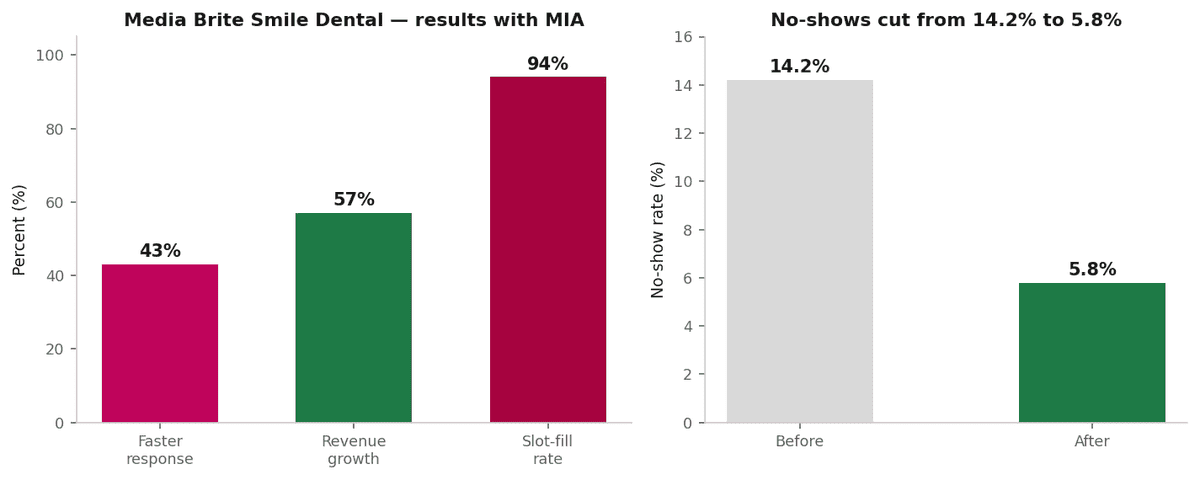
Why most conversational AI fails (and how MIA avoids it)
Teams that try conversational AI and give up usually hit the same three walls. None of them are about the language model.- Context drift. The bot forgets what was said a minute ago and asks again. Fix: strong dialogue management with real memory.
- Robotic voice. Stiff, scripted speech that customers hang up on. Fix: natural TTS and conversational design.
- Data that never lands. Names, emails, and phone numbers don't make it into the CRM, so bookings break. Fix: the execution layer that writes verified data straight to your systems.
Why SuperMIA is different
Most conversational AI platforms stop at responses. MIA is designed for execution. Key differences:- Voice + chat support from day one
- True no-code customization for non-technical teams
- A growing marketplace of 50+ AI personas
- Tool libraries for CRM, calendars, payments, and workflows
- Centralized logs, insights, and conversation analytics
Getting started with MIA
Launching your first agent doesn't take months. The process: sign up, pick a persona, train it on your data, deploy on web, WhatsApp, or voice, then monitor logs and insights. Most teams go live in days, not weeks. See MIA pricing to find the right plan.See MIA handle a live conversation for your use case
Book a 20-minute demo — see the 5-step loop and the execution layer in action on your workflow.
Book a Demo →Frequently asked questions
What is conversational AI in simple terms?
Conversational AI is software that understands human language and replies naturally across chat and voice. Instead of following a fixed script, it interprets intent and context, so it can hold a back-and-forth conversation and improve over time.
How does conversational AI actually work?
It runs a fast loop: natural language processing reads the input, natural language understanding figures out intent and context, a dialogue manager decides the response using memory and connected data, and natural language generation writes a natural reply. Advanced agents then take an action, such as booking or updating a CRM.
What is the difference between conversational AI and generative AI?
Conversational AI is the broader system that manages a dialogue end to end - understanding, deciding, responding, and acting. Generative AI, usually a large language model, is one component that produces the language. Most modern conversational AI uses generative AI inside it, but adds intent handling, memory, guardrails, and integrations.
Is conversational AI the same as a chatbot?
No. A rule-based chatbot follows decision trees and scripted answers. Conversational AI understands free-form language, remembers context, and can complete tasks. Every conversational AI can act like a chatbot, but most chatbots are not conversational AI.
Why do so many AI chatbots fail or feel robotic?
Common causes are context drift (the bot forgets what was said), poor voice quality, and broken data capture where details never reach the CRM. These come from weak dialogue management and shallow integrations, not from the language model alone.
Does conversational AI work over the phone as well as chat?
Yes. For voice, automatic speech recognition turns speech into text and text-to-speech turns the reply back into natural speech. MIA runs the same agent across phone calls, website chat, and messaging so answers stay consistent.
Do I need to code to build a conversational AI agent with MIA?
No. MIA is a no-code platform. You pick a pre-trained persona, add your knowledge and rules, connect your tools, and deploy on web, voice, or messaging - usually in days, without developers.
What results can a business expect from conversational AI?
Results vary by use case. In one dental deployment, MIA helped cut no-shows from 14.2% to 5.8%, sped up response times by 43%, and supported 57% revenue growth. Gains typically come from faster responses, 24/7 availability, and fewer dropped leads.
Conclusion
Conversational AI works by understanding language, deciding with context, replying naturally, and — in the systems that matter — taking action. That last step is what separates a demo from a result. MIA is built for that last step: no-code, voice and chat, and an execution layer that turns conversations into booked appointments, captured leads, and updated records.
Harikrishna Patel
Harikrishna Patel is the founder of MIA – My Intelligent Assistant, the AI automation platform built under Botfinity Inc. in Dallas, Texas. With 15+ years in software engineering, AI/ML, and enterprise solution design, he focuses on creating practical, scalable AI tools that help businesses automate support, workflows, and operations through voice and chat.