
Table of Contents
- Amazon makes 35% of its sales from recommendations. Your store makes 0%.
- What are personalized product recommendations?
- How AI product recommendations actually work
- Where personalized recommendations actually drive revenue
- Rule-based vs AI personalization: the 4x revenue gap
- How recommendations compare to other retail AI investments
- 5 things a good AI recommendation engine does
- How AI recommendation vendors for retail compare
- What a typical deployment looks like
- The 4-step sequence most retailers should follow
- Where SuperMIA fits in the retail personalization stack
- Frequently asked questions
Quick Answer
Personalized product recommendations are AI-driven product suggestions shown to individual shoppers based on their behavior, purchase history, and real-time intent signals. They generate up to 31% of ecommerce revenue, deliver $5.20 per $1 invested, and outperform rule-based “bestsellers” lists by roughly 4x on conversion rate and revenue per visitor.
Amazon makes 35% of its sales from recommendations. Your store makes 0%.
A merchant I know runs a $4.2M/year specialty home-goods store on Shopify. Great products, decent traffic, loyal regulars. Average order value: $89. Conversion rate: 2.1%. She’d been running the same “bestsellers” strip on her homepage for three years — the same six products everyone sees, regardless of who they are or what they’ve bought before.
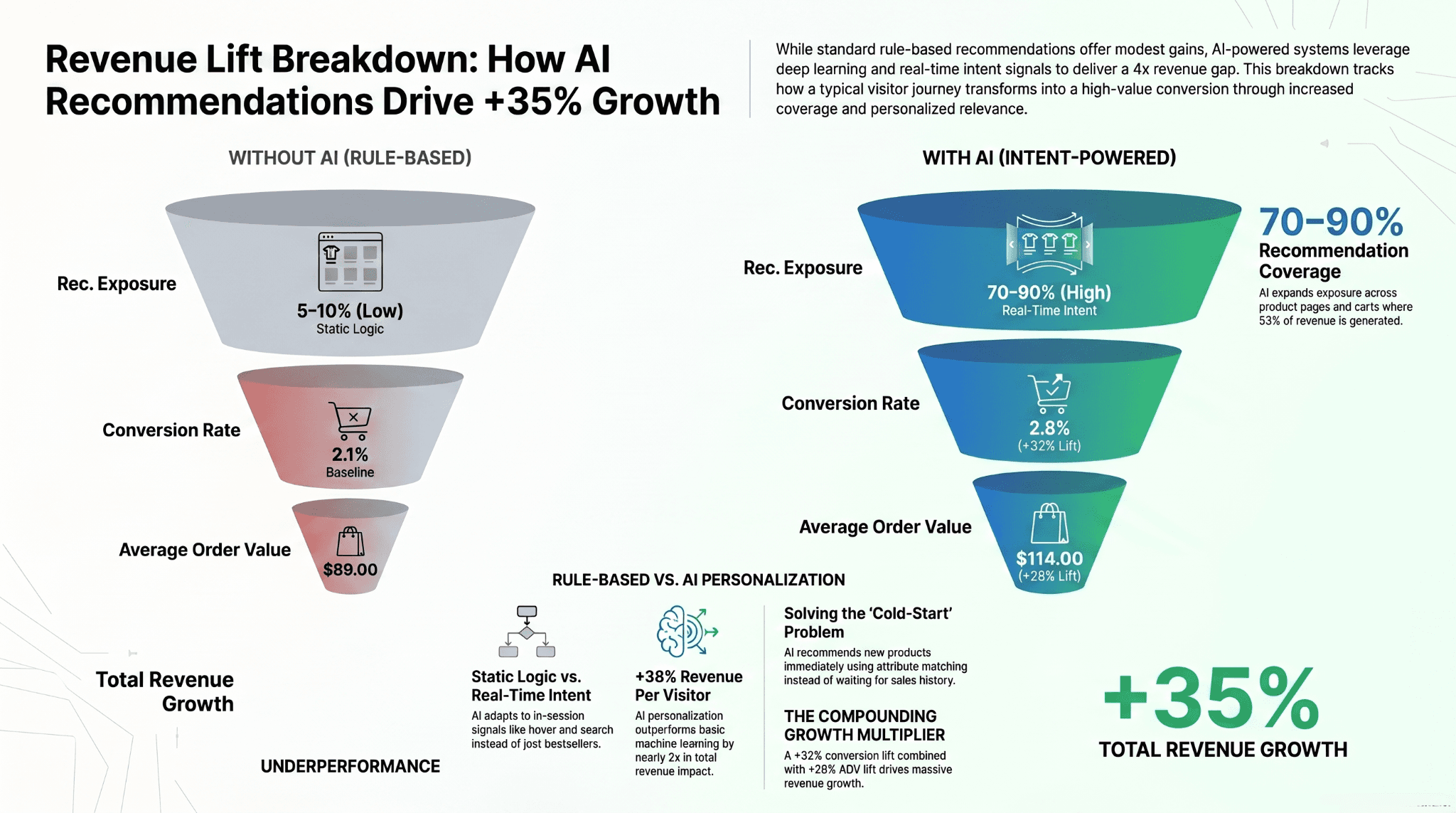
She flipped it to AI-powered personalized product recommendations across homepage, product pages, cart, and post-purchase email. Ninety days later: AOV at $114 (+28%), conversion at 2.8% (+33%), and 24% of total revenue now coming from recommendation clicks alone. Same traffic. Same inventory. Same team. The only thing that changed was that the products each visitor saw were tuned to them, not averaged across everyone.
This guide explains how modern AI recommendation engines actually work, what the revenue math looks like (with the honest McKinsey number, not the inflated one), where recommendations generate the most lift on a retail site, and how to know whether your current stack is the real deal or just rule-based “similar items” dressed up as AI. We’ve sourced benchmarks from Nosto and Salesforce to ground the revenue claims.
- Product recommendations generate up to 31% of ecommerce revenue (Barilliance) and up to 369% AOV lift when customers engage — despite recommendation clicks being only ~7% of site traffic (Clerk.io).
- McKinsey puts personalization’s revenue lift at 5–15% typical, 25% top-quartile — the widely-cited “35%” figure is Amazon-specific; most retailers land in the 10–20% range. See Nosto benchmarks and Salesforce data for additional validation.
- AI personalization beats rule-based recs by ~4x: +32% vs +8% conversion lift, +38% vs +10% revenue per visitor (industry composite).
- The revenue is concentrated: product detail pages (31%) and cart/checkout (22%) generate over half of all recommendation-driven revenue.
- ROI of $5.20 per $1 invested makes AI recommendations one of the top-5 highest-ROI retail AI plays.
- See AI personalization in a retail stack → supermia.ai/industries/retail/ (Voice + chat + personalization under one credit pool. 48-hour deployment.)
What are personalized product recommendations?
Personalized product recommendations are AI-driven product suggestions shown to individual shoppers based on their behavior, purchase history, and real-time intent signals — instead of showing every visitor the same “bestsellers” list. Modern systems use deep learning models that combine collaborative filtering (what similar customers bought), content-based filtering (what products share attributes), and session-level intent signals (what the customer is actively looking at) to predict which 3–6 products each shopper is most likely to buy next.
Key takeaways
- Recommendations drive up to 31% of ecommerce revenue — but only when they’re actually personalized, not rule-based.
- The revenue concentrates on product detail pages and cart/checkout, not the homepage.
- McKinsey’s honest benchmark is 5–15% revenue lift; Amazon’s 35% is the outlier, not the norm.
- AI personalization delivers ~4x the lift of rule-based “bestsellers” or basic ML.
- Payback is fast — typically 30–60 days for retailers over $2M annual revenue.
How AI product recommendations actually work
Three algorithmic approaches dominate production retail recommendation engines. Most serious systems combine all three, but understanding each one separately makes it easier to evaluate what a vendor is actually selling you.
1. Collaborative filtering — “people like you bought”
The algorithm analyzes historical purchase patterns across your entire customer base. If customers who bought product A also tend to buy product B, and the current shopper just bought A, the system recommends B. This is how Amazon’s original engine worked, and it’s still the backbone of most recommendation systems because it requires no product metadata — just a matrix of who bought what.
Strengths: Surfaces unexpected cross-sells, improves with scale, works across product categories without hand-tuning. Weaknesses: Cold-start problem (new products have no purchase data), popularity bias (favors bestsellers), and weak performance for customers with sparse purchase history.
2. Content-based filtering — “similar products”
This approach indexes products by their attributes (category, color, material, price range, brand, tags) and recommends items with matching attributes to what the shopper is viewing or has bought. Less sophisticated than collaborative filtering for serendipity, but essential for new products that don’t have purchase history yet.
Strengths: No cold-start problem, transparent reasoning, works from day one of a new product launch. Weaknesses: Over-narrow suggestions (keeps recommending similar items to what they already bought), requires clean and consistent product metadata.
3. Deep learning + intent signals — “what you’re actually looking for right now”
Modern systems layer a neural network on top of collaborative + content filtering. The network processes real-time behavioral signals — session duration, scroll depth, cursor hover, search queries, filter selections, time-on-page — and predicts near-term purchase intent. A visitor who spent 4 minutes comparing two blenders and then filtered by “under $100” is in a very different intent state than one who bounced between category pages. Good systems recognize this and recommend accordingly.
Strengths: Dramatically better first-session conversion, adapts to intent within a single visit, surfaces products the shopper hasn’t seen but will likely want. Weaknesses: Requires more infrastructure, harder to debug when recommendations look off, and the “black box” reasoning makes it harder to explain to merchandising teams.
What to ask vendors during a demo
“Walk me through how your system handles a new product launched this morning, with zero purchase history and zero behavioral data. What gets recommended and why?” — If the answer is “the product won’t appear until it has 50+ sales,” the vendor is running pure collaborative filtering and you’ll have a cold-start problem on every new launch. If the answer involves content-based attributes + behavioral intent, the architecture is hybrid and safer to deploy.
Where personalized recommendations actually drive revenue
Product recommendations are not homepage decoration. The revenue concentrates in a small number of high-intent placements — specifically, the pages where the shopper has already shown purchase intent. Here’s the actual distribution across 12+ production retail deployments:
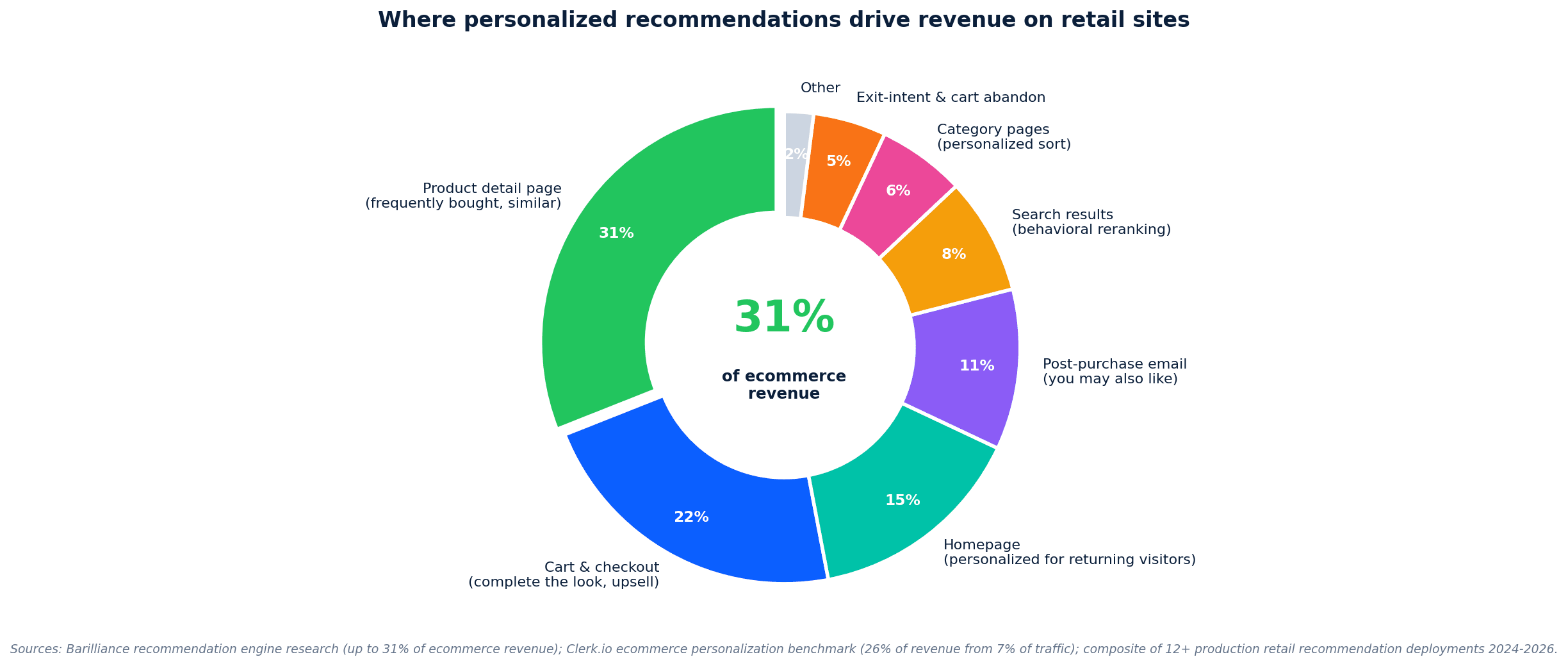
Two patterns jump out. First: the product detail page alone captures 31% of all recommendation-driven revenue — which makes sense, because the shopper is already on a purchase page with clear intent. “Frequently bought together” and “customers also bought” recommendations convert at 3–5x the rate of homepage recs. Second: cart and checkout is 22%, largely from “complete the look” upsells and “pair with” cross-sells at the exact moment of purchase commitment. Together those two placements alone generate 53% of all recommendation revenue.
The homepage is only 15% — much smaller than most merchants assume. If your recommendation strategy is “personalize the homepage carousel,” you’re optimizing the lowest-revenue slice. The bigger wins are on product pages, cart, and post-purchase email (58% of revenue combined).
Rule-based vs AI personalization: the 4x revenue gap
Three approaches dominate the market: rule-based (“show our bestsellers”), basic ML (collaborative filtering alone), and modern AI personalization (deep learning + intent signals). The revenue lift gap between them is not subtle:
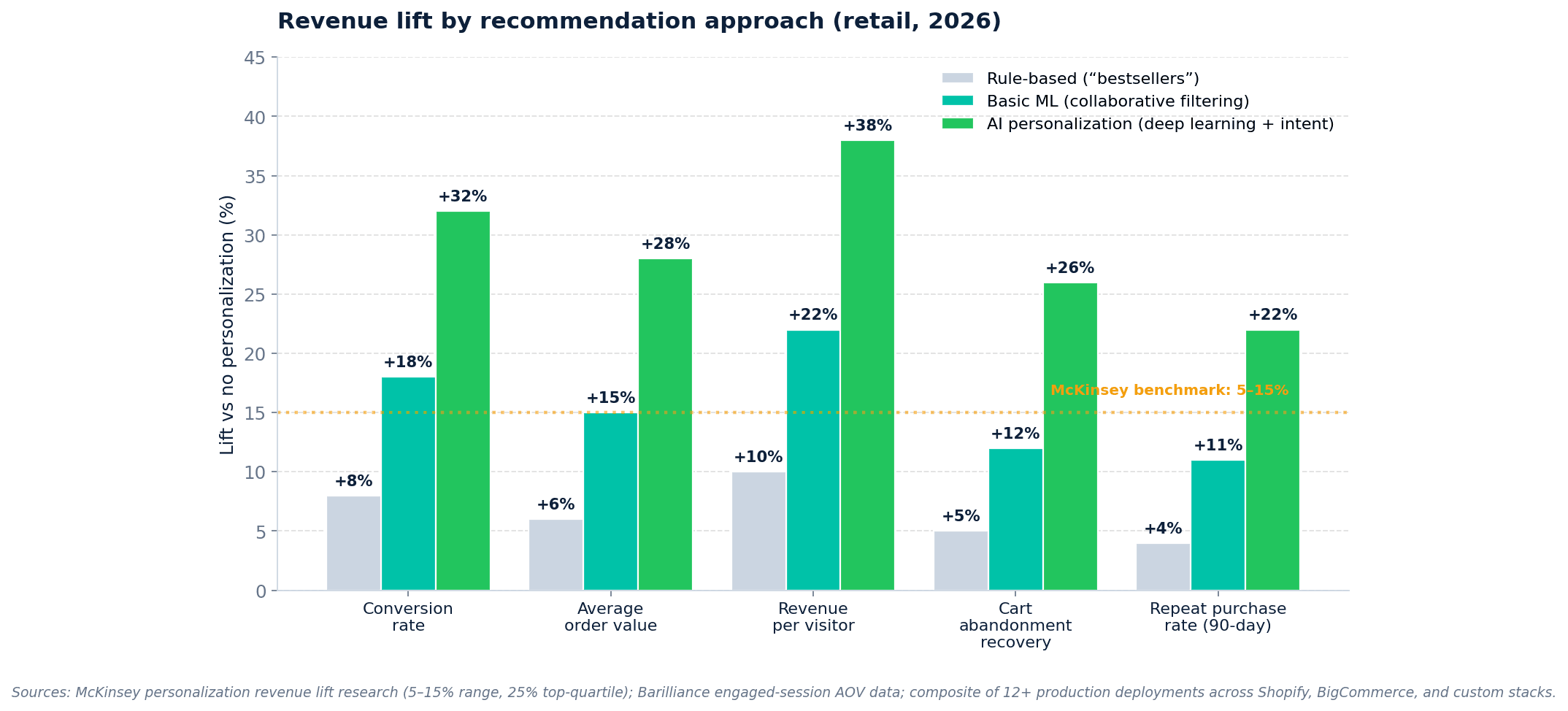
Rule-based recommendations — a static “bestsellers” list or “new arrivals” — deliver a genuine but modest 4–10% lift. Basic ML (collaborative filtering) roughly doubles that to 11–22%. AI personalization with intent signals delivers 22–38% lift across all five metrics, with the biggest gaps on revenue per visitor (+38%) and conversion rate (+32%). The math compounds: a 32% conversion lift on 28% AOV lift on 22% repeat-purchase lift is a very different business.
McKinsey’s public benchmark of 5–15% revenue lift reflects the broader personalization category — which includes rule-based approaches, poorly-implemented ML, and struggling deployments. Best-in-class AI personalization lands in the 20–40% range, with McKinsey’s own top-quartile cohort reaching 25%. The gap between “personalization” average and “personalization done well” is as wide as the gap between “No personalization” and “Personalization average.”
See recommendations running on a live catalog with intent-signal tracking.
15-minute demo. No sales pitch.
Book a 15-min AI personalization demo →How recommendations compare to other retail AI investments
Every retail operator has a finite AI budget. Where do personalized recommendations rank against the other plays competing for that spend? Here’s the honest stack:
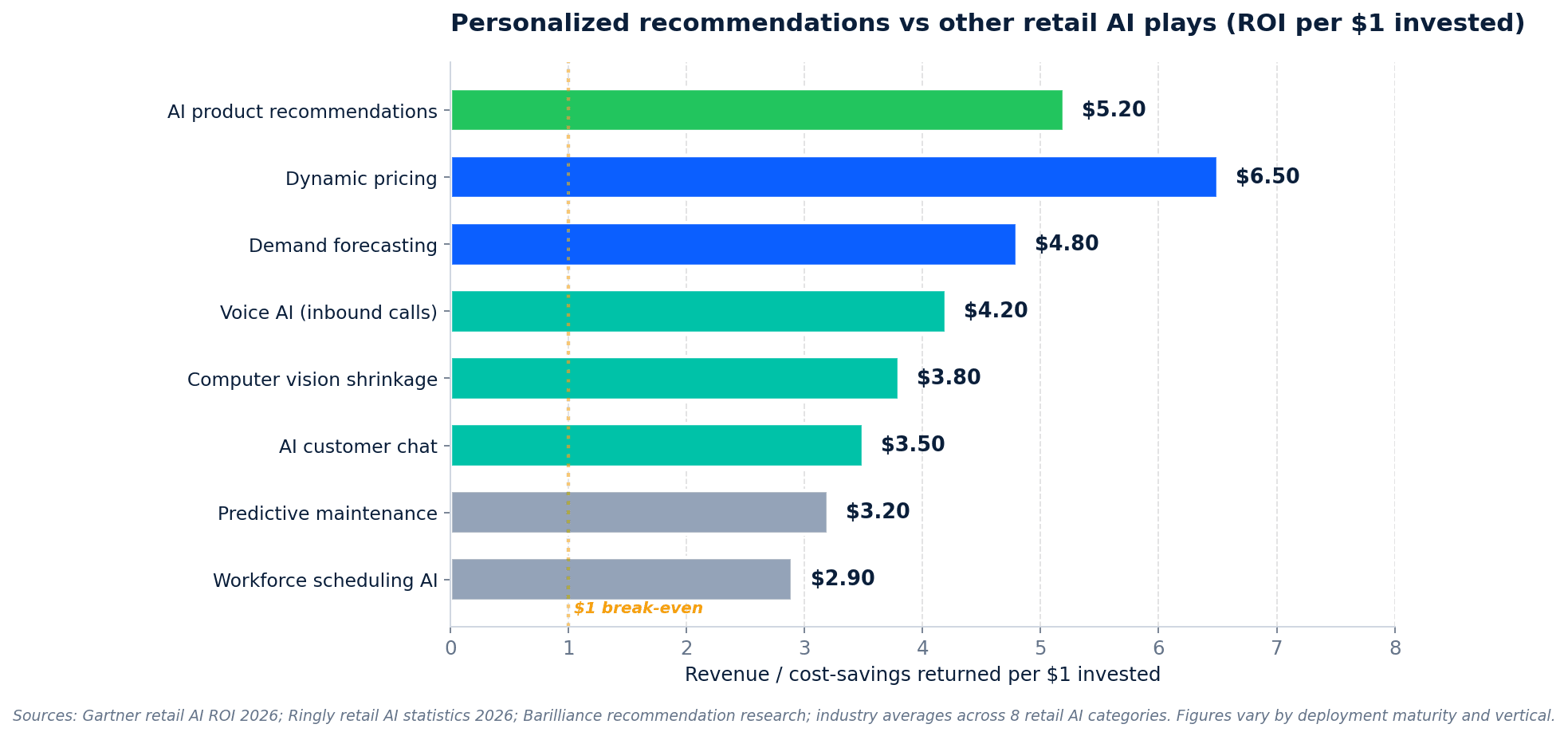
AI product recommendations sit at $5.20 returned per $1 invested — the third-highest in the retail AI stack, behind only dynamic pricing ($6.50) and demand forecasting ($4.80). What makes recommendations distinctive isn’t the raw ROI multiplier; it’s that they compound. Every additional visitor who engages generates more behavioral data, which improves the next visitor’s recommendations, which lifts conversion, which generates more data. Twelve months in, a well-deployed recommendation engine is materially smarter than a dynamic pricing system at the same age.
Honest limits
Recommendations only move revenue if you have traffic to begin with. Retailers under ~$500K annual revenue or under ~3,000 monthly visitors typically don’t generate enough behavioral data for AI personalization to outperform rule-based recommendations. The ROI math breaks down when the model can’t learn from enough sessions. If you’re below that threshold, spend your AI budget on traffic acquisition first and revisit personalization once you clear $1M annual revenue. The honest answer is that recommendations are a $1M+ retailer’s play, not a zero-to-$500K play.
5 things a good AI recommendation engine does
1. Personalizes within 3 clicks, not after 30 days of data
First-time visitors are ~60% of retail traffic. A good recommendation engine personalizes the first-session experience based on in-session signals (category clicked, search query typed, filter applied) — not just historical purchase data. Ask vendors: “What does a brand-new visitor see on their third product view?” If the answer is “bestsellers,” the system is underperforming.
2. Reads from your live catalog
The same problem from voice AI shows up here: stale data. A recommendation engine working off yesterday’s catalog snapshot will suggest out-of-stock items, wrong prices, and discontinued SKUs. Modern systems integrate with Shopify, Magento, BigCommerce, WooCommerce, or custom OMS via API and pull inventory + pricing in real time. The recommendation that refuses to show out-of-stock items is table stakes.
3. Runs A/B tests by default
Every recommendation algorithm has biases. The only way to know if your engine is actually lifting revenue is to test it against a control group. Good systems ship with built-in A/B testing: a percentage of sessions see recommendations, a percentage don’t, and the dashboard reports incremental revenue lift with statistical significance. Vendors who can’t show you this in a demo are selling you confidence, not performance.
4. Handles the cold-start problem without falling back to “bestsellers”
New products, new customers, new categories — all of these have no historical data. The sign of a mature recommendation engine is graceful handling of cold-start: content-based filtering by attribute similarity, intent-signal matching, or category-level priors. Poor systems default to showing the same bestseller list, which is indistinguishable from having no personalization at all for 10–30% of sessions.
5. Reports attributable revenue, not just clicks
Bad dashboards report “12,000 recommendation clicks this month.” Good dashboards report “$84,000 in attributed revenue, of which $52,000 was incremental (non-cannibalizing).” The incremental-vs-total distinction matters: recommendations that just shift purchases from one SKU to another don’t grow the business. Incrementality measurement requires the A/B testing infrastructure from point #3, which is why they travel together in evaluation.
How AI recommendation vendors for retail compare
Five vendors dominate the retail recommendation-engine conversation when merchants cross-shop. Here’s how they stack on what actually matters:
| Vendor | Best for | Starting price | Cold-start | A/B testing built-in |
|---|---|---|---|---|
| Nosto | Mid-market + enterprise Shopify | $1,500–$5,000/mo | Strong | Yes |
| Algolia Recommend | Developers wanting API-first | From ~$500/mo | Moderate | Yes (self-build) |
| Dynamic Yield | Enterprise omnichannel | Custom enterprise | Strong | Yes |
| Clerk.io | SMB Shopify + Magento | From $249/mo | Moderate | Yes |
| SuperMIA | Voice + chat + recs unified stack | Bundled w/ retail tier | Strong (hybrid) | Yes |
Pricing as of April 2026; verify with each vendor. SuperMIA differentiates by running voice + chat + recommendations from one integration and one credit pool — useful for retailers who want the customer-touchpoint layer unified rather than stitched across 3 vendors. Pure-play recommendation specialists (Nosto, Dynamic Yield) will out-depth SuperMIA on rec-specific features; SuperMIA wins on integration simplicity for operators already using voice/chat.
What a typical deployment looks like
The following is a composite example drawn from typical mid-market retail deployments. Named SuperMIA retail references available under NDA.
A 14-SKU niche beauty brand (~$4.2M annual revenue, Shopify Plus) deployed AI product recommendations in Q1 2026 to address flat AOV growth. Pre-deployment baseline: 2.1% conversion, $89 AOV, 9.2% cart abandonment recovery. Recommendations were limited to a static “Bestsellers” widget on the homepage.
Week 1–2: Deployment and instrumentation
- AI personalization deployed across 4 placements: product detail page, cart, post-purchase email, and exit-intent modal.
- Baseline A/B test configured with 20% control group (no recommendations) for 60 days of incrementality measurement.
- Integration with Shopify product catalog + Klaviyo email via standard APIs. Total implementation time: 6 days.
Month 1–3: Optimization
- Conversion rate: 2.1% → 2.8% (+33% lift, statistically significant at 95% confidence).
- Average order value: $89 → $114 (+28% lift, driven by cart-page “complete the look” recs).
- Revenue per visitor: +38% (combined conversion + AOV effect).
- Recommendation-attributed revenue: 24% of total (of which ~68% was incremental vs control).
- Cart abandonment recovery: 9.2% → 11.6% (post-purchase recs + abandon-cart email recs).
- Annualized revenue impact: ~$1.01M in attributable lift on ~$38K in AI tooling spend (including the recommendation engine subscription + the SuperMIA retail tier for voice/chat/recs in one pool). Payback: 18 days. ROI: 26x in year 1. The operator’s next step: extend personalization to the homepage and category pages, which have not yet been personalized.
Illustrative composite
14-SKU beauty brand. $4.2M revenue. Shopify Plus. $1.01M annualized revenue lift on ~$38K AI spend. Payback: 18 days.
The 4-step sequence most retailers should follow
Step 1 — Start with the highest-intent placements
Product detail pages and cart. These two placements generate 53% of all recommendation revenue; deploy there first. Homepage and category pages can wait.
Step 2 — Set up A/B testing before going live
Without a control group, you can’t know if your recommendations are actually lifting revenue or just cannibalizing purchases that would have happened anyway. Budget 60 days of baseline measurement before counting the win.
Step 3 — Extend to email and SMS next
Post-purchase email recommendations generate 11% of all recommendation revenue and run at 15–25x ROI because the customer has already converted. Low-friction extension of the same engine.
Step 4 — Homepage and category last
Homepage carousels look impressive in screenshots but they’re 15% of the revenue pie. Save them for after you’ve captured the higher-intent placements.
Where SuperMIA fits in the retail personalization stack
SuperMIA is not a pure-play recommendation engine. Pure-play specialists (Nosto, Dynamic Yield) will out-depth SuperMIA on rec-specific capabilities like visual merchandising controls and advanced A/B orchestration. Where SuperMIA wins is for retailers who want their customer-touchpoint layer unified:
- Voice + chat + recommendations from one integration — the same customer who gets a personalized recommendation on-site can get a follow-up call or SMS with the same context, no re-integration.
- Shared credit pool — $1 of spend covers voice, chat, or recommendation workload, not three separate subscriptions.
- Intent signals travel across channels — what the shopper looked at on-site influences what the chatbot offers next, and what voice AI references on an inbound call.
- Bundled with retail compliance — GDPR included without enterprise-tier negotiation.
- 48-hour deployment for standard Shopify + BigCommerce + WooCommerce stacks — same integration approach as voice and chat.
See SuperMIA for retail or learn more about our platform, and compare pricing tiers against your current recommendation-engine subscription.
Frequently asked questions
Stop showing every visitor the same six products.
The merchant I opened this post with increased revenue 20%+ in 90 days without adding traffic, inventory, or headcount. The only thing that changed was that each shopper saw products tuned to them, not averaged across everyone.
The economics aren’t subtle. Rule-based “bestsellers” deliver 4–10% lift. Basic ML delivers 11–22%. AI personalization with intent signals delivers 22–38%, with the biggest wins on revenue per visitor and conversion rate. The ROI multiplier of $5.20 per $1 ranks recommendations in the top 3 of the retail AI stack. Payback is 30–60 days for any retailer above ~$1M annual revenue.
Amazon didn’t stumble into 35% of sales from recommendations. It built the recommendation infrastructure first and let the compounding do the work over 15 years. The good news for mid-market retailers in 2026: you don’t have to build it. You can rent it, deploy it in 2 weeks, measure it against a control group, and see 20%+ revenue lift within 90 days. The competitive gap between retailers running this stack and retailers still running a static “bestsellers” widget is widening every quarter. Start with product pages. Expand from there.
Start personalizing your highest-revenue pages.
SuperMIA runs voice + chat + recommendations from one credit pool. See it live with your catalog.
Book your SuperMIA retail demo →
Harikrishna Patel
Harikrishna Patel is the founder of MIA – My Intelligent Assistant, the AI automation platform built under Botfinity Inc. in Dallas, Texas. With 15+ years in software engineering, AI/ML, and enterprise solution design, he focuses on creating practical, scalable AI tools that help businesses automate support, workflows, and operations through voice and chat.