
Table of Contents
An answering service captures and routes your calls; a call center resolves them at volume with live agents. An AI answering service does the capture-and-book job in software, 24/7. On cost, AI runs about $0.10–$0.50 per call versus $2–$4 for a human service and $3–$8 for a call center. AI wins for routine, high-volume calls; a call center still wins when calls need real resolution or empathy.
See what an AI answering service costs on your volume →
Key takeaways
- An answering service captures and routes; a call center resolves at volume — AI does the capture job for a fraction of either.
- Cost per call: ~$0.10–$0.50 (AI) vs $2–$4 (human service) vs $3–$8 (call center) — the gap compounds at volume.
- Run the formula on your own volume — the cheapest model flips as calls scale from 200 to 3,000 a month.
- The cheapest model is worthless if it drops calls — weigh the missed-call cost, not just the sticker price.
- A call center still wins for genuine resolution, distress, or high-value calls — AI wins the routine 80%.
Answering service vs call center: what's the actual difference?
Most cost comparisons skip this, and it's the whole decision. These are not the same thing:
- An answering service captures and routes. It answers your phone, takes a message or books an appointment, and passes the caller on. It's about coverage — never missing a call.
- A call center resolves at volume. A team of live agents handles support, sales, or service end to end. It's about throughput and resolution — solving the problem on the call.
- An AI answering service does the capture-and-book job in software — 24/7, every line at once, at a fraction of either human model.
So "AI answering service vs call center" is really two questions: do your calls need to be captured, or resolved? For the capture job, see what an AI answering service does. This guide is about the cost of each choice.
The three models, side by side
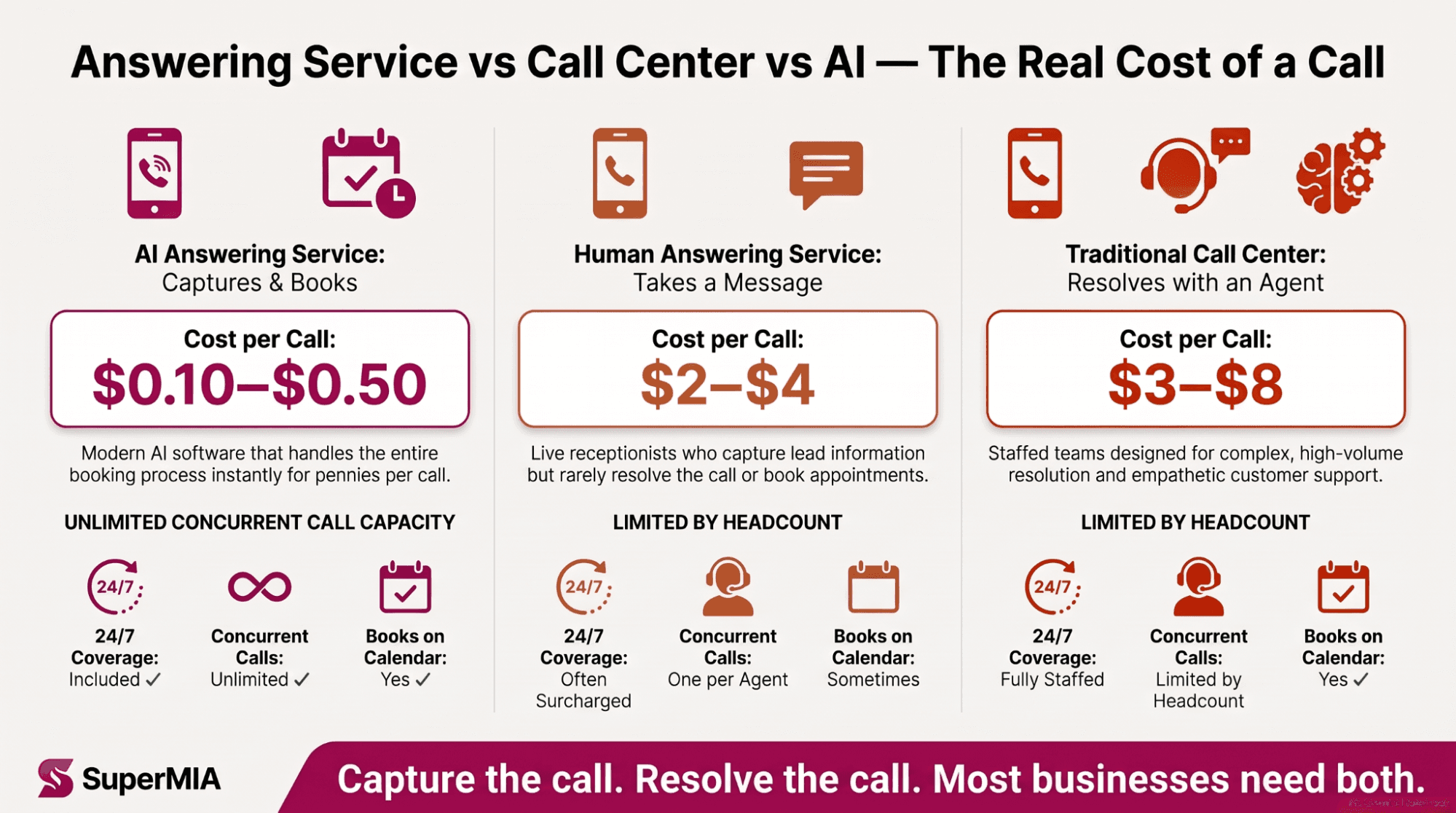
| Factor | AI answering service | Human answering service | Traditional call center |
|---|---|---|---|
| Core job | Capture + book (software) | Capture + message | Resolve at volume |
| Cost per call | $0.10–$0.50 | $2–$4 | $3–$8 |
| 24/7 coverage | Yes, included | Yes, often surcharged | Yes, staffed |
| Concurrent calls | Unlimited | One per agent | Limited by headcount |
| Books / updates CRM | Yes, natively | Sometimes | Yes |
| Best at | Routine, high volume | Simple message-taking | Complex resolution |
The asymmetry that matters: the AI service and the human service both cost far less than a call center, but only the AI service reliably ends the call with something booked on your calendar.
The cost breakdown: per call, per month, at your volume
Per call is where the gap is clearest. An AI answering service handles a call for cents; a live model costs dollars.
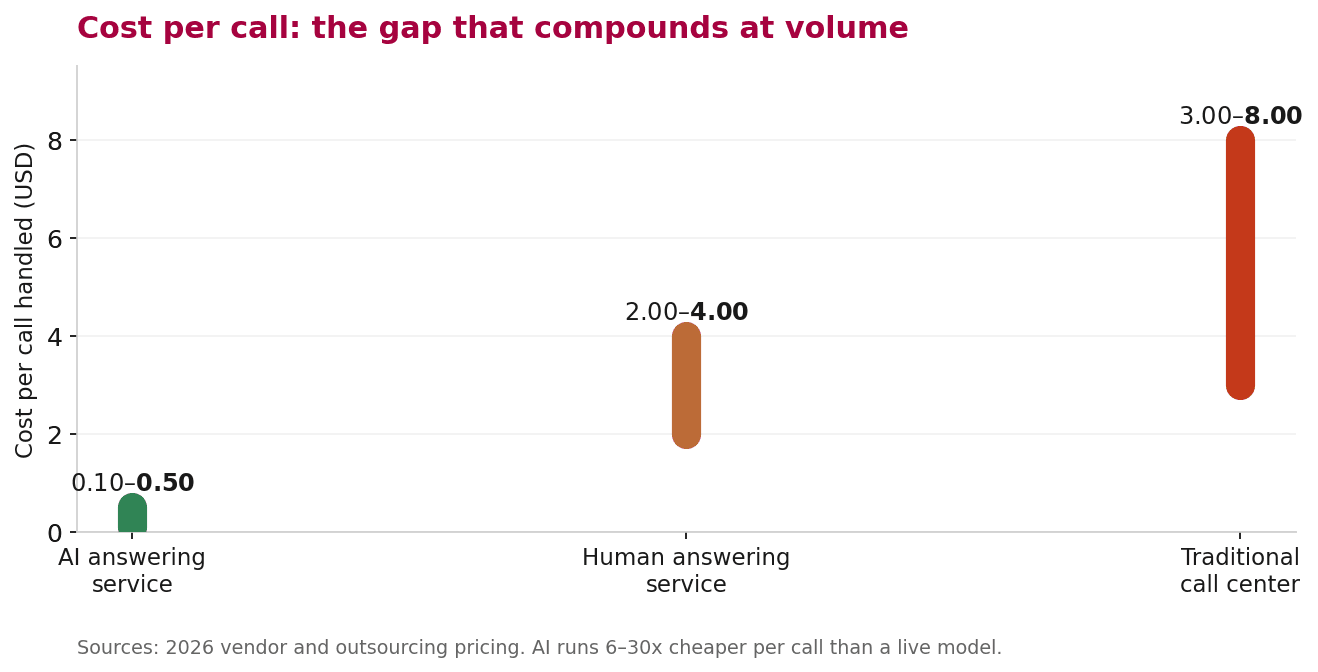
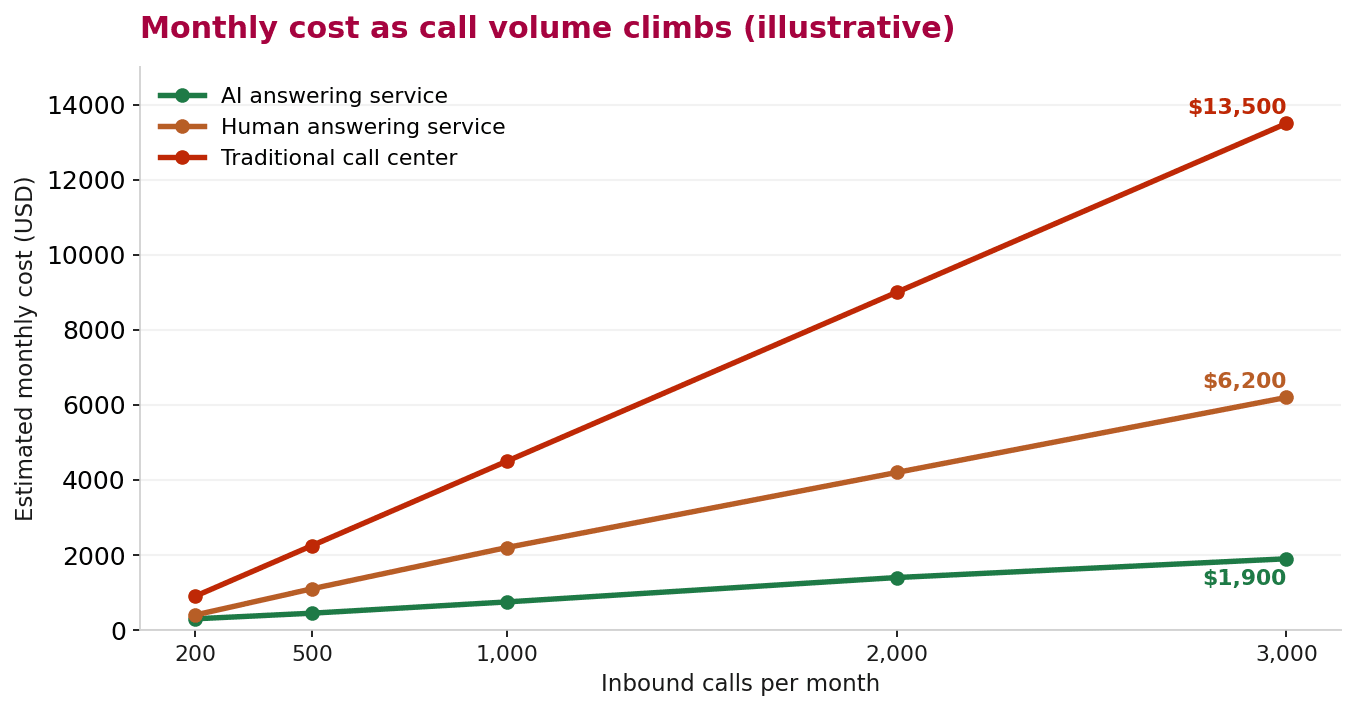
But per-call cost only tells half the story. What you actually pay depends on your monthly volume — and that's where the models separate. A flat-rate AI plan barely moves as calls climb; a per-call or per-minute human model scales linearly. Free tiers exist too — see a free AI answering service for when "free" is enough.
The cost-per-call formula (run it on your numbers)
Don't trust a generic table — run your own. The formula is simple:
Cost per call = total monthly cost ÷ calls handled per month. Work it out for each model at your real volume, then multiply the cheapest option's per-call cost by your missed-call rate to see what coverage is actually worth.
Example: at 1,000 calls a month, an AI plan near $750 is $0.75 all-in; a call center at $4,500 is $4.50. If you currently miss 30% of calls, the model that answers all 1,000 is worth far more than the one that's cheaper per call but drops 300 of them.
Where each model wins as call volume scales
The honest answer changes with volume — which is exactly what the static comparisons miss:
- Under ~200 calls/month: a free or entry AI tier, or a light human service, both work. Low stakes, low spend.
- 200–2,000 calls/month: AI wins decisively on cost while keeping full coverage. This is the sweet spot for most SMBs.
- 2,000+ calls/month with complex resolution: a call center (or a hybrid) earns its cost — but only for the calls that truly need an agent.
If you're already running a call center and don't want to rip it out, you can add AI to your existing call center to absorb the routine volume first.
When a call center still beats AI
The part a vendor selling AI won't tell you. A call center is worth its higher cost when calls need resolution, not just capture:
- Technical or account support that requires real troubleshooting, not a booking.
- Distressed or high-stakes callers — medical, legal, financial — who need human judgment and empathy.
- Complex sales negotiations where the average deal value is high enough to justify a live rep on every call.
- Regulated conversations your compliance team hasn't cleared for AI.
The honest rule. If your calls need to be resolved, staffed, and empathetic, pay for the call center. If they need to be captured, booked, and never missed, AI does it for a fraction of the cost. Most businesses have both kinds of calls — which is why the hybrid usually wins.
The hybrid model: AI for the 80%, humans for the 20%
The smartest setups don't pick a side. AI handles the routine, high-volume 80% — bookings, FAQs, after-hours, overflow — and routes the genuinely complex 20% to a human agent with full context. You get AI's cost and coverage plus a human safety net where it counts.
For teams that want a full call-center platform with AI built in, AI calling software for call centers compares the options. For most SMBs, SuperMIA's AI voice agent that answers, books, and escalates is the faster, cheaper start.
Map your call mix to the right model →
Frequently asked questions
What is the difference between an answering service and a call center?
An answering service captures and routes calls: it answers, takes a message or books an appointment, and passes the caller on. A call center resolves calls at volume with a team of live agents who handle support, sales, or service end to end. An answering service is about capture and coverage; a call center is about resolution and throughput.
How much does an AI answering service cost compared to a call center?
An AI answering service typically handles a call for about $0.10 to $0.50, or a flat $50 to $500 a month. A human answering service runs roughly $2 to $4 per call, and a traditional call center $3 to $8 per call once agents, management, and overhead are included. The cost gap widens quickly as call volume grows.
Is an AI answering service cheaper than a call center?
For routine, high-volume calls, almost always. An AI answering service costs a fraction per call and answers every line at once, 24/7, with no overtime. A call center only becomes worth its higher cost when calls need genuine resolution, empathy, or complex judgment that AI should not handle alone.
Can an AI answering service replace a call center?
It can replace the capture-and-book portion of a call center's work, which is often the majority of inbound volume. It should not replace the agents who resolve complex issues or handle sensitive conversations. The common pattern is a hybrid: AI takes the routine 80 percent and routes the tricky 20 percent to a human.
When is a call center worth it over an AI answering service?
A call center is worth the higher cost when your calls need real resolution rather than capture: technical support, distressed or high-stakes callers, complex sales negotiations, or regulated conversations. If your average deal value is high or your callers need human empathy, the extra spend on live agents pays for itself.
Start with the cheapest model that never misses a call
Run the cost-per-call formula on your own volume, then weigh it against what a missed call costs you. For most businesses under a few thousand calls a month, an AI answering service captures every call at a fraction of a call center's price — and you can always route the complex ones to a human.
Want the real number for your call volume? Book a demo and we'll show SuperMIA's AI voice agent answering, booking, and escalating on your exact call flow.

Urvil Dhanani
Urvil Dhanani is the AI/ML Lead at SuperMIA, focused on the architecture behind reliable conversational AI - agent design patterns, voice and chat orchestration, and platform evaluation. He writes practical, vendor-neutral guides that help technical teams build and choose AI systems that hold up in production.