
Table of Contents
- What is an AI admissions assistant?
- Why admissions is now a 24/7 job
- The applicant journey: where an assistant answers (and where you lose people)
- The ROI enrollment teams actually care about
- Meeting applicants on every channel
- What it can’t do — and where counselors stay essential
- How to choose an AI admissions assistant
- Frequently asked questions
What is an AI admissions assistant? A virtual assistant that answers prospective and current applicants’ questions instantly, 24/7, across web chat, WhatsApp, SMS and the admissions phone line. It handles the high-volume, repetitive inquiries — entry requirements, deadlines, documents, fees, application status — in many languages, and routes complex or sensitive cases to a human counselor. The point is cutting application abandonment and enrollment melt without adding staff.
Book a demo — and see an AI admissions assistant answer an applicant question →
Key takeaways
- Admissions is now a 24/7 job. International applicants ask across time zones, and a 48-hour email turnaround reads as slow.
- Applicants have moved to messaging. WhatsApp-based applicant inquiries more than doubled from 9% (2023) to 20% (2025), per Keystone Enrolment Services.
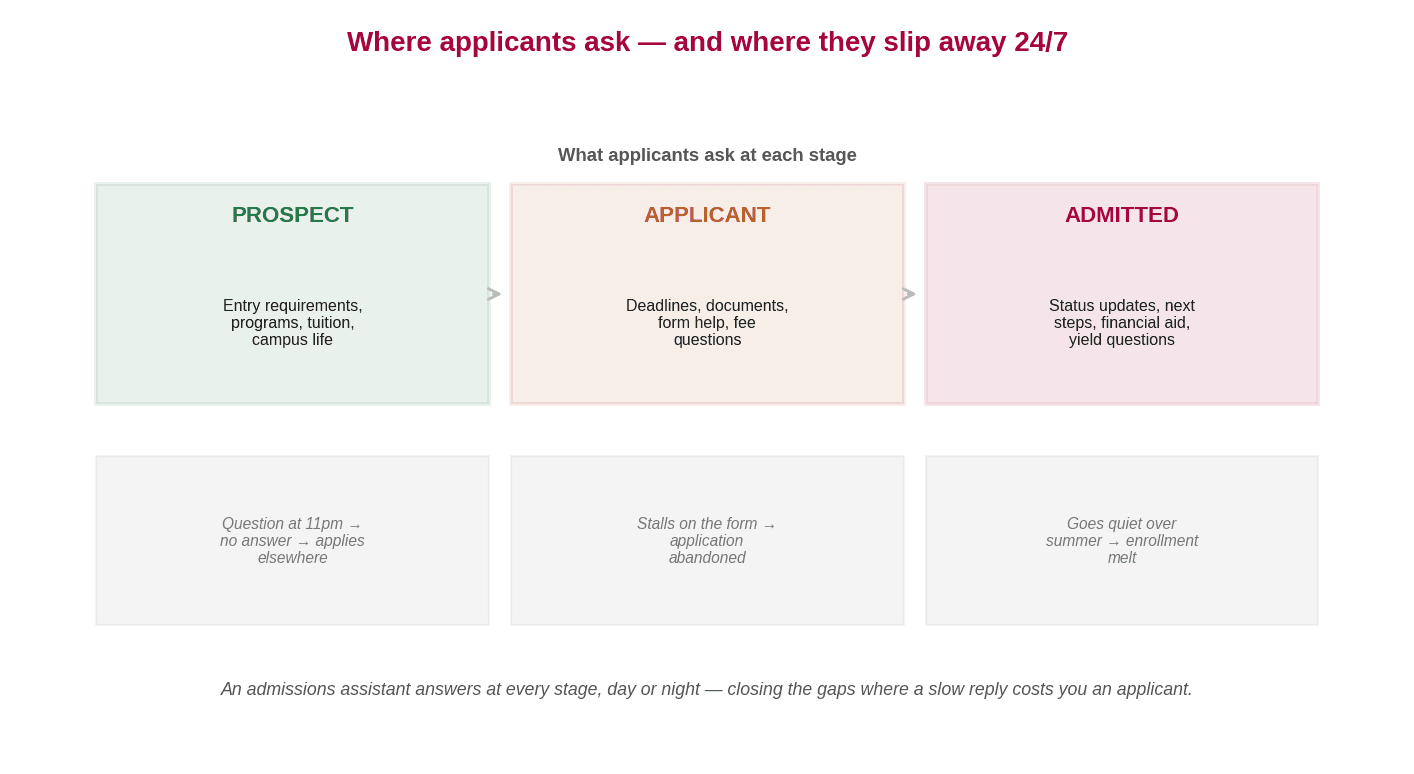
- Each funnel stage leaks differently. Prospects apply elsewhere, applicants abandon the form, admitted students melt over the summer.
- The ROI is completion and yield, not deflected calls. Reported institutional results include a 3.3% enrollment lift and a 21% melt reduction — credited to those institutions, not promised.
- It amplifies counselors, it doesn’t replace them. Nuanced advising, visa cases, aid appeals and sensitive conversations stay human.
It’s 11pm. A prospective student in another country is deciding where to apply, and they have a specific question about whether their qualifications meet your entry requirements. Your admissions office closed hours ago. By the time someone reads their email tomorrow afternoon, they’ve already had an instant answer from another university — and started an application there instead. Nothing about that student was unqualified or uninterested. They were just met faster somewhere else.
This is the problem an AI admissions assistant is built to solve. Application volume is rising, admissions teams are small and stretched, and the applicants you most want — including international students across every time zone — expect answers now, not in two business days. This guide walks through how an AI admissions assistant answers every applicant inquiry around the clock, where it fits across the enrollment funnel, the enrollment-specific returns it delivers, and — just as importantly — where your counselors stay essential. It’s written for enrollment leaders weighing whether this is worth a line in the budget. If you’re looking at AI across your whole institution, our AI for education overview is the wider starting point.
What is an AI admissions assistant?
An AI admissions assistant is a virtual assistant that answers prospective and current applicants’ questions instantly, at any hour, across the channels they actually use — your website, WhatsApp, SMS, and the admissions phone line. It understands natural language, so an applicant can ask “what grades do I need for the computer science program?” and get a real, specific answer rather than a link to dig through. Critically, a good one answers from your content — your prospectus, course pages, and admissions requirements — rather than guessing, so it never quotes last year’s deadline or invents a requirement. And when a conversation needs a human, it routes the applicant to a counselor with the context already attached.
It runs on the same conversational technology as any modern AI chatbot platform, but it’s tuned for one job: moving applicants through admissions. One real example of how mainstream this has become — Point Park University began rolling out one university’s 24/7 admissions rollout in early 2026, explicitly to answer applicant questions around the clock and free counselors to review applications and talk to students. It’s not about replacing the human touch; it’s about making sure no question sits unanswered overnight.
Why admissions is now a 24/7 job
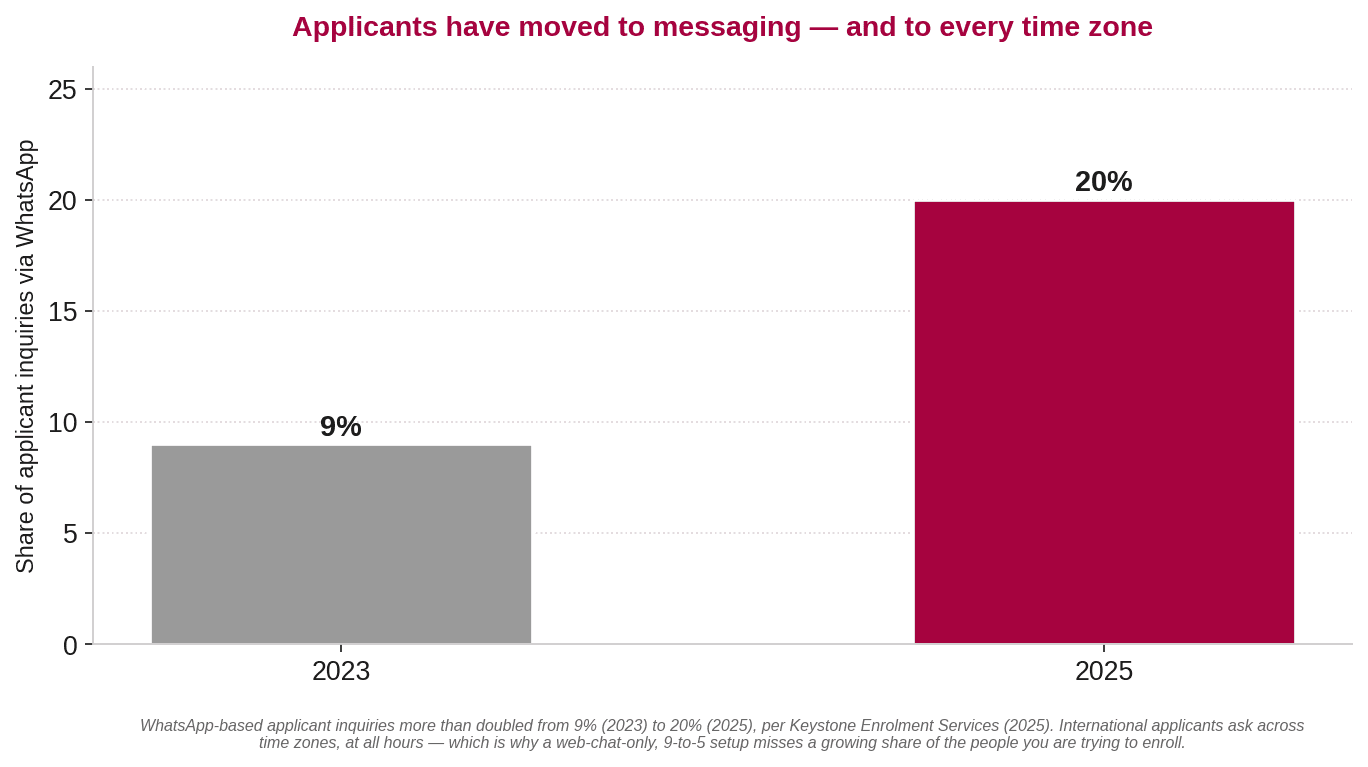
The expectation has simply changed. A 48-hour email turnaround, once considered good service, now reads as slow — especially to applicants who’ve been trained by every other digital experience to expect instant answers. For higher education, two forces make this acute. First, international applicants research and ask across time zones, so your busiest inquiry hours may be the middle of your night. Second, applicants have moved to messaging: as the chart above shows, WhatsApp-based applicant inquiries more than doubled from 9% in 2023 to 20% in 2025, according to Keystone Enrolment Services — and when institutions respond on messaging channels, students re-engage far more often. A web form checked at 9am can’t meet that. An assistant that answers instantly, on the channel the applicant chose, in their language, can.
The applicant journey: where an assistant answers (and where you lose people)
The most useful way to see the value is to follow an applicant through the funnel, shown in the chart above. At each stage they ask a predictable set of questions — and at each stage, a slow or missing answer costs you someone.
Prospects
Before they apply, prospective students want to know the basics: entry requirements, program details, tuition, scholarships, campus life, “is this school right for me?” These are high-volume, repetitive, and time-sensitive — a prospect comparing five schools will go with the ones that answer clearly and fast. An assistant handles this flood instantly, at any hour, so a late-night question becomes an engaged prospect instead of an application somewhere else.
Applicants
Once they’ve started, the questions shift to deadlines, required documents, form help, and fee payment — and this is where application abandonment happens. An applicant who stalls on a confusing form, isn’t sure which document to upload, or hits a payment question at midnight often just… stops. An assistant that answers the question in the moment, nudges about missing documents, and reminds about deadlines keeps the application moving to submission instead of letting it die half-finished.
Admitted students
The funnel doesn’t end at admission — and neither does the risk. Between an offer and the first day of term, admitted students go quiet, questions pile up over the summer, and some simply never enroll. That’s enrollment melt, and it’s one of the most expensive leaks in the whole process because these are students you already won. An assistant keeps them engaged — answering financial-aid, housing, and next-step questions instantly, and sending proactive reminders — so fewer admitted students drift away before they arrive. For the broader picture of how AI supports student support beyond admissions, the education overview covers the full lifecycle.
The ROI enrollment teams actually care about
Generic ‘deflect calls’ math doesn’t move an enrollment budget. The metrics that do are application completion and yield — and the evidence from institutions that have deployed admissions assistants is encouraging. Reported results (compiled by industry sources, and credited to the institutions themselves) include proactive chatbot nudges boosting freshman enrollment and reducing enrollment melt — in one set of figures, a 3.3% enrollment lift and a 21% reduction in melt. Named-institution case studies in the same reporting cite an admissions chatbot resolving queries with around 91% accuracy at one university, and another’s assistant (“Penny”) cutting call volume by about 10%. A 2024 survey it references found 38% of undergraduate and 48% of graduate students had used website chat, with roughly 90% rating it helpful.
Read these as directional, not guaranteed. Every figure above belongs to a specific institution or survey and is credited as such — they’re what other universities have reported, not a promise for yours. Your results depend on your applicant volume, your funnel’s current leak points, and how well the assistant is trained and integrated. The consistent pattern across them is the useful part: keeping applicants engaged and answered, at every stage and every hour, measurably reduces the two leaks — abandonment and melt — that quietly cost enrollment.
Meeting applicants on every channel
“An admissions chatbot” undersells what a modern assistant does, because applicants don’t live in one channel. The strongest setups are genuinely multi-channel — which is exactly what an AI admissions assistant multi-channel communication platform is built for.
- Web chat. The front door — answering questions the moment a prospect is on your site weighing a decision.
- WhatsApp and SMS. Where applicants increasingly are, especially international students — and where messages actually get read. This is the channel that’s grown fastest.
- The admissions phone line. Often overlooked in ‘chatbot’ conversations, but plenty of applicants and parents still call — and the phone rings after hours too. An AI voice bot can answer those after-hours calls the same way the chat assistant answers messages, so a prospect who calls at 9pm isn’t sent to voicemail.
- One assistant, one brain. The point of a multi-channel platform is that it’s the same trained assistant everywhere, so an applicant gets the same accurate answer whether they type on your site, message on WhatsApp, or call — and your CRM sees it all in one place.
For a fuller picture of how conversational assistants support students beyond the application stage, our guide to the best AI tutors covers the learning side of the same technology.
What it can’t do — and where counselors stay essential
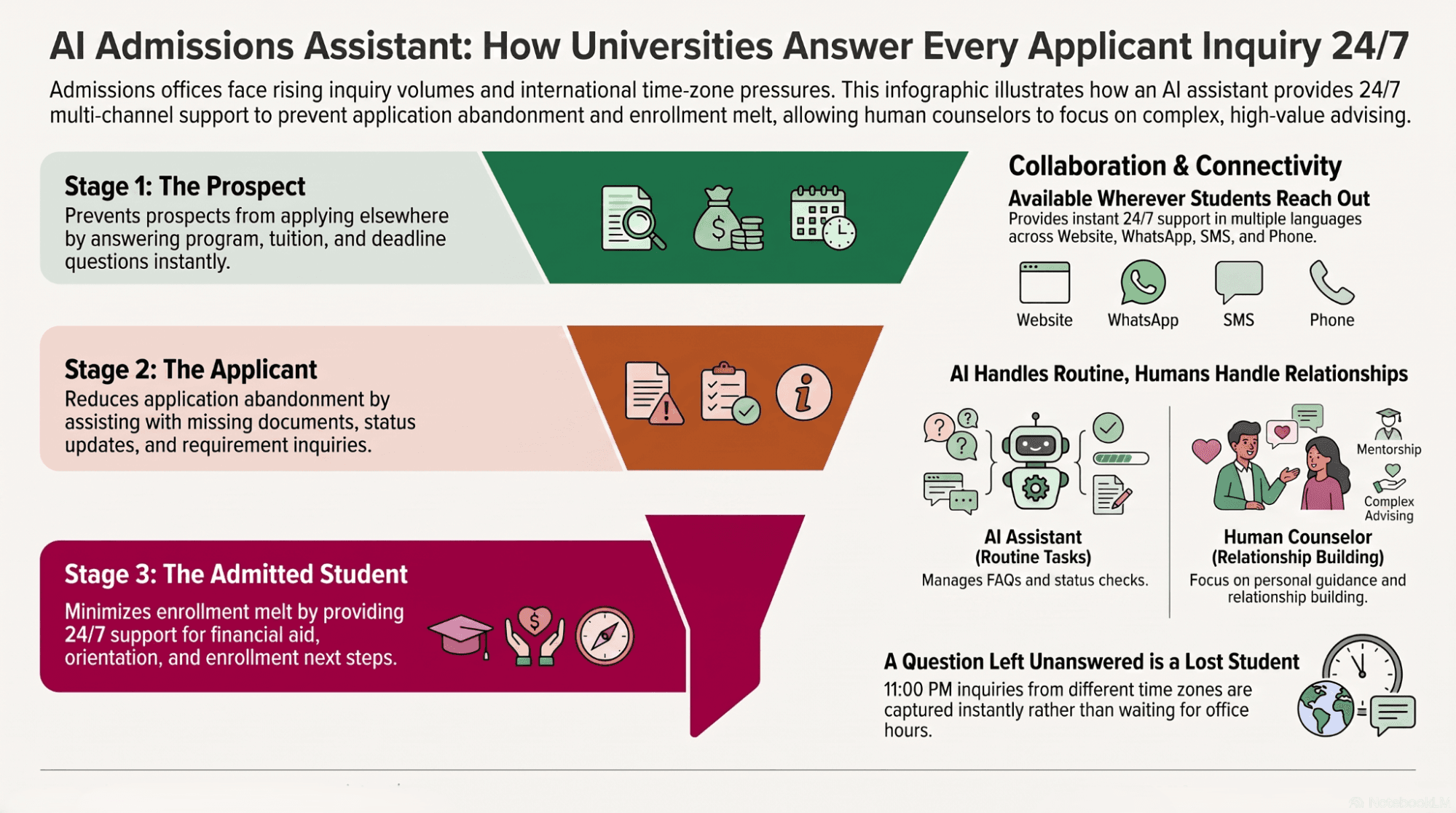
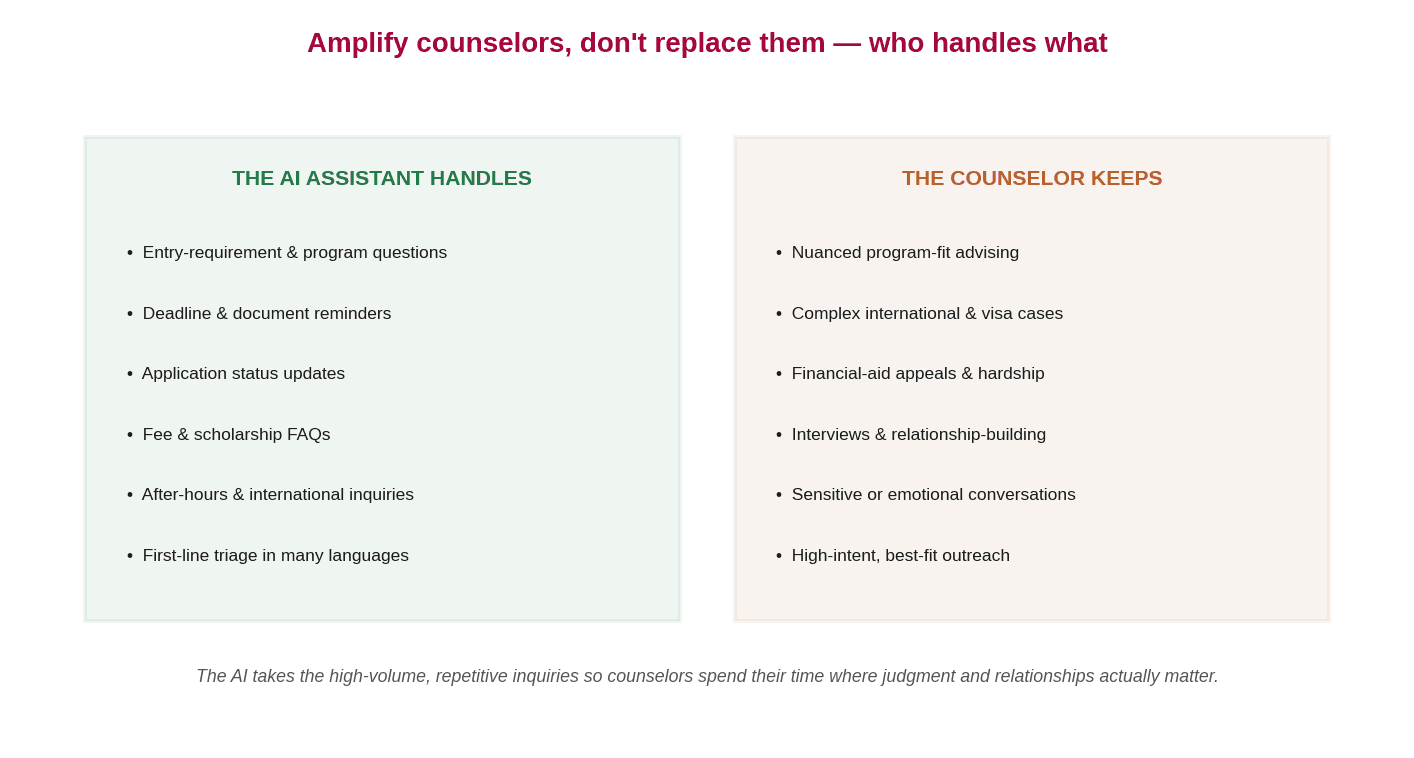
Every credible source on this agrees, and so do we: an AI admissions assistant amplifies your counselors, it doesn’t replace them. The chart above splits the work honestly. Here’s where a human stays essential.
- Nuanced program-fit advising. ‘Which of your two engineering tracks suits a student like me?’ is a judgment conversation, not a lookup — and it’s exactly the high-value work counselors should be free for.
- Complex international and visa cases. Credential equivalency, visa nuances, and country-specific situations often need a human who can weigh specifics; the assistant should gather the details and hand off.
- Financial-aid appeals and hardship. Anything involving money, exceptions, or personal circumstances needs empathy and authority — route it to a person.
- Sensitive or emotional conversations. An anxious applicant or a difficult family situation deserves a counselor, and a well-built assistant recognizes the moment and escalates rather than pushing through.
Set up this way — AI on the repetitive volume, counselors on the judgment calls — you get round-the-clock coverage without losing the human relationships that actually convert best-fit applicants. That balance is the whole design goal.
How to choose an AI admissions assistant
If you’re evaluating options, weigh them on the things that matter for admissions specifically. Does it answer from your own content (so answers are accurate and current), or does it guess? Is it genuinely multi-channel — web, WhatsApp, SMS, and phone — or chat-only? Does it integrate with your CRM (such as Slate) so leads, context, and handoffs flow to your team? Can it handle the languages your international applicants use? And does it route cleanly to counselors for the cases that need them? A tool that nails those is a genuine admissions assistant; one that misses them is a basic FAQ widget with a higher price tag. As you shortlist, our education solution covers how this fits alongside the rest of your student support.
Where does SuperMIA fit? We’re one option among several, and we’d rather be the right fit than the loudest pitch. SuperMIA is a multi-channel conversational platform that handles the admissions job in this guide — answering applicant inquiries across web, WhatsApp, SMS, and phone, trained on your institution’s content, with clean handoff to your counselors. The most useful next step isn’t reading more; it’s watching it answer a real applicant question from your own admissions pages.
Book a demo — and see an AI admissions assistant answer an applicant question →
Frequently asked questions
What is an AI admissions assistant?
An AI admissions assistant is a virtual assistant that answers prospective and current applicants’ questions instantly, 24/7, across web chat, WhatsApp, SMS, and phone. It handles high-volume, repetitive inquiries — entry requirements, deadlines, documents, fees, application status — in many languages, and routes complex or sensitive cases to a human counselor. It helps universities cut application abandonment and enrollment melt without adding staff.
How do universities use AI chatbots for admissions?
Universities use them to answer applicant questions around the clock, send deadline and document reminders, provide application status updates, and re-engage admitted students over the summer. The assistant is trained on the institution’s own admissions content so answers are accurate, and it hands complex cases to counselors. Several institutions have reported meaningful gains in engagement and enrollment after deploying one.
Does an AI admissions assistant replace admissions counselors?
No. The goal is to amplify counselors, not replace them. The assistant handles the high-volume, repetitive inquiries — deadlines, requirements, status checks — so counselors can spend their time on nuanced advising, interviews, complex international cases, and building relationships with best-fit applicants. Sensitive or high-stakes conversations are routed to a person.
Can an AI assistant answer applicant questions 24/7 in multiple languages?
Yes. That is one of its biggest advantages for higher education, where international applicants ask questions across time zones at all hours. A capable admissions assistant responds instantly on web chat, WhatsApp, SMS, and phone, in many languages, so no prospect waits until office hours — and no qualified applicant is lost to a faster-responding institution.
How does an AI admissions assistant reduce enrollment melt?
Enrollment melt is when admitted students fail to enroll, often because they go quiet over the summer with unanswered questions. An admissions assistant keeps them engaged — answering financial-aid, next-step, and logistics questions instantly, and sending proactive reminders — so fewer admitted students drift away before the term starts. Some institutions have reported notable melt reductions after deploying one.

Vicky Lalwani
Vicky Lalwani is Marketing Manager at SuperMIA, focused on practical AI education, buyer's guides, and solution explainers that help business teams evaluate and adopt conversational AI across support, sales, and operations.