
Table of Contents
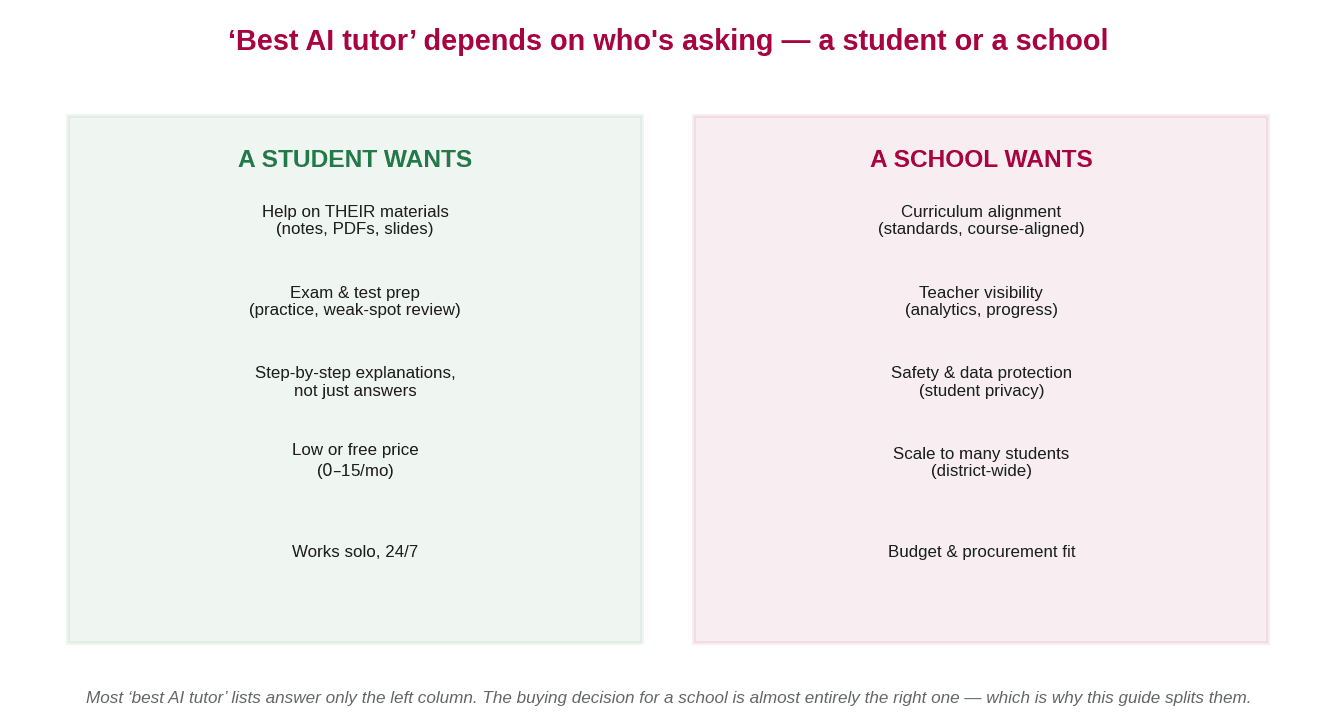
What is the best AI tutor? There's no single best AI tutor — the right one depends on who's asking. A student studying from their own notes wants exam prep and step-by-step explanations at a low price; a school wants curriculum alignment, teacher analytics, safety and scale. The best platforms teach through questions rather than handing over answers, which is what actually builds understanding. This guide compares eight, split by student and school.
Try StudyMate on your own subject — or book a 15-minute demo for your school →
Key takeaways
- There's no universal 'best.' The right AI tutor depends on the learner and the goal — a student's needs and a school's are almost opposites.
- Teach vs tell is the real test. Tools that guide with questions build understanding; tools that hand over answers train answer-seeking.
- The research is promising but conditional. Grounded in Bloom's 2-sigma finding; reported effect sizes of 0.73–1.3 SD — but the gains come from active use, not reading summaries.
- Students and schools buy on different things. Students: own-materials, test prep, price. Schools: curriculum, analytics, safety, scale.
- Match the tool to the job. Best-for-K-12-budget, best-for-own-materials, best-for-STEM, best-for-a-district — not a single ranking.
What is the best AI tutor? The short answer
If you came here for one name, here's the honest answer: it depends on who's asking. 'Best AI tutor' is really two different questions. A high-schooler revising from their own notes and a district evaluating a tool for ten thousand students are solving completely different problems, and the platform that's perfect for one can be wrong for the other.
So this guide does something most 'best AI tutor' lists don't: it splits the recommendation by audience. First the eight platforms and what each is genuinely good at, then a clear pick for students and a separate pick for schools, then a best-fit grid so you can match a tool to your exact situation. Throughout, the test that matters most is whether a tutor teaches through questions or just hands over answers — because that's what separates tools that build understanding from tools that quietly train students to look up answers.
What makes an AI tutor actually good (the 2-sigma test)
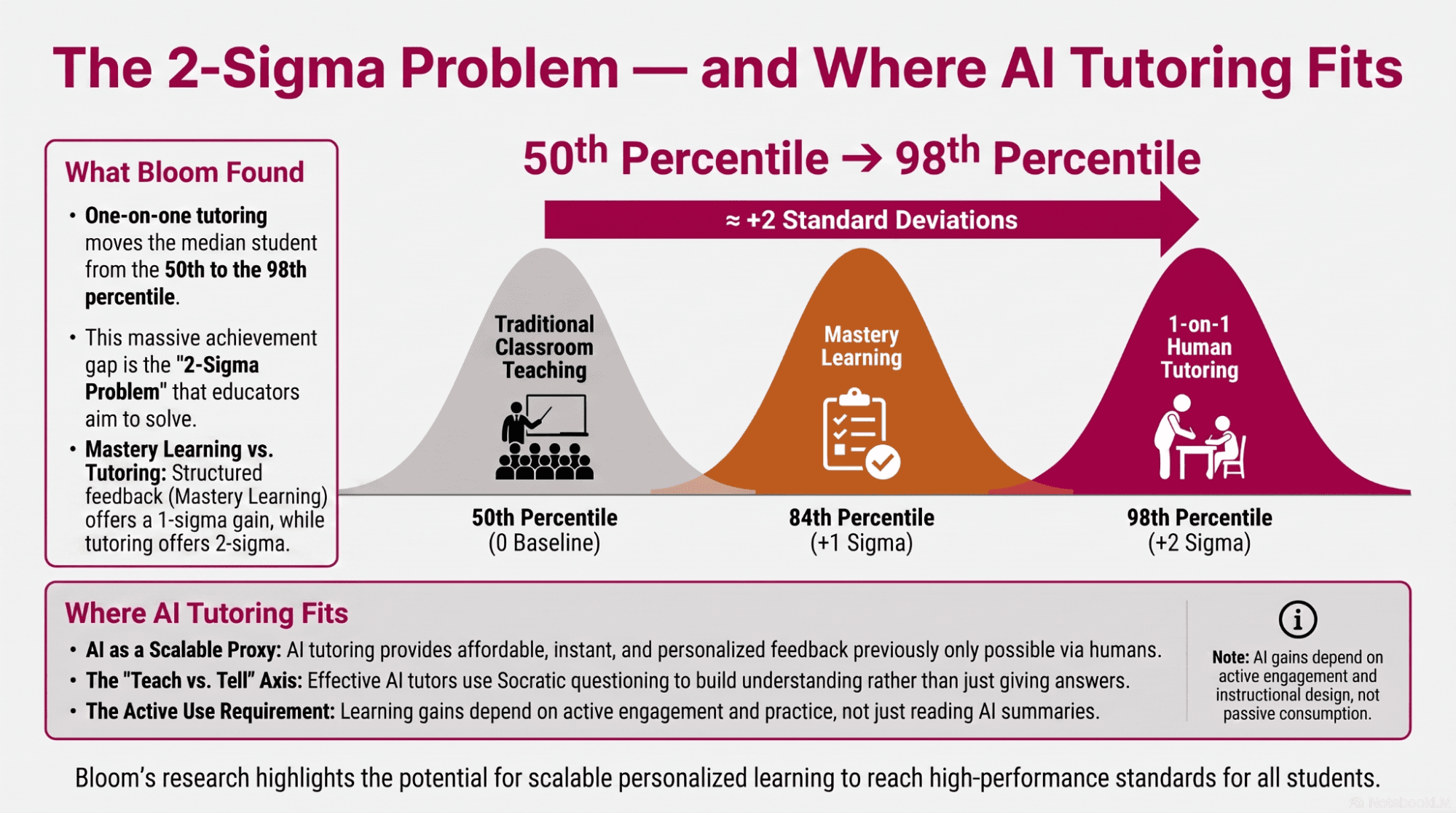
To judge AI tutors, it helps to know what they're trying to replicate. In 1984, the educational psychologist Benjamin Bloom published the foundational tutoring research now known as the 2-sigma problem: students who received one-on-one tutoring performed about two standard deviations better than students taught in a conventional classroom — roughly the difference between the 50th and the 98th percentile. The problem was economic. Human one-on-one tutoring at that quality is far too expensive to give every student. AI tutoring is the first credible, affordable attempt to approximate it.
Does it work? The early evidence is encouraging but conditional. Recent controlled trials have reported meaningful effect sizes, and a January 2026 Brookings review found substantial learning gains across the studies it examined, with well-designed systems approaching the effectiveness of human tutoring. But there's a consistent catch worth being honest about: the gains come from active engagement — practising, quizzing, working through mistakes — not from passively reading AI-generated summaries. Which leads to the single most useful test when you're comparing tools.
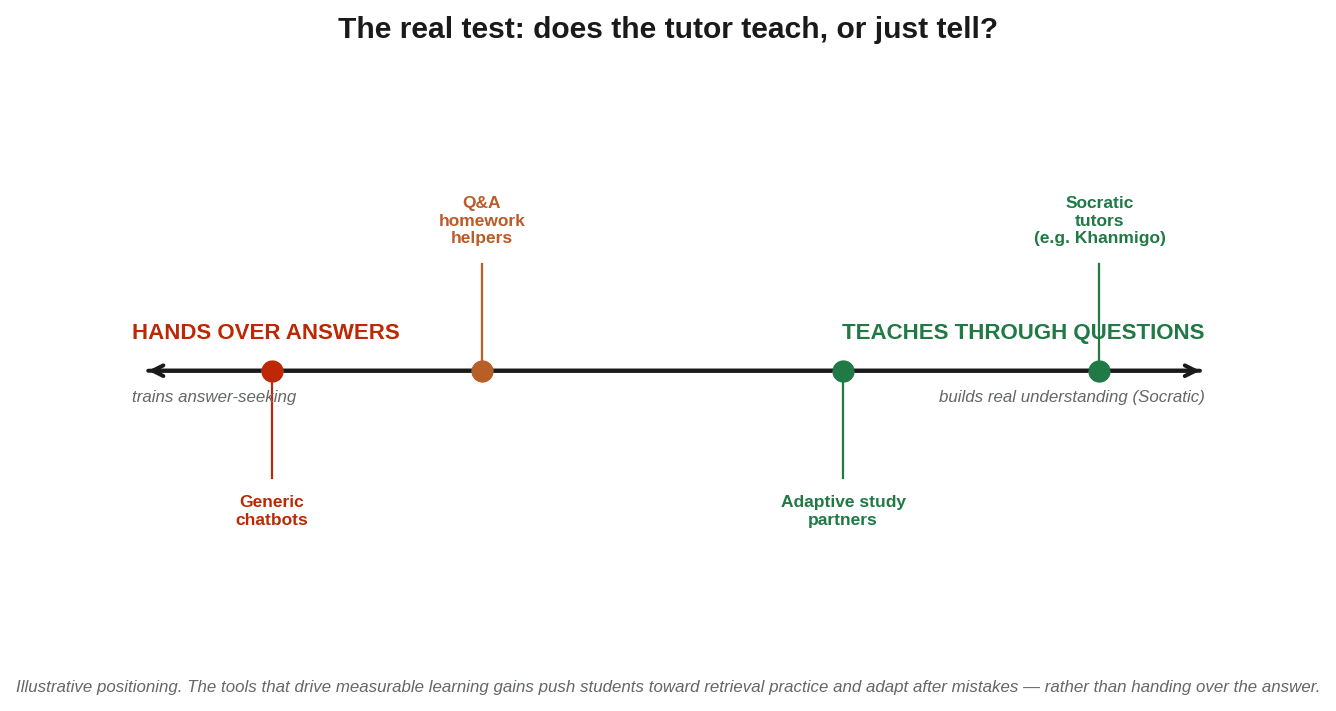
Teach vs tell. The best AI tutors use something like the Socratic method — they ask guiding questions, prompt the student to reason, and adapt when the student gets stuck, rather than immediately printing the answer. Khan Academy's Khanmigo is the tool most often cited as 'teaches rather than tells,' and it's a fair benchmark. At the other end are tools that solve the homework problem for you — fast, satisfying, and quietly counterproductive, because they train answer-seeking instead of understanding. When you test any tutor, ask it something you don't know and watch whether it makes you think or just hands you the answer.
How we compared them
Four things, weighted for real learning rather than flashy demos:
- Pedagogy (teach vs tell). Does it guide understanding, or just answer? Weighted highest.
- Verified pricing and value. Real, current prices — reported as of mid-2026, because tiers change often.
- Fit for the audience. Does it suit an independent student, a school, or both?
- Honest limitations. What each tool is genuinely not good at — stated plainly.
Where a statistic comes from a vendor with an obvious interest in the result — a company's own 'learning gains' number, say — we've flagged it rather than repeated it as fact. Prices and figures are reported as of mid-2026; verify current numbers before you commit.
The 8 best AI tutors in 2026
Listed by fit, not as a strict 1-to-8 ranking — because the right pick depends on the learner.
1. Khanmigo (Khan Academy) — best for teach-not-tell, on a budget
Khanmigo is the benchmark for Socratic tutoring. Built on Khan Academy's vast, curriculum-aligned content, it guides students with questions rather than handing over answers, and it's reported at roughly $4/month (or about $44/year) for families — with a free tier for teachers and, increasingly, free access through school partnerships. Khan Academy reports a 2026 pilot across roughly 200 schools and 15,000 students; as a nonprofit with an interest in the result, treat its own outcome figures as encouraging rather than definitive. Strongest for K-12. Honest limitation: it's tied to Khan's content and structure, so it's less useful for studying from your own materials.
2. SuperMIA StudyMate — best for a personalized study partner
SuperMIA StudyMate takes the study-partner approach: an adaptive, one-on-one-style tutor that works with a student conversationally, adjusts to where they're struggling, and is designed to explain rather than just answer. It sits in the AI-native group — built around a genuine conversational agent rather than a fixed content library — which makes it flexible across subjects and useful for students who want a patient partner to think alongside. It's part of a broader education suite (alongside MentorX and CourseSmith), so it also fits programmes and institutions, not only individual learners. As with any tool, try it on your own subject before committing, and check current plan details on the product page.
3. Synthesis Tutor — best for young learners in math
Synthesis focuses on K-5 math with a conversational tutor, reported at roughly $20–$45/month (or about $99/year). Parents report strong engagement for young children. Honest note: it markets itself as the 'first superhuman AI math tutor,' which is a marketing claim, not a measured result — and at the upper end of the price range, it's a premium choice for a fairly narrow age and subject band.
4. Numerade (Ace) — best for college STEM
Numerade's Ace tutor pairs with an enormous library of expert-made STEM videos, reported at about $29.99/month. For college students in math, physics, chemistry and engineering, the combination of step-by-step help and video explanations is genuinely strong, and it accepts image inputs so you can photograph a problem. Honest limitation: it's STEM-focused, so it's less useful outside those subjects.
5. YouLearn — best for studying from your own materials
YouLearn turns your own uploads — lecture notes, PDFs, slides, even videos — into study outputs: summaries, quizzes, flashcards and a tutor that answers from your material. For a student who wants help with their specific course rather than generic content, that's the key strength. Reported to generate several study formats from a single upload. Honest limitation: it's only as good as what you feed it, and works best as a study aid rather than a from-scratch teacher.
6. StudyFetch — best all-in-one study suite
StudyFetch (with its tutor 'Spark') bundles notes, flashcards, practice tests and a tutor, and reports a large user base (around 7 million) at roughly $7.99–$11.99/month. A solid generalist for students who want one tool that does a bit of everything. Honest note: breadth over depth — specialists like Numerade go further in their niche.
7. Gemini for Education — best free option for schools
For institutions already on Google Workspace for Education, Gemini for Education is reported free for schools and integrates with Google Classroom. That combination — no extra cost, familiar environment, admin controls — makes it a pragmatic default for many districts. Honest limitation: it's a broad AI assistant rather than a purpose-built Socratic tutor, so pedagogy depends heavily on how teachers structure its use.
8. Socratic by Google — best free homework helper
Socratic by Google is a free mobile app that lets students photograph a question and get explanations and resources. It's genuinely useful for quick, on-the-spot help and is completely free. Honest limitation: it leans toward answering and pointing to resources rather than sustained, adaptive tutoring — handy for a stuck moment, less so as a long-term study partner.
Best AI tutors for students
If you're a student choosing for yourself, three things usually matter most: help on your own materials, real exam preparation, and a price that fits a student budget. Here's how the picks shake out.
- Studying from your own notes? YouLearn is purpose-built for it — upload your material and get quizzes and a tutor that answers from it.
- Want a patient study partner across subjects? StudyMate's personalized study-partner approach is built for exactly this — an adaptive tutor that explains and adjusts rather than just answering.
- On a tight budget in K-12? Khanmigo gives you Socratic tutoring at roughly $4/month on top of Khan's free content.
- College STEM? Numerade's Ace plus its video library is hard to beat in math and the sciences.
- Just need a free quick-help app? Socratic by Google for on-the-spot explanations.
The student rule of thumb: pick for your material and your subject, not for whichever tool tops a list. If your studying revolves around your own course notes, a materials-based tool wins. If you want something that teaches you to reason through problems, choose one that asks questions rather than one that just prints answers — and test that before you pay.
Best AI tutors for schools and districts
For a school, the calculation changes almost entirely. Price-per-student still matters, but so do curriculum alignment, teacher visibility into progress, student-data privacy, and the ability to roll out to a lot of learners without chaos. If you're evaluating for an institution, it's worth understanding how schools are deploying AI before picking a single tool.
- Already on Google Workspace? Gemini for Education is free for schools and integrates with Classroom — the pragmatic default for many districts.
- Want a proven Socratic tutor with school partnerships? Khanmigo is designed for classrooms and curriculum alignment, with a growing number of school programmes.
- Want a broader institutional programme (tutoring + mentorship + course support)? SuperMIA's education suite pairs StudyMate with MentorX for mentorship and CourseSmith for course content, and SuperMIA for education covers the institutional side — useful when you want more than a single-purpose tutor. Teachers building their own materials may also want an AI lesson plan generator alongside the tutoring layer.
How to actually roll one out: the districts that succeed rarely flip a switch overnight. They start with a pilot among a few enthusiastic teachers, train staff on using the tool to prompt thinking rather than replace it, check the privacy and data terms carefully, and expand gradually once they've seen what works. Whatever platform you choose, budget for the change-management, not just the licences.
How to choose — best fit by learner type
Pull it together with a single question: who's the learner, and what's the goal?
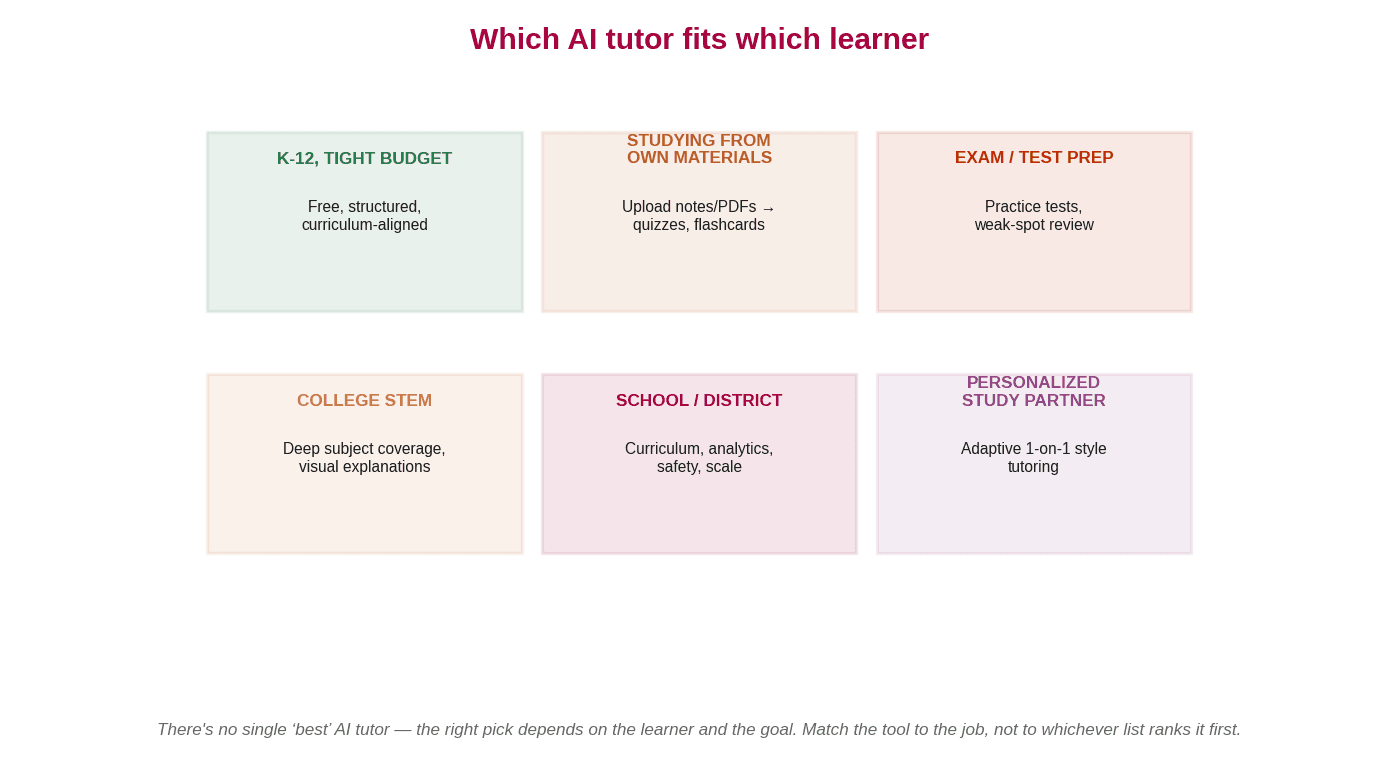
| If you are… | Prioritise… | Strong fits |
|---|---|---|
| A K-12 student on a budget | Free/low-cost, structured, curriculum-aligned | Khanmigo, Khan Academy, Socratic |
| Studying from your own materials | Upload-and-study (notes → quizzes) | YouLearn, StudyFetch |
| Prepping for an exam | Practice tests, weak-spot review | StudyFetch, Numerade, StudyMate |
| A college STEM student | Deep subject coverage + visual help | Numerade (Ace) |
| Wanting a personalized study partner | Adaptive, conversational, explains not tells | SuperMIA StudyMate |
| A school or district | Curriculum, analytics, safety, scale | Gemini for Education, Khanmigo, SuperMIA education suite |
There's no trophy for 'best AI tutor' — there's the right fit for a specific learner and goal. The one habit that beats any ranking: try two or three on a real task, and keep the one that makes the student think, not the one that answers fastest. If a patient, adaptive study partner is what you're after, you can try StudyMate or book a demo and test it on your own subject.
Try StudyMate on your own subject — or book a 15-minute demo for your school →
Frequently asked questions
What is the best AI tutor?
There is no single best AI tutor, because the right choice depends on who is asking. A student studying from their own notes wants exam prep, step-by-step explanations and a low price. A school wants curriculum alignment, teacher visibility into progress, strong safety and data protection, and the ability to scale to many students. The best platforms across both groups teach through questions rather than handing over answers, which is what research suggests actually builds understanding. This guide compares eight, split by student and school.
Are AI tutors as good as human tutors?
Not identical, but the research is encouraging. The benchmark is Benjamin Bloom's 1984 finding that one-on-one human tutoring moved the average student roughly two standard deviations, from the 50th to about the 98th percentile. Human tutoring at that quality does not scale, and AI tutoring is the first affordable attempt to approximate it. Recent trials report meaningful effect sizes, and a 2026 Brookings review found substantial learning gains, but those gains depend on active use, practising and working through problems, rather than passively reading AI-generated summaries.
What is the best free AI tutor?
For K-12 students on a tight budget, Khan Academy remains the strongest free option for structured, curriculum-aligned content, with Khanmigo adding guided tutoring at a low price. For schools already on Google Workspace, Gemini for Education is free for institutions and integrates with Classroom. Several other platforms offer free tiers with limited usage. Just remember that free tiers usually cap chats, uploads or features, so verify the current limits before committing a class or a study plan to one.
Can AI tutors be used in schools?
Yes, and a growing number of districts are piloting them. The considerations for a school are different from those for an individual student: curriculum alignment to standards, teacher visibility into student progress through analytics, strong student-data privacy and safety controls, and the ability to scale across many learners without a large budget increase. Successful rollouts typically start with a pilot among enthusiastic teachers, train staff on effective use, and expand gradually rather than deploying district-wide overnight.
Do AI tutors actually help students learn?
The evidence suggests they can, under the right conditions. Studies of intelligent tutoring systems and recent AI tutoring trials report learning gains, and reviews have found that well-designed systems can approach the effectiveness of human tutoring. The consistent caveat is that the benefit comes from active engagement: quizzes, practice tests, retrieval practice and working through mistakes. Tools that simply hand over answers can actually train answer-seeking rather than understanding, so the pedagogy of the tool matters as much as the underlying AI.

Vicky Lalwani
Vicky Lalwani is Marketing Manager at SuperMIA, focused on practical AI education, buyer's guides, and solution explainers that help business teams evaluate and adopt conversational AI across support, sales, and operations.