
Table of Contents
- What's the difference?
- What is a chatbot?
- What is a voice agent?
- What is an AI agent?
- Side-by-side: the three-way comparison
- How they overlap (and why the labels confuse buyers)
- Which one does your business need?
- What each one costs and how fast it ships
- Where SuperMIA fits
- Frequently asked questions
Quick Answer
A chatbot answers questions within a set scope. A voice agent holds a spoken conversation over the phone and completes voice tasks. An AI agent reasons about a goal, picks tools, and takes multi-step action across your systems. The simplest test: if it only responds, it's a chatbot; if it speaks, it's a voice agent; if it decides what to do next and acts, it's an AI agent.
Key takeaways
- Chatbots answer. Voice agents talk and act by phone. AI agents reason and execute across tools.
- Autonomy is the real dividing line - not how human the conversation sounds.
- Channel matters too: chatbots are text-first, voice agents are speech-first.
- They overlap - an AI agent often sits behind a chat or voice interface.
- Most businesses run all three together, matched to the job.
AI agent vs. chatbot vs. voice agent: what's the difference?
The three terms get used interchangeably in vendor demos, but they describe different things. Two questions separate them: how does the user interact (text or voice?), and how much can the system do on its own (answer, or act?).
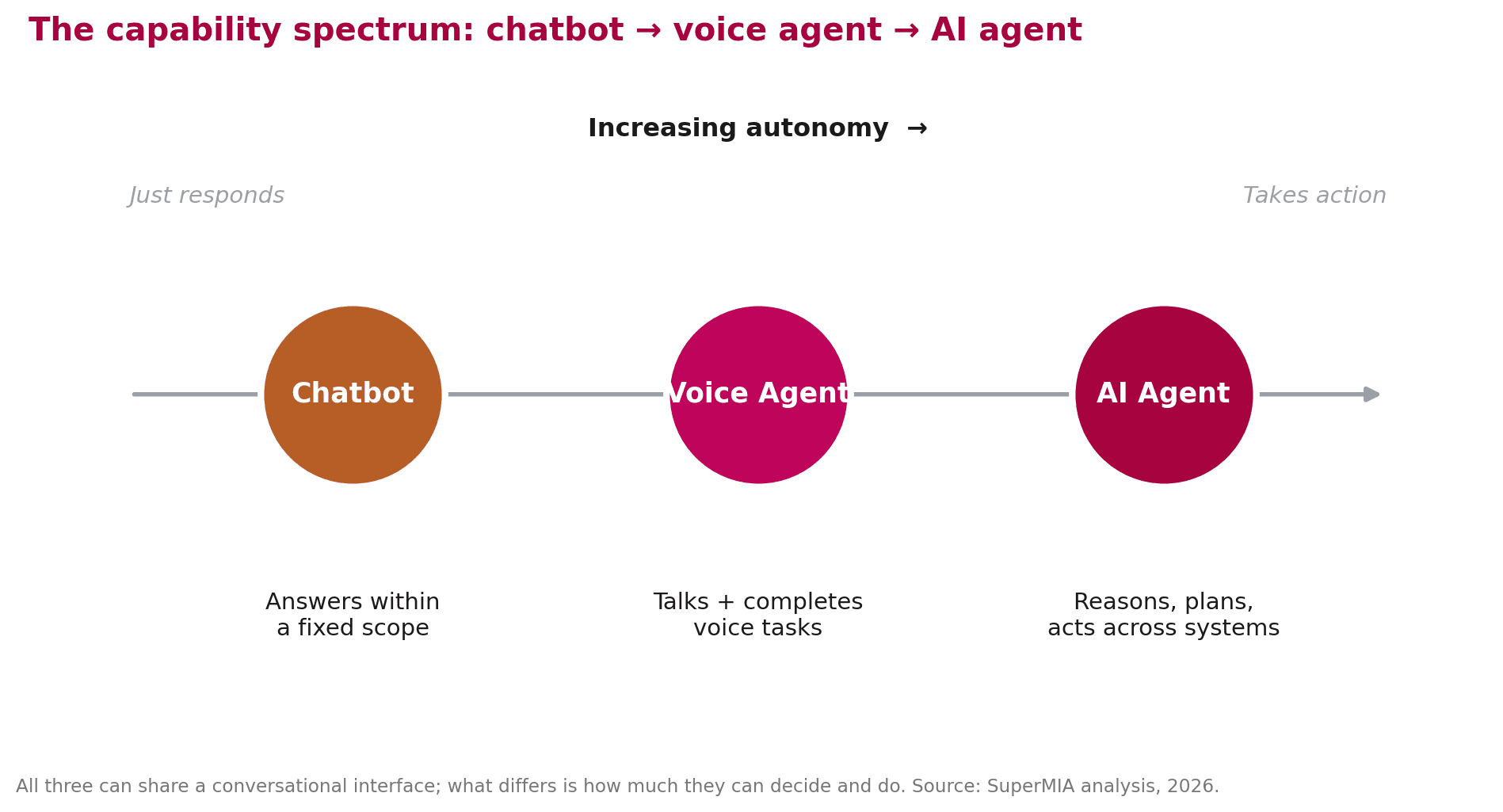
Figure 1. Chatbot → voice agent → AI agent on an autonomy spectrum.
Here's the short version before we go deeper:
- Chatbot - text-first, answers within a defined scope.
- Voice agent - speech-first, holds live phone conversations and completes voice tasks.
- AI agent - autonomous, reasons toward a goal and acts across systems.
| If you need to… | You're looking at a… |
|---|---|
| Answer FAQs on your website or app | Chatbot |
| Handle phone calls in natural speech | Voice agent |
| Complete multi-step tasks across systems | AI agent |
| Do all three across channels | A platform that combines them |
What is a chatbot?
A chatbot is a conversational interface that responds to text input within a defined scope. It takes a question, matches it against its training or rules, and returns an answer. Early chatbots used rigid decision trees; modern ones use natural language processing to handle varied phrasing.
A chatbot can be smart about language and still be a chatbot - because its job ends with returning text. SuperMIA's AI chat agent handles instant text support across web, WhatsApp, and app.
What chatbots do well - and where they stop
Chatbots shine in high-volume, low-ambiguity situations: product questions, policy explanations, document lookups, lead qualification, and first-line FAQ deflection. See how SuperMIA's AI chatbot handles these flows across web, WhatsApp, and app.
Where they stop: the limit isn't intelligence, it's agency. Ask "where's my order?" and a chatbot points you to a tracking page. Ask "my address is wrong, fix the shipment and tell the carrier" and it needs access, decision logic, and the ability to act - that's agent territory.
What is a voice agent?
A voice agent is a speech-first assistant that runs over the phone or voice-enabled apps. The user speaks, and the system holds a live audio conversation - understanding natural language, not just menu options. SuperMIA's AI voice agent answers inbound and outbound calls with human-quality conversation and transfers to a person when needed.
According to Gartner customer-service research, a large majority of customer-service leaders are exploring conversational voice agents - because voice captures urgency, tone, and context that text can't.
How a voice agent actually works (STT → NLU → TTS)
A voice agent runs a real-time loop: speech-to-text (STT) converts what the caller says into text, natural-language understanding (NLU) figures out intent, the system decides a response, and text-to-speech (TTS) speaks it back. That loop has to stay within a second or two, or the call feels broken.
Voice agents can be simple (answer spoken FAQs) or fully agentic (book the appointment, update the record, confirm completion). For the deeper version, see our voice agents vs. traditional bots breakdown and the complete voice agent guide. To see SuperMIA's AI voice bot in action - including inbound call handling, booking, and escalation - visit the voice bot page.
What is an AI agent?
An AI agent perceives input, reasons about how to reach a goal, selects tools, and takes action across multiple steps - instead of returning a single response. It doesn't just formulate an answer; it evaluates the request, decides whether it needs more information, queries databases or APIs, and executes actions across systems.
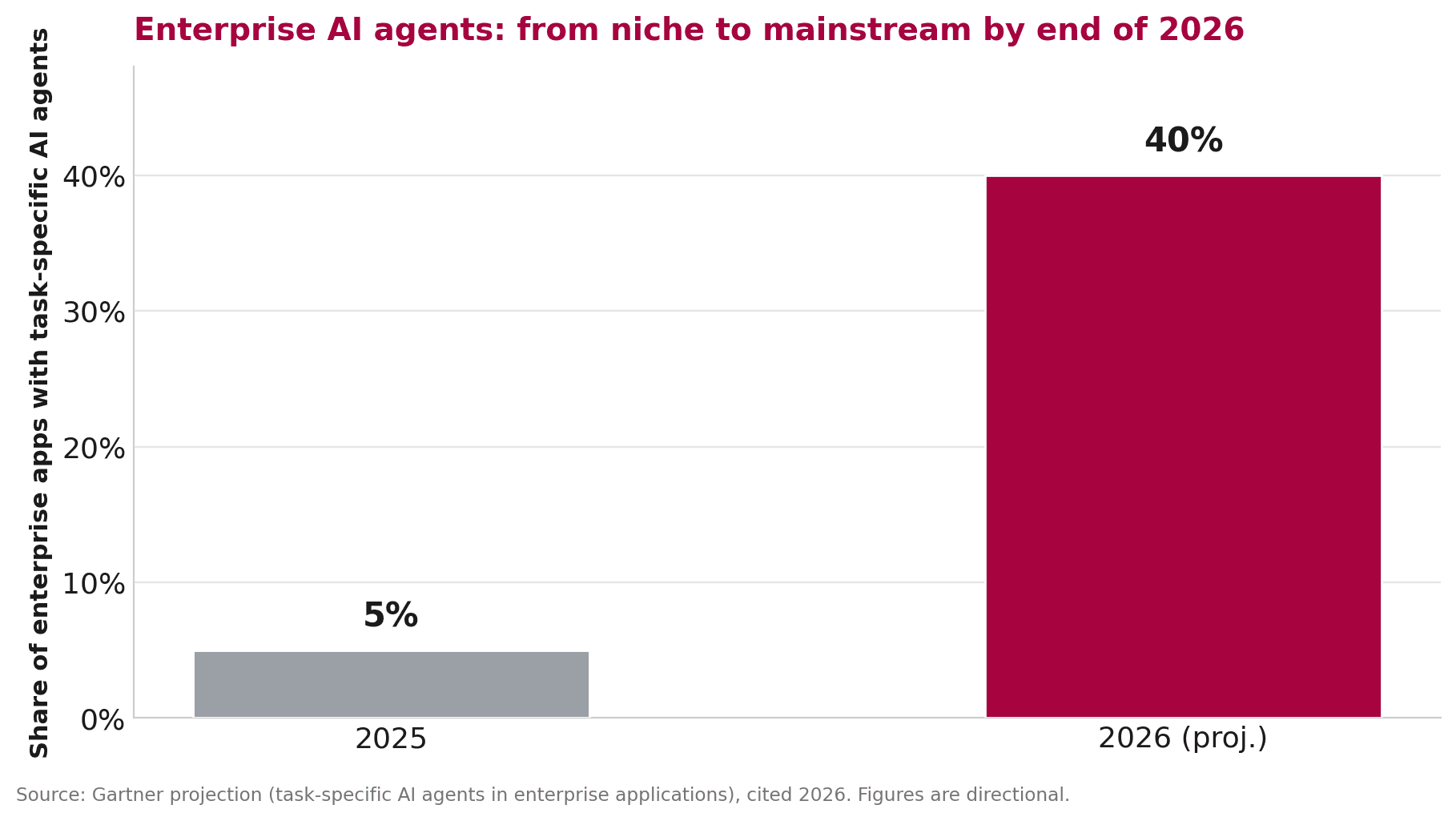
Figure 3. Task-specific AI agents in enterprise apps: 2025 vs 2026 (projected).
This is why adoption is climbing fast: Gartner projects that 40% of enterprise applications will include task-specific AI agents by the end of 2026, up from under 5% in 2025. SuperMIA's custom AI agent trained on your data connects to your workflow automation so it can act, not just talk.
Why autonomy is the real dividing line
The fastest way to tell an agent from a chatbot: does the system only respond, or does it also act? If it returns text based on what it knows, it's a chatbot. If it can inspect the current state, choose tools, and carry out changes in connected systems, it's an agent. That one question cuts through almost all the marketing language.
Side-by-side: the three-way comparison
| Dimension | Chatbot | Voice Agent | AI Agent |
|---|---|---|---|
| Primary channel | Text (web, app, WhatsApp) | Voice (phone, voice apps) | Any (often behind chat/voice) |
| Core job | Answer questions | Hold spoken conversations + act | Reason and complete tasks |
| System access | Usually read-only | Read + some actions | Read, write, execute |
| Autonomy | Low - responds | Medium - talks + does | High - decides + acts |
| Best for | FAQs, lead capture | Calls, scheduling, support | Multi-step, cross-system work |
| Setup focus | Knowledge + tone | Speech + call flows | Tools, guardrails, approvals |
| Fails when | Asked to take action | Latency or accent issues | Acts on incomplete context |
Now the capability differences as a chart:
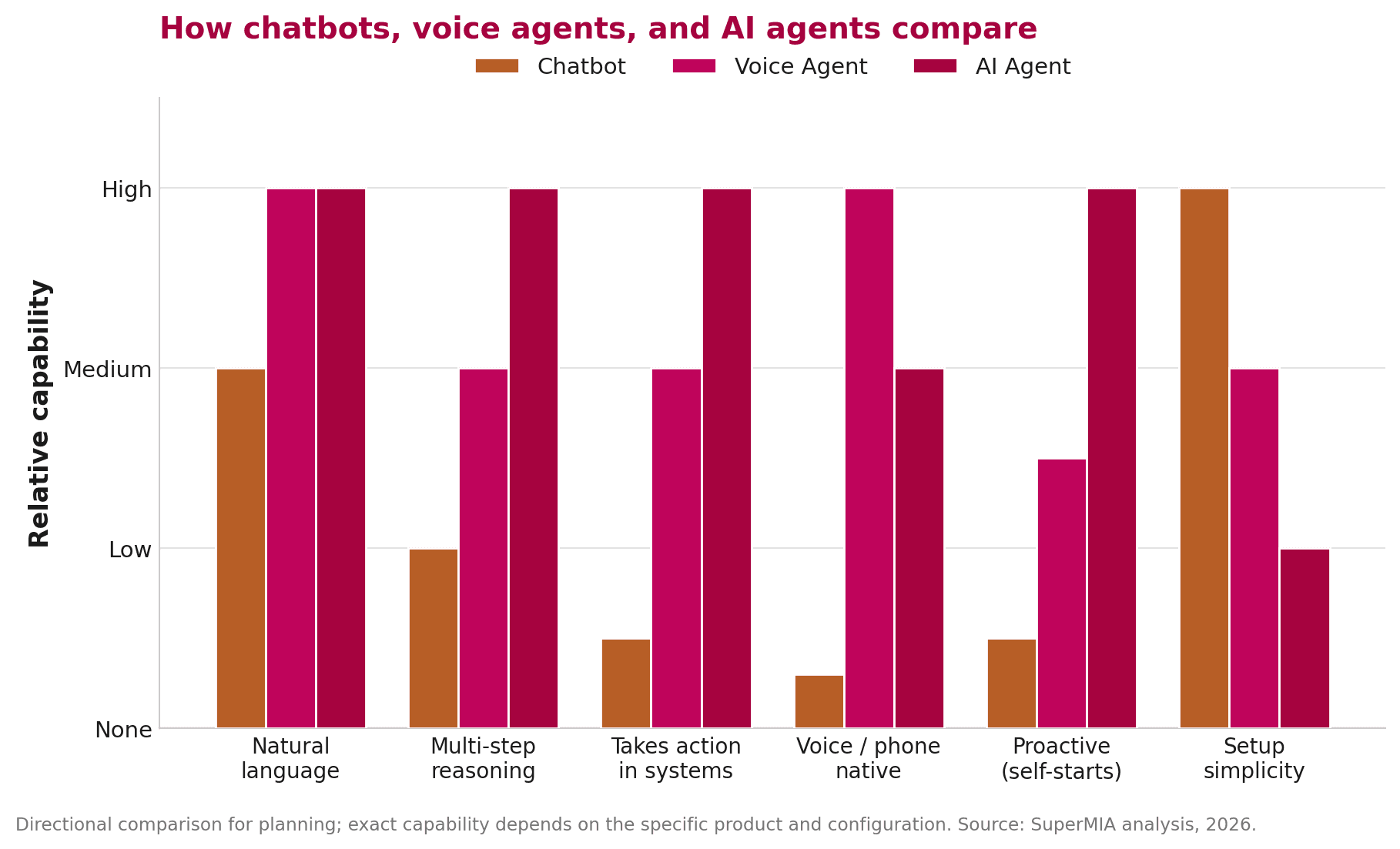
Figure 2. How the three compare across six capabilities.
How they overlap (and why the labels confuse buyers)
Most of the confusion comes from interface. Many AI agents have a chatbot or voice front-end, so buyers judge the part they can see - the conversation quality - and miss the part that matters: what happens behind the window.
A useful mental model: the chatbot (or voice channel) is the interface; the agent is the operator. One manages the dialogue. The other decides whether a tool call, a lookup, or a write operation needs to happen next. Two products can look identical in a demo and behave very differently in production.
So "connecting a chatbot to a powerful model" doesn't create an agent. A stronger model improves language; it doesn't add the ability to choose tools and act. That only comes from the architecture behind the conversation.
Which one does your business need?
Start with the outcome, not the technology. If the interaction ends with giving someone information, you need a chatbot. If it happens by phone, you need a voice agent. If it requires evaluating input and taking action across tools, you need an AI agent.
A 5-question decision framework
- Does the interaction happen by voice/phone? → lean voice agent.
- Does the task end with an answer, or with an action in another system?
- Is a human currently copy-pasting between tabs to finish it? → AI agent.
- Do you need it live across web, WhatsApp, and phone at once? → a platform.
- How much risk if it acts wrong? → more risk means more guardrails and approvals (agent design).
Rule of thumb: chatbots for information, voice agents for phone-based service, AI agents for work that spans systems. Most growing teams end up using all three.
Not sure which fits?
Book a working session and we'll map the right setup for your business.
Book a working session →
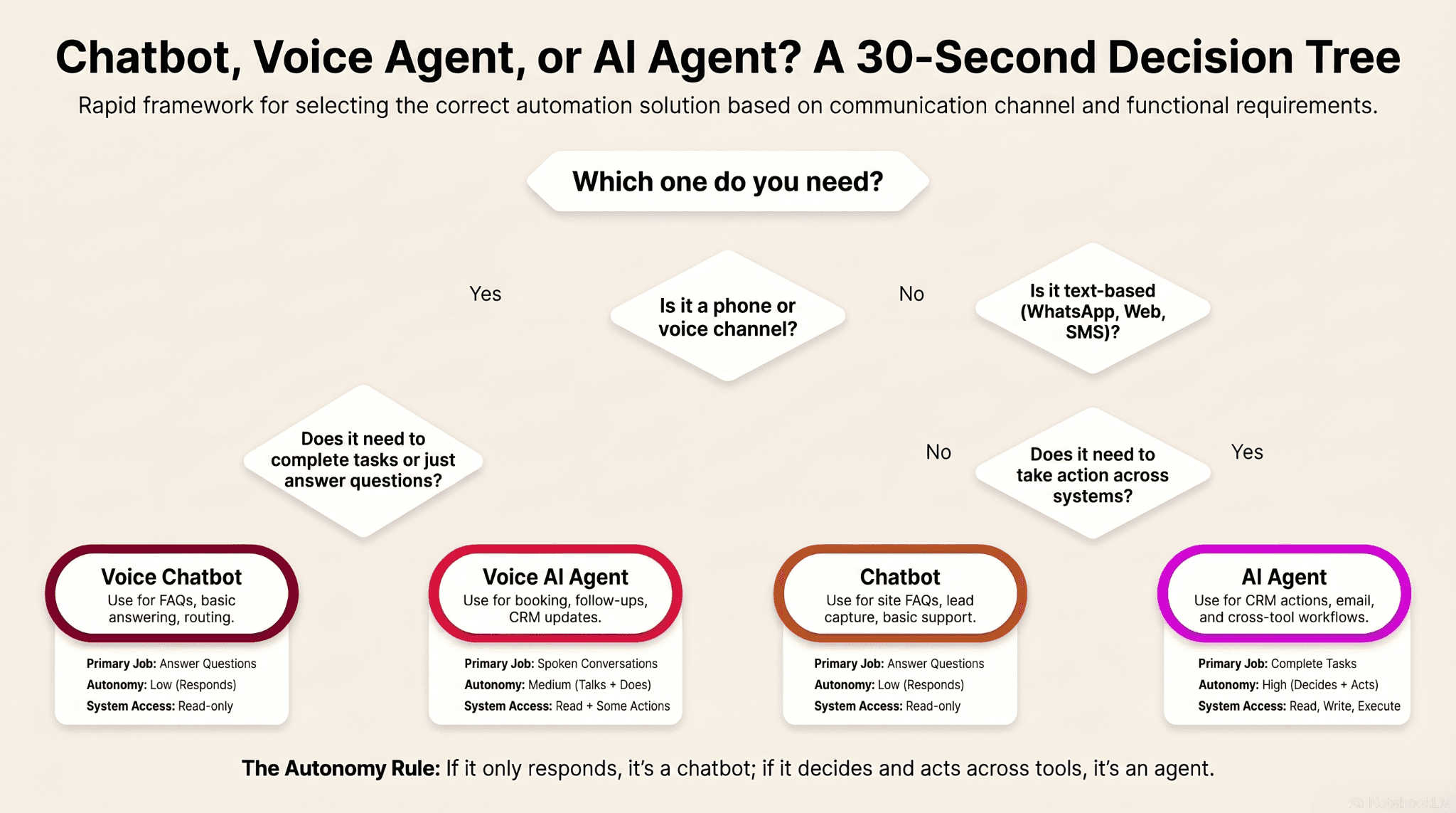
Chatbot, Voice Agent, or AI Agent? A 30-second decision tree.
What each one costs and how fast it ships
Cost tracks capability. A chatbot is the cheapest and fastest to stand up. A voice agent adds telephony and real-time speech, so it costs more. An AI agent adds integrations, guardrails, and monitoring - the most setup, and the most value when the work is complex.
| Type | Cost | Time to Live | Setup Focus |
|---|---|---|---|
| Chatbot | $ - lowest | Days | Knowledge quality + tone |
| Voice agent | $$ - medium | Days to weeks | Telephony + latency tuning |
| AI agent | $$$ - highest | Weeks | Integrations + guardrails |
The good news: a single platform can deliver all three with shared business knowledge, which collapses setup time. SuperMIA publishes transparent pricing and most teams go live the same week.
Where SuperMIA fits
SuperMIA is a conversational AI platform that runs all three in one place: a chat agent for text, a voice agent for calls, and agentic logic that takes action across your CRM, booking system, and helpdesk. Because they share the same business knowledge, a customer gets the same answer whether they call, chat, or message - and the system can act, not just reply.
The honest takeaway: you rarely pick just one. Use a chatbot where answers are enough, a voice agent where customers call, and AI-agent logic where work spans systems. The win is matching each to the job - and running them from one platform so the experience stays consistent.
See all three working together
Book a demo to see chat, voice, and agent logic in a single platform.
See all three working together →Frequently asked questions

Harikrishna Patel
Harikrishna Patel is the founder of MIA – My Intelligent Assistant, the AI automation platform built under Botfinity Inc. in Dallas, Texas. With 15+ years in software engineering, AI/ML, and enterprise solution design, he focuses on creating practical, scalable AI tools that help businesses automate support, workflows, and operations through voice and chat.