

Table of Contents
- Before you compare anything - which problem do you actually have?
- What Decagon is (and who it's genuinely built for)
- What Decagon costs - and why nobody can tell you exactly
- The line item almost every comparison forgets
- Per-conversation vs per-resolution - where your risk sits
- The best Decagon alternatives, by which problem you're solving
- Where SuperMIA fits (and where it doesn't)
- Frequently asked questions
Decagon doesn't publish pricing. Third-party teardowns report roughly a $50K annual platform fee plus per-conversation usage, with six-figure contracts typical - estimates only, so verify directly. But before comparing alternatives, check which problem you have: too many digital tickets (Decagon's lane), nobody answering the phone (you need voice), or agents underperforming (you need enablement). They are not the same purchase.
Not sure which problem you're solving? Book a 15-minute demo →
Key takeaways
- Decagon publishes no pricing. Every number online - including the ones below - is a third-party estimate. Verify directly before budgeting.
- Plan for a six-figure floor. Reported ~$50K/yr platform fee, plus usage, plus the helpdesk you still run underneath.
- There is no native helpdesk. You keep paying Zendesk or Salesforce on top - the line most comparisons leave out.
- Per-conversation means paying when the AI fails. Decagon's own glossary admits "resolution" gray areas cause billing disagreements.
- Qualify before you shortlist. Deflection, voice, and agent quality are three different problems.
Before you compare anything - which problem do you actually have?
This is the question every other "Decagon alternatives" article skips, and skipping it is expensive. An enterprise CX evaluation takes weeks. Teams routinely get to the end of one before realising the thing breaking their support operation was never the thing the platform fixes.
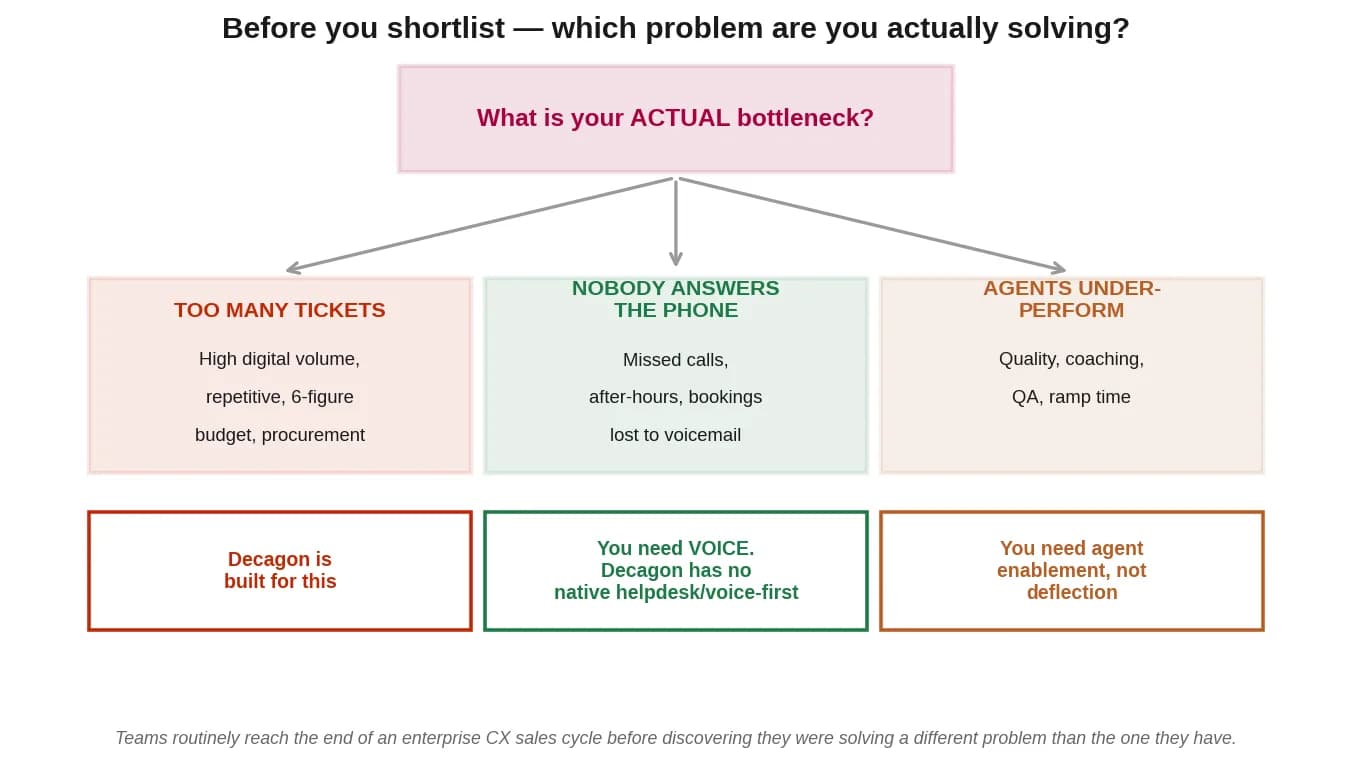
Problem 1: Too many digital tickets
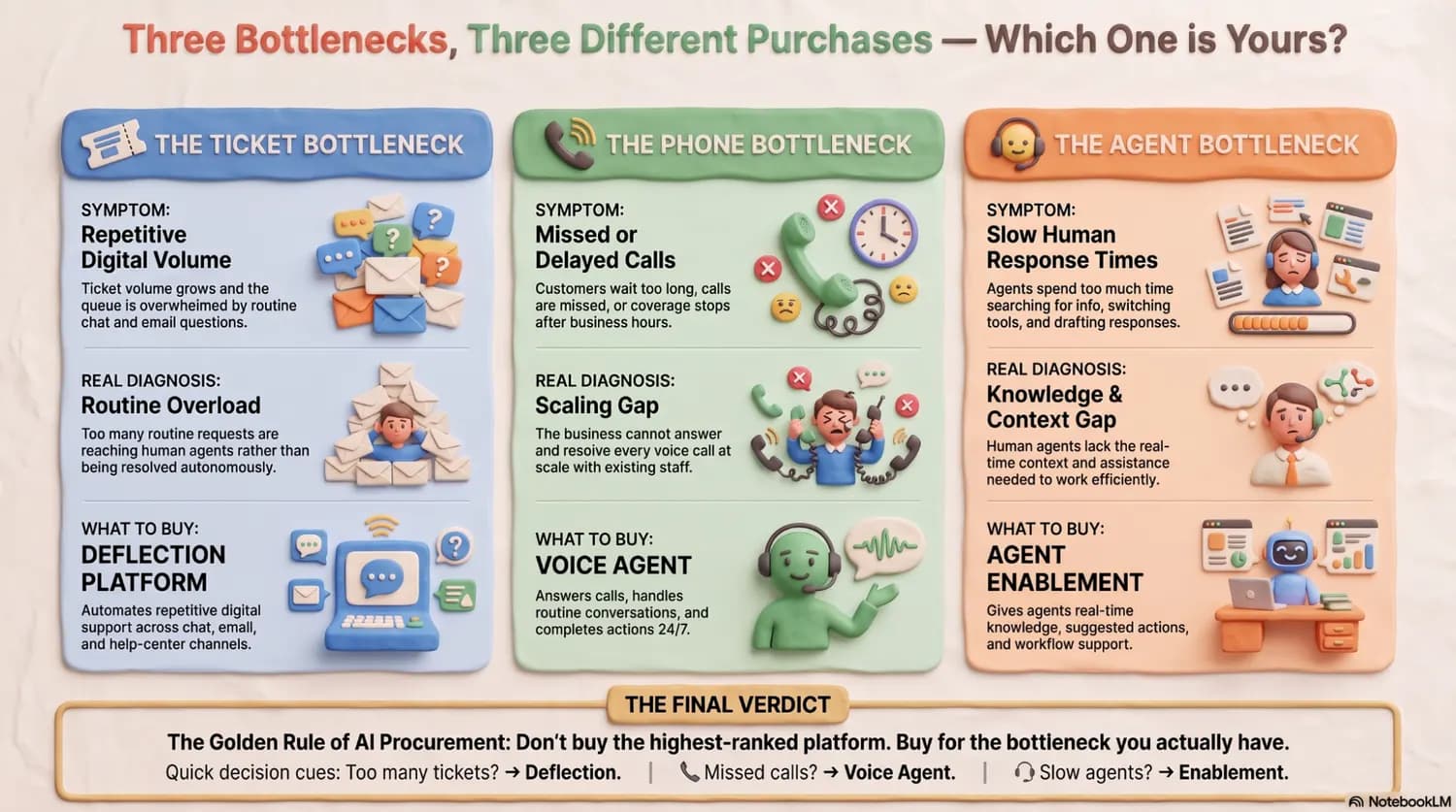
Symptom: the queue never clears. High volume, mostly repetitive, mostly digital - chat, email, in-app. Your agents spend their day on password resets and order-status questions.
Diagnosis: you need deflection and autonomous resolution. This is exactly what Decagon is built for, and it is genuinely very good at it. If you also have a six-figure budget and a procurement process, stop reading comparison articles and go evaluate Decagon properly, alongside Sierra, Fin and Ada. That's the honest advice.
Problem 2: Nobody is answering the phone
Symptom: missed calls. Voicemail nobody returns. Enquiries arriving after 5pm that are gone by 9am. Bookings lost because the line rang out.
Diagnosis: deflecting chat tickets will not fix a ringing phone. This is a genuinely different category of product, and it's the mismatch we see most often. If your revenue leaks through the phone line, you need an AI voice agent that answers the phone, not a ticket-deflection platform. Voice is also metered differently from chat in most stacks - real-time processing and telecom layers change the cost profile entirely - so a chat-shaped quote tells you very little about what voice will cost. We've written about why voice, IVR and chat solve different problems if you want the longer version.
Problem 3: Your agents are underperforming
Symptom: quality varies by agent. New hires take months to ramp. CSAT is inconsistent and you can't see why.
Diagnosis: you need agent enablement - coaching, QA, real-time assist. Automating the front line does not fix the back line. If you deflect 40% of tickets but the 60% that reach a human are still handled inconsistently, you've bought the wrong thing. This is a category Decagon doesn't serve, and neither do we - look at agent-assist and coaching platforms instead.
If you take one thing from this page: write down what actually goes wrong on a bad day, before you take a single vendor call. If the answer is "the queue never clears", you're in Decagon's lane. If it's "the phone rings out" or "my agents are inconsistent", you're about to spend two months evaluating the wrong category of product.
What Decagon is (and who it's genuinely built for)
Let's be fair to them, because most of this SERP isn't. Decagon is an enterprise AI customer support platform, founded in 2023, that deploys autonomous agents to handle support conversations end to end - not just drafting replies, but taking actions like processing refunds and updating subscriptions. It reached a reported $4.5B valuation in March 2026 after a $250M raise, and its customer list includes Duolingo, Chime, Hertz, Notion, Rippling and Affirm.
Its distinctive idea is Agent Operating Procedures - workflows described in plain English that compile into executable logic, so non-technical teams can iterate on how the agent behaves. That's a genuinely good piece of product design, and it's why enterprises with complex, high-volume support operations like it.
Who it's built for: companies with enough digital ticket volume to justify a six-figure contract, a team to run it, and a procurement process to buy it. Who it isn't built for: anyone who needs to try before buying. There is no free trial, no sandbox, no self-serve tier. Getting a number means booking a discovery call, sharing your ticket volume, and waiting for a custom proposal.
What Decagon costs - and why nobody can tell you exactly
⚠️ Read this before you read any Decagon pricing figure, here or anywhere else. Decagon publishes no pricing. No page, no tiers, no calculator. That means every number circulating online - including the ones below - is a third-party estimate of a private contract, and most of them are published by Decagon's competitors. We've included them because a range is more useful than nothing, but treat them as approximate and confirm directly with Decagon before you budget anything.
| Component | Reported figure | Confidence |
|---|---|---|
| Annual platform fee | ~$50,000 / year | Cited consistently across five independent teardowns - but reported, never confirmed by Decagon |
| Per-conversation rate | ~$0.99 / conversation (estimate) | Single-source estimate, repeated. Volume discounts reportedly available. |
| Per-resolution rate | ~$0.50 / resolution (reported, negotiated) | One reported enterprise rate. Treat as an outlier data point, not a list price. |
| Typical total contract | Six figures; reported range ~$95K–$590K+ | Range from third-party teardowns |
| Reported median annual spend | ~$400K | Vendr marketplace data (buyer-side procurement data - the most credible source available) |
To Decagon's credit, they've written openly about how they price, where they confirm the two models and note that the vast majority of their customers choose per-conversation. The opacity isn't dishonesty - it's a deliberate enterprise sales motion. It just means you cannot budget without entering their pipeline, and for a lot of teams that alone is the disqualifier.
The line item almost every comparison forgets
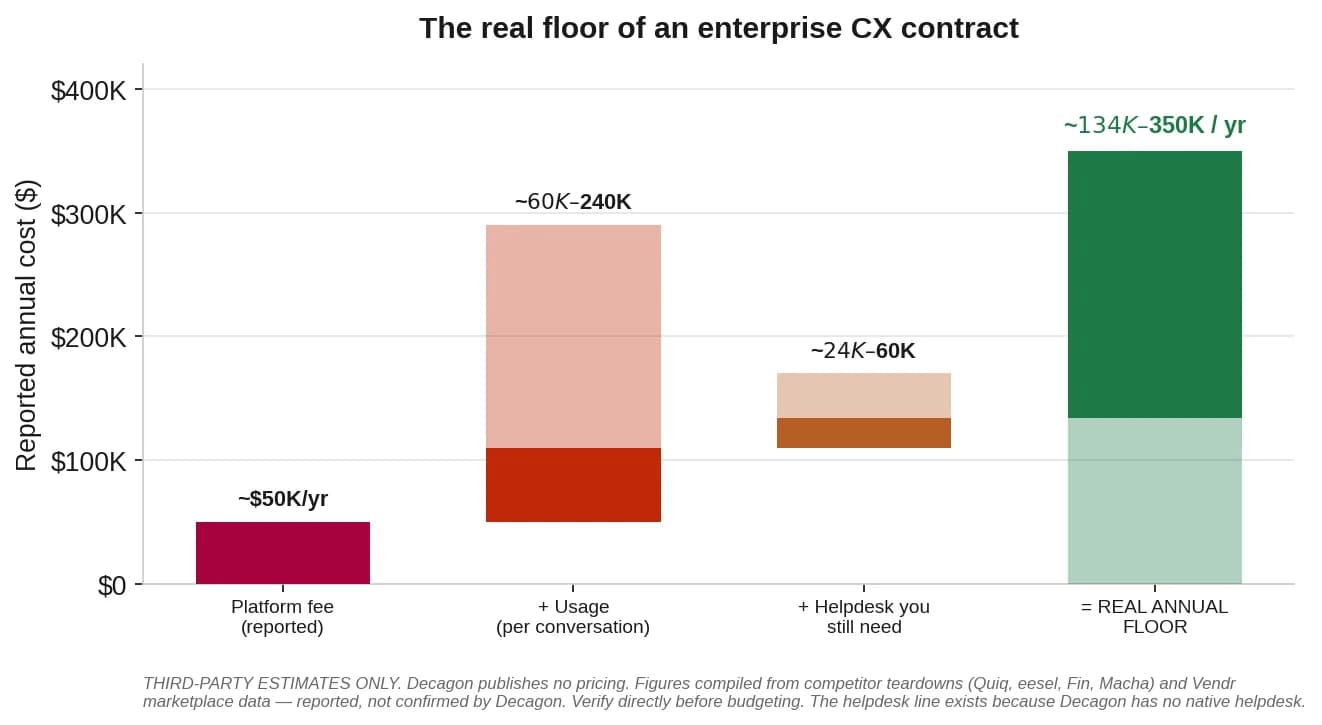
Decagon has no native helpdesk. It's an AI layer that sits on top of one. So you keep running - and keep paying for - Zendesk, Salesforce Service Cloud, or whatever you use today, for human agent workflows, inbox management and reporting.
Do the arithmetic. Zendesk runs roughly $55–$169 per agent per month. Salesforce Service Cloud starts around $175+ per user per month. For a 20-agent team, that's $2,000–$5,000+ per month - $24,000 to $60,000 a year - that you are still paying, before a single AI conversation is billed.
So the real floor isn't the reported ~$50K platform fee. It's that fee, plus usage, plus a helpdesk contract you never get to cancel. Nearly every comparison article in this space quotes the platform fee and stops there.
This isn't a criticism of the architecture - layering on top of an existing helpdesk is a sensible design, and it's why enterprises can adopt Decagon without ripping out their stack. But if you're building a business case, the helpdesk line has to be in it.
Per-conversation vs per-resolution - where your risk sits
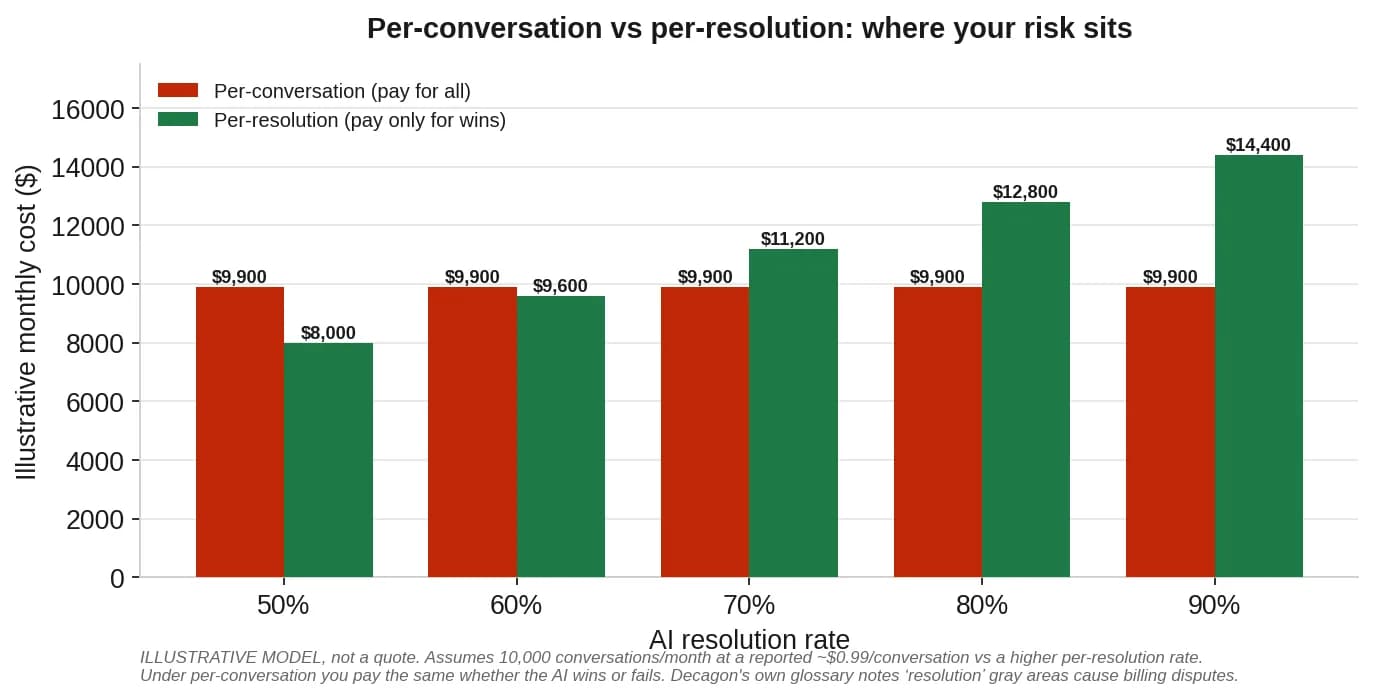
Decagon offers two models, and the difference decides who carries the risk when the AI fails.
| Model | How it bills | Who carries the risk |
|---|---|---|
| Per-conversation | A fixed rate for every interaction the AI touches - resolved or not | YOU. If the AI fails and escalates, you still pay the AI fee, then pay a human to fix it. |
| Per-resolution | A higher rate, but only for conversations the AI closes without a human | The VENDOR - in theory. In practice, it depends entirely on how "resolved" is defined in your contract. |
The per-resolution model sounds obviously better, and it often is - but the ambiguity is real, and Decagon says so themselves. Their own glossary entry on resolution-based pricing acknowledges that defining a resolution "can be tricky" and that "gray areas can lead to billing disagreements." If a customer gets a partial answer and gives up, is that a resolution? If you go down this route, pin the definition down hard in the contract - that sentence is the single most useful thing on Decagon's own website for a prospective buyer.
And note which model they steer you toward. Decagon states plainly that the vast majority of their customers choose per-conversation - the model where you pay whether the AI wins or loses.
The best Decagon alternatives, by which problem you're solving
Not a ranking - a mapping. Find your row.
| If your problem is… | Look at | Why |
|---|---|---|
| High-volume digital deflection, enterprise budget | Decagon, Sierra, Ada | This is genuinely Decagon's lane. Compare it properly against its actual peers. |
| Deflection, but you want published pricing | Fin, eesel, Featurebase | Transparent, self-serve rates and no six-figure floor. (Note: Salesforce agreed to acquire Fin/Intercom in June 2026 - worth weighing for a long-term decision.) |
| You need to layer AI onto an existing helpdesk cheaply | eesel, Macha | Task-based billing, sits on Zendesk/Freshdesk, trial before you buy |
| Agents are inconsistent - quality, coaching, QA | Agent-assist / enablement platforms | A different category. Deflection doesn't fix agent quality. |
| Nobody is answering the phone | Voice agent platforms (incl. SuperMIA) | A different category again - and the mismatch we see most. See below. |
If you want the broader selection framework rather than just the Decagon comparison, our full guide to choosing an AI chatbot platform walks through the criteria that actually matter. And if you're comparing developer voice platforms - a genuinely different purchase - that comparison is separate.
Where SuperMIA fits (and where it doesn't)
We're in that table, so here's the honest version.
SuperMIA is NOT an enterprise ticket-deflection platform. If you're running a very high-volume digital support operation with a six-figure budget, a procurement department, and a dedicated CX team - Decagon, Sierra and Ada are the right shortlist, and we're not on it. We'd rather tell you that than waste a call.
SuperMIA IS the answer if your bottleneck is the phone. That's the mismatch we see constantly: a team goes shopping for enterprise deflection because that's what the market talks about, when what's actually costing them money is a phone ringing out at 6pm.
SuperMIA's AI chat agent and voice agent run on one platform, so the same agent handles a web chat and answers the phone - and you get published pricing you can read without a discovery call. If you want to see how that works end to end, how MIA handles customer conversations end to end covers it. The trade-off is real and worth naming: we are not built for the scale or the workflow depth that a Fortune-500 CX operation with 100,000 monthly tickets needs. That is Decagon's territory, and they've earned it. Ours is the mid-market team that needs voice and chat working next week, with SuperMIA's plans and pricing you can read on a public page.
Not sure which problem you're solving? Book a 15-minute demo →
Frequently asked questions
How much does Decagon AI cost?
Decagon does not publish pricing. There is no pricing page, no self-serve tier, and no free trial, so every figure circulating online is a third-party estimate rather than a confirmed rate. Independent teardowns consistently report an annual platform fee of roughly $50,000 plus usage charged either per conversation or per resolution, with total contracts commonly running into six figures. Treat all of those numbers as approximate and confirm directly with Decagon before budgeting.
What is the best Decagon alternative?
It depends on which problem you are solving. If you genuinely need high-volume digital ticket deflection at enterprise scale, the closest comparisons are Sierra, Fin, and Ada. If your bottleneck is unanswered phone calls rather than chat tickets, you need a voice agent platform instead, which is a different category entirely. If your agents are underperforming, you need agent enablement and coaching tools rather than autonomous deflection. Comparing vendors before identifying the bottleneck is how teams lose two months in the wrong sales cycle.
Does Decagon have a native helpdesk?
No. Decagon operates as an AI layer on top of an existing helpdesk, so you continue to run and pay for a platform such as Zendesk or Salesforce Service Cloud underneath it for human agent workflows, inbox management, and reporting. That licence commonly adds several thousand dollars a month before any AI charge, and it is the line item most cost comparisons leave out of the total.
What is the difference between per-conversation and per-resolution pricing?
Under per-conversation pricing you pay a fixed rate for every interaction the AI handles, whether it succeeds or escalates to a human, so you carry the cost of failed attempts. Under per-resolution pricing you pay a higher rate but only for conversations the AI closes without human help. Decagon states that the vast majority of its customers choose per-conversation, and its own glossary acknowledges that defining a resolution can be tricky and that gray areas can lead to billing disagreements.
Is Decagon worth it?
For the buyer it was designed for, yes. Decagon is a well-funded enterprise platform used by companies including Duolingo, Chime, Notion, and Rippling, and it is genuinely strong at autonomous resolution of high-volume digital support. It is a poor fit if you cannot justify a six-figure annual commitment, if you need to evaluate before buying, or if your real bottleneck is voice or agent quality rather than digital ticket volume.

Urvil Dhanani
Urvil Dhanani is the AI/ML Lead at SuperMIA, focused on the architecture behind reliable conversational AI - agent design patterns, voice and chat orchestration, and platform evaluation. He writes practical, vendor-neutral guides that help technical teams build and choose AI systems that hold up in production.