
Table of Contents
- First, the three things that changed in 2026
- The success penalty: why your AI bill grows as the AI improves
- What an Intercom/Fin bill actually looks like
- The gap almost nobody leads with: there's no phone line
- Name what you're escaping - then pick
- The best Intercom alternatives, by what you're escaping
- When you should stay on Fin
- Where SuperMIA fits (and where it doesn't)
- Frequently asked questions
Intercom renamed itself Fin in May 2026, and in June Salesforce signed a deal to acquire it for around $3.6 billion, folding it into Agentforce. Its AI charges $0.99 per resolution with no cap - so your bill grows as the AI improves. The best alternative depends on what you're escaping: cost volatility, the AI ceiling, or the missing phone line.
If the phone is the problem - book a 15-minute demo →
Key takeaways
- Intercom is now Fin. The company renamed itself after its AI agent in May 2026.
- Salesforce is acquiring it (~$3.6B, announced 15 June 2026). It will be folded into Agentforce.
- Per-resolution pricing penalises success. $0.99 per resolution, no volume discount, no cap. The better the AI gets, the more you pay.
- There is no native voice. If your customers phone you, that's a hard limit.
- Fin is still right for some teams. Chat-first, strong help centre, steady volume - don't switch on someone else's say-so.
First, the three things that changed in 2026
Most "best Intercom alternatives" articles you'll read today were written before June, and it shows. Three things have changed, and each of them should affect your shortlist.
It's not called Intercom any more
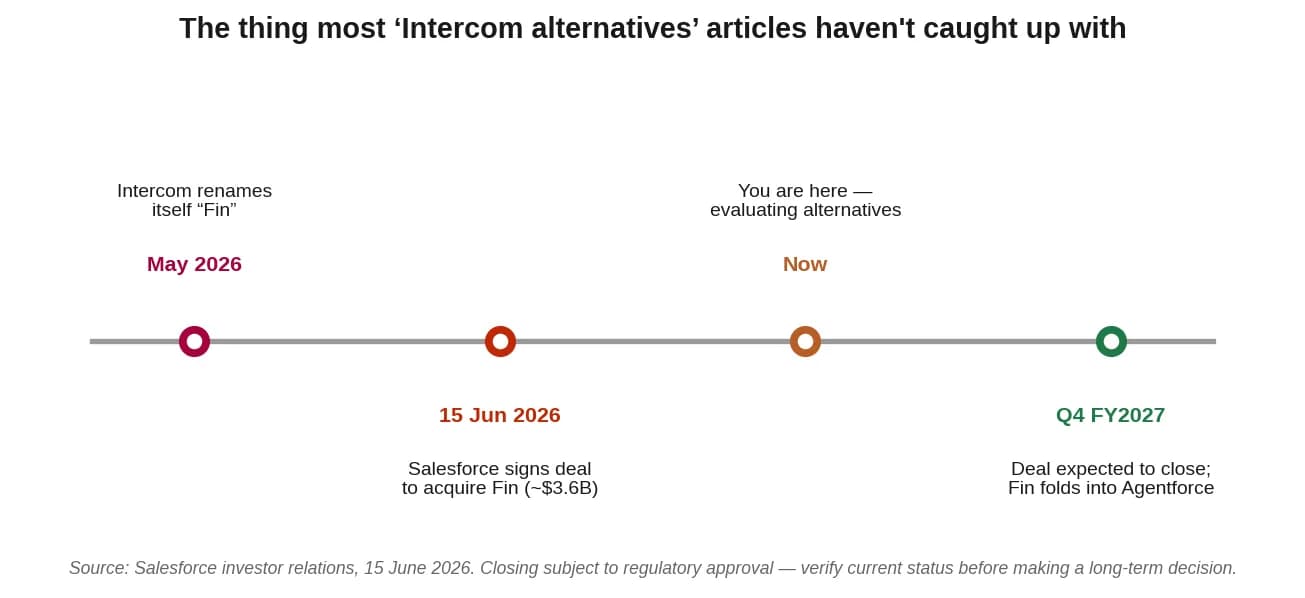
In May 2026 the company renamed itself Fin - after its AI agent - signalling a full pivot around the AI business. So if you're searching for Intercom alternatives, you're searching for a brand that no longer exists under that name. Most comparison articles, and most of the internet, haven't caught up.
Salesforce is acquiring it
On 15 June 2026, Salesforce's announcement of the acquisition confirmed a definitive agreement to buy Fin for approximately $3.6 billion. Salesforce plans to fold Fin's technology into Agentforce, its AI agent platform. The deal is expected to close in the fourth quarter of Salesforce's 2027 fiscal year, subject to regulatory approval. TechCrunch's coverage of the deal has the wider context.
For balance: this is not automatically bad news. Salesforce says Fin brings more than 30,000 business customers and an AI agent that resolves roughly 76% of support volume without a human, and being inside Agentforce may well mean more investment, not less. Those are Salesforce's figures, not ours.
What that means if you're signing a contract. The practical question isn't "is Salesforce good or bad". It's this: are you comfortable signing a two- or three-year contract with a product whose roadmap, pricing model and integration priorities will be set by a different company by the time your renewal comes around? For some teams that's fine - Salesforce is not going to switch it off. For others, especially those who chose Intercom precisely because it wasn't enterprise CRM software, it's a genuine reason to look around now rather than in eighteen months.
The success penalty: why your AI bill grows as the AI improves
This is the mechanic that catches people out, and it's worth understanding before you compare a single alternative. Fin AI charges $0.99 per resolution - with a 50-resolution monthly minimum, no volume discount, and no cap.
Read that again, because the consequence is counterintuitive: you pay more when the AI does better. Improve your help centre, tune your knowledge base, get your resolution rate from 50% to 80% - congratulations, your bill just went up 60%. As Lorikeet put it in their analysis of the pricing curve: as Fin gets more effective, the bill grows.
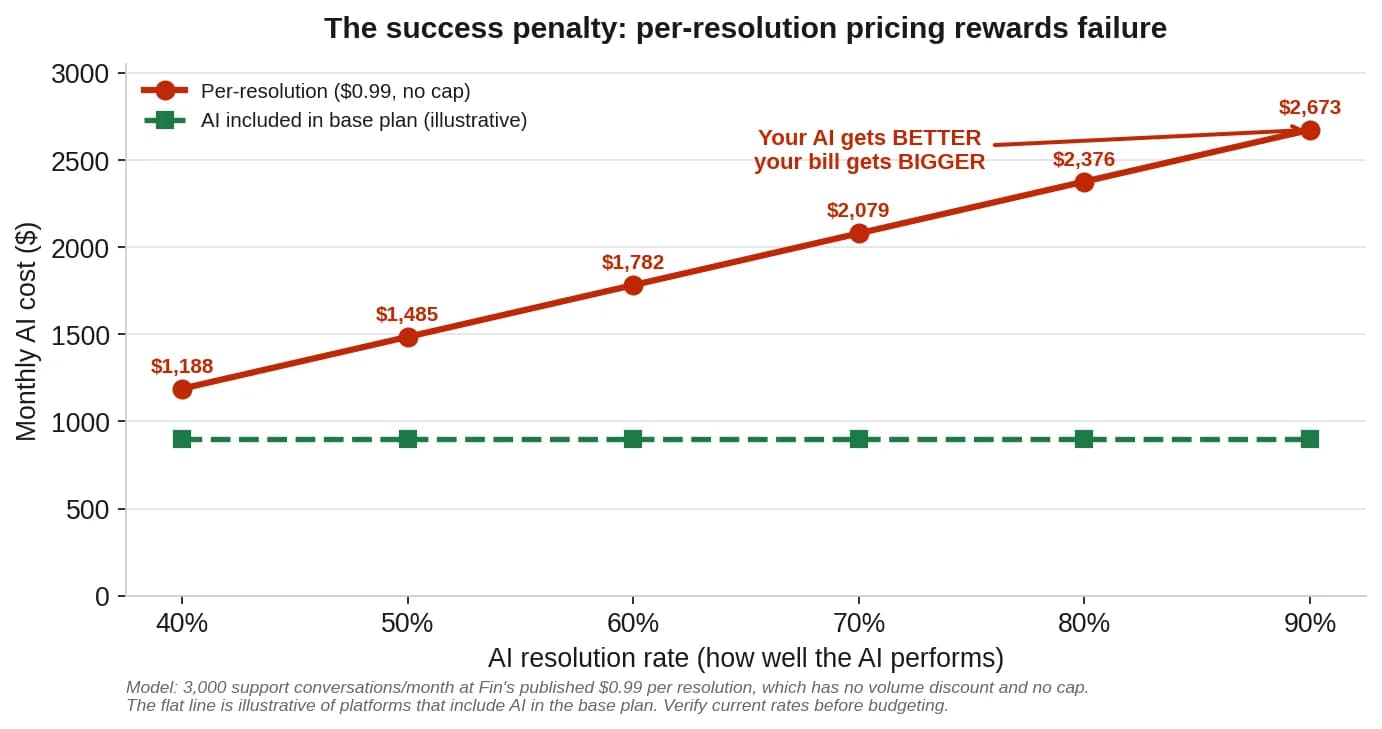
⚠️ Why this matters more than the sticker price. Every other efficiency investment you make - better docs, clearer onboarding, a tidier knowledge base - normally reduces your support costs. Under per-resolution pricing, those same investments increase your AI bill, because they raise the resolution rate. Your incentives and your vendor's incentives are pointing in the same direction, which sounds good until you're the one paying for it.
None of this makes per-resolution pricing dishonest. It's a defensible model - you only pay when the AI actually works, which is more than can be said for per-conversation billing. But you have to model it against your own trajectory, not today's numbers.
What an Intercom/Fin bill actually looks like
Two line items, billed separately: seats and AI.
| Component | Published price | Notes |
|---|---|---|
| Essential seat | ~$29 / seat / month | Entry tier |
| Advanced seat | ~$85 / seat / month | The tier most mid-market teams land on |
| Expert seat | ~$132 / seat / month | Top tier |
| Fin AI Agent | $0.99 per resolution | Separate from seats. 50-resolution monthly minimum. No volume discount. No cap. |
| Add-ons | Extra | WhatsApp, proactive messaging and others are billed on top |
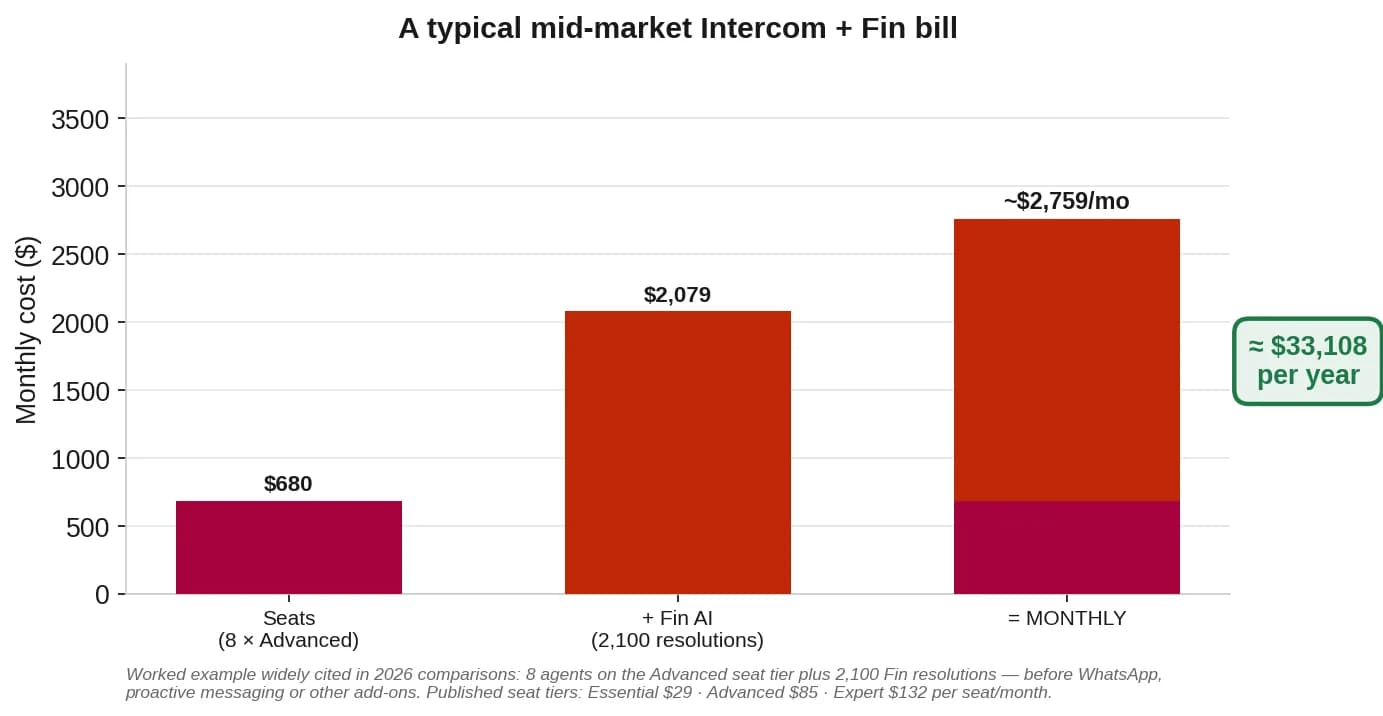
Work a real example. Eight agents on the Advanced tier is $680/month in seats. Add 2,100 Fin resolutions at $0.99 and that's another $2,079. Total: roughly $2,960 a month, or about $35,500 a year - before WhatsApp, proactive messaging, or any other add-on. That worked example comes from Lorikeet's pricing analysis, and the arithmetic is easy enough to check yourself.
The number that should worry you isn't $35,500. It's what happens to that second line when your volume doubles, or when your resolution rate climbs. Neither of those is capped.
The gap almost nobody leads with: there's no phone line
Intercom - now Fin - is chat-first. It always has been. That's its heritage and, honestly, its strength: the Messenger widget is excellent, and for in-app B2B SaaS support it's still one of the best experiences in the category.
But it has no native voice. Independent comparisons list this consistently among the reasons teams leave - alongside pricing volatility and missing contact-centre features. And if a meaningful share of your customers pick up the phone, this isn't a feature gap. It's a category mismatch. Deflecting a chat ticket does nothing at all for a call that rings out at 6pm.
Who this actually disqualifies: clinics, dental practices, home-services businesses, property managers, hospitality, salons, insurance agencies, anyone with a booking line. In those businesses the phone is the support channel, and a world-class chat widget is solving a problem you don't have. If that's you, you're not shopping for an Intercom alternative at all - you're shopping for an AI voice agent that answers the phone, which is a different product entirely.
We've written separately about why chat and voice solve different problems, and it's worth reading before you shortlist anything, because this is the single most common mis-diagnosis we see. Teams spend two months evaluating chat platforms when the revenue was leaking through the phone line the whole time. If that's your situation, an AI voice agent that answers the phone is the category you want.
Name what you're escaping - then pick
Borrowing a good idea from open.cx, whose framing on this is the sharpest in the category: don't start by comparing vendors. Start by naming what you're trying to get away from. The right alternative falls out of that answer almost automatically.
| What you're escaping | What you actually need | Where to look |
|---|---|---|
| Cost volatility - the bill moves and you can't forecast it | AI included in the base plan, or a cap | Plain, Help Scout, platforms with flat AI pricing |
| The AI ceiling - it deflects FAQs but can't take actions | Autonomous action, not deflection | Lorikeet, Sierra, Decagon (enterprise), open.cx |
| No phone line - your customers call and nobody answers | Native voice | A voice agent platform (incl. SuperMIA) - a different category |
| It's just too expensive for what we need | A solid, cheaper helpdesk | Freshdesk, Help Scout, Zoho Desk, Crisp, Tidio |
| Chat-first architecture struggling with real ticketing | A proper ticketing backbone | Zendesk, Freshdesk, Front |
| Roadmap uncertainty after the Salesforce deal | An independent vendor | Any of the above - but weigh it honestly, not reflexively |
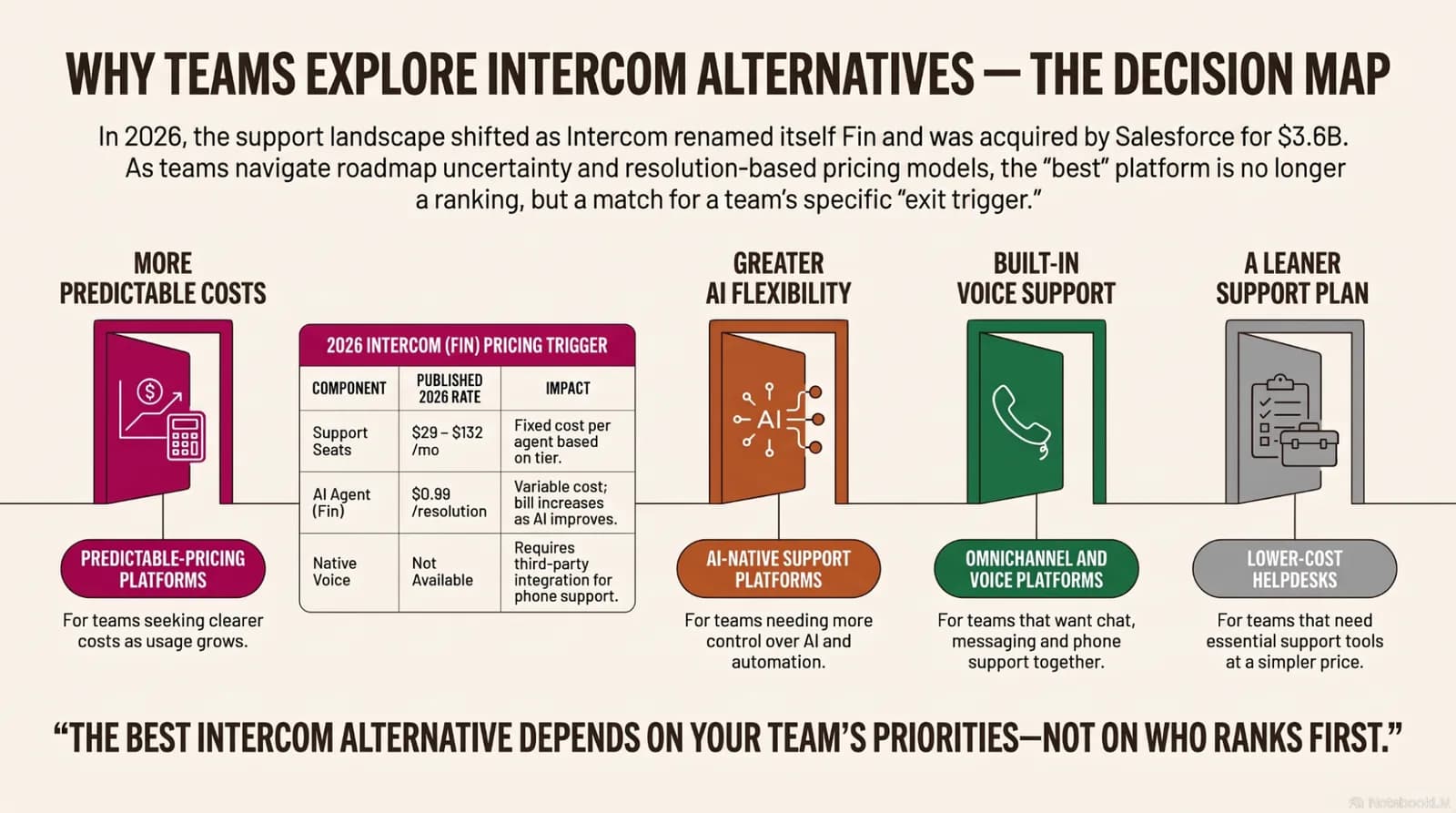
The best Intercom alternatives, by what you're escaping
A mapping, not a ranking. Published prices where available - verify before buying, because everything in this category moves.
| Platform | Best for | Roughly |
|---|---|---|
| Zendesk | Complex ticketing, mature reporting, big support ops | Seat-based, from the high teens to $169/agent/mo; AI add-ons extra |
| Freshdesk | Mid-market wanting most of the features for much less | Free tier; paid from low double digits per agent |
| Help Scout | Small, email-first teams who value simplicity | From ~$22/user/mo; free migration from Intercom |
| Front | Collaborative inbox, shared-ownership workflows | $25 / $65 / $105 per seat/mo |
| Plain | B2B SaaS with Slack/Teams-native support and Linear/Jira sync | AI in base pricing - no per-resolution charge |
| Gorgias | Shopify and ecommerce order-related tickets | From ~$50/mo |
| Crisp / Tidio / Zoho Desk | SMBs who just need chat + inbox affordably | From ~$9–$29/mo |
| Voice agent platforms (incl. SuperMIA) | Businesses whose customers phone them | A different category - see below |
If you want the broader selection framework rather than just the Intercom comparison, our full guide to choosing an AI chatbot platform walks through the criteria that actually matter.
When you should stay on Fin
Stay if: you're a chat-first B2B SaaS company with a strong help-centre culture; your support is deflection-shaped rather than action-shaped; your ticket volume is steady enough that $0.99 per resolution doesn't outrun your budget; the Messenger widget is genuinely part of your product experience; and the phone isn't a meaningful channel for you. For that team, Fin is excellent and switching would cost you more than it saves. Migration is not free - it costs weeks, and it risks the customer experience while you do it.
Every other page in this SERP needs Intercom to be wrong. It isn't. It's specific - and if you're the buyer it was built for, the honest advice is to stay put and negotiate harder on the AI line.
Where SuperMIA fits (and where it doesn't)
We're on that list, so here's the straight version.
SuperMIA is NOT a helpdesk replacement. If you need a mature ticketing backbone, SLA management, deep reporting, and a shared agent inbox that fifty people live in all day - Zendesk and Freshdesk do that properly and we don't. Nor are we a drop-in swap for the Messenger widget in a B2B SaaS product. Those are real products solving real problems, and we're not going to pretend otherwise.
SuperMIA IS the answer if the phone is your problem. That's the gap Intercom has never filled, and it's the mismatch we see most often: a business shopping for chat alternatives when what's actually costing them money is a call ringing out after hours.
SuperMIA's AI chat agent and voice agent run on one platform - so the same agent that handles a web chat also answers the phone, books the appointment, and hands off cleanly when it needs to. You can see how MIA handles customer conversations end to end if you want the detail. And our pricing doesn't rise every time the AI gets better at its job - you can read SuperMIA's plans and pricing on a public page, without a discovery call. The trade-off is genuine and worth naming: we are not a fifty-agent contact-centre helpdesk, and if that's what you need, we're the wrong answer.
If the phone is the problem - book a 15-minute demo →
Frequently asked questions
Is Intercom being acquired?
Yes. On 15 June 2026, Salesforce announced it had signed a definitive agreement to acquire Fin, the company formerly known as Intercom, for approximately $3.6 billion. Salesforce plans to fold Fin's technology into Agentforce, its AI agent platform. The transaction is expected to close in the fourth quarter of Salesforce's 2027 fiscal year, subject to regulatory approval. Intercom had already renamed itself Fin, after its AI agent, in May 2026.
How much does Fin AI cost per resolution?
Fin AI is priced at $0.99 per resolution, with a minimum of 50 resolutions per month, and independent analyses report no volume discounts and no spending cap. Seats are billed separately, with published tiers at approximately $29, $85, and $132 per seat per month. The important consequence of this structure is that the AI charge scales directly with how many conversations the AI successfully resolves, so a better-performing agent produces a larger bill.
What is the best Intercom alternative?
It depends on what you are trying to escape. If the problem is unpredictable AI costs, look for platforms that include AI in the base plan rather than charging per resolution. If it is the AI ceiling on complex or multi-step requests, look at platforms built for autonomous action rather than deflection. If it is the missing phone line, you need a platform with native voice, which is a different category. And if it is simply price, cheaper helpdesks such as Freshdesk, Help Scout, Zoho Desk, and Crisp cover the basics at a fraction of the cost.
Does Intercom have native voice?
No. Intercom, now Fin, is chat-first, and independent comparisons consistently list the absence of native voice and contact-centre features among the main reasons teams move away from it. If a meaningful share of your customers pick up the phone, that gap is usually decisive, because deflecting chat tickets does nothing for a call that rings out.
Should I switch away from Intercom?
Not necessarily. If you are a chat-first business with a strong help centre, steady ticket volume, and no significant phone channel, Fin is a genuinely strong product and switching may gain you little. Consider moving if your AI costs rise unpredictably as resolution rates improve, if the AI cannot take the actions your workflows require, if your customers phone you, or if the pending Salesforce acquisition creates roadmap uncertainty you are not comfortable underwriting in a multi-year contract.

Urvil Dhanani
Urvil Dhanani is the AI/ML Lead at SuperMIA, focused on the architecture behind reliable conversational AI - agent design patterns, voice and chat orchestration, and platform evaluation. He writes practical, vendor-neutral guides that help technical teams build and choose AI systems that hold up in production.