
Table of Contents
- The after-hours problem: where dental calls go to die
- What is an AI answering service for dentists?
- How an after-hours AI call actually works
- What happens with a dental emergency?
- What one missed after-hours call really costs
- AI vs. a traditional answering service
- Is patient data safe? (HIPAA in one minute)
- How to choose an after-hours AI (and where SuperMIA fits)
- Frequently asked questions
Quick Answer
An AI answering service for dentists handles calls 24/7 so after-hours patients do not hit voicemail. It understands caller intent, books routine appointments directly into your PMS, and escalates true emergencies to your on-call team. The practical result is fewer lost callers and better front-desk continuity outside office hours.
Key takeaways
- After-hours unanswered calls are a major revenue leak for dental practices.
- AI is strongest on nights, weekends, and overflow periods.
- Emergency routing should always hand off to a human immediately.
- Routine calls can be booked directly into your calendar with integration.
- Capturing even a small number of missed new-patient calls can cover service cost quickly.
The after-hours problem: where dental calls go to die
Many high-intent callers reach practices outside staffed hours and fall into voicemail. Industry data frequently cites significant unanswered-call rates and poor callback behavior, which means patient demand leaks to nearby competitors. For clinics, this is not only a CX issue but a measurable revenue problem.
The pattern is predictable. A patient with a cracked tooth on a Saturday night, a new resident searching for a dentist after work, or a parent whose child knocked out a tooth at a weekend game - these are the highest-intent calls a practice receives, and they almost always land outside staffed hours. Research from the ADA Health Policy Institute consistently shows administrative capacity and access as top pressures on practices, while staffing benchmarks from the MGMA highlight how hard it is to keep a front desk fully covered. When the phone rings and no one answers, most callers don't leave a voicemail - they dial the next practice on the list.
This is exactly the gap a dental voice AI is built to close: it answers the calls your team physically can't, at the moments your patients are most motivated to book.
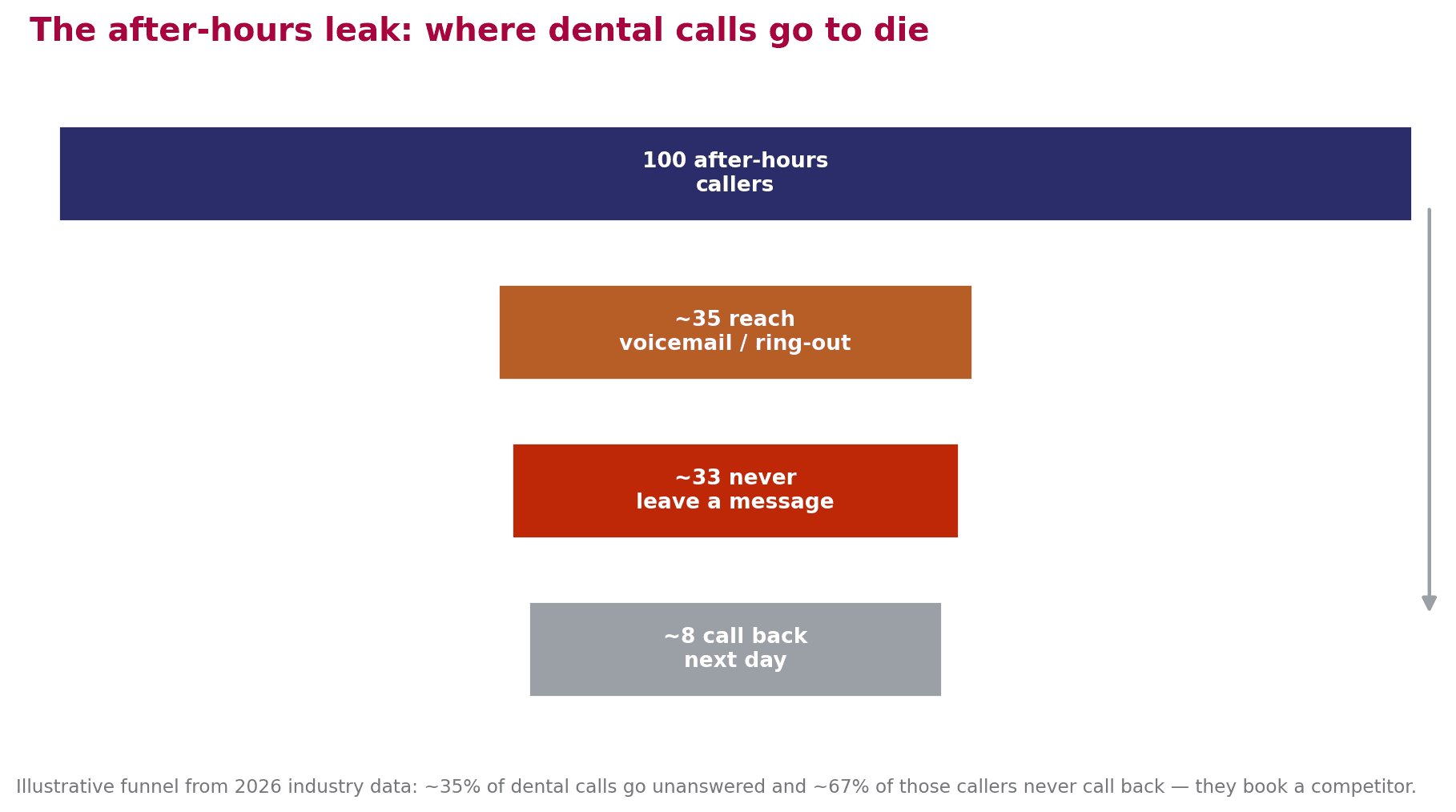
Figure 1. After-hours call leakage in dental practices.
What is an AI answering service for dentists?
It is a voice AI layer that answers your practice line when team members are unavailable. Unlike voicemail or message-only services, it can complete actions: gather patient details, answer routine questions, book appointments, and escalate urgent calls. In practice, teams often deploy it first for after-hours and lunch-hour overflow where missed-call risk is highest.
Think of it as a tireless front-desk teammate that never sleeps. It's the same core voice AI technology behind modern phone automation, tuned specifically for the language, intents, and compliance demands of a dental practice. For a wider look at how AI supports the front office beyond just answering calls - scheduling, recall, insurance verification - see our dental practice solutions. The answering service is usually the first piece practices deploy because the after-hours revenue leak is the easiest win to measure.
How an after-hours AI call actually works
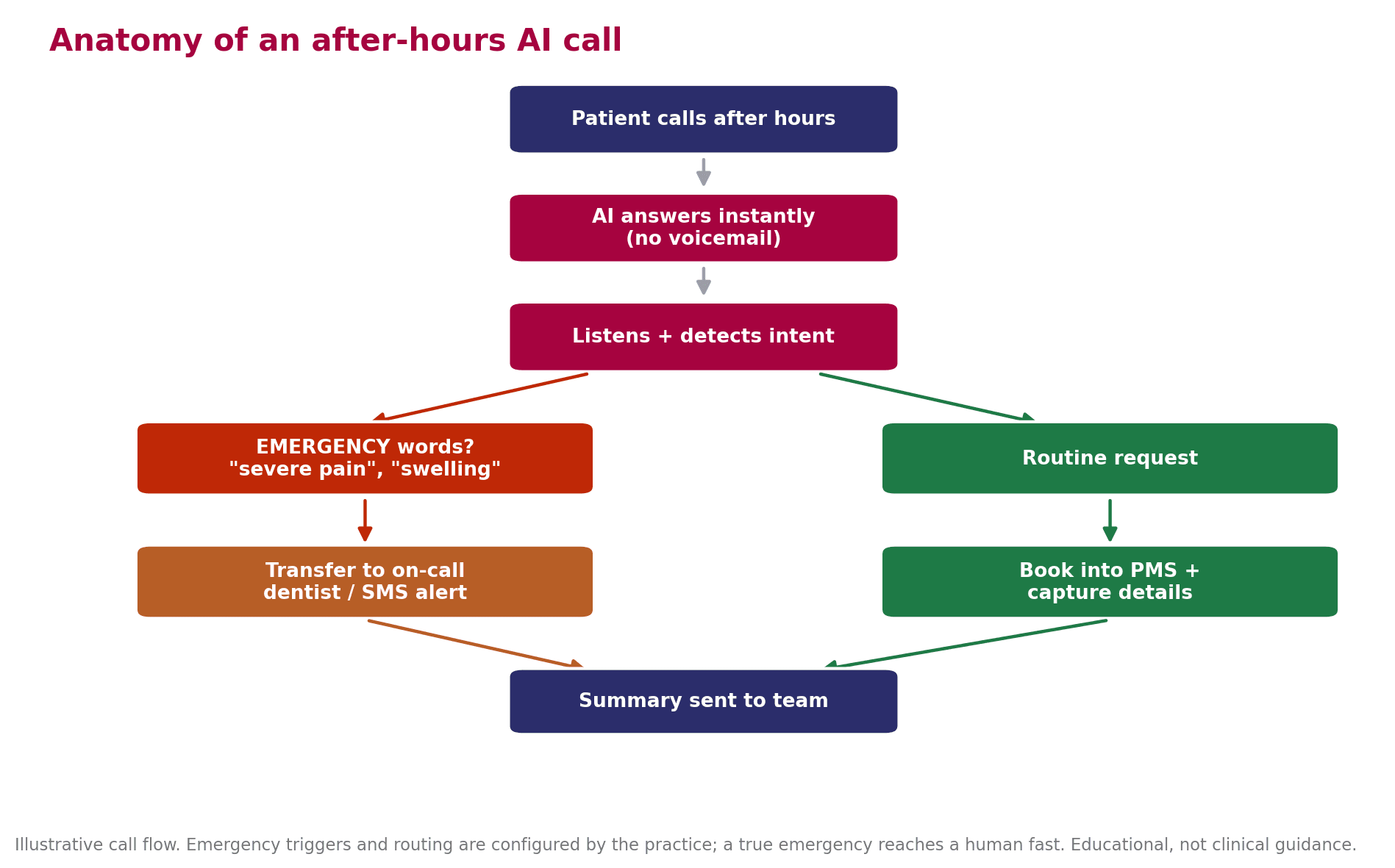
Figure 2. Typical after-hours AI call workflow for dental practices.
- Answer immediately, 24/7.
- Detect intent in natural language.
- Route emergencies to human on-call pathways.
- Book routine requests into PMS schedules.
- Send call summary to office staff for follow-up.
What happens with a dental emergency?
Emergency handling should be rule-driven and immediate. Practices define trigger intents (for example severe pain, swelling, trauma, uncontrolled bleeding), and the AI exits normal flow to transfer to an on-call dentist or alert pathway. AI should triage and route; licensed humans handle urgent clinical decisions.
In practice the triage logic is conservative by design - it errs toward escalation. Walk through a real example: a caller says "I was hit in the mouth playing basketball and my tooth is loose and bleeding." The AI recognizes the trauma and bleeding triggers, immediately stops trying to book anything, confirms the patient's name and callback number, and connects to the on-call dentist or sends an urgent alert per the rules you set. It never attempts to give clinical advice. A softer call - "my filling fell out but it doesn't really hurt" - is handled differently: the AI books the soonest appropriate slot and flags it for the morning team. Getting these boundaries right is the single most important configuration decision, because a missed true emergency is far costlier than an over-cautious transfer.
Crucially, the AI documents every triage decision. Staff arrive to a clear log of which calls escalated, which booked, and why - so nothing falls through the cracks overnight and clinical accountability stays with licensed humans, where it belongs.
What one missed after-hours call really costs
The real benchmark is not monthly software price but opportunity cost. If one high-intent caller converts elsewhere, the loss can exceed many months of answering-service fees depending on treatment value and patient lifetime economics.
Put numbers to it. A new dental patient is worth a few hundred dollars in their first visit alone and often a few thousand over their lifetime once recurring hygiene, restorative work, and family referrals are counted. Now assume your practice misses just five high-intent after-hours calls a week. If even two of those would have booked and become patients, the annual value at risk runs well into five or six figures - orders of magnitude above the cost of an AI answering service. That asymmetry is why the math almost always favors coverage: see our transparent pay-per-task pricing and weigh it against the value of a single recovered new patient.
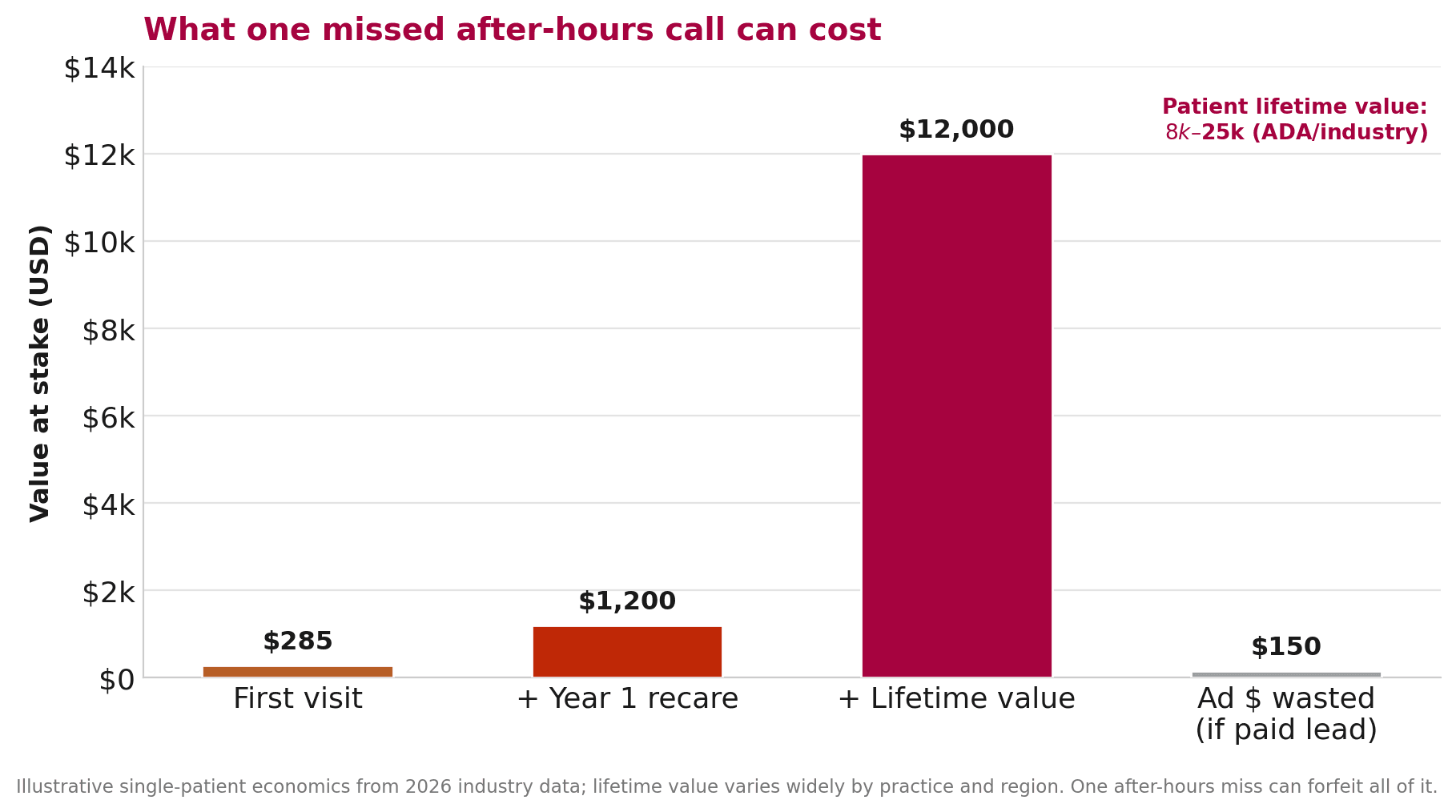
Figure 3. Revenue value at risk from a single missed after-hours call.
AI vs. a traditional answering service
| Dimension | AI answering service | Traditional service |
|---|---|---|
| Availability | Instant 24/7 coverage | Depends on staffing model |
| Appointment booking | Direct with PMS integration | Often message relay only |
| Hold and response time | Near-instant | Can vary at peak |
| Cost model | Flat or pay-per-task | Commonly per-minute |
The decisive difference is what happens after the call connects. A traditional service usually takes a message and relays it, which means the patient still waits until morning for an actual booking - and many won't wait. An AI answering service completes the job in the moment: it books the appointment, answers routine questions, and only escalates what genuinely needs a human. A growing advantage is multi-channel coverage: the same system that answers the phone can also run an AI chatbot on your website, so a patient who'd rather type than call gets the same instant booking experience. Unifying voice and chat under one assistant means no missed inquiry, regardless of how the patient chooses to reach you.
Is patient data safe? (HIPAA in one minute)
Any system handling patient calls may process PHI, so safeguards are non-negotiable: signed BAA, encryption, access controls, and auditability. If you need a checklist, review this HIPAA dental AI compliance guide before selecting a vendor.
To make that concrete, the controls follow the HHS HIPAA Privacy Rule: the vendor must sign a Business Associate Agreement, encrypt call data in transit and at rest, restrict access to authorized staff, and keep audit logs of who accessed what and when. Ask any prospective vendor to show these in writing before a single patient call is routed through their system. A reputable provider will have a BAA ready and clear documentation of its security posture; hesitation on either is a reason to walk away. Compliance is not a feature to add later - for a dental practice it is the entry ticket.
How to choose an after-hours AI (and where SuperMIA fits)
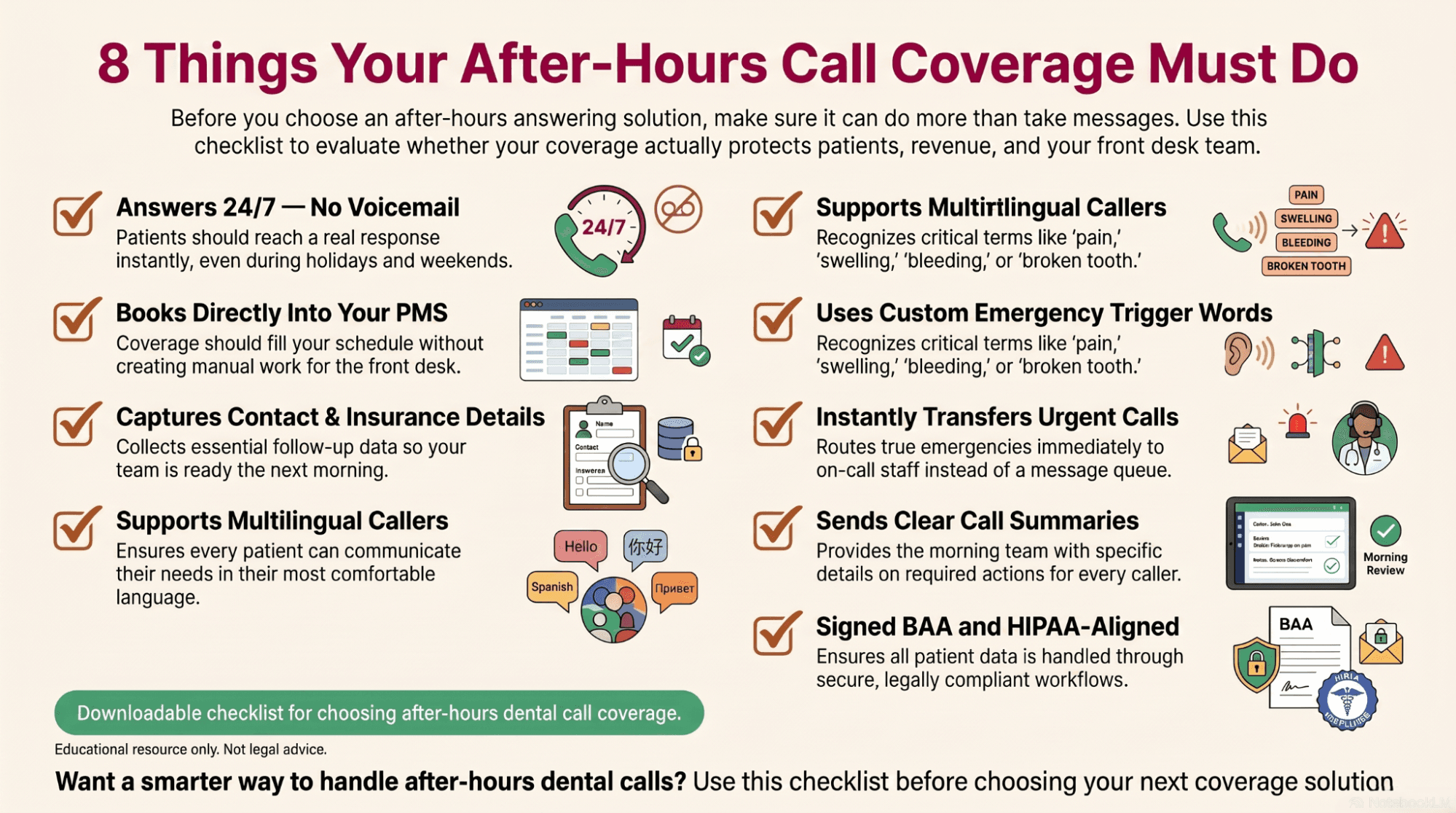
Prioritize five criteria: true 24/7 answer speed, real PMS write-back booking, configurable emergency routing, actionable team summaries, and BAA-backed compliance controls. SuperMIA AI dental assistant is designed around these operational requirements and can be tested on your call flow before rollout.
A few practical tests separate a real after-hours AI from a glorified voicemail. Ask to hear it handle a live emergency scenario and a routine booking back to back. Confirm it writes directly into your specific practice management system rather than emailing a message for someone to re-key. Check that the morning call summary is genuinely actionable - caller, intent, action taken - not just a recording you have to listen through. And verify the compliance paperwork is ready before you commit.
Because SuperMIA runs on a single conversational AI platform, the same setup that answers your after-hours phone also covers daytime overflow, website chat, and recall outreach - so you're buying one coherent system rather than stitching together point tools. Start with the after-hours gap where the revenue leak is largest, prove it on your own call flow, and expand from there once the numbers are in.
Hear it answer a real after-hours call.
See emergency routing, booking flow, and call summaries on your own scenarios.
Book a demo →Frequently asked questions

Harikrishna Patel
Harikrishna Patel is the founder of MIA – My Intelligent Assistant, the AI automation platform built under Botfinity Inc. in Dallas, Texas. With 15+ years in software engineering, AI/ML, and enterprise solution design, he focuses on creating practical, scalable AI tools that help businesses automate support, workflows, and operations through voice and chat.