
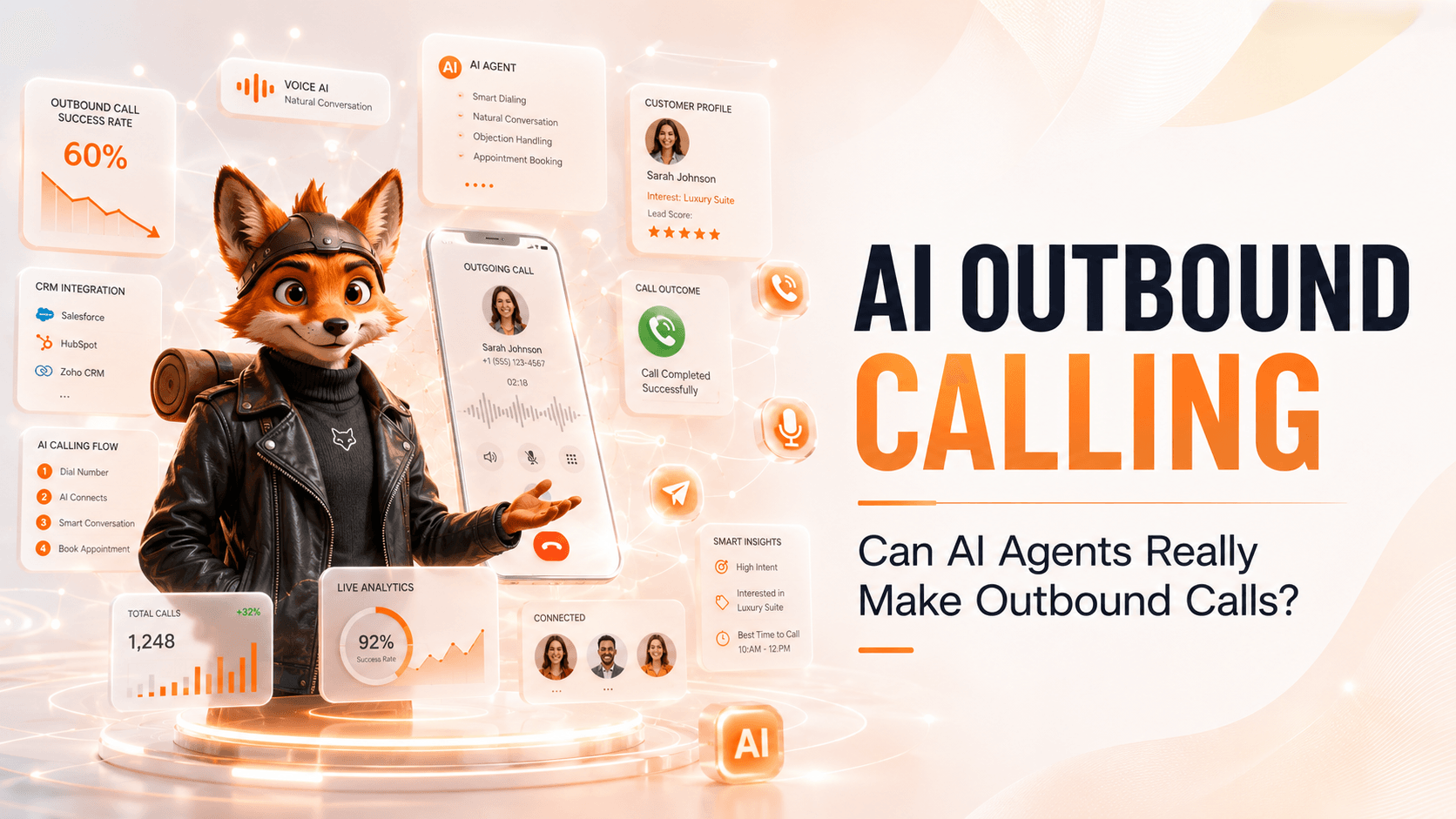
Table of Contents
- Can AI agents make outbound calls? The short answer
- AI outbound calling vs a robocall — the difference that matters
- How AI outbound calling works (the workflow)
- The six jobs of outbound calling (not just sales)
- Is AI outbound calling legal? TCPA, FCC and the compliance gradient
- When to use AI, a human, or a hybrid
- What AI outbound calling costs
- How SuperMIA handles outbound (and inbound)
- Frequently asked questions
Can AI agents make outbound calls? Yes. AI agents can make outbound calls today — and not only for sales. Modern AI voice agents dial contacts, hold natural two-way conversations, and complete a task, then log the outcome and hand off to a human when needed. They handle appointment reminders, follow-ups, collections, reactivation, surveys and sales outreach. The catch isn't whether the technology works — it's doing it in a way that's compliant with TCPA and FCC rules.
See AI outbound calling on your own use case — book a 15-minute demo →
Key takeaways
- Yes — and it's not a robocall. A modern AI voice agent listens, adapts and acts in real time; a robocall plays a fixed recording. That difference is the whole point.
- Outbound is six jobs, not 'sales.' Reminders, follow-ups, collections, reactivation, surveys and sales — the same technology, six different use cases.
- Each job has a different compliance profile. A survey to an existing customer and a cold sales call to a wireless number sit at opposite ends of TCPA risk.
- Compliance is the real gating factor. The 2024 FCC ruling put AI voices under the TCPA's artificial-or-prerecorded-voice rules — consent and opt-outs matter more than the voice model.
- Hybrid wins. AI for routine, structured calls; humans for judgment; AI-gathers-then-transfers for everything in between.
Can AI agents make outbound calls? The short answer
Yes — and the technology is well past the point of being a novelty. A modern AI voice agent dials a contact, holds a real two-way conversation, understands what the person says, completes a defined task, and logs the outcome to your CRM automatically, with no human on the line. It can also transfer to a person the moment the conversation needs one.
The important correction to most coverage: this isn't only a sales tool. The same technology that qualifies a cold lead also confirms an appointment, chases an overdue invoice, checks in after a service call, wins back a lapsed customer, or runs a satisfaction survey. Six different jobs, one underlying capability. And the honest headline, which we'll spend the second half of this piece on, is that the hard part isn't whether it works — it's doing it in a way that's compliant and trusted.
AI outbound calling vs a robocall — the difference that matters
If you take one distinction from this page, take this one, because it's the source of most confusion.
A robocall plays a fixed, pre-recorded message. It says the same thing to everyone, it can't hear a reply, and it can't do anything with one. It's a broadcast.
An AI outbound call is a live, two-way conversation. The agent listens, interprets what the person actually says, responds dynamically, and then takes an action — books the appointment, records the opt-out, transfers to a human. It's a conversation, not a broadcast. This is the same distinction that separates a genuine voice agent from older automated systems, which we cover in how voice agents differ from IVR and chatbots.
But here's the compliance catch, and it trips people up: from a legal standpoint, a natural-sounding AI voice is still treated as an artificial or prerecorded voice under FCC rules. 'The call is conversational, so it's not a robocall' is a dangerous assumption. The technology is completely different; the regulatory treatment of the voice is not. More on that below.
How AI outbound calling works (the workflow)
The process is simpler than it sounds, and every serious platform follows the same six-step pattern.
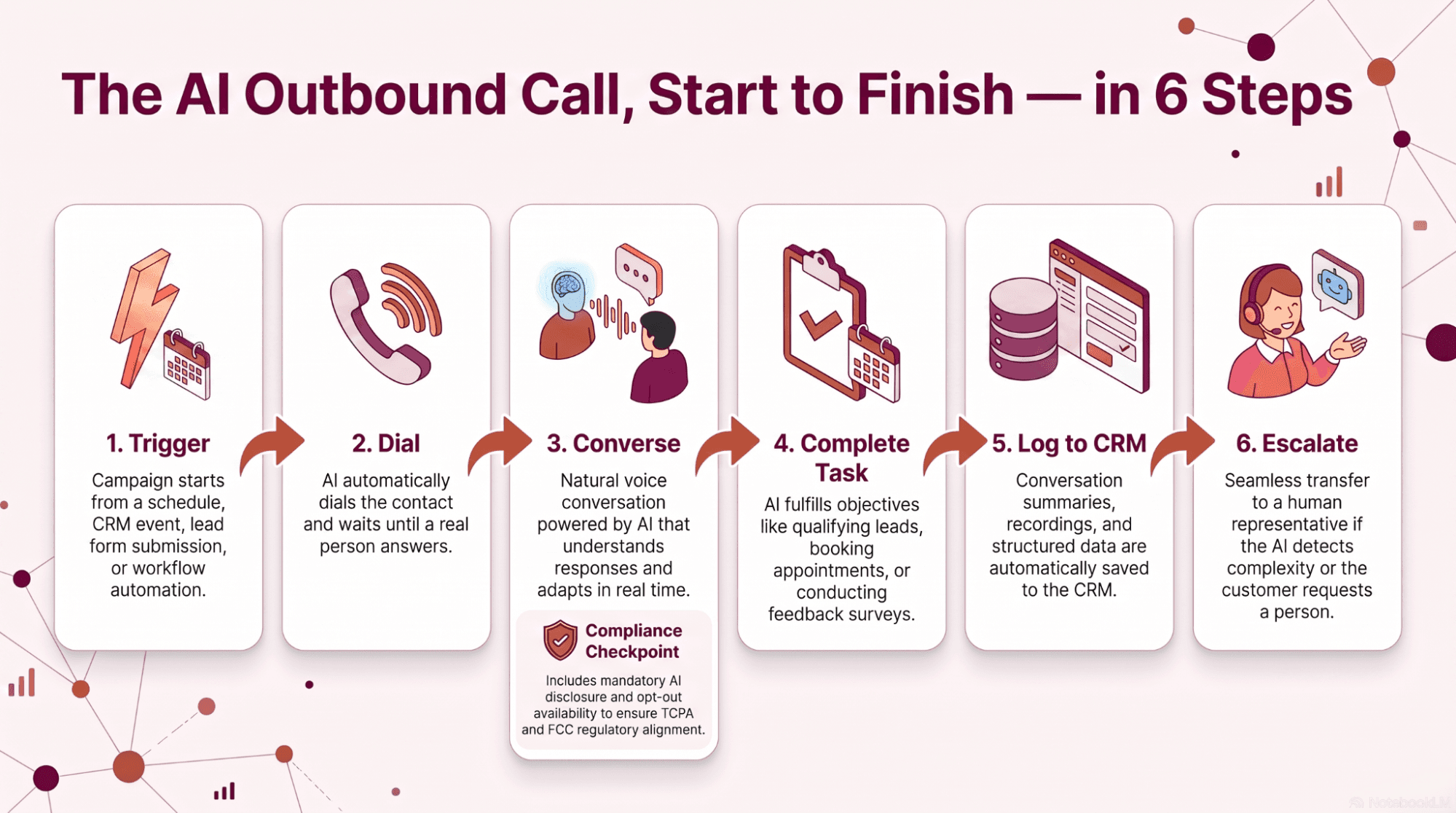
- A trigger fires. A new lead lands in the CRM, a follow-up time arrives, an appointment is coming up, an invoice goes overdue, or a cart is abandoned. The trigger decides who gets called, and when.
- The agent places the call. It dials through a telephony connection, respecting call windows and time zones — and it can call many contacts in parallel, which is where the scale advantage over manual dialing comes from.
- It holds a live conversation. Using speech recognition, a language model and text-to-speech, it speaks, listens, interprets and responds in real time, adapting to what the person actually says.
- It completes the task. Confirm the appointment, remind about the payment, qualify the lead, run the survey, re-engage the customer — delivering any required disclosure and recognising opt-outs along the way.
- It logs the outcome. What happened, what the person said, and the next step, written back to the CRM automatically — no manual note-taking.
- It escalates when needed. If the call exceeds the agent's scope, it transfers to a human, ideally warm-transferring the context so the customer doesn't have to repeat themselves.
The six jobs of outbound calling (not just sales)
This is where most guides fall short: they treat 'outbound' as a synonym for 'cold sales calls.' In reality, it's six distinct jobs — and knowing which one you're doing shapes everything from the script to the compliance risk.
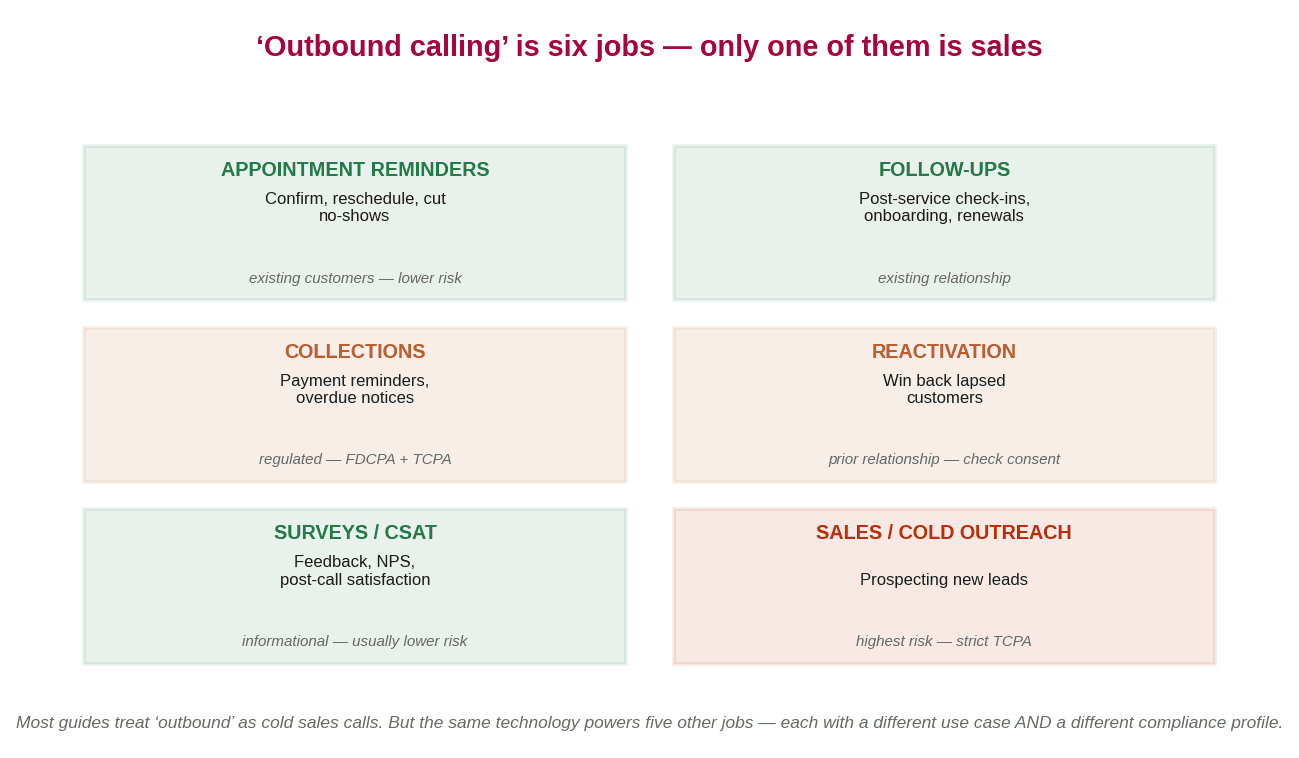
- Appointment reminders and confirmations. Confirm, reschedule and cut no-shows. Usually to existing customers, usually lower-risk, and often the highest-ROI place to start.
- Follow-ups. Post-service check-ins, onboarding steps, renewal nudges. An existing relationship, so trust is already established.
- Collections and payment reminders. Overdue-invoice and billing calls. Effective when handled with an empathetic, compliant script — but this is a regulated area (FDCPA as well as TCPA), so tread carefully.
- Reactivation. Winning back lapsed customers. There's a prior relationship, but check that consent still covers the outreach.
- Surveys and feedback. CSAT, NPS, post-interaction satisfaction. Informational and typically lower-risk, and AI scales it in a way manual calling never could.
Where sales / cold outreach fits
Sales prospecting is the sixth job — and the highest-risk one, because cold outreach to people you have no relationship with sits at the strict end of TCPA. It's also a deep discipline of its own, with its own playbook around targeting, scripting and conversion. We've written about that separately: our deep dive on AI cold calling for sales goes into the sales-specific side in detail, because sales prospecting has its own playbook that the other five jobs don't need. This page stays on the full breadth; that one goes deep on sales.
Is AI outbound calling legal? TCPA, FCC and the compliance gradient
Short answer: it can be, but it's fact-specific — and this section is not legal advice. What follows is the lay of the land; your specific program needs qualified legal counsel before it goes live.
The single most important development: in a 2024 declaratory ruling, the FCC confirmed that AI-generated voices fall under the TCPA's rules for artificial or prerecorded voices. You can read the FCC's 2024 ruling on AI-generated voice calls and the TCPA rules directly. In practice this means consent, clear identification and disclosure, honouring opt-outs, suppression and do-not-call lists, and call-recording rules all apply to AI calls — and that a natural-sounding voice doesn't exempt you.
The useful mental model is a risk gradient, not a yes/no. Not all outbound calls carry the same risk:
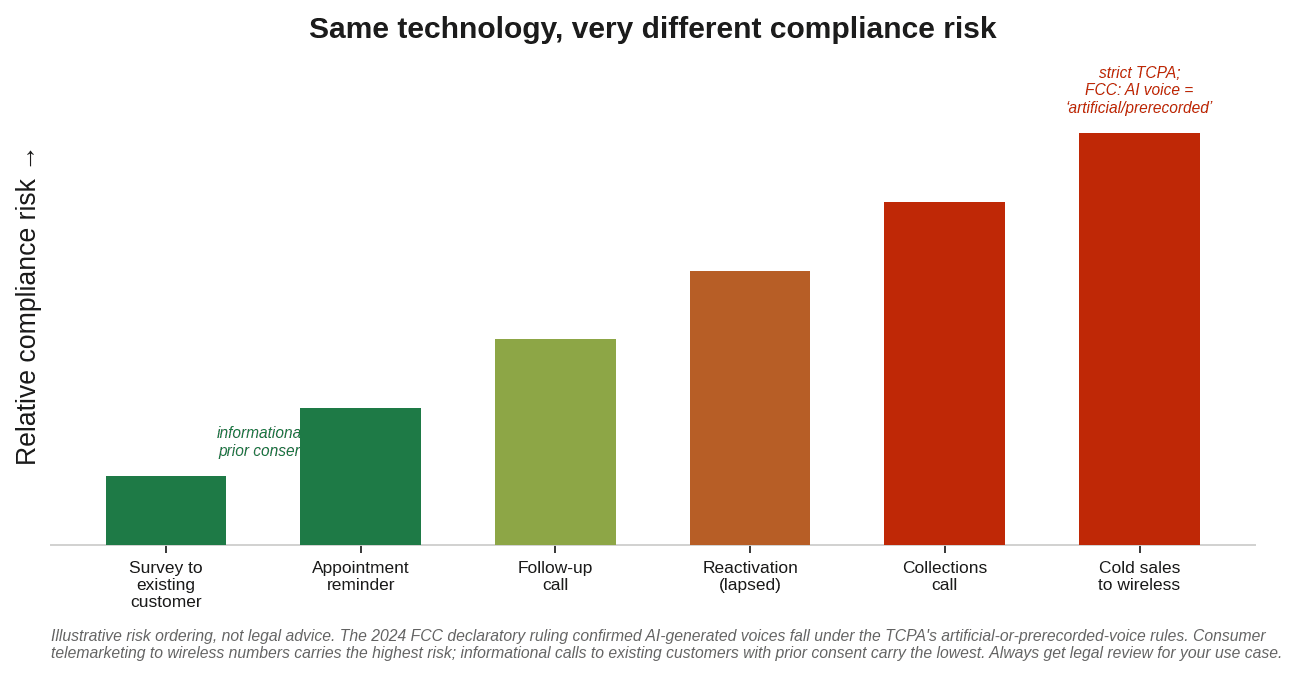
At the low-risk end: an informational survey or an appointment reminder to an existing customer who has given consent. At the high-risk end: a cold sales call using an artificial voice to a wireless number. Collections calls sit in a regulated middle, governed by additional rules. The safest programs distinguish consumer telemarketing from business outreach, informational calls from sales calls, and business lines from wireless numbers — and they build consent, disclosure and opt-out handling in from the start.
And the trust dimension, which is separate from the law but just as real: there's a trust crisis in phone outreach. techcaffeine, citing Hiya, reports that roughly 1 in 4 Americans received an AI deepfake voice call in the past year, and that people receive close to ten unwanted calls a week. Even a perfectly legal AI call can fail if the person assumes it's a scam — which is why clear identification and genuine value in the call matter as much as compliance. State-level rules are tightening too, with measures like the Colorado AI Act adding scrutiny.
When to use AI, a human, or a hybrid
The honest answer isn't 'replace everyone with AI.' It's to route each call by two things: how repeatable the script is, and how high the emotional stakes are.
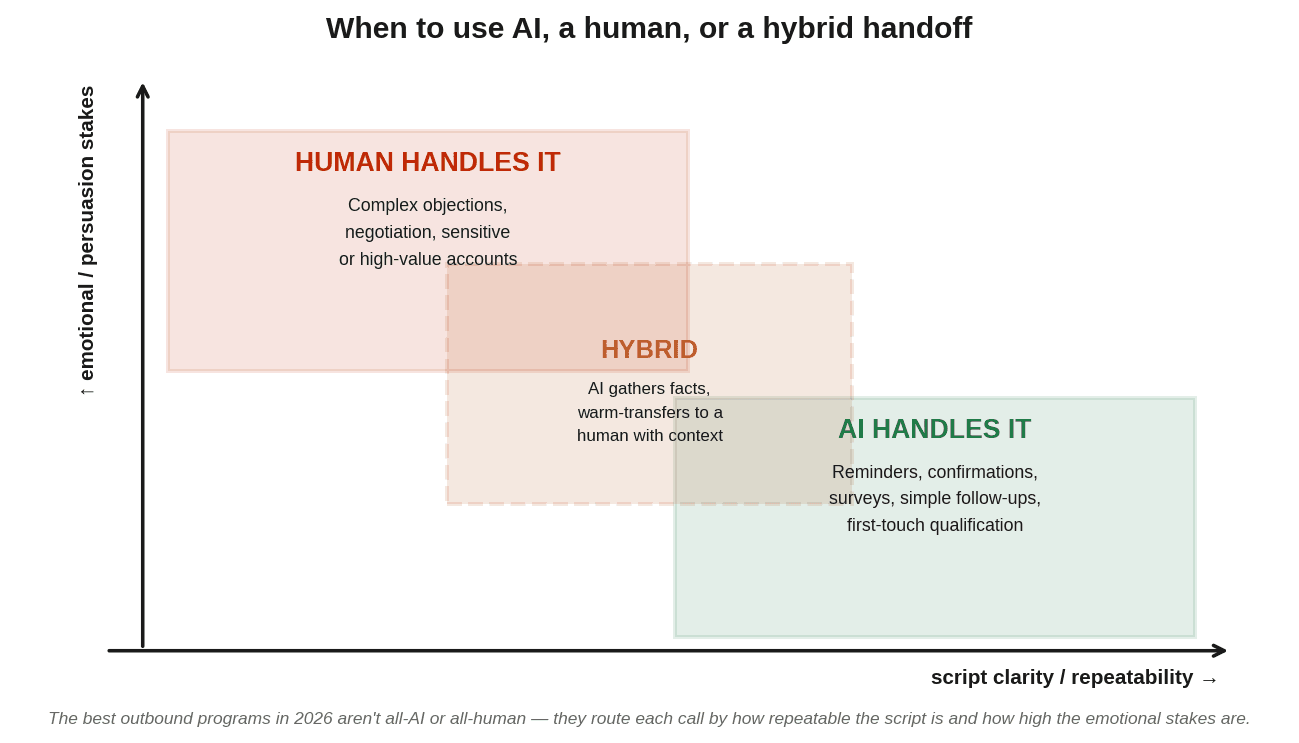
Let AI handle it when the call is repeatable and the stakes are contained: reminders, confirmations, surveys, simple follow-ups, and first-touch qualification. This is where AI's consistency and scale genuinely beat manual dialing.
Keep a human for complex objections, negotiation, sensitive situations, and high-value accounts where judgment and emotional intelligence carry the call.
Go hybrid for everything in between — and this is usually the strongest model. The AI gathers facts, qualifies, and handles the routine opening, then warm-transfers to a human with full context. The customer gets speed and a person; the team gets leverage without losing the human touch where it counts.
What AI outbound calling costs
Pricing is almost always per minute, and the all-in number depends on the platform, the voice and language models you choose, and telephony. Bring-your-own-key orchestration platforms typically land somewhere from a few cents to around thirty cents a minute once everything is stacked; bundled platforms quote a single plan instead. If you want to see how the whole field prices and performs — from developer-first tools to turnkey platforms — our guide to the top 12 AI voice agent platforms covers the comparison in depth.
The bigger cost question is volume. A program making a few hundred calls a month is priced very differently from one making tens of thousands. Model your real call volume first, then compare tools — the per-minute rate matters far less than how it multiplies at your scale.
How SuperMIA handles outbound (and inbound)
Here's where we fit, briefly. SuperMIA's AI voice agent handles outbound calling across the jobs above — reminders, follow-ups, qualification, reactivation, surveys — with CRM logging and human handoff built in. The distinction worth knowing is that it's not outbound-only: it's an agent that handles outbound and inbound with shared context, so a customer the agent called yesterday is recognised when they call back today. Outbound is one half of a conversation; a lot of platforms only do that half.
The honest caveat: we give you the tools — disclosure prompts, opt-out handling, call windows, recording controls — but a compliant program is something you run, not something any vendor can guarantee on your behalf. The technology handles the call; your consent process, your data and your legal review make it compliant. Any platform that claims to make you compliant automatically is overpromising.
The best way to judge whether it fits your outbound use case is to see it on a real call. You can see how outbound works on SuperMIA against your own scenario.
See AI outbound calling on your own use case — book a 15-minute demo →
Frequently asked questions
Can AI agents make outbound calls?
Yes. Modern AI voice agents can dial contacts, hold natural two-way conversations, understand replies, complete a defined task and log the outcome automatically, without a human on the line. They handle appointment reminders, follow-ups, lead qualification, collections, reactivation and surveys as well as sales outreach. This is different from a robocall, which plays a fixed recording. The real question is not whether the technology works but whether you can run it in a way that is compliant and trusted.
Is AI outbound calling legal?
It can be, but it is fact-specific and this is not legal advice. In the United States, the FCC confirmed in a 2024 declaratory ruling that AI-generated voices fall under the TCPA's rules for artificial or prerecorded voices. That means consent, clear disclosure, honouring opt-outs, suppression and do-not-call lists, and recording rules all apply. Informational calls to existing customers who have consented carry lower risk than cold sales calls to wireless numbers. Review your specific program with qualified legal counsel before launching.
What is the difference between AI outbound calling and a robocall?
A robocall plays a fixed, pre-recorded message the same way to everyone, with no ability to respond. An AI outbound call is a live, two-way conversation: the agent listens, interprets what the person says, and responds dynamically in real time, then takes an action such as booking an appointment or transferring to a human. The technology is fundamentally different, though from a compliance standpoint an AI-generated voice is still treated as an artificial or prerecorded voice under FCC rules.
What can AI outbound calling be used for besides sales?
Sales outreach is only one use case. The same technology powers appointment reminders and confirmations, post-service follow-ups and onboarding checks, collections and payment reminders, reactivation of lapsed customers, and satisfaction or feedback surveys. Many of these are lower-risk than cold sales calls because they go to existing customers with an established relationship, though each still has its own compliance considerations.
How much does AI outbound calling cost?
Pricing is usually per minute, and the all-in cost depends on the platform, the voice and language models you use, and telephony. Bring-your-own-key orchestration platforms often land somewhere in the range of a few cents to around thirty cents a minute once everything is added, while bundled platforms quote a single plan. The bigger cost question is usually volume: a program making thousands of calls a month is priced very differently from a few hundred, so model your real call volume before comparing tools.

Urvil Dhanani
Urvil Dhanani is the AI/ML Lead at SuperMIA, focused on the architecture behind reliable conversational AI - agent design patterns, voice and chat orchestration, and platform evaluation. He writes practical, vendor-neutral guides that help technical teams build and choose AI systems that hold up in production.