
Table of Contents
- The missed call problem in dental front desks
- What is an AI dental receptionist?
- Why the dental front desk loses calls
- AI vs human receptionist vs answering service
- How it works: call to booking to PMS write-back
- What it costs and ROI
- PMS integrations: Dentrix, Open Dental, Eaglesoft, Curve
- HIPAA and compliance for dental AI
- Can AI replace your receptionist?
- Choosing a vendor: 11-point checklist
- Case study: Media Brite Smile Dental
- 30-day implementation roadmap
- Frequently asked questions
- The bottom line
Quick Answer
An AI dental receptionist is voice and text automation software that answers patient calls 24/7, books and reschedules appointments, handles routine front-desk questions, and writes outcomes into your practice management system. It works best as front-desk support, not a clinical tool: routine calls are automated while complex or urgent conversations are escalated to your team.
The missed call problem in dental front desks
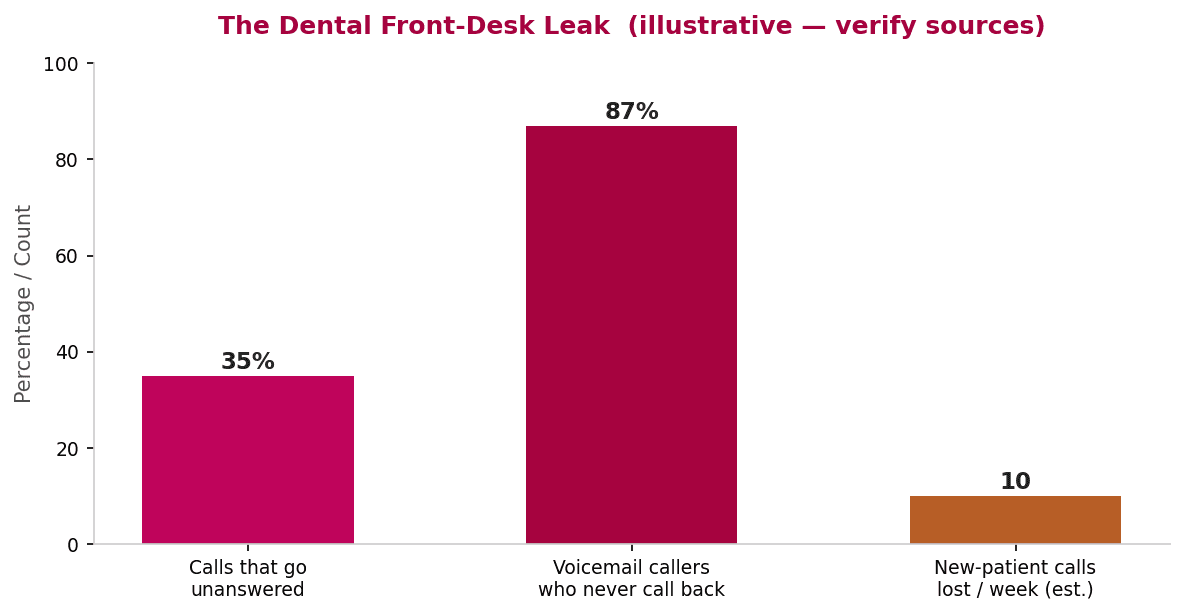
It is 7:48 a.m. on a Monday. Your front desk coordinator is checking in two patients, collecting a payment, and watching line two blink. Line two is a new patient ready to book. The call rolls to voicemail. They hang up. They call another practice.
That single missed call is a quiet revenue leak in many dental offices. The front desk is trying to run in-office workflows and phone operations at the same time. AI dental receptionists are built for exactly this gap: they capture overflow and after-hours demand that human teams cannot always reach in real time.
What is an AI dental receptionist?
Definition
An AI dental receptionist is conversational software that answers inbound patient calls, books and reschedules appointments, responds to common office questions, and logs outcomes into the PMS. It runs continuously and escalates complex or urgent calls to human staff.
Why the dental front desk loses calls
The problem is structural overload. One or two coordinators are handling check-in, checkout, insurance, payments, and phones simultaneously. During peak times, calls are the first workflow to slip.
Practices often underestimate how much this compounds: missed calls reduce same-week bookings, reduce after-hours capture, and increase chair-time inefficiency when recall gaps stay unfilled.
AI vs human receptionist vs answering service
| Factor | Human Front Desk | Answering Service | AI Dental Receptionist |
|---|---|---|---|
| Availability | Business hours | 24/7 message intake | 24/7 task completion |
| Books appointments | Yes | Usually no | Yes, with PMS sync |
| Escalation quality | Direct | Message relay | Warm transfer with context |
| Cost profile | Highest ongoing payroll | Lower, but limited workflow depth | Typically lower with booking impact |
How it works: call to booking to PMS write-back
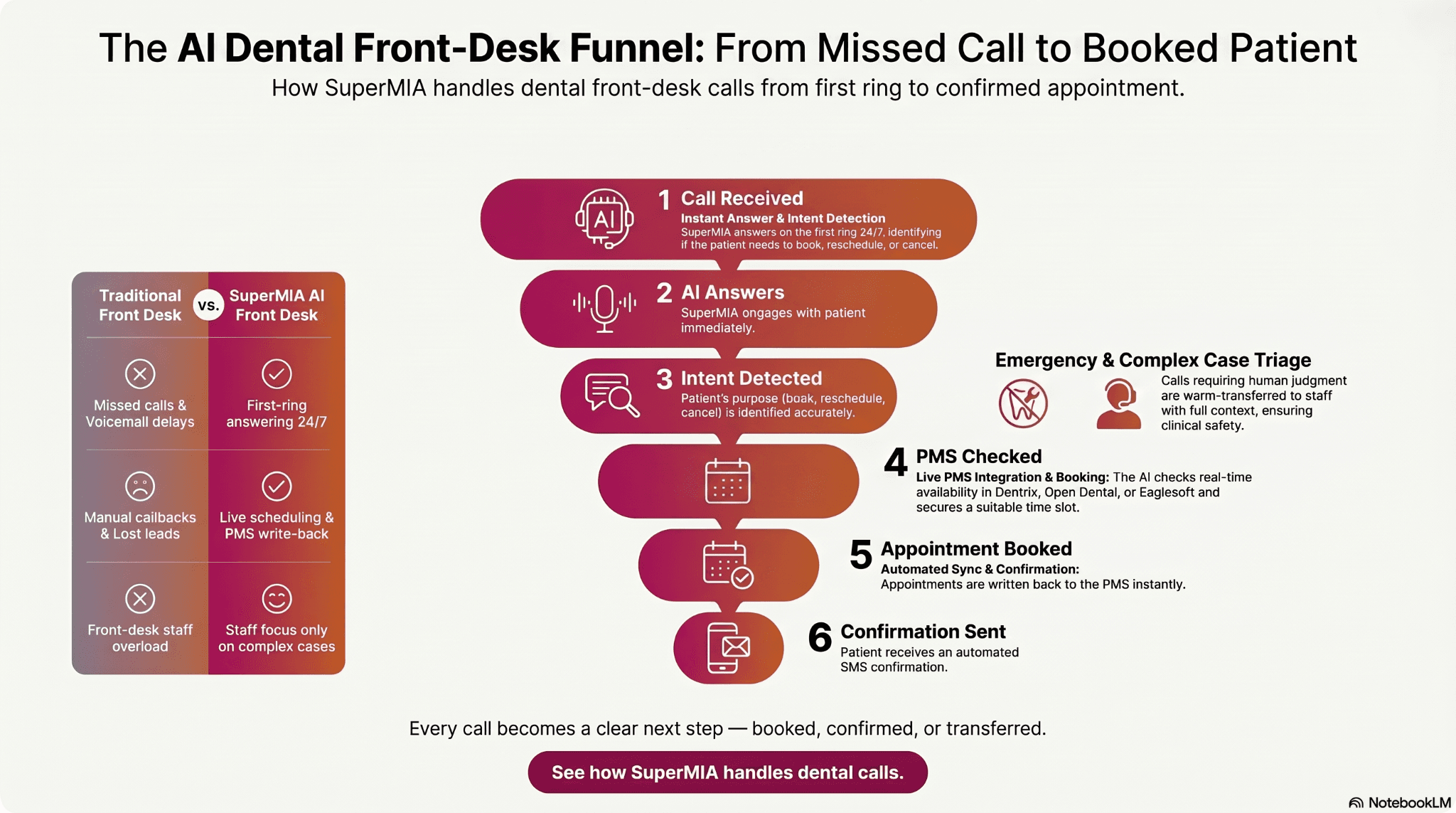
- Answer and identify intent: appointment, reschedule, insurance, or urgent issue.
- Collect key context: patient type, provider preference, and time window.
- Check real-time availability: pull open slots from your PMS schedule.
- Book and write-back: create or update the appointment record automatically.
- Confirm and escalate: send SMS confirmation; transfer urgent or complex calls to staff.
See SuperMIA handle live dental workflows
Explore voice automation, booking, and escalation in one system.
See Voice Bot ->What it costs and ROI
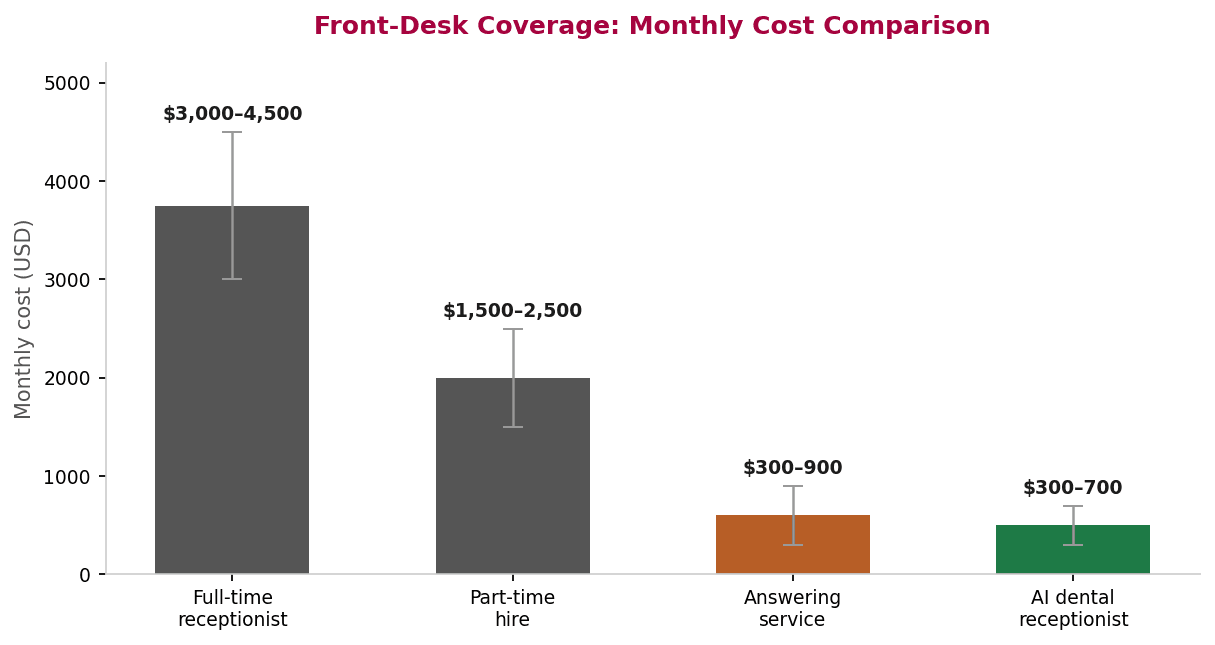
Most dental AI receptionist programs are flat monthly subscriptions. The business case is less about replacing people and more about recovering missed bookings and reducing no-show drag.
| Option | Typical Monthly Cost | Booking Depth |
|---|---|---|
| Full-time receptionist | $3,500-$4,500+ | High |
| Answering service | $400-$1,500 | Low to medium |
| AI dental receptionist | $300-$700 | Medium to high (with PMS integration) |
For planning, use your own baseline: inbound call volume, missed-call rate, new-patient value, and no-show impact. If those four numbers are known, ROI is usually straightforward to model.
PMS integrations: Dentrix, Open Dental, Eaglesoft, Curve
A dental AI receptionist is only useful when booking data lands inside the exact schedule your team already uses. Look for real-time two-way sync and provider-level slot logic, not delayed exports.
- Dentrix: confirm bidirectional appointment updates and write permissions.
- Open Dental: validate mapping for providers, operatories, and appointment types.
- Eaglesoft: confirm schedule integrity and conflict handling.
- Curve: verify cloud API support and live availability checks.
See product details for AI dental assistant workflows and compare deployment options on pricing.
HIPAA and compliance for dental AI
Any system handling patient information must be deployed with proper safeguards. Start with the baseline: signed BAA, encryption at rest and in transit, access controls, and auditability.
Use these checks before signing any contract:
- Signed BAA for your exact plan tier.
- Encryption standards documented for data in transit and at rest.
- Access controls with role-based permissions.
- Audit logging for call activity and configuration changes.
- Data retention controls aligned with your internal policy.
Can AI replace your receptionist?
No. The strongest deployments do not try to replace the front desk. They remove repetitive call pressure so staff can focus on in-person care and conversations where human judgment matters.
The best fit is support, not substitution: automate routine calls, escalate complexity, and keep humans in control.
Choosing a vendor: 11-point checklist
- Does it complete bookings, not just message capture?
- Does it integrate with your current PMS stack?
- Does it support structured warm transfers?
- Can it handle after-hours demand reliably?
- Are no-show reminders and confirmations configurable?
- Is there a signed BAA for your plan?
- Are audit logs available for operations and compliance?
- Can your team tune scripts and escalation rules easily?
- Can it support multi-location policy differences?
- Are reports clear for missed calls, booking rate, and outcomes?
- Can you pilot at one location before full rollout?
Get a practical vendor walk-through
Book a short demo and evaluate each of the 11 points with your own call flow.
Book a 15-minute demo ->Case study: Media Brite Smile Dental
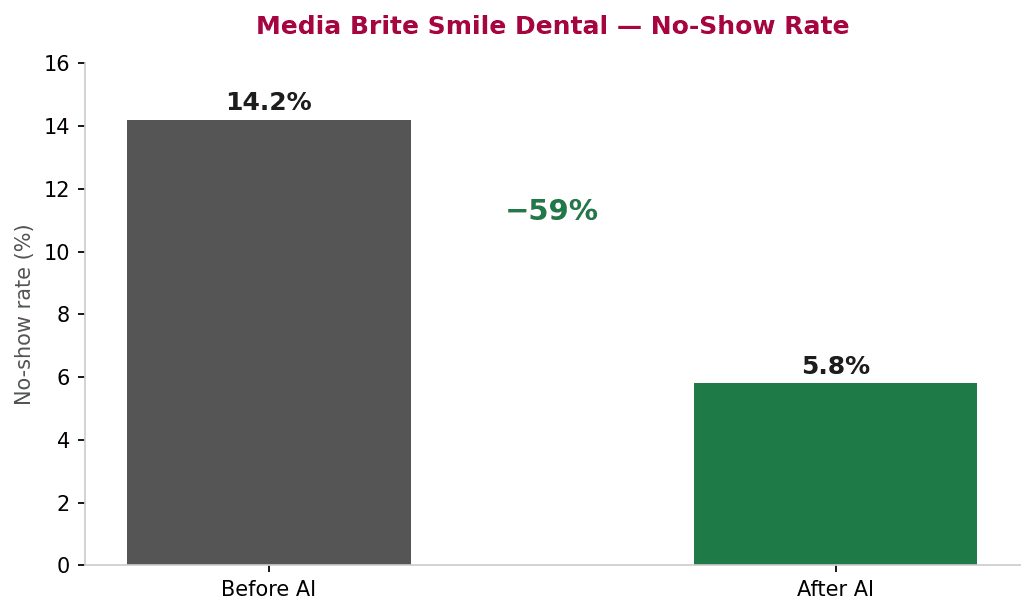
Media Brite Smile Dental rolled out SuperMIA's AI dental assistant for inbound and after-hours calls. The goal was straightforward: answer more calls, book faster, and reduce no-show waste without adding headcount. See more dental practice results on SuperMIA's dental deployments page.
| Metric | Before | After |
|---|---|---|
| Patient response speed | Baseline | 43% faster |
| Revenue growth | Baseline | +57% |
| Weekday slot fill | Baseline | 94% |
| No-show rate | 14.2% | 5.8% |
| AI-booked appointments | - | 143 |
| Weekly revenue recovered | - | $5,600 |
30-day implementation roadmap
Week 1: Setup and integration
Connect your PMS, configure call intents, and define escalation rules.
Week 2: Pilot overflow and after-hours
Route missed and after-hours calls first while daytime operations stay human-led.
Week 3: Expand and tune
Review transcripts, refine prompts, and add recall and reschedule workflows.
Week 4: Measure and decide
Compare missed-call rate, slot fill, and no-show trend to baseline. Decide on full rollout with data, not assumptions. For the full call-flow builder and voice capability details, see the SuperMIA AI voice bot - and for the complete platform overview including workflow automation, see the SuperMIA platform.
Frequently asked questions
The bottom line
An AI dental receptionist closes the missed-call gap that costs practices bookings every week. It answers every call, automates routine scheduling, and hands complex conversations back to your team.
Start small: pilot one location for 30 days, measure missed-call rate, slot fill, and no-shows, then scale based on outcomes.
Start with SuperMIA today
Book a short walkthrough and map AI reception to your current front-desk workflow.
Book a demo ->
Harikrishna Patel
Harikrishna Patel is the founder of MIA – My Intelligent Assistant, the AI automation platform built under Botfinity Inc. in Dallas, Texas. With 15+ years in software engineering, AI/ML, and enterprise solution design, he focuses on creating practical, scalable AI tools that help businesses automate support, workflows, and operations through voice and chat.