
Table of Contents
- What "AI calling software" means in 2026
- How we picked the 10 tools
- AI calling software market map
- The 10 best AI calling software platforms
- Feature matrix — where each tool is deep vs light
- Category winners — who to shortlist first
- How to pick the right one (5-question framework)
- What's the ROI of adding AI to a call center?
- Frequently asked questions
The best AI calling software for a call center in 2026 falls into three groups — full AI CCaaS platforms (Genesys Cloud CX, NICE CXone, Five9), AI-native voice tools (Dialpad Ai, Talkdesk), and AI voice-agent overlays (SuperMIA, Convoso). Pick by fit: workflow depth for enterprises, AI-native speed for growing teams, and voice-agent overlays for automation-first call centers.
Book a 20-minute walkthrough — see where AI voice agents fit in your stack →
Key takeaways
- Ten tools cover the buyer market — this list is category-winner ordered, not a single 1-to-10 ranking.
- Genesys Cloud CX, NICE CXone, and Five9 lead for full AI CCaaS; Dialpad Ai leads AI-native voice.
- SuperMIA's MIA voice agent is the best fit when a majority of calls follow a scriptable pattern.
- AI CCaaS deploys usually take 3–9 months. AI voice-agent overlays typically take 1–4 weeks.
- Pick by five things: call mix, automation appetite, integration surface, deploy speed, compliance needs.
What "AI calling software" means in 2026
Calling software used to be a phone system with a queue and a report. In 2026, buyers searching for "AI calling software" usually mean one of three different things, and mixing them up is the fastest way to buy the wrong platform.
The first is an AI CCaaS platform — a full contact-center-as-a-service suite (routing, IVR, WFM, quality management, analytics) with AI added as a layer: real-time agent assist during a call, live sentiment scoring, and post-call summaries written into the CRM. Genesys Cloud CX, NICE CXone, and Five9 sit here. These platforms are what buyers picture when they think "call center."
The second is an AI-native voice tool — a cloud phone system built AI-first, with the same AI capabilities threaded through every feature rather than bolted on. Dialpad Ai Contact Center is the clearest example; Talkdesk's AI Trainer product also fits here. Deploys are faster and the AI feels less like a plug-in.
The third is an AI voice-agent overlay — a conversational AI that answers the call itself, understands the caller, books, routes, or resolves the call, and only hands off to a human when the request needs judgment. SuperMIA's MIA voice agent, Convoso's dialer-side AI, and a few point tools live here. Overlays don't replace the CCaaS or the phone system — they sit in front of it and take the repeatable share of the call volume.
The right pick depends on which of those three problems dominates. Most established call centers already have a CCaaS or a phone system; they don't need a rip-and-replace, they need to add AI where the volume hurts.
How we picked the 10 tools (methodology)
We scored every candidate on six dimensions before naming category winners. All ten made the shortlist because they cover a distinct buyer segment; none was excluded on brand size or reputation alone.
- AI voice agent — can the tool answer, understand, and complete a call on its own?
- Real-time agent assist — does it coach live agents during a call?
- Post-call AI + CRM logging — does it auto-summarize and write back to the system of record?
- Automated outbound (AI dialing) — does it handle outbound campaigns with AI qualification or agent-assist dialing?
- Multilingual voice, on demand — can it switch language without new hires?
- Deploy time — realistic, not vendor best-case.
The list is intentionally not one flat ranking. Buyers don't shop with a single scoreboard — a 6-agent SMB inbound team has almost nothing in common with a 400-seat outbound sales floor. Category winners map fit to reality.
AI calling software market map
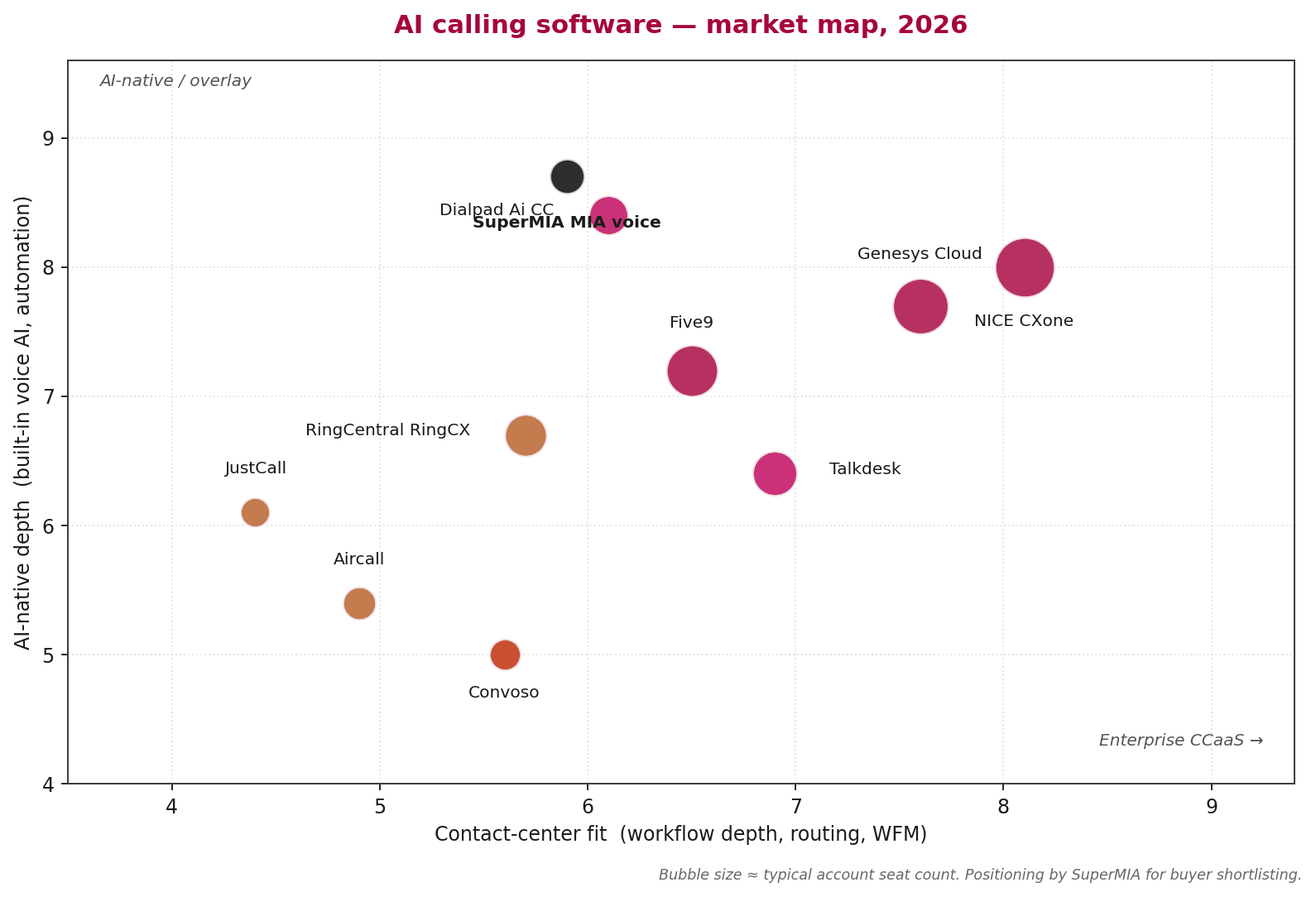
The map below places each platform on two axes — contact-center fit (routing, WFM, workflow depth) on the horizontal, AI-native depth (built-in voice AI, agent assist, automation) on the vertical. Bubble size is the typical account seat count. Positioning is SuperMIA's read for buyer shortlisting, not a certified benchmark.
The 10 best AI calling software platforms for call centers
1. Genesys Cloud CX — best overall AI CCaaS
Genesys Cloud CX is the most balanced pick for a mid-to-large call center that wants deep routing plus a mature AI layer. Its AI capabilities (agent assist, live transcription, post-call summaries, predictive engagement) sit on top of one of the strongest workflow and WFM engines in the category.
Best for: 100+ seat contact centers running blended inbound/outbound. Standout AI: real-time agent assist, generative post-call summaries, predictive routing. Honest limit: enterprise deploys typically take 4–9 months; pricing is per-seat with AI tiers on top. Deploy time: 4–9 months.
2. NICE CXone — best for global voice + enterprise WFM
NICE CXone leads on workforce management depth and global voice quality. Enlighten (NICE's AI layer) covers agent assist, auto-summarization, and analytics across dozens of languages. If a buyer's problem is multi-country compliance and 10,000+ interactions a day, this is where the shortlist starts.
Best for: enterprise contact centers with global voice and strict WFM needs. Standout AI: Enlighten AI for agent assist and quality; strong analytics. Honest limit: heaviest platform to stand up; not right for a 20-seat team. Deploy time: 5–9 months.
3. Five9 — best for mature inbound + outbound blends
Five9 has been in the CCaaS market long enough that its outbound dialing, blended queueing, and CRM connectors are enterprise-grade. Its AI story — Agent Assist 2.0 and Genius AI Suite — is real but not the primary reason buyers pick it. Buyers pick it because the phone side just works.
Best for: teams that need reliable outbound dialing and blended queues, with AI added. Standout AI: Agent Assist 2.0, IVA, voice analytics. Honest limit: UI is functional rather than modern; AI is layered on rather than AI-native. Deploy time: 3–6 months.
4. Talkdesk — best for teams that want no-code AI
Talkdesk's AI Trainer lets non-engineers train and refine the AI on real call data — one of the cleanest self-serve AI experiences in the category. Its Autopilot AI voice agent is production-ready for common flows. For teams without an ML function, Talkdesk lowers the barrier.
Best for: mid-market teams that want to train AI without an engineering hire. Standout AI: AI Trainer, Autopilot voice agent, Copilot agent assist. Honest limit: the AI voice agent works best on clean, scripted flows; complex intents still need routing. Deploy time: 6–12 weeks.
5. Dialpad Ai Contact Center — best AI-native voice
Dialpad built its transcription and AI stack from day one — Ai Voice, Ai Recap, Ai Scorecards, Ai Playbooks are all threaded through the product, not bolted on. For growing teams that want AI features to feel first-class rather than optional, this is the strongest AI-native pick.
Best for: growing SMB and mid-market teams that want AI to feel native. Standout AI: real-time transcription, Ai Recap, live coaching, Ai Playbooks. Honest limit: contact-center depth (WFM, complex routing) is lighter than Genesys or NICE. Deploy time: 4–8 weeks.
6. RingCentral RingCX — best for RingCentral shops
If a business is already running RingCentral MVP for its phone system, RingCX is the frictionless CCaaS upgrade. AI features (RingSense, real-time coaching, AI summaries) are competitive rather than category-leading; the win here is stack alignment.
Best for: existing RingCentral customers extending into a formal contact center. Honest limit: buyers not already on RingCentral rarely pick it purely on AI merit. Deploy time: 4–10 weeks.
7. Aircall — best for SMB inbound
Aircall is not a CCaaS. It's a modern cloud phone system with contact-center features and a growing AI layer (AI Voice Agent, Call Summary, Talk-to-Text). For a 5- to 50-seat inbound team that wants to answer calls better without picking a full contact-center suite, it's the cleanest option on the list.
Best for: SMB inbound teams (5–50 seats) that want fast setup + light AI. Honest limit: no deep WFM, no advanced outbound dialing, AI depth is early. Deploy time: 1–3 weeks.
8. JustCall — best for SMB with light AI
JustCall covers most of the same ground as Aircall at a friendlier price, with an AI Copilot for coaching, AI SMS suggestions, and workflow automations. For SMB sales teams that want a phone + AI stack without paying enterprise pricing, JustCall is the pragmatic pick.
Best for: SMB sales and support teams that need voice + SMS with AI coaching. Honest limit: reporting and enterprise controls are still maturing. Deploy time: 1–2 weeks.
9. Convoso — best for outbound sales
Convoso is built for outbound. Its predictive dialer, list management, and answering-machine detection are as strong as anyone's, and it's added an AI layer for agent guidance, sentiment, and answering-machine handling. For an outbound floor doing thousands of dials a day, this is the shortlist.
Best for: high-volume outbound sales floors. Honest limit: not an inbound-first tool; TCPA compliance responsibility stays on the buyer's operations team. Deploy time: 3–6 weeks.
10. SuperMIA MIA voice agent — best AI voice-agent overlay
SuperMIA is not a CCaaS. It is an AI voice agent that answers calls end-to-end — 24/7 inbound answering, outbound campaigns, appointment booking, FAQ handling, call routing — and hands off to a human when the caller wants one. It sits in front of an existing phone system, CRM, and calendar rather than replacing them. That's why it deploys in one to four weeks instead of six months.
Best for: teams that want to fully automate the repeatable 60–80% of calls, keep humans for the rest. Standout AI: MIA voice agent (inbound + outbound), CRM + calendar auto-logging, multilingual on demand, HIPAA-aligned workflows on eligible plans. Honest limit: not a full contact-center suite — no WFM, no seat-based agent desktop; pair it with a CCaaS or phone system for human agents. Deploy time: 1–4 weeks.
See the AI voice agents pillar for the full breakdown of how modern voice agents work and where they fit.
Feature matrix — where each tool is deep vs light
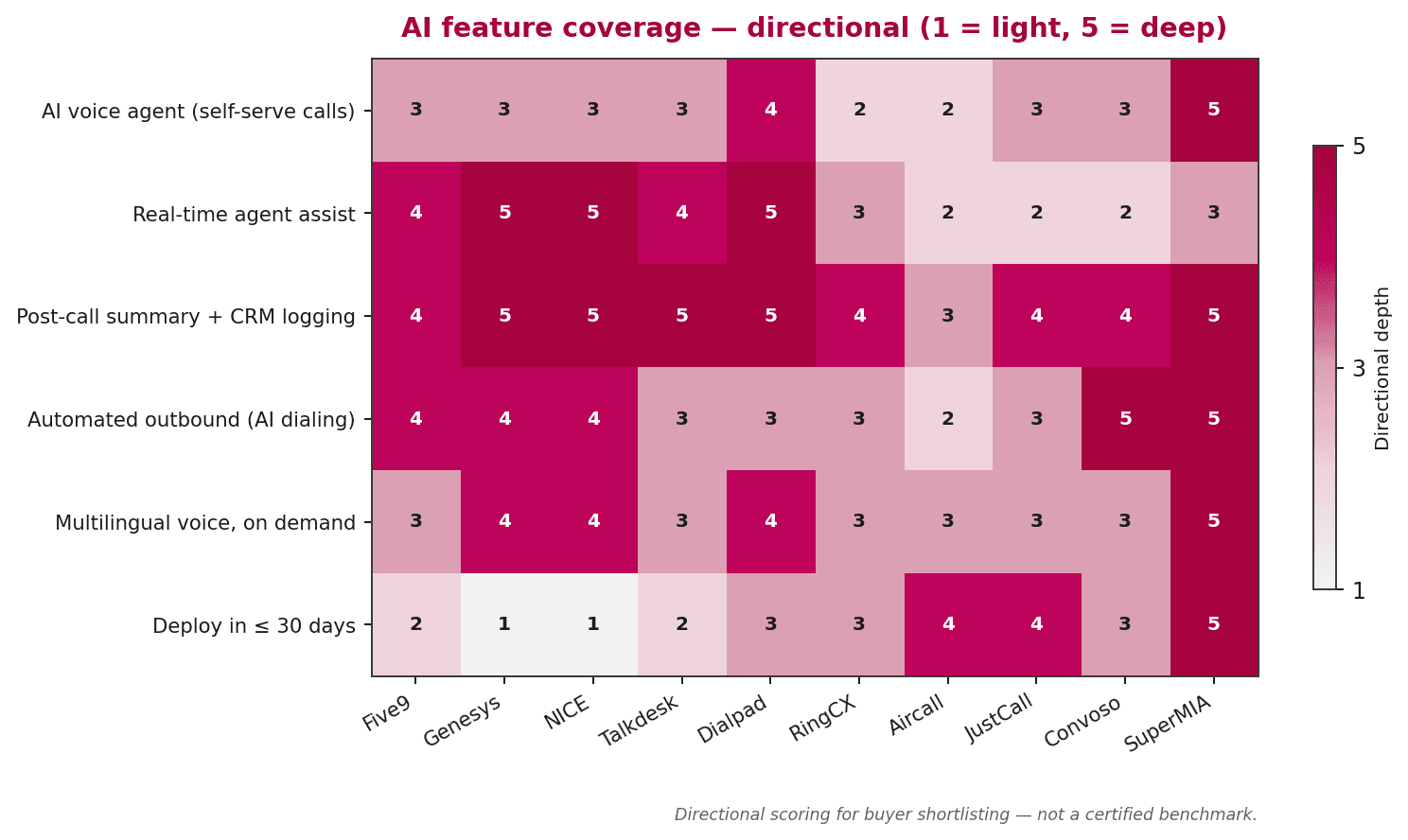
The matrix below scores every tool on the six AI dimensions used in the methodology. Scoring is directional (1 = light, 5 = deep) for buyer shortlisting, not a certified benchmark.
| Platform | Best for | Deploy time | AI voice agent | Auto CRM log |
|---|---|---|---|---|
| Genesys Cloud CX | Overall AI CCaaS | 4–9 months | Layered | Yes |
| NICE CXone | Global voice / WFM | 5–9 months | Layered | Yes |
| Five9 | Blended inbound + outbound | 3–6 months | Layered | Yes |
| Talkdesk | No-code AI CCaaS | 6–12 weeks | Autopilot | Yes |
| Dialpad Ai CC | AI-native voice | 4–8 weeks | Native | Yes |
| RingCentral RingCX | RingCentral shops | 4–10 weeks | Layered | Yes |
| Aircall | SMB inbound | 1–3 weeks | Light | Yes |
| JustCall | SMB with light AI | 1–2 weeks | Light | Yes |
| Convoso | Outbound sales | 3–6 weeks | Native (outbound) | Yes |
| SuperMIA MIA voice | AI voice-agent overlay | 1–4 weeks | Native (in + out) | Yes |
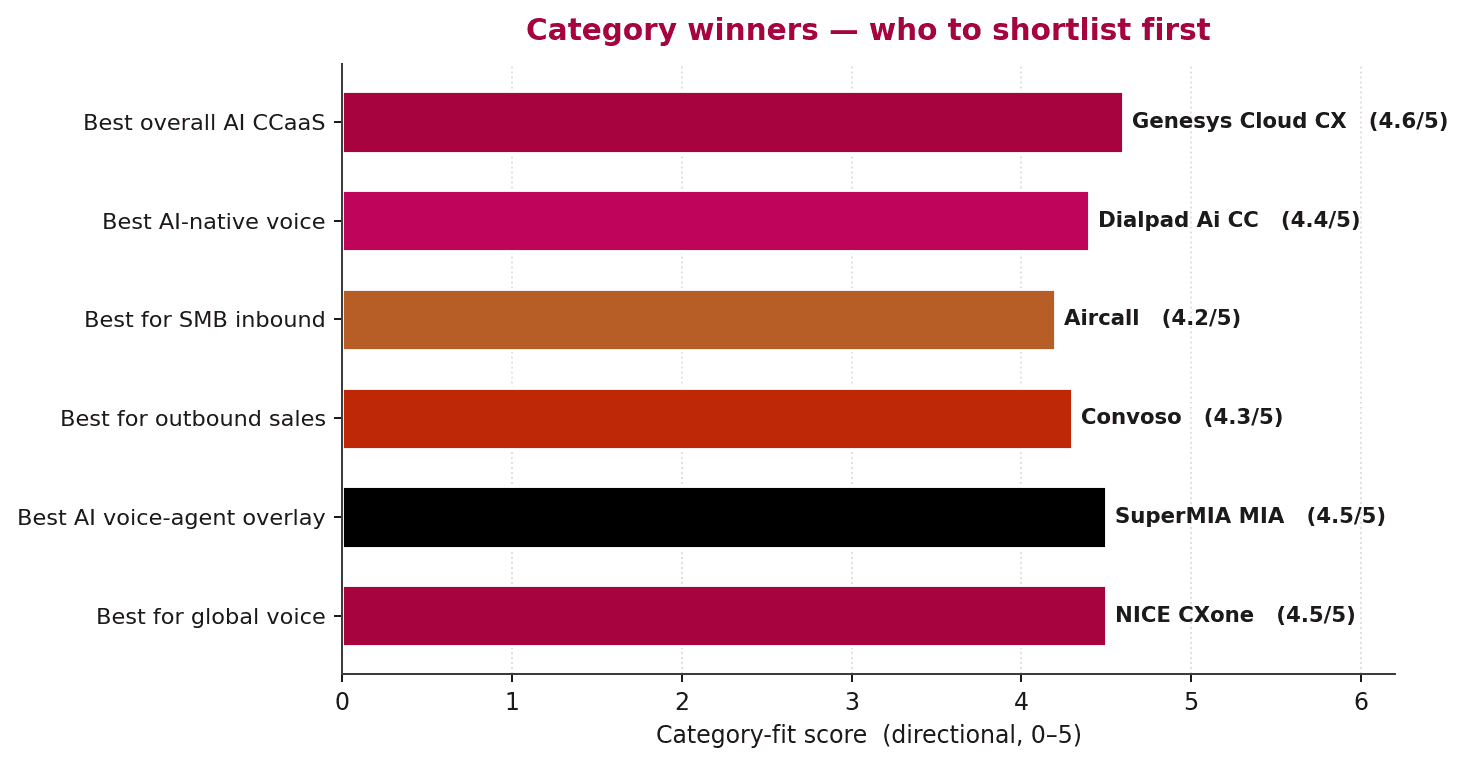
Category winners — who to shortlist first
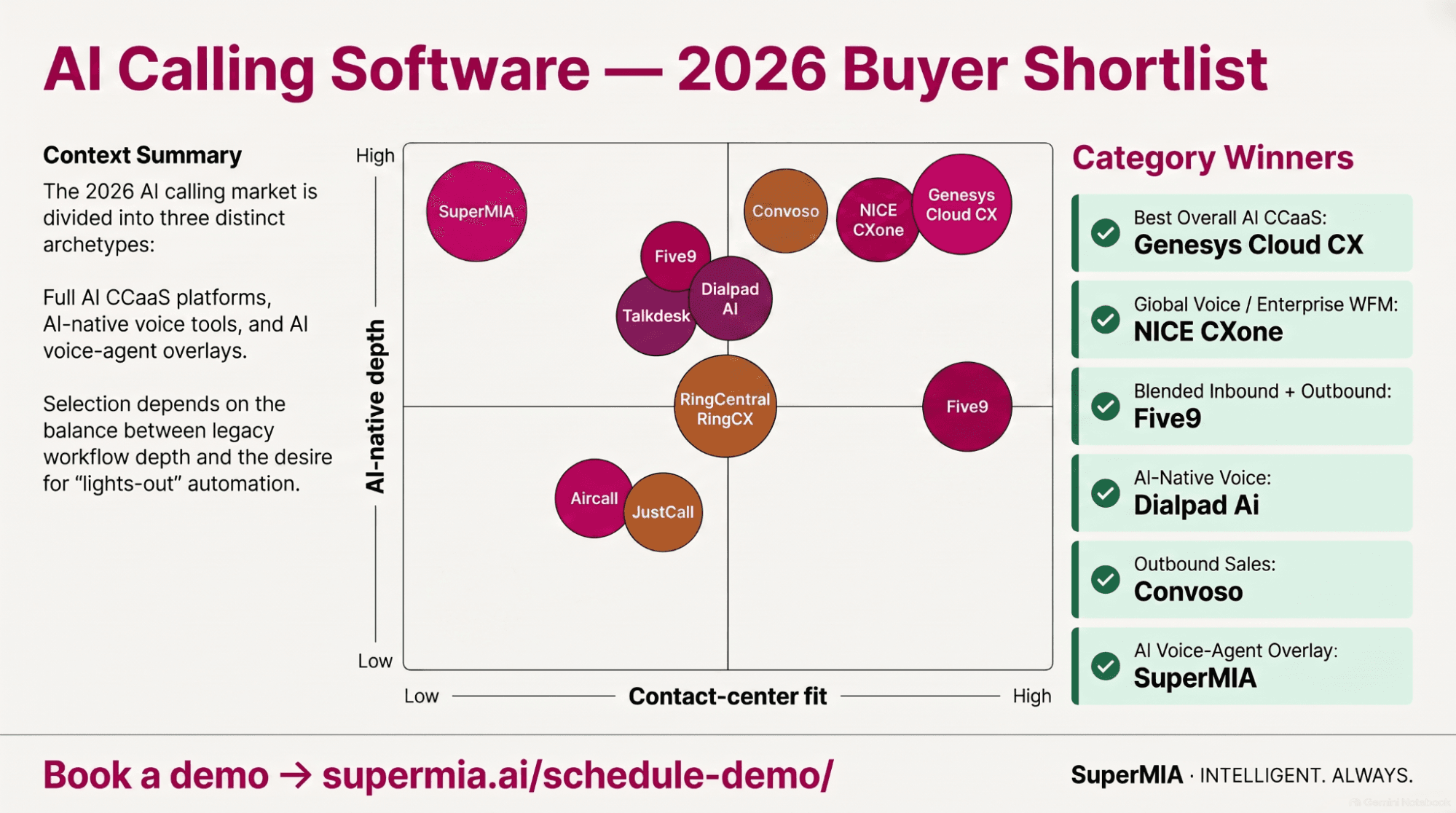
Six categories, one pick each. This is where most buyers land after the market-map view — six defensible short lists rather than one contested #1.
How to pick the right AI calling software (5-question framework)
Buyers who bought the wrong platform almost always skipped one of these questions. Run through them in order.
- What's your call mix? Pull two weeks of call logs. If more than half your calls are inbound scripted work (FAQs, bookings, routing), an AI voice-agent overlay is on the table. If it's blended with heavy WFM, look at CCaaS.
- How aggressive is your automation appetite? Do you want AI to help your agents (agent assist) or to answer instead of your agents (voice agent)? Different tools optimize for different answers.
- What's your integration surface? List every system that must be touched — CRM, calendar, practice-management, ticketing. Any tool that can't integrate cleanly gets cut on this question, regardless of AI depth.
- How fast do you need to be live? If your ROI plan needs impact in the current quarter, an AI voice-agent overlay or an AI-native tool wins. If you're budgeting for a 12-month transformation, CCaaS is fine.
- What's your compliance envelope? HIPAA, PCI, TCPA, and jurisdiction-specific voice-recording rules narrow the list quickly. Ask each vendor for a BAA or DPA before the demo, not after.
When SuperMIA's voice agent is the right pick
SuperMIA's MIA voice agent is the right pick when three things line up. If you can only check one or two of these, a full CCaaS or an AI-native tool is probably a better fit — and that's fine to say out loud.
- You have a large share of calls that follow a scriptable pattern (bookings, FAQs, routing, screening, outbound campaigns).
- You want to keep your existing phone system, CRM, and calendar — not replace them.
- You want the tool live in weeks, not months, and priced by plan or minute rather than by seat.
If those three fit, SuperMIA's AI voice agent can cover the repeatable share of your call volume while your team handles the rest. See the lead-generation use case for a real deployment example.
What's the ROI of adding AI to a call center?
Illustrative — sanity-check before quoting. The ranges below reflect what teams commonly report on modern AI calling software deployments. Actual results depend on call mix, script complexity, and pre-AI baselines. Treat these as directional — do not quote as verified figures.
Most call centers see impact in three places when AI is added correctly. First, average handle time drops 20–40% because agent assist and post-call summaries take the note-taking work out of the human's hands. Second, after-hours coverage becomes near-100% at flat cost — an AI voice agent doesn't sleep. Third, first-call resolution improves because AI can pull the caller's history faster than a human can navigate five browser tabs.
The tighter the script, the higher the automation rate. Teams with clean call flows (dental scheduling, appointment reminders, order status) commonly automate 60–80% of inbound volume with an AI voice-agent overlay. Teams with heavily judgment-driven calls (complex insurance claims, tier-2 IT support) usually target agent-assist first and full automation later.
For the full breakdown of how modern voice AI cost curves work, see the AI voice bot for customer service deep-dive.
Frequently asked questions
What is the best AI calling software for a call center in 2026?
For most contact centers, Genesys Cloud CX is the best overall AI calling software in 2026 because it combines deep routing and workforce-management with a mature AI agent-assist and post-call analytics layer. For teams that want to fully automate a large share of inbound calls, SuperMIA's MIA voice agent is the best AI voice-agent overlay.
What is the difference between an AI CCaaS platform and an AI voice agent?
An AI CCaaS platform is a full contact-center system with routing, WFM, and analytics, with AI added as a layer for agent assist and analytics. An AI voice agent is a conversational AI that answers the call itself, understands the caller, and completes routine work like booking, FAQs, and routing without a human. Many teams use both — CCaaS for their humans, an AI voice agent for the repeatable calls.
How much does AI calling software cost in 2026?
Enterprise AI CCaaS platforms typically start around $150–$250 per seat per month for AI-enabled tiers. AI-native voice tools like Dialpad usually price in the $95–$170 per seat range. AI voice-agent overlays like SuperMIA are usually priced per plan or per minute, and the cost stays flat as call volume grows rather than scaling with headcount. Compare SuperMIA plans for the current pricing.
Can AI calling software handle inbound and outbound calls?
Yes. Most modern platforms cover both. AI CCaaS platforms are strong on inbound routing and blended queues. Outbound-first tools like Convoso specialize in dialing productivity. AI voice-agent overlays like SuperMIA can run inbound answering, outbound campaigns, or both from the same agent. For a deeper look at the voice-agent-vs-bot distinction, see voice agent vs voice bot.
Is AI calling software HIPAA compliant?
It depends on the vendor and plan. Several platforms — including SuperMIA — are designed to support HIPAA-aligned workflows with a Business Associate Agreement (BAA) on eligible plans. Confirm the BAA before handling any protected health information. See healthcare voice agent (HIPAA-aligned) for the healthcare-specific coverage.
How long does it take to deploy AI calling software?
Enterprise AI CCaaS deployments (Genesys, NICE, Five9) commonly take three to nine months. AI-native tools (Dialpad, Talkdesk) can be live in four to eight weeks. AI voice-agent overlays like SuperMIA can typically be deployed in one to four weeks because they connect to an existing phone system, CRM, and calendar rather than replacing them.
Book a 20-minute walkthrough — we'll map your call mix and show what's automatable →

Urvil Dhanani
Urvil Dhanani is the AI/ML Lead at SuperMIA, focused on the architecture behind reliable conversational AI - agent design patterns, voice and chat orchestration, and platform evaluation. He writes practical, vendor-neutral guides that help technical teams build and choose AI systems that hold up in production.