
Table of Contents
- What is AI IVR (and how is it different from a legacy phone tree)?
- How we ranked these IVR platforms
- The 9 best IVR software platforms in 2026
- How much does IVR software cost?
- You might not need a new platform: layer vs rip-and-replace
- IVR vs voice agent vs chatbot — which do you actually need?
- How to migrate without downtime
- Frequently asked questions
The best IVR software in 2026 depends on your size and stack. For SMBs, CloudTalk, MightyCall, and RingCentral lead on price and ease; enterprises lean on Genesys, NICE, Five9, or Talkdesk. But the bigger shift is AI IVR — natural speech instead of "press 1" — and you can often add it to the phone system you already run instead of ripping it out.
See AI IVR running on your existing stack →
Key takeaways
- Entry pricing spans 8x — from ~$15/user/month (SMB) to $120+/user/month (enterprise).
- AI IVR is the real 2026 upgrade: callers speak naturally and the system resolves or routes without a menu.
- You often don't need a new platform — layer an AI voice agent onto your existing stack instead.
- Shortlist by buyer type, not by a flat ranking.
- Keep a fast route to a human — "IVR jail" is the #1 CX killer.
What is AI IVR (and how is it different from a legacy phone tree)?
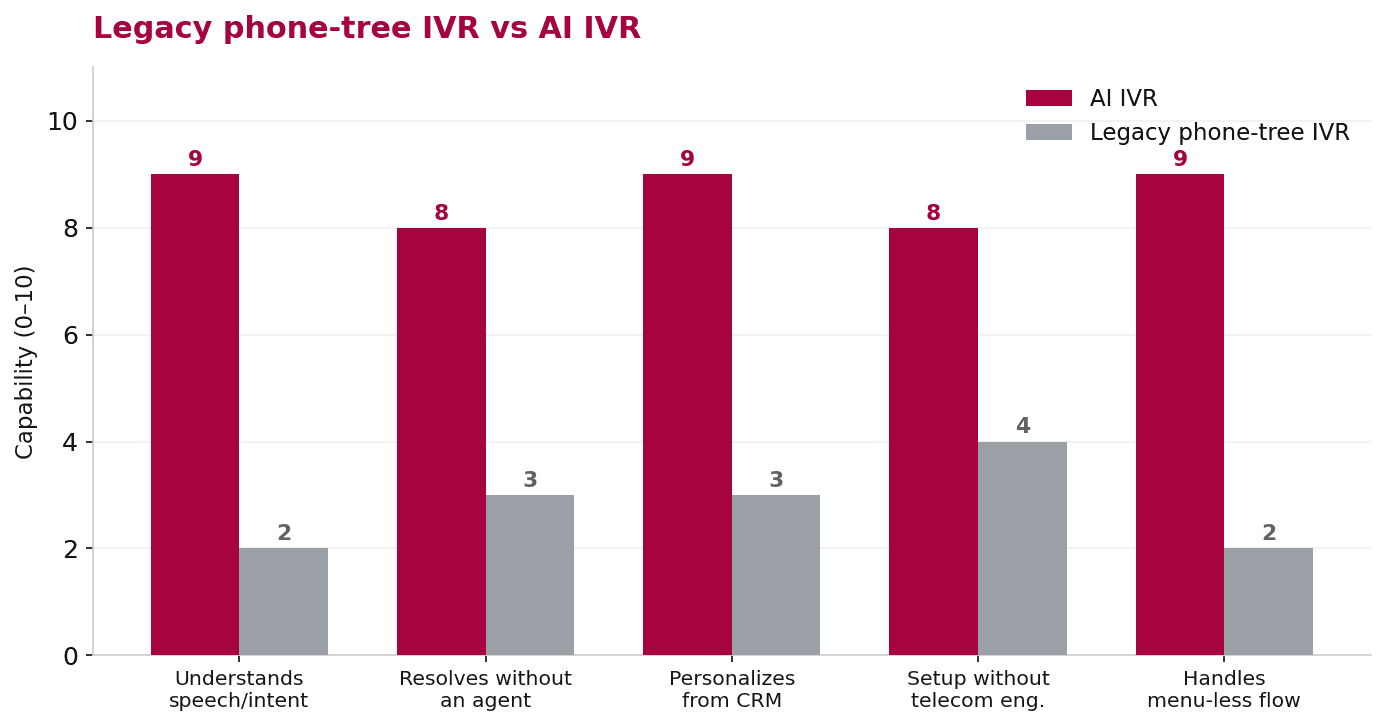
AI IVR replaces the fixed "press 1 for sales" menu with natural speech. The caller just says what they need, and the system understands intent, answers or completes the task, and routes to a human with context when it can't.
A legacy phone tree can only match a keypress to a branch. Go off-script and it loops or dead-ends. AI IVR handles the long tail of how people actually talk — and it can pull from your CRM to personalize the answer.
If you're still deciding whether you want an IVR, a voice agent, or a chatbot, start with IVR vs voice agent vs chatbot — this guide assumes you're shopping for IVR software specifically.
How we ranked these IVR platforms
We're a conversational-AI company, so here's our bias up front: SuperMIA builds an AI voice agent that can layer onto your stack. We still ranked every platform below on the same criteria, and we tell you plainly where a full platform beats a layer and vice versa.
Four things decided the list, cross-checked against verified user reviews on G2 and each vendor's published pricing:
- Fit by buyer type — SMB, mid-market, enterprise, or keep-your-carrier.
- Real entry price, not a "contact us."
- AI capability — does it understand speech, or just route keypresses?
- Setup effort — can you launch without a telecom engineer?
The 9 best IVR software platforms in 2026
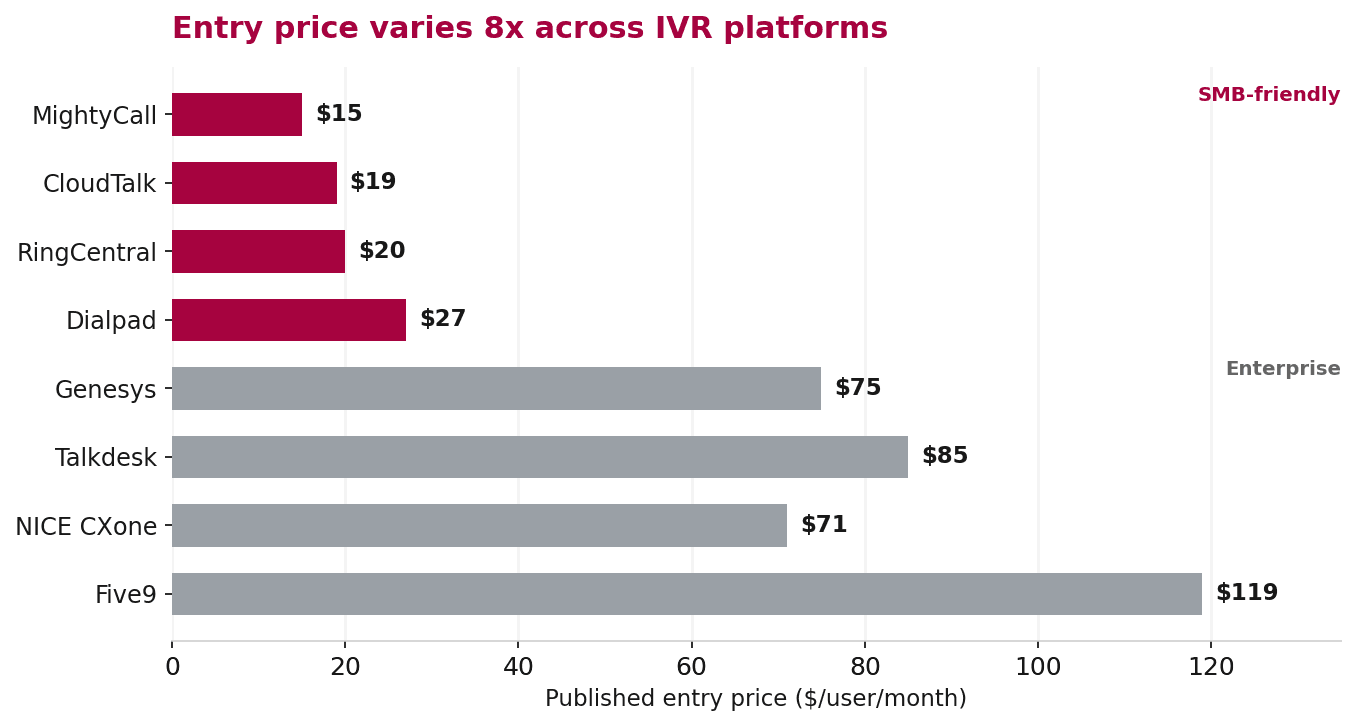
Grouped by who each one is for, so you can shortlist in a minute. The chart below shows the price spread.
By buyer type (shortlist here first)
| Buyer type | Shortlist | Why |
|---|---|---|
| SMB / growing team | CloudTalk, MightyCall, RingCentral | Low entry price, no-code call flows, fast setup |
| Mid-market | Dialpad, Aircall, Five9 | AI features + scale without full enterprise cost |
| Enterprise / regulated | Genesys, NICE CXone, Talkdesk | Deep routing, compliance, omnichannel |
| Keep-your-carrier | Layer an AI voice agent (e.g. SuperMIA) | Add AI to calls without replacing the phone system |
1. CloudTalk — best for SMBs that want to scale
No-code call-flow designer, AI voice agent, native CRM sync. Entry around $19/user/month. Watch-out: leans on a stable connection; no video.
2. MightyCall — best for ease and affordability
Drag-and-drop multi-level IVR, quick setup. From ~$15/user/month. Watch-out: some users report call-quality and app bugs.
3. RingCentral — best all-in-one for growing orgs
Visual IVR builder, 500+ integrations, part of a full comms suite. From ~$20/user/month. Watch-out: better features sit behind higher tiers.
4. Dialpad — best balanced AI pick for smaller teams
Built-in AI, strong integrations, accessible pricing. Watch-out: fewer deep contact-center controls than enterprise tools.
5. Aircall — best clean interface for CRM-connected teams
Simple, CRM-first workflows. Watch-out: usage add-ons can raise the real cost.
6. Five9 — best for AI features at mid-to-large scale
Visual IVR, omnichannel, intelligent virtual agents. From ~$119/user/month. Watch-out: setup and learning curve for advanced flows.
7. Genesys — best for large, complex contact centers
Conversational routing, omnichannel, deep analytics. From ~$75/user/month. Watch-out: cost and reporting limits noted by some users.
8. NICE CXone — best for regulated, high-volume environments
Advanced routing, conversational AI, strong compliance. From ~$71/user/month. Watch-out: steep scripting learning curve.
9. Talkdesk — best for enterprise-ready automation
Conversational IVR, virtual agent, auto-summaries, HIPAA/GDPR options. From ~$85/user/month. Watch-out: pricing skews to larger companies.
How much does IVR software cost?
Entry pricing spans about 8x. SMB-friendly platforms start around $15–$20 per user per month; enterprise contact-center platforms run roughly $70–$120+ per user per month, plus telecom minutes and AI usage fees. On-premises setups trade the subscription for high upfront hardware cost.
The sticker price isn't the whole story. For the full three-year cost model — including migration, integration, and the savings from deflecting routine calls — see the full IVR-to-AI cost model.
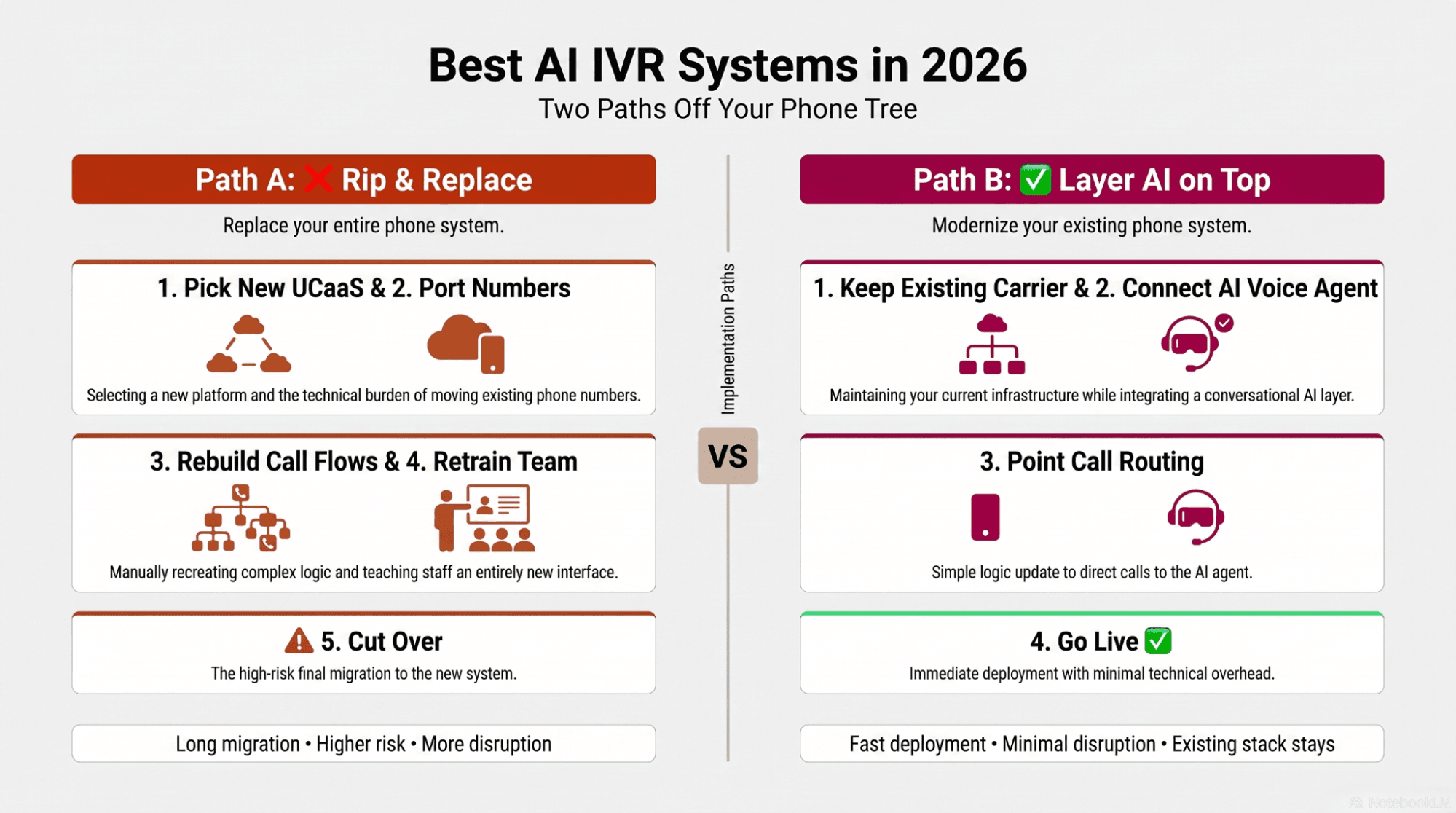
You might not need a new platform: layer vs rip-and-replace
Here's what the other lists won't tell you, because they're selling you a platform: if your main goal is AI on your calls, you can often skip the migration entirely.
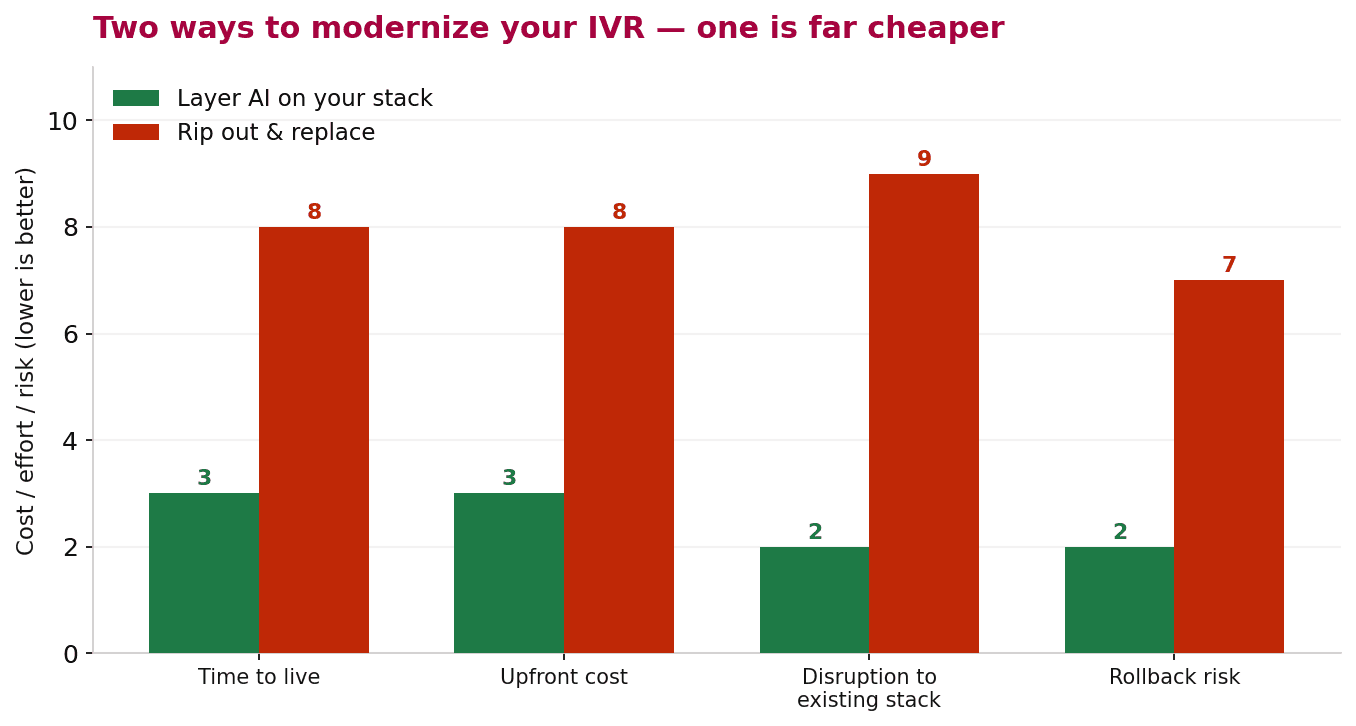
| Keep your stack + layer AI if… | Replace the platform if… |
|---|---|
| Your phone system works; you just want AI on calls | Your current platform is end-of-life or unreliable |
| You want to keep your numbers, carrier, and routing | You're consolidating several tools into one suite |
| You need to prove value fast, with low rollback risk | You need deep omnichannel + workforce management |
SuperMIA's AI voice agent is built for the first column — it adds conversational AI to the calls you already take.
IVR vs voice agent vs chatbot — which do you actually need?
Short version: an IVR routes with fixed menus, a voice agent understands free-form speech and acts, and a chatbot does the same in text. Many teams run more than one.
We won't rebuild the full breakdown here — IVR vs voice agent vs chatbot covers the decision in depth, with the use-case matrix.
How to migrate without downtime
The safe path is to layer first: connect the AI voice agent to a single number or queue, prove it, then expand — no big-bang cutover.
The three integration patterns for doing this on top of an existing phone system are laid out in how to layer AI on your existing phone system. For SMBs starting from scratch, an AI phone answering service is the simplest on-ramp.
The honest rule. If your phone system works and you just want AI on your calls, layer — don't rip-and-replace. Save the platform switch for when the platform itself is the problem.
Frequently asked questions
What is the best IVR software in 2026?
It depends on your size and stack. For SMBs, CloudTalk, MightyCall, and RingCentral lead on price and ease of use. Enterprises with high volume or compliance needs lean on Genesys, NICE CXone, Five9, or Talkdesk. If you mainly want AI on your calls, you can often add an AI voice agent to your existing phone system instead of switching platforms.
How much does IVR software cost?
Entry pricing spans about 8x. SMB-friendly platforms start around $15 to $20 per user per month, while enterprise contact-center platforms run roughly $70 to $120+ per user per month, plus telecom and AI usage fees. On-premises setups carry high upfront hardware costs instead.
What is AI IVR (or conversational IVR)?
AI IVR replaces the fixed "press 1" menu with natural speech. Callers say what they need, and the system understands intent, answers or completes the task, and routes to a human with context when needed. It is the main IVR upgrade in 2026.
Can I add AI to my existing phone system?
Yes. In many cases you can layer an AI voice agent onto your current UCaaS or carrier without a rip-and-replace. This is faster, cheaper, and lower-risk than switching platforms, and it keeps your numbers and routing in place.
What is the difference between IVR and a voice agent?
A traditional IVR follows fixed menu paths. A voice agent uses conversational AI to understand free-form speech and take action. Many teams run both: the voice agent handles natural requests, and the IVR handles simple, deterministic routing.
Shortlist by fit, then decide layer vs replace
Pick two or three platforms that match your buyer type and price band. Then ask the question the other lists skip: do you actually need a new platform, or just AI on the calls you already take?
If it's the latter, book a demo and we'll show an AI voice agent running on your existing stack — no rip-and-replace.

Urvil Dhanani
Urvil Dhanani is the AI/ML Lead at SuperMIA, focused on the architecture behind reliable conversational AI - agent design patterns, voice and chat orchestration, and platform evaluation. He writes practical, vendor-neutral guides that help technical teams build and choose AI systems that hold up in production.