
Table of Contents
- What is an AI agent for a small business?
- How we picked these AI agents
- The 10 best AI agents for small business
- How much do AI agents cost for a small business?
- Build vs buy: should you configure your own agent?
- Where a human still beats the bot
- How to roll out your first AI agent in a week
- Frequently asked questions
The best AI agents for small business remove specific busywork — answering calls, qualifying leads, scheduling interviews, running campaigns, and monitoring your brand — without adding headcount. No-code options cost $29–$300/month; a purpose-built agent beats a general builder for a small team because it works on day one. Pick the agent that kills your single biggest time-sink first.
See which agent fits your busywork →
Key takeaways
- Buy the outcome, not the platform — the best agent removes one clearly defined task well.
- No-code agents run $29–$300/month, far below a part-time hire; custom builds start around $15,000.
- Half the "top" lists online include developer frameworks a small team can't run. Skip them.
- Purpose-built agents beat general builders on time-to-value — days, not sprints.
- Keep a human in the loop for judgment and empathy. Agents replace busywork, not people.
What is an AI agent for a small business (and how is it different from a chatbot)?
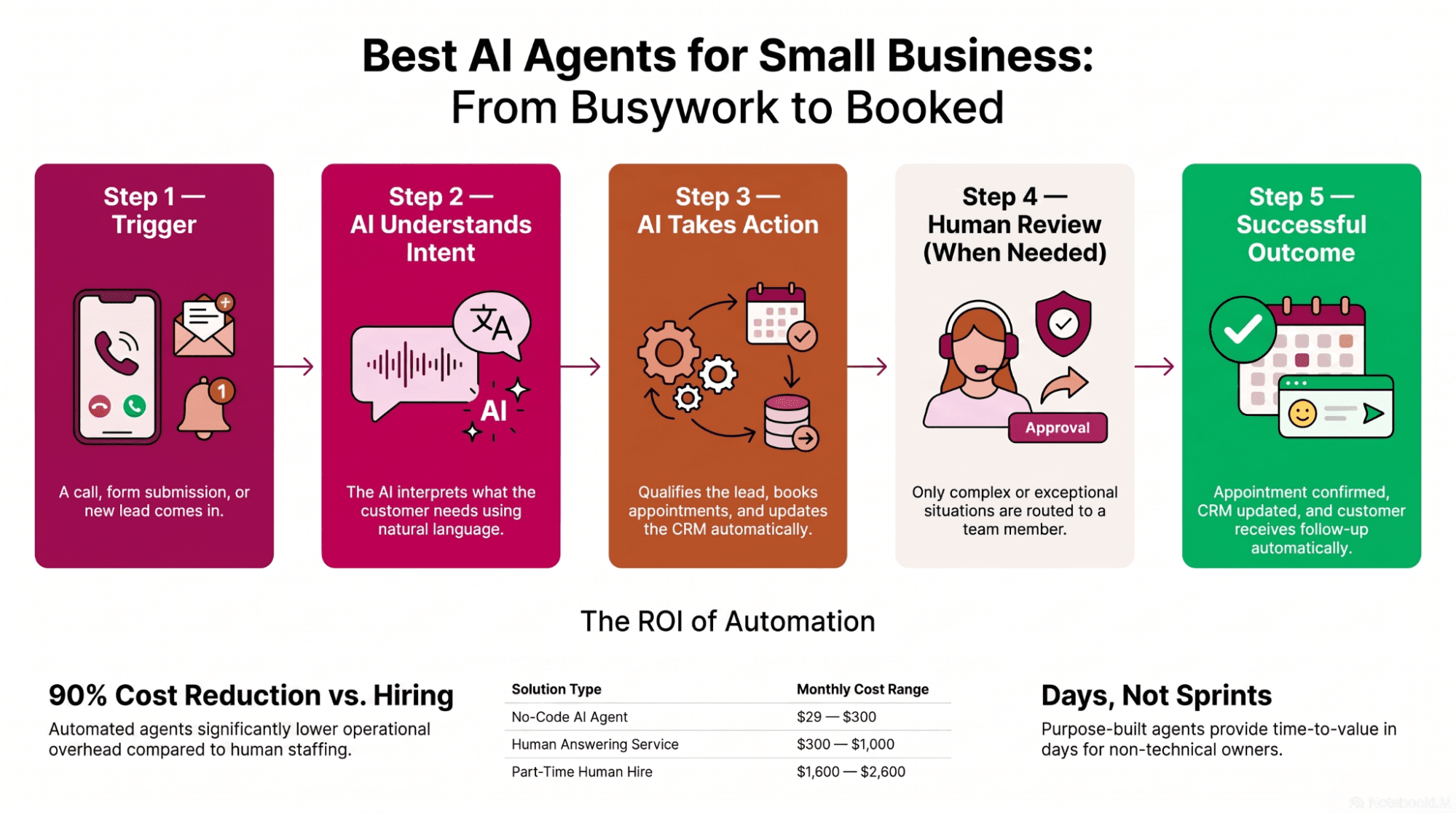
An AI agent is software that can plan a task, use your existing tools, and finish it with little human input. That is the line between an agent and a basic chatbot. A chatbot answers a question when you ask it. An agent qualifies the lead, books the meeting, and updates your CRM — then follows up if nobody replies.
Automations sit in between. They run fixed "when X, do Y" rules. An agent decides the steps to reach a goal you set. For a small team, that difference is hours: the agent handles the whole loop, not just one trigger.
If you want the full breakdown, see the full agent-vs-chatbot breakdown. This guide stays focused on the picks.
How we picked these AI agents
We're a conversational-AI company, so we'll be straight about our stake: SuperMIA builds several of the agents below. We still held every pick to the same small-business test, and we name the tools we don't make where they're the better fit.
Four rules decided the list:
- Works without a developer — a non-technical owner can launch it.
- Removes a clearly defined task, not "everything" in theory.
- Connects to tools small teams already use — calendar, CRM, inbox, phone.
- Proves value in weeks, not quarters.
It's the same standard behind why we built an agent marketplace instead of one do-everything bot.
The 10 best AI agents for small business (by the busywork they replace)
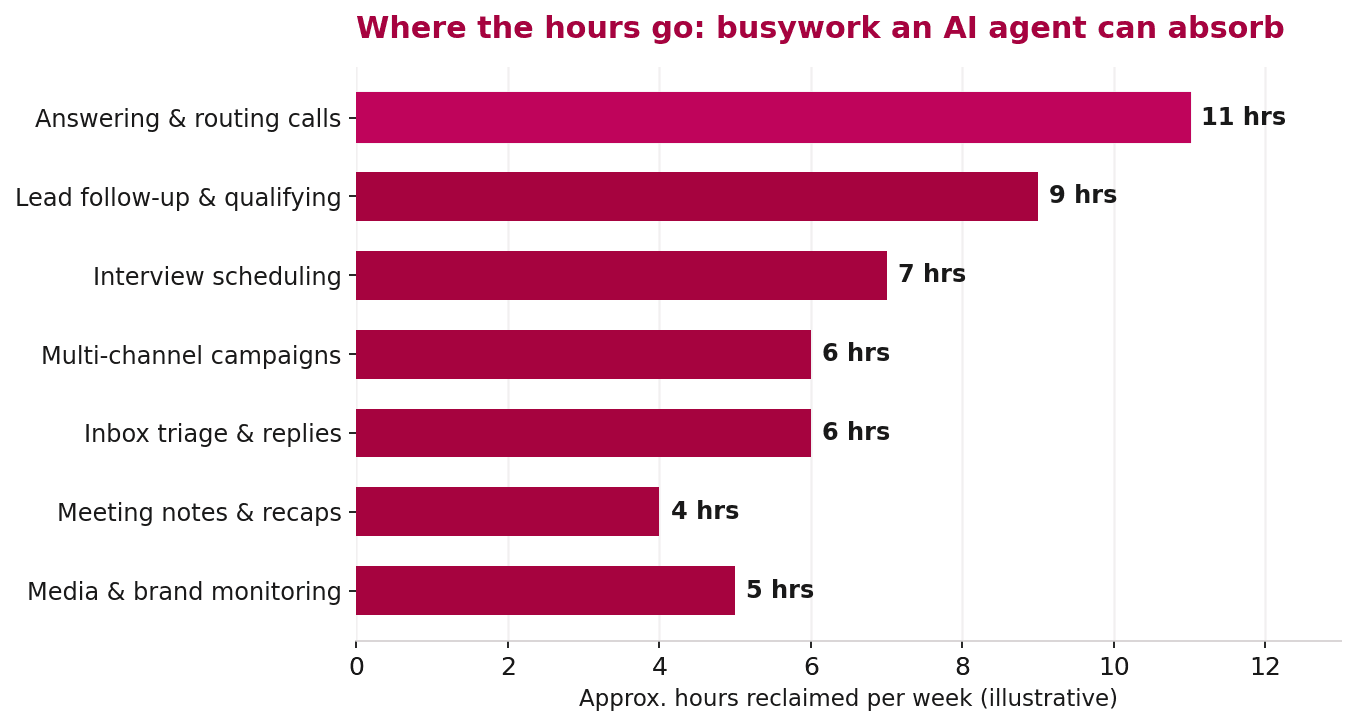
Each pick is mapped to the task it removes, who it's for, whether it's no-code, and a real 2026 price. The chart below shows where the hours actually go.
1. AI voice agent — replaces: answering and routing every call
Missed calls are the most expensive busywork a small business has. A voice agent answers 24/7, books the appointment, and routes urgent calls to a human. Best for practices, home services, and any team that lives on the phone. No-code. From roughly $0.10–$0.40 per call on usage plans.
2. AI chat agent — replaces: repetitive website and support questions
A chat agent deflects the same 20 questions your team answers every day and hands off the rest. Best for e-commerce and SaaS with steady inbound. No-code. Free tiers exist; paid from ~$29/month.
3. IntelliHire — replaces: screening and interview scheduling
Hiring eats a founder's week in scheduling ping-pong. IntelliHire, our interview agent, screens applicants and books interviews from apply to scheduled in minutes. Best for high-volume or seasonal hiring. No-code.
4. Campaign Generator — replaces: the multi-channel campaign grind
One brief becomes email, social, ad, and landing-page copy. Campaign Generator turns a half-day of stitching tools together into ten minutes. Best for lean marketing teams of one. No-code.
5. MailPilot — replaces: inbox triage and reply drafting
A crowded inbox buries the messages that matter. MailPilot prioritizes, drafts replies in your voice, and keeps follow-ups visible. Best for owners doing the work of three. No-code.
6. ZoomSync — replaces: meeting notes, recaps, and action items
Every call should end with notes and next steps, not a scramble. ZoomSync captures the recap and pushes action items where your team will see them. Best for sales and client teams. No-code.
7. Sentinel AI — replaces: manual brand and media monitoring
Small teams find out about a bad review or a press mention too late. Sentinel AI tracks coverage across print, digital, and social and flags what needs a response. Best for PR-conscious brands and agencies. No-code.
8. A no-code workflow builder (Make / Zapier) — replaces: app-to-app handoffs
When the job is "move this data from A to B when X happens," a visual automation tool is the right, cheap answer. Best for simple, rules-based glue between apps. No-code. From ~$10–$30/month. Note: these run rules, not autonomous goals — don't expect judgment.
9. A no-code agent assistant (Lindy) — replaces: cross-app executive admin
For inbox, calendar, and follow-up that spans several tools, a general assistant can carry work across them. Best for founders who want one assistant for many small jobs. No-code. From ~$50/month. Trade-off: broader, but less tuned to any single task than a purpose-built agent.
10. A developer framework (CrewAI / LangChain) — replaces: fully custom logic
Honest flag. These are powerful and free to start — but they need Python and engineering time. If you don't have a developer, they fail the small-business test. Listed so you know what to skip, not because most small teams should build here.
How much do AI agents cost for a small business?
No-code AI agents typically cost $29 to $300 per month. Managed "done-for-you" setups run $3,000 to $12,000, and fully custom builds start around $15,000 (cost benchmarks, 2026 vendor guides). Most small teams start on a no-code plan and move up only when volume or integrations demand it.
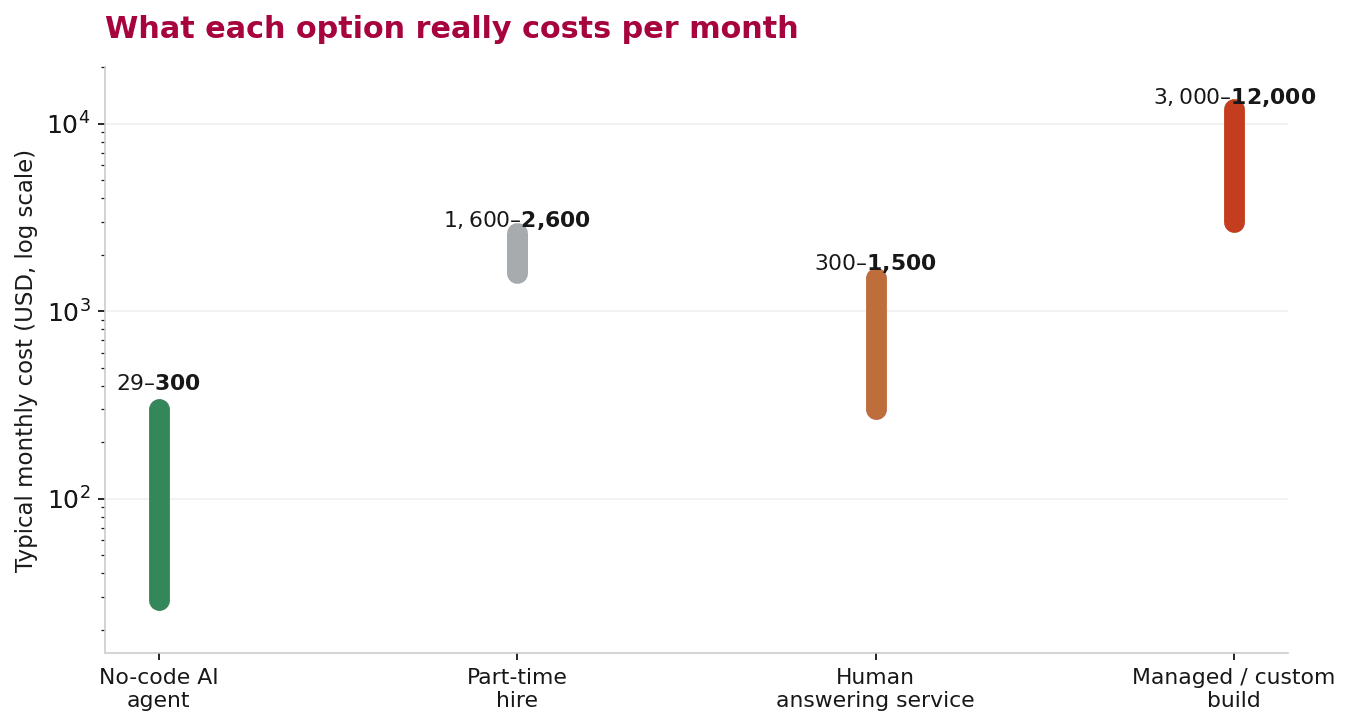
The math that matters: a part-time hire runs $1,600–$2,600/month loaded. A single no-code agent covering the same task lands in the low hundreds — and it doesn't call in sick during your busy season.
Build vs buy: should you configure your own agent?
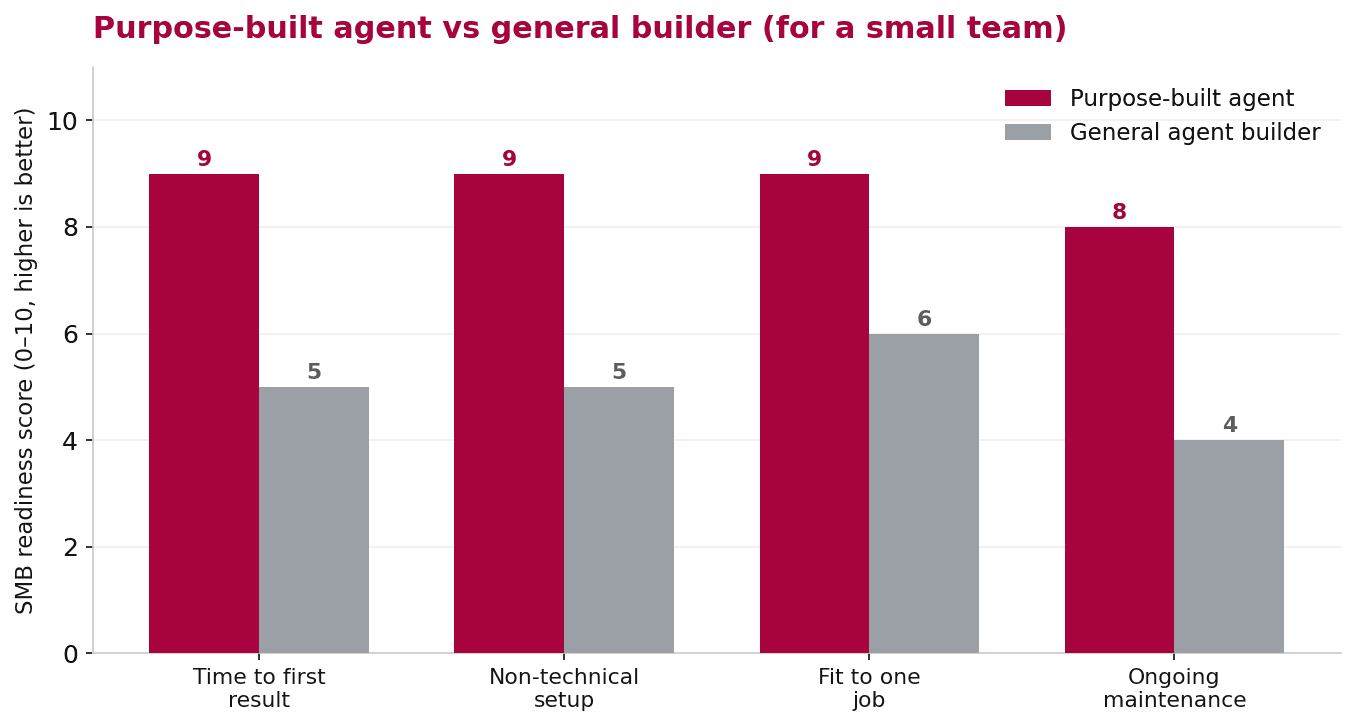
Almost always buy first. A purpose-built agent works on day one; a general builder makes you design the workflow before it earns a dollar. The chart below shows the gap for a small team.
| Buy a purpose-built agent if… | Build / configure if… |
|---|---|
| You need one clearly defined job done now | You have a developer and a genuinely custom workflow |
| Nobody on your team writes code | You need deep, unusual integrations no vendor offers |
| You want to prove ROI in weeks | You're standardizing many workflows across a bigger team |
Where a human still beats the bot
Agents replace busywork, not people. Keep a person on the work that needs judgment: an upset customer, a high-stakes negotiation, a nuanced hiring call, anything touching regulated data. For healthcare or client PHI, keep a human review step and confirm the vendor supports HIPAA requirements (HHS) before any patient data flows through an agent.
The honest rule. If getting it wrong loses a customer or breaks a law, keep a human in the loop. Everything repeatable and low-stakes is fair game for an agent.
How to roll out your first AI agent in a week
- Pick your biggest time-sink — the one task that costs the most hours.
- Choose a purpose-built agent for that task, not a general builder.
- Connect your tools — calendar, CRM, inbox, or phone number.
- Set a human-in-the-loop rule for when the agent escalates.
- Measure hours saved for two weeks, then add a second agent.
Frequently asked questions
How much do AI agents cost for a small business?
No-code AI agents typically cost $29 to $300 per month. Managed setups run $3,000 to $12,000, and fully custom builds start around $15,000. Most small teams start on a no-code plan and only move up when volume or integrations demand it.
Do you need a developer to set up an AI agent?
Not for the picks that matter. No-code agents like SuperMIA, Lindy, Make, and Zapier let a non-technical owner build and launch a working agent without code. Developer frameworks such as CrewAI, LangChain, and AutoGen do require Python and engineering time.
What tasks can a small business automate with AI agents?
The highest-value tasks are answering and routing calls, qualifying and following up on leads, scheduling appointments and interviews, running multi-channel campaigns, triaging the inbox, summarizing meetings, and monitoring your brand across media.
Are AI agents worth it for a small business?
Yes, when your team loses hours each week to repetitive work. A single agent running around the clock can absorb work that used to take a part-time hire, at a fraction of the cost, and it frees your people for judgment-heavy work.
What is the best AI agent for a small business?
The best AI agent is the one that removes your single biggest time-sink first. For most small teams that is calls and follow-up. Start with one clearly defined job, prove the time saved, then add a second agent.
Start with one agent, one task
Don't buy a platform and hope. Name your biggest time-sink, hand it to one agent, and count the hours you get back. When it works, do it again.
Want a shortcut? Book a 15-minute demo and we'll map the right agent to the busywork eating your week — or point you to a better-fit tool if we're not it.

Vicky Lalwani
Vicky Lalwani is Marketing Manager at SuperMIA, focused on practical AI education, buyer's guides, and solution explainers that help business teams evaluate and adopt conversational AI across support, sales, and operations.