
Table of Contents
- What is conversational AI in hospitality?
- Conversational AI vs a rule-based chatbot
- Why hotels and restaurants are adopting it now
- Where conversational AI works across the guest journey
- The operator's cost math: what it saves and what it costs
- Voice, chat, or messaging: where should you start?
- Where conversational AI still falls short
- How to roll out conversational AI in your property
- Frequently asked questions
Conversational AI in hospitality is software that understands a guest's natural-language request across voice, chat, and messaging — then acts on it, booking a room, changing a reservation, or answering a question, around the clock. Unlike a rule-based chatbot, it grasps intent, keeps context across channels, and connects to your PMS. Hotels and restaurants use it to cover the calls and messages staff can't.
See conversational AI built for hospitality →
Key takeaways
- Conversational AI understands intent and takes action; a chatbot only answers scripted questions.
- 58% of hoteliers say guest communications is where AI has its biggest impact (Canary, 2026).
- The value is coverage — guests message at 2am and on WhatsApp, when the front desk can't answer.
- It works for restaurants too: reservations, waitlists, and FAQs during the dinner rush.
- Start with one channel and one job, measure it, then expand.
What is conversational AI in hospitality?
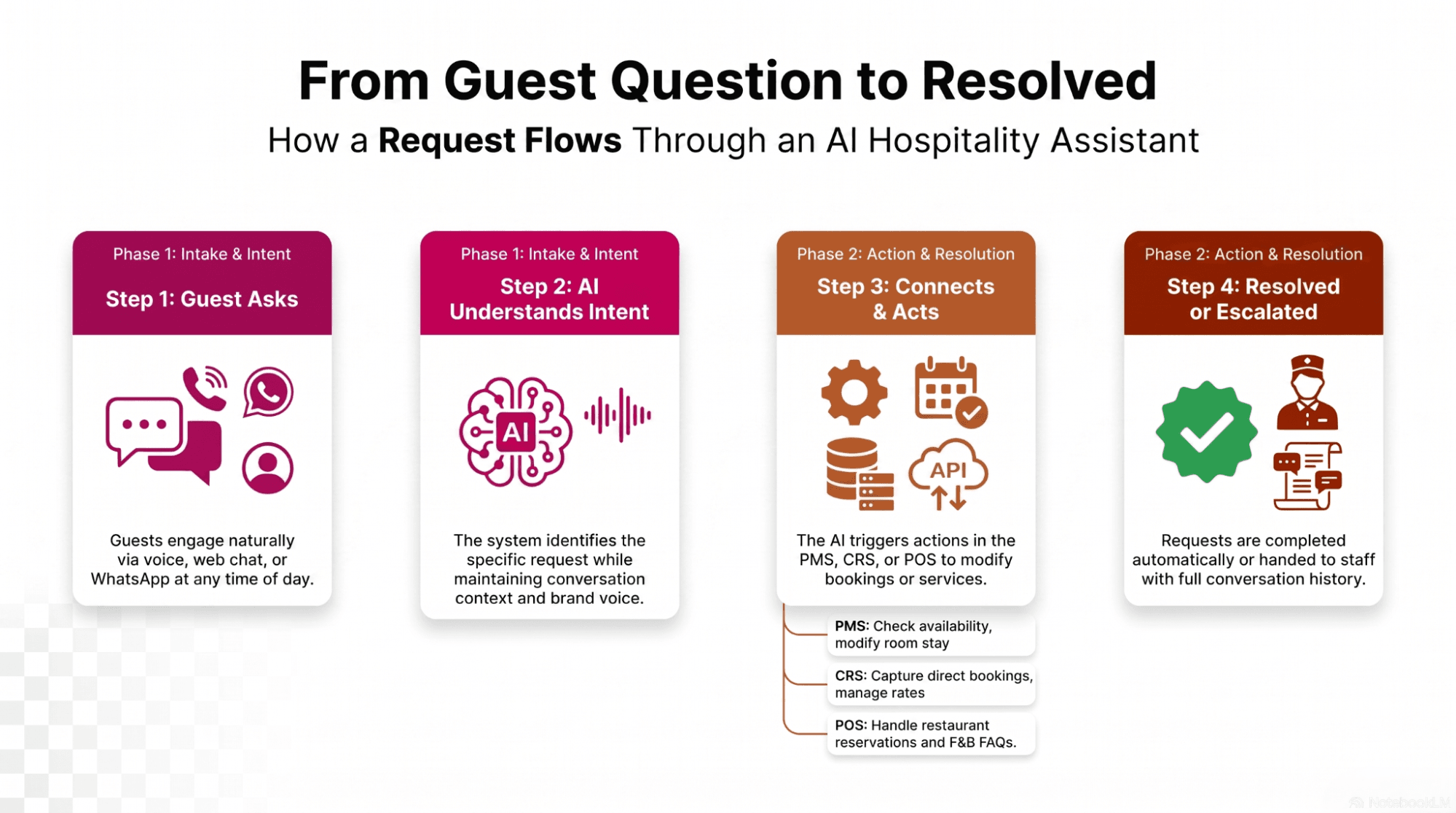
Conversational AI in hospitality is software that understands a guest's natural-language request across voice, chat, and messaging, and takes action on it around the clock. A guest can ask to move a reservation, order room service, or check parking — in their own words — and get it done, not just acknowledged.
Three things separate it from older automation: it reads intent instead of matching keywords, it keeps context when a guest switches from a call to a text, and it connects to your systems to actually complete the task.
For a deeper look at how SuperMIA applies this in hotels and resorts, see SuperMIA for hospitality.
Conversational AI vs a rule-based chatbot: what's the difference?
A rule-based chatbot follows a scripted decision tree. Ask something off-script and it stalls. Conversational AI understands the request, adapts as the conversation unfolds, and can finish with an action — the difference between answering a question and completing a booking.
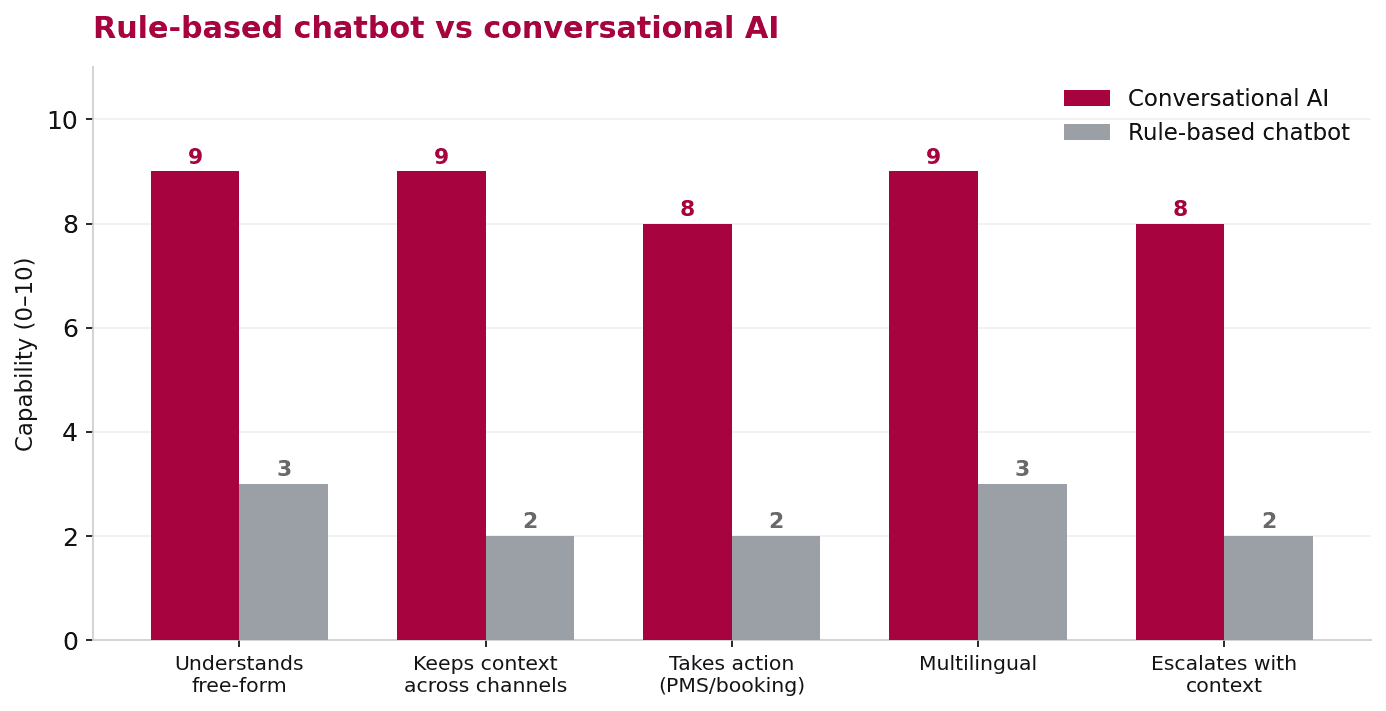
| Capability | Rule-based chatbot | Conversational AI |
|---|---|---|
| Understands free-form questions | No — exact-match only | Yes — reads intent |
| Keeps context across channels | No | Yes — one thread |
| Takes action (PMS / booking) | Rarely | Yes — end to end |
| Multilingual | Limited | Yes — real-time |
| Escalates with full context | No | Yes — staff see history |
Why hotels and restaurants are adopting it now
Guest expectations moved faster than staffing models. People used to instant answers from consumer apps expect the same from your property at 11pm. At the same time, staffing shortages mean calls and messages get missed. According to Canary's 2026 hospitality AI research, 58% of hoteliers say guest communications is where AI will have its biggest impact.
The buying journey shifted too. Boston Consulting Group's 2026 travel research found the guest journey for 37% of travelers now starts with a single prompt — so guests arrive already in a conversational mindset.
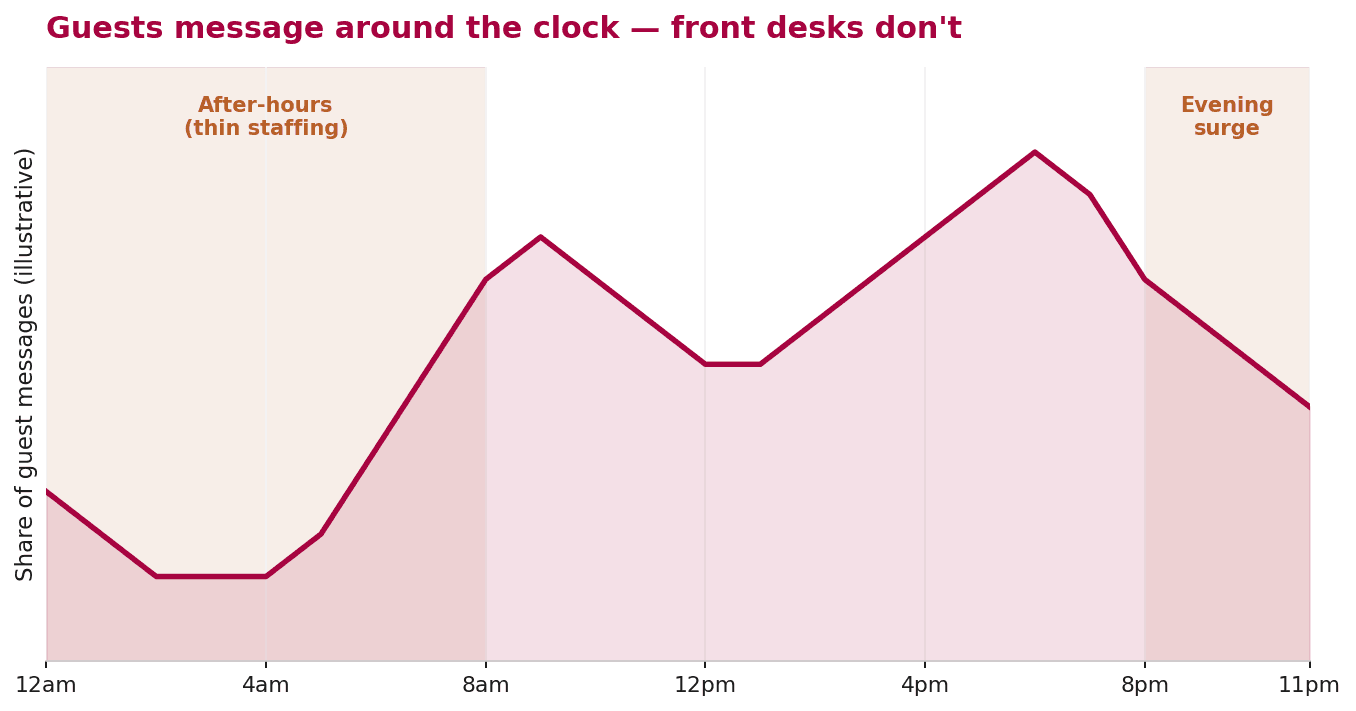
The core value isn't novelty. It's coverage: answering the contacts your team physically can't, before they become a missed booking or a one-star review.
Where conversational AI works across the guest journey
It shows up at every stage, for both hotels and restaurants. The chart below shows roughly how much of the routine load it can carry.
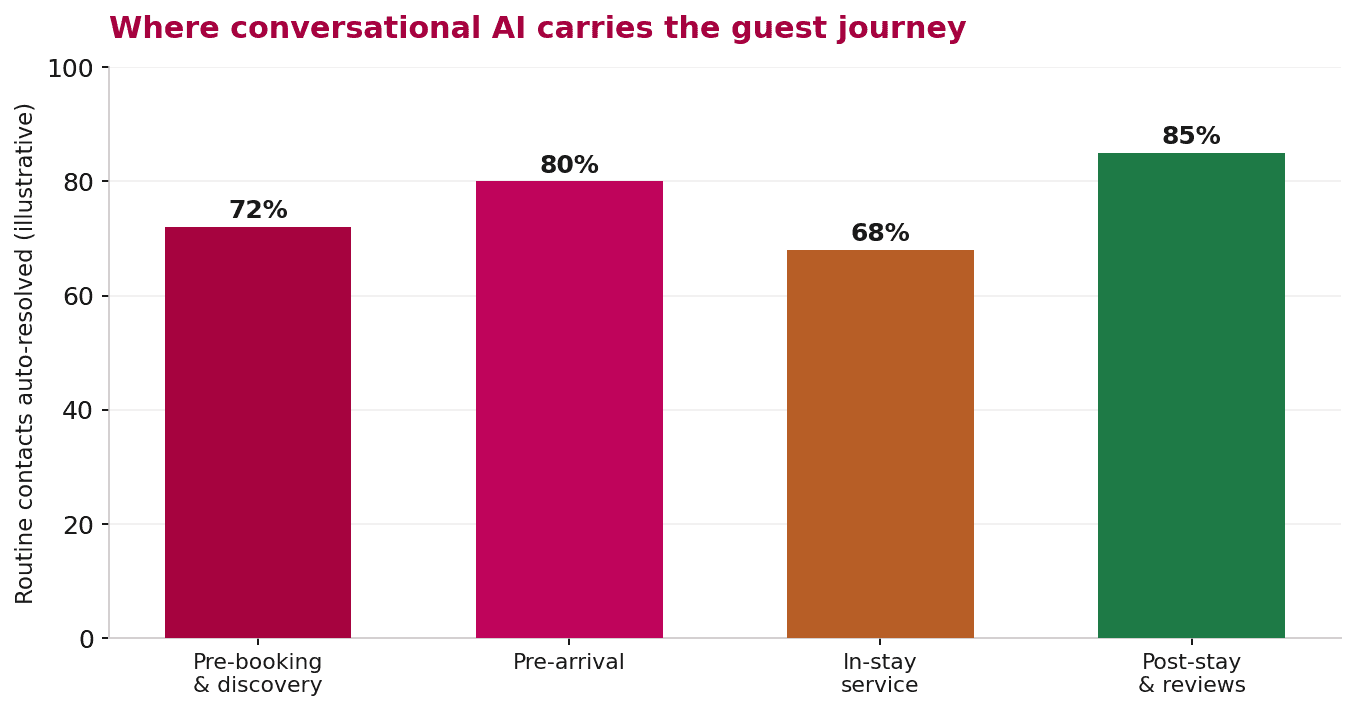
Hotels: booking, in-stay service, upsells, and reviews
- Pre-booking: answers nuanced questions ("is the pool heated in October?") and completes reservations 24/7.
- In-stay: handles housekeeping, late checkout, and local recommendations through the messaging apps guests already use.
- Boosts ancillary revenue with well-timed upsells — Medallia found 61% of guests will pay more for a personalized experience.
- Post-stay: sends review requests and flags service-recovery issues before they go public.
For the deep dive on chat specifically, see our guide to hotel chatbots.
Restaurants: reservations, waitlists, and FAQs
Restaurants are the vertical every competitor skips. The phone rings during the dinner rush and the host has to choose between the guest at the door and the one on the line. Conversational AI takes the call.
- Books, changes, and cancels reservations without pulling a host off the floor.
- Manages the waitlist and answers hours, menu, and parking questions after close.
- Captures the late-night booking that would otherwise go to voicemail.
More on this in conversational AI for restaurants.
The operator's cost math: what it saves and what it costs
Here's what competitors leave out. Every missed call is a potential lost booking, and every OTA-booked room costs you 15–25% in commission. A conversational AI that answers after-hours and captures direct bookings goes straight at both.
Pricing usually runs per resolved conversation or per voice minute, landing in the low hundreds of dollars per month for a single property. The number that matters is payback: one recovered booking often covers a month of the tool. For the underlying missed-call math, see the missed-call cost breakdown.
| What it costs | What it saves |
|---|---|
| Low hundreds / month per property (per-conversation or per-minute) | Recovered after-hours bookings that used to hit voicemail |
| One-time setup + PMS integration effort | Direct bookings that avoid 15–25% OTA commission |
| Ongoing tuning (treat it like a staff member) | Front-desk hours returned to in-person guests |
Voice, chat, or messaging: where should you start?
Don't turn on everything at once. Start with the channel that loses you the most business.
| Channel | Start here if… | Best for |
|---|---|---|
| Voice (phone) | You miss calls after hours or during rushes | Restaurants, independent hotels, front-desk relief |
| Web chat | Your site gets traffic but few direct bookings | Converting browsers into direct bookings |
| Messaging (WhatsApp/SMS) | Guests already text you and expect fast replies | In-stay service and international guests |
Phone is the most common starting point — an AI voice agent answers every call and books straight into your system.
Where conversational AI still falls short
The honest part most vendor guides skip. Conversational AI is not a fix for everything:
- Emotional or high-stakes moments — a complaint or a special-occasion request — still need a human.
- It's only as good as its integration. Bolt a bot onto your site with no PMS connection and you get a fancier FAQ, not a booking engine.
- It needs guardrails and a source of truth, or it will confidently give a wrong answer about your own policies.
Keep a human in the loop for judgment and edge cases — the same principle we apply across regulated verticals, like how we handle this in other verticals.
The honest rule. Automate the routine and the after-hours. Keep a person on the moments where empathy or judgment decides whether a guest comes back.
How to roll out conversational AI in your property
- Pick the channel that loses you the most business — usually after-hours calls or unanswered messages.
- Connect it to your PMS or booking system so it can act, not just deflect FAQs.
- Set your brand voice and escalation rules.
- Test on real past guest messages before going live, so you catch bad answers first.
- Measure containment and recovered bookings, then add the next channel.
Frequently asked questions
Is conversational AI the same as a chatbot?
No. A rule-based chatbot follows a scripted decision tree and stalls when a guest goes off-script. Conversational AI understands natural language, keeps context across channels, and can take an action at the end, such as completing a booking, rather than only answering a question.
How is conversational AI used in restaurants?
Restaurants use conversational AI to answer calls during the dinner rush, take and modify reservations, manage waitlists, handle FAQs about hours and menus, and capture bookings after hours. It keeps the host at the door instead of on the phone.
How much does conversational AI cost for a hotel or restaurant?
Pricing varies by channel and volume. Many platforms charge per resolved conversation or per minute of voice, and hospitality plans commonly land in the low hundreds of dollars per month for a single property. The number that matters is payback: one recovered booking often covers a month of the tool.
Can conversational AI integrate with my PMS?
Yes. Hospitality-specific platforms connect to your property management system, central reservation system, and point-of-sale so the AI can check availability, modify reservations, and personalize answers in real time rather than just deflecting FAQs.
What is the best conversational AI for hospitality?
The best fit is a platform built for hospitality that integrates with your PMS, covers the channels your guests actually use, keeps context across them, and lets your team control tone and escalation. Start with the channel that loses you the most business, usually phone or after-hours messaging.
Start with one channel, one job
You don't need a full digital-guest-experience overhaul to begin. Pick the channel that's costing you bookings, connect it to your system, and measure what comes back. When it works, add the next one.
Want to see it on your own property's workflows? Book a demo and we'll show conversational AI handling the calls and messages your team can't get to.

Vicky Lalwani
Vicky Lalwani is Marketing Manager at SuperMIA, focused on practical AI education, buyer's guides, and solution explainers that help business teams evaluate and adopt conversational AI across support, sales, and operations.